Carved In Stone

Carved in Stone

Brief Introduction

“Poetry explains itself. If it doesn’t, it’s inexplicable.” Pedro Salinas.

I entered this collection of poems for the Alfred G. Bailey Awad (poetry manuscript), WFNB, 2025. Alas, it did not win an award, but the judge, Kathy Mac, made some excellent suggestions as to how I might improve the manuscript. I have followed her advice to the best of my ability.

Carved in Stone is the second dialog (Chronotopos II) in my Bakhtinian Dialogs with my time and my place. Clepsydra, Chronotopos I, won third place in the Bailey Award (2025) and has already been published. I have one, possibly two, more Dialogs planned.

Reception Theory – I write, you read. Any meaning that you extract from my poetry will depend on your own culture and background. Tolle, Lege – Take and read. Read slowly, and with care.

I am a poet, a dreamer, if you will. These are my dreams. When you enter my world, you mingle your dreams with mine. The result, I hope, will be an interesting intellectual blend of new creativity. Pax amorque.

1

Behold me here,
filled with a sort of shallow,
hollowed-out wisdom
accumulated over decades
while listening with my eyes
to the words and thoughts
of writers, long-dead.

Imprisoned in book pages,
do they bang their heads
against walls that bind,
or hammer with their fists
at the barred lines
of their printed cages?

These spirits long to break free,
but they choke on library dust
and pollen from verbal flowers
that bloom unseen.

Those old ones avoided
the traps of temporal power,
or, once trapped,
gnawed off a precious limb
to limp into freedom.

Comment:
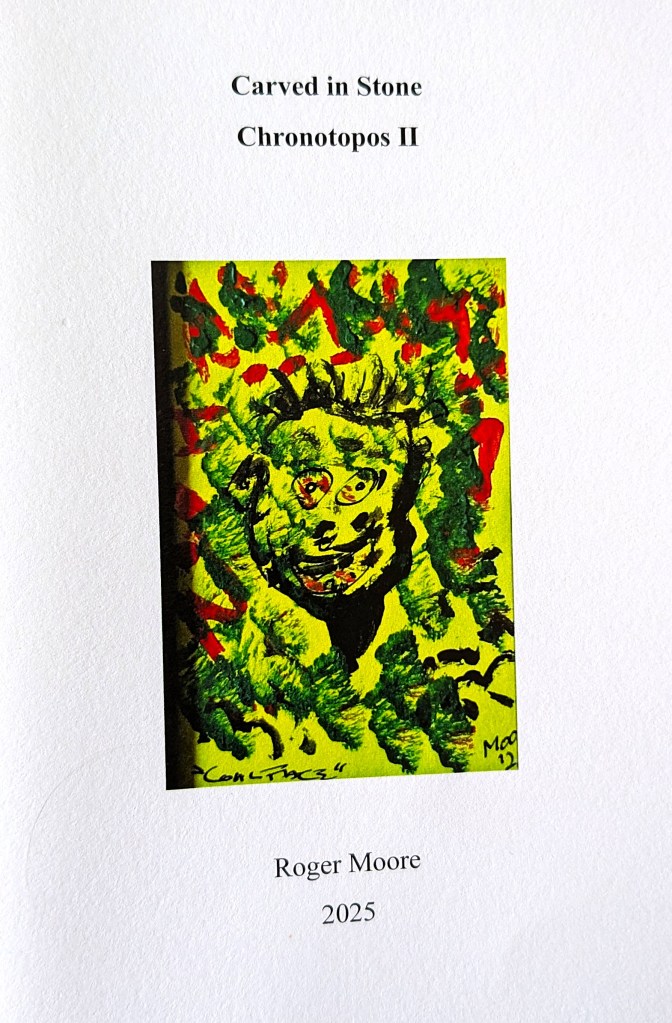
The cover painting, painted for me by my friend Moo when he read the manuscript of this book, is called Coal Face. It refers to the young Welsh boys in the Rhondda coal fields, aged 8-12 years old, who went down the mines to work at the coal face. This happened when the coal seams grew thin and only small children had the ability to work at the coal face and carve and mine the coal. Here are the relevant verses (44 – 45).

44

The old man, withered,
last house on the left,
leaning on his garden wall,
coughing, spitting up
coal dust and blood.

He’s not old, when you get close,
just grown old, underground,
where emphysema
and pneumoconiosis
devour men and boys.

He spits on the side walk.
Mining souvenirs,
Max Boyce calls them,
and they appear
every time the young man,
turned suddenly old,
starts to cough.

He can’t walk far,
wearing carpet slippers,
soft and furry,
just leans on the wall.

He fell, or was pushed,
into the trap at an early age,
when the coal seams
had grown so thin,
that only a small boy
could kneel at the coal face
before the black altar
of the underground god.

There, with a pick and shovel
he learned to carve and shape
those seams.

45

No candles burned at that altar.
A single match, let alone
a candle flame,
would spell the end,
if gas leaked from the seam.

Only the canaries,
confined in their cages,
sang songs.

Doomed,
like the blind pit ponies,
never to see the light of day,
they lived out their lives
down there.

So many died underground,
unable to get out,
buried alive,
before they were even dead.

Which food, when you eat it, instantly transports you to childhood?

Daily writing prompt
Which food, when you eat it, instantly transports you to childhood?

Which food, when you eat it, instantly transports you to childhood?

That’s an easy one – diolch yn fawr / thank you very much – and the answer is Bara Lawr / laverbread of course.

What does laverbread taste like? I must thank Wikipedia for the answer below.

Welsh Laverbread (PDO) | Business Wales - Food and drink

Welsh Laverbread is made from cooked laver (seaweed) which has been plucked by hand from the Welsh coastline. It has a unique texture and salty flavour which provides a taste of the fresh, Welsh sea. Laver or Laver porphyra umbilicalis is the only seaweed which is only one cell thick.

And click on the link for a video from YouTube on the Traditional Welsh breakfast.

Laverbread could be found all around the Gower Peninsula in my childhood. When I was very young, you could buy it at Swansea Market for three pence a pound. Later, the price went up to sixpence a pound. When I lived in Cardiff, back in the early sixties, it sold at a pound per pound. Later, as the coast around Wales became more and more polluted, the sea weed had to be imported from the West of Ireland, and that certainly drove the price up – five pound a pound in the eighties.

But laverbread has two histories – the scientific / culinary one, and the personal one. Laverbread, on the plate, looks suspiciously like a cowpat. So much so, that when the cows visited the bungalow field where we had our summer home, the cowpats were called laverbread. “Don’t step in the laverbread, dear.”

Field rolling was a childhood joy. Start at the top of the slope and roll all the way down to the bottom. Born and bred in a laverbread field, we would plot our route between the patties before we rolled. Alas, our London cousins, with their cockney accents, were city and street wise, but not laver bread wise. Down the field they rolled, without looking, right through the laverbread patches. I leave the ensuing scene to you imaginations – and remember that the bungalow had no electricity in those early days, and no running water.

I remember the first day my beloved came to visit us at home. My mother served her fresh hot laverbread. Of course, she had never seen anything like it, except genuine Somerset cowpats. She picked around her food, left the laverbread on her plate until it cooled and – “Hold on a moment,” said my mother, “your laverbread’s cold. Here – I’ll warm it up for you.” Poor Clare. I am ashamed to say, I ate her helping while my mother was looking elsewhere – just devoured the extra portion, enjoying every moment, and Clare was so happy to see it disappear.

Here, in New Brunswick, while Clare was away one weekend, Becky and I decided to make laverbread from dulse. We followed the recipes and they worked. The laverbread was delicious – but – ah yes, there’s always a but – but the house stank of the sea shore at low tide and the first thing Clare said when she got home was – “What is that awful smell?”

I remember, opening a closet to get a clean shirt, about six weeks later, and that familiar whiff of the seashore immediately assaulted my nostrils. Alas, Becky and I love our laverbread, but -there’s that word again – but making it in our house long been banned.

Kipper Kapers

Kipper Kapers

Old Welsh Intelligence Test Question: “Does a kipper swim folded or flat?”

5-4-3-2-1 –
Time’s up, Ladies and Gentlemen.
So – what’s your answer?

Yes? No? Maybe? I don’t know?
It’s a trick question of course / wrth gwrs. And Kippers can play tricks on you too as they flipper and flapper, and flip and flop. Especially if you eat them late at night.

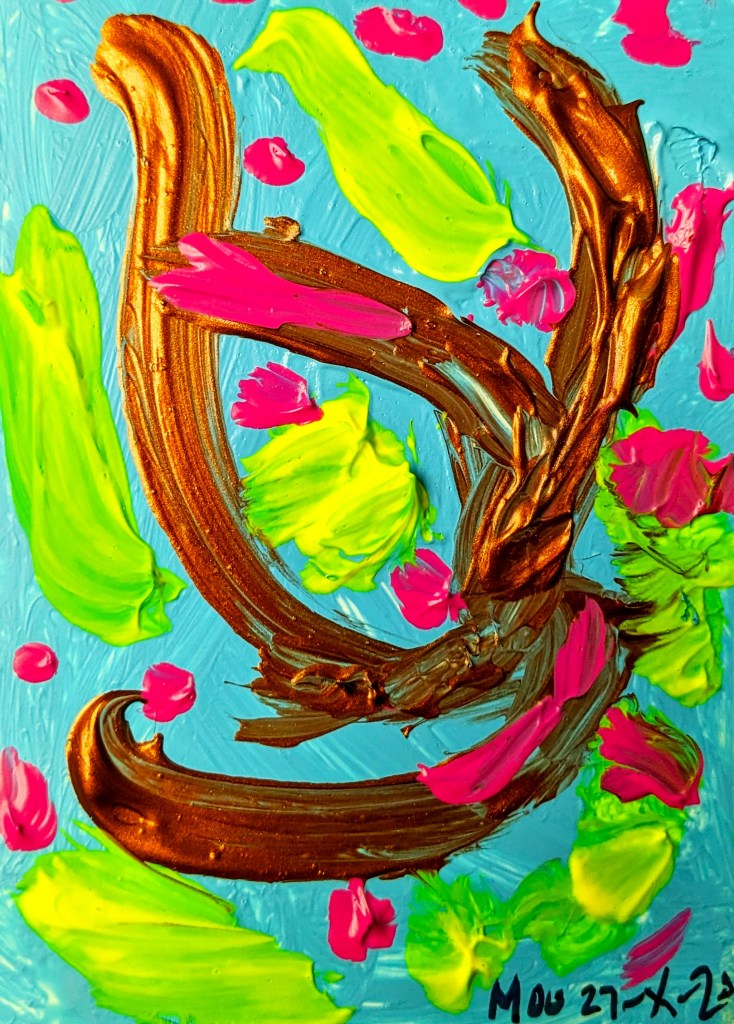
So this is a painting of a midnight Kipper Kaper Attack, when you want to sleep, but can’t, because you don’t know the answer to the kipper IQ test and all those little kippers are capering around and making fun of you and mocking you.

How do you avoid a Kipper Kaper Attack when the bad dreams start and the Kippers Kaper? Well, you answer this next Welsh IQ test question. “Adam and Eve and Pinch Me when down to the river to swim. Adam and Eve got drowned. Who do you think was saved?”

And if you answer “Pinch Me!” Then I will, and when I do, you’ll wake up, and you’ll be safe from another Kipper Kaper attack until the next time you eat them.

There – simple isn’t it?

Doubts

Doubts

At midnight,
when that dark owl calls,
I sip a bitter wine.

The thoughts I think
are not my thoughts,
how could they ever
be mine?

And yet they are
the thoughts I think,
and round and round
they twine.

They wrap me in
a thousand threads
and none of them
are mine.

Whose are they then,
these thoughts I think?
They do not come from me.

And yet they make me
double think
this person that is me,
and who I am,
and what I am,
and where I’m going to be.

Comment:
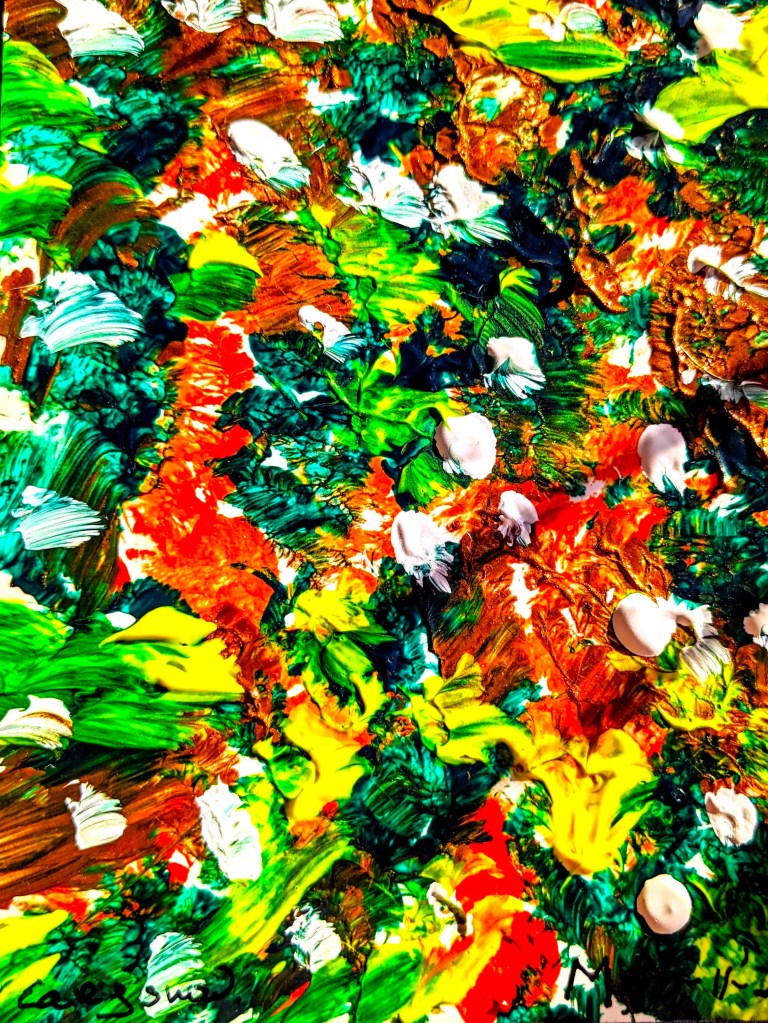
I guess that’s what happens when you finish your bottled sunshine (sol embotellado) before going to bed. The painting and the poem match up nicely though, ribbons of dark thought streaming through an empty head. Guessing and double-guessing, thinking and double-thinking, doubting and finding yourself inside that great cloud of unknowing in which you rarely know where you are going. Still, if you don’t know where you are going, any road will take you there. Pen-y-Bont, anyone? Or Abertawe, Cas Newydd, Llandeilo, Caerfili, Rhiwbina, Treorci, Trebanog

Magnolia

Magnolia

She stands there, at the garden gate, waiting for me.
I can see the scene, the flower beds, the magnolia
bleeding, in Wales, its soft, spring snow of ivory pearls.

Some fall on her head, crowning her with a beauty
more precious than frankincense or myrrh. Petals
also perch their pure, ermine cape on her shoulders.

She walks towards me, eyes shining, arms open.
Then, the vision fades and she drifts away, leaving me
alone, my face bathed in the tears of her passing.

For pass each other by, we did. Ships in the night,
trains rushing through a tunnel of darkness, bathed,
for an instant, in the constellation of a station’s light.

Now, when I try to go back and to recreate that scene,
I find an empty garden, fallen leaves, and winter’s cold.

Comment:
I have been struck recently by the number of published articles that speak of post-Covid loneliness and the difficulties of re-establishing old friendships that fell by the wayside, let alone establishing new ones. It seems to get harder and harder, as we age, to leave our post-Covid isolation, to get out of our new comfort zones – sometimes so limited and limiting – and to make new friends. As we age, our minds go backwards and we return to earlier days and happier memories. Yet all too often those memories are tinged with the sepia sadness of old photos, from a non-digital age, faded and stained.

What aspects of your cultural heritage are you most proud of or interested in?

Daily writing prompt
What aspects of your cultural heritage are you most proud of or interested in?

What aspects of your cultural heritage are you most proud of or interested in?

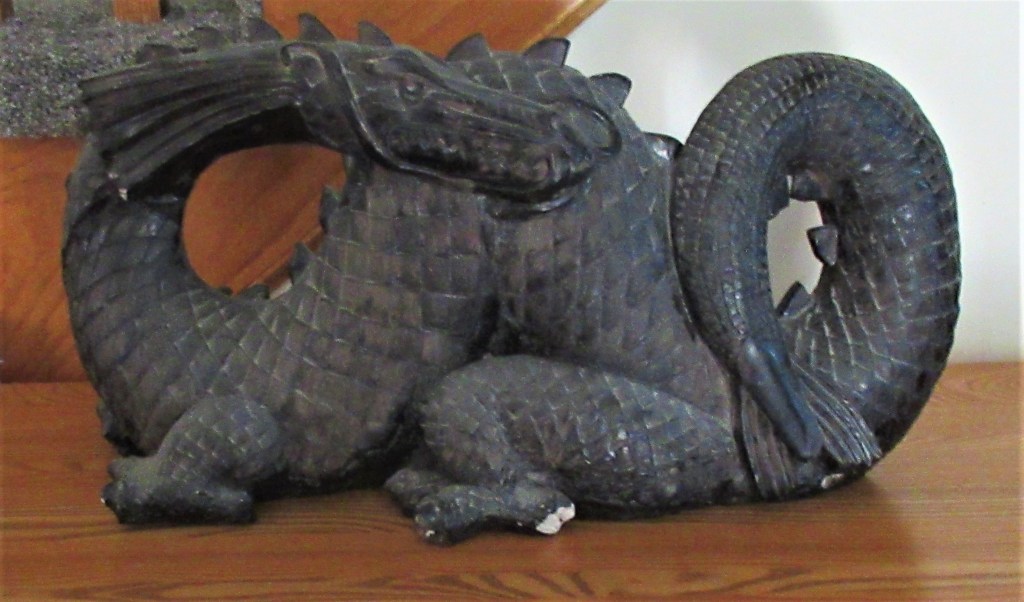
This dragon is not a dragon, well, it’s not a Welsh Dragon anyway. So, let us change the question – What aspects of your cultural heritage are you least proud of? Now that changes the perspective totally. I guess that I am least proud of the fact that, although born in Wales, I was never allowed to speak Welsh as a child. I speak with an English accent because I was sent to school in England so I wouldn’t even speak English like a person born in Wales. I am not proud of that aspect of my cultural heritage.

But I am proud of one little thing that stems from that Welsh cultural heritage – learning how to speak Welsh in my old age. It’s not easy to do that, here in Canada, but the internet carries many blessings, one of which is the learning of ‘foreign’ languages. Strange that Welsh should be considered a foreign language for somebody born in Wales. Something else not to be proud of, I suppose. Here’s my story.

Here I sit, an old man now, in front of my computer, learning at last my mother tongue, Welsh. I have discovered the beauty of simple words, not so much their meaning as their sound, the way they flow, the poetry of remembered rhythms: Cwmrhydyceirw, the Valley of the Leaping Stag, though legend has it that ceirw was really cwrw, and cwrw is beer, and its real name was the Valley of the Brown Stream Frothing like Beer.

Words have their own music, even if you cannot pronounce them properly: Mae hi’n bwrw glaw nawr yn Abertawe / it’s raining now in Swansea. Mae’r tywydd yn waeth heddiw / the weather’s worse today. Bydd hi’n dwym ddydd Llun / it will be warm on Monday. Place names also have their own magic: Llantrisant, Llandaff, Dinas Powis, Gelligaer, Abertawe, Cas Newydd, Pen-y-bont … Meaning changes when you switch from one language to another:  gwyraig ty / a housewife, gwr ty / a househusband, a concept of equality that has ruled Welsh lives since long before Julius Caesar invaded Albion, coming from Gaul with his legions in 55 BC.

The photographer asks me to smile. He wants me to say ‘cheese’ so I say it in French [fromage], then Spanish [queso], then Italian [formaggio]. “No, no, no,” he shakes his head. “I want to catch the real you. Try again.” So I say it in Welsh [caws]. He checks the memory card in his camera and looks puzzled.

“Your facial expression changes each time you speak a different language,” he tells me. “Please, won’t you just say ‘cheese’ in English? I want the real you.”

French, Spanish, Italian, then Welsh: all different and he wants the real me. Each language carves a new a map into my face.  Am I a clown, then, a comedian, a chameleon to wear so many masks and to slip so easily from one to another? And who am I, this stranded immigrant, marooned on a foreign shore that has finally become my home? Who or what is the real me?

“Cheese!” I say in desperation. “Got it,” he grins. “At last, I have captured the real you.”

Coal Face

And Every Valley

And every valley shall be filled with coal.
And the miners will mine, growing old
before their time, with pneumoconiosis
a constant companion, and that dark spot
on the grey slide of the sidewalk a mining
souvenir coughed up from the depths
of lungs that so seldom saw the sun
and soaked themselves in the black dust
that cluttered, clogged, bent and twisted
those beautiful young bodies into ageing,
pipe-cleaner shapes, yellowed and inked
with nicotine and sorrows buried so deep,
a thousand, two thousand feet down,
and often so far out to sea that loved ones
knew their loved ones would never see
the white handkerchiefs waved, never
in surrender, but in a butterfly prayer,
an offering, and a blessing that their men
would survive the shift and come back
to the surface and live again amidst family
and friends, and always the fear, the pinched
-face, livid, living fear that such an ending
might never be the one on offer, but rather
the grimmer end of gas, or flame, or collapse,
with the pit wheels stopped, and the sirens
blaring, and the black crowds gathering, and
no canaries, no miners, singing in their cages.

Comment: A friend wrote to me about the closing of the pits in Nottinghamshire and how the mining communities had suffered, were still suffering, and might never recover. This poem is the first one in a sequence on the mine closures in South Wales and other mining communities. Poems For the End of Time – the book is available here.

What is the most important thing to carry with you all the time?

Daily writing prompt
What is the most important thing to carry with you all the time?

What is the most important thing to carry with you all the time?

Things I carry with me

            That old black cast-iron stove, wood-fired, that baked the best ever breads and cakes and warmed the bungalow on cold, summer mornings. The Welsh dresser with its age-blackened rails that displayed the plates, and cups, and saucers. The old tin cans that ferried the water from the one tap located at the end of the field. Full and wholesome, its weight still weighs me down as I carry it in my dreams. The Elsan toilet from the shed by the hedge and the shovels that appeared, every so often, as if by magic, as my uncle braved the evening shadows to dig a hole on the opposite side of the field, as far from the bungalow as possible.

            The outhouse at the end of the garden. The steps down to the coal cellar where they went when the sirens sounded, to sleep in the make-shift air raid shelter, along with the rats and mice that scurried from the candles. The corrugated iron work shop in the garden where my uncle built his model ships, the Half-Penny Galleon and the Nonesuch. The broken razor blades I used to carve my own planes from Keil Kraft Kits, Hurricanes and Spitfires, an SE5, and once, a Bristol Bulldog. Twisted and warped, they winged their ways into nobody’s skies, though once we built a paper kite that flew far away in a powerful wind and got tangled in a tree. The greenhouse from which I stole countless tomatoes, red and green. Kilvey Hill towering above the window ledge where the little ones sat when there were more guests than chairs in the kitchen. The old bombed buildings across the street. The bullet holes in the front of the house where the Messerschmidt strafed us.

            The old men spitting up coal dust from shrivelled lungs. The widows who took in lodgers and overnight travelers. The BRS lorries, parked overnight, that littered the street. The steep climb upwards into those lorries. The burrowing under dirty tarpaulins to explore the heavy loads, and many other things. The untouchable, forbidden drawer where the rent money waited for the rent collector’s visit. The old lady, five houses down who, when the shops were shut, sold warm Dandelion & Burdock and Orange pop for an extra penny a bottle.  The vicious, snub-faced Pekinese that yapped fierce defiance from the fortress of her lap. The unemployed soccer referee who on Saturdays walked five miles to the match and five miles back just to save the bus fare, his only financial reward. My father’s shadowy childhood. His first pair of shoes, bought at five years old, so he wouldn’t go barefoot to school. 

            Wet cement moulded onto the garden wall, then filled with empty bottles to be smashed when the cement set solid. The coal shed where the coal man delivered the coal: cobbledy-cobbledy, down the hole. The outside toilet with its nails and squares torn from yesterday’s newspaper. The lamp-lighter who lit the lamps every evening as the sun went down. The arrival of electricity. The old blackout curtains that shut in the light and shut out the night. The hand rolled fabric sausage that lay on the floor by the door and kept the heat of the coal fire in the kitchen. The kitchen itself with its great wooden chair drawn up by the fire. That chair: the only material possession I still have from that distant past.

Hearth and Soul

Hearth and Soul

The kitchen – hearth and soul of the house. Here we gather, sit around the table and talk our hearts out. But here, in Island View, we have a kitchen, a gathering, but no hearth, and hence no real heart around which the household revolves.

In spite of that, old habits die hard. I remember the old coal fires in Swansea. My grandmother’s house in the Hafod, with a kitchen in a separate room from the stove, with a huge cast iron fire-place where cookpots and kettles could be hung or nestled into the coals. My grandfather’s house in Brynmill, where kitchen and hearth were separated, but the fire-place still held its magic. Banked in at night, those fires gave warmth and light ar hyd a nos and then they we resurrected the next morning.

We have a woodstove here in Island View, but we rarely light it as the fine particles make breathing difficult after a while. We keep it for emergencies. This winter we lit it when the temperatures dropped to -40C, with the wind chill factor, and heat pump and electric furnace needed assistance.

Warmth, comfort, the family gathered, the wisdom of the old folks shared with the young, and the passing on of traditional melodies. All the old memories and thoughts, the wishes and desires, the hiraeth too, handed down, from old to young. Everybody was welcome and everyone had his or her special place.

Such memories tug at the heart strings – hearth strings. Anyone who shares them with me will know what I mean.

Swansea

Swansea

To be Welsh in Swansea is to know each stop on the Mumbles Railway: the Slip, Singleton, Blackpill, the Mayals, West Cross, Oystermouth, the Mumbles Pier. It’s to remember that the single lines turn double by Green’s ice-cream stall, down by the Recreation Ground, where the trams fall silent, like dinosaurs, and wait, without grunting, for one to pass the other. It’s to read the family names on the War Memorial on the Prom. It’s to visit Frank Brangwyn in the Patti Pavilion and the Brangwyn Hall. It’s to talk to the old men playing bowls in Victoria Park. It’s to know that starfish stretch like a mysterious constellation, at low tide, when the fishnets  glow with gold and silver, and the banana boats bob in the bay, waiting to enter harbour, and the young boys dive from the concrete pipes without worrying about pollution.  But when the tide turns, the Mumbles Railway has been sold to a Texan, the brown and yellow busses no longer run to Pyle Corner, Bishopston, Pennard, Rhossili, sweet names of sand and tide, where my father’s ghost still fishes for salmon bass, casting its lines at the waves as they walk wet footprints up the beach to break down the sand-castle walls I built to last forever at Brandy Cove and by the Slip on Swansea sands.

Click here to listen to Roger’s reading on Anchor.