Searching for le mot juste, the exact word that sums it all up, catches the essence of the thing and holds it in the mind forever.
Think flowers. Think scent. Think of the limited ways we describe how daffodils lift and clematis clings.
I look across the breakfast table and see my wife of fifty years, a teenager reborn, walking into that café where we had our first date.
I search my memory and my mind for the words to describe that beauty, that surge of excitement, I still feel when she enters the room:
but find I cannot find le mot juste.
Comment: I shortened this poem from its earlier version. You can click on this link to compare the two versions. I am always puzzled by the dilemma of lengthening or shortening. My thoughts center on the longer and shorter versions of some Raymond Carver stories. Follow the editor’s advice and cut all material down to its essential bones or fill out the skeleton with flesh and blood and expand the creative process further. I also think of the exhortation to ‘stay in the moment’. Anything that takes the reader away from the central experience is superfluous. Experienced writers are aware of that moment and its importance. Writers at my stage are often baffled by it and need to be told yes, this is the moment or no, that is not the moment. I guess the more we write, the more we understand the process. Understand: do we work this out consciously or does it develop in unconscious fashion? Are some people just born with those skills or we must work hard to develop them? Sunt rerum lachrimae: tears are in all things and I guess hard work is all part of the process. As I was told a long time ago: genius is 99% perspiration and 1% inspiration. You have to put in the hard work for that little light bulb to go ‘pop’!
Los toros de Guisando, pre-Christian Celtic stone bulls, Avila, Spain.
Invisible Scars
Our minds absorb words as blotting-paper soaks up ink. Phrases carve beehives deep in our inner circuits. No te preocupes / don’t worry. Yet tone and carry are different in each language and the comfort-blanket serenity of note preocupes does not translate easily from Spanish to English. The verbal vibes are just not the same. Nor do the catcalls from the soccer, aimed equally at opponent and referee, and tumbling raucous from the stands where people sit. Shrill whistles sound in the bull ring: a matador who seems afraid to approach this particular bull for reasons only known to him, yet his shakiness visible to all who watch and understand what they are seeing. The Cordobés answers the telephone he places on the bull’s nose, yet fails to approach between the horns and his sword rebounds off bull bone: pincha hueso. Each one wounds, the last one kills. El Viti, stately, graceful, an elderly churchman proud of his vocation and always willing to perform to perfection the weekly ceremony of the sacrifice. The boos when the bull enters the ring, stumbles, and comes up lame and limping. The cheers that accompany the arrival of the seventh bull. The refusal to eat meat that has been slaughtered in the bullring, even though it is advertised outside the butcher’s: tenemos solomillo de toro de lidia / we have tenderloin steaks from fighting bulls. Bulls who have led the best of lives, fed on the tenderest pastures, watered by flowing streams. Bulls grown for slaughter and public sacrifice.
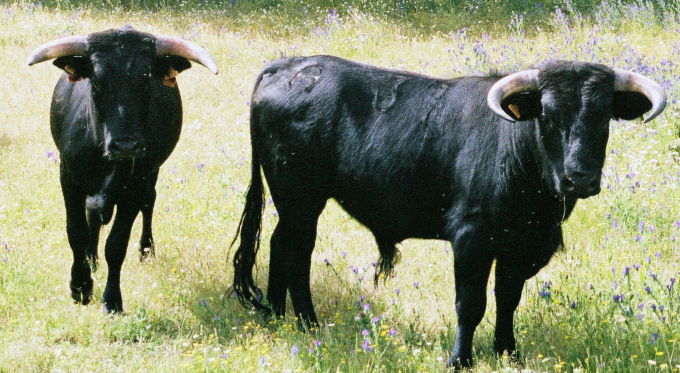
The real thing: young fighting bulls (novillos) on a bull farm in Salamanca, Spain.
Guernica. The bull fight in the sand-filled square. Except it wasn’t a fight, it was more a circus. The slippery pig. The hens and chickens. The rabbits and hares. All the animals running scared. The animals released, one by one, and the spectators jumping into the ring, really a sand-filled square, one by one, and chasing down the animals, taking them home for dinner, if they could catch them. Then the bigger beasts. The mule, ferocious, jumping into the air, kicking four tormentors, one with each leg, and biting a fifth with his teeth. No fearful, clucking chicken this, nor the cow who came after with her padded horns. Participants moved more carefully now. She watched them from her querencia, the where she chose to fight, not die. She knelt, scraped off the rubber balls that covered her horns. Re-armed, she charged and the crowd scattered, all but one young kid, caught, falling to the ground, the cow standing over him, ready to gore again. Sixteen years old, an outsider, I jumped with others over the barrier, twisted this away and that, thumped the cow’s side, smelled her fury, her fear, the whole soured being that emanated from her. Together, we hustled her, bustled her, dragged her kicking, butting, from the ring, backwards, pulled by the tail. Visible scars of damaged animals. Scars of the participants. That young man who broke his leg. That old man, inebriated, stuffed with food and drink, who loosened his belt to move more freely. We watched as his pants slipped from his waist to fall around his knees and trap him, just as the cow charged. He survived but will bear the scars forever, some visible, many not. Long summer days, on the Sardinero, the Segunda Playa, playing soccer. Different rules, different skills, different swear words: I carry a dictionary tucked into my bathing trunks and refuse to play while I look up the words spat at me by my opponent. Good heavens, I think, is that anatomically possible? The ball bounces away on the hard, sand ridges. I chase it and steadily dehydrate under the hot sun. A sea-salt wind desiccates my body. My mouth fills with salt water when I swim out to retrieve the ball from the sparkling sea. My tongue sticks to the inside of my mouth. When I spit, I spit dry and everyone laughs. Now I am totally dry, shiver, and no longer sweat. On the way home, we get off the trolleybus early, at Jesús del Monasterio and enter the long string of bars that lead past Numancia towards Perines. Red wine in glasses, in porrones, with tapas and raciones to soak up the alcohol, morcilla, mariscos, callos, patatas bravas, wine consumed until our blotting-paper bodies are ready once more to sweat. Bread soaks up the wine that relieves the oil that now filters through our skins and who needs suntan lotion when the oil is inside us and bodies are oiled, well-oiled, from the inside out? These excursions are all male, just like the soccer teams. I have four friends and I know them by their nicknames and the way they play soccer. I also know them from the way they try to trick me and laugh at my mistakes, or the way they treat me as a human being and help me to understand this new world into which, sink or swim, I have been thrust. Total immersion in another culture does not come with a set of instructions and the rules of soccer change from grass field to beach sand. Pedro plays centre-half, loves heading the ball, even when it’s laden with sand. I watch him playing field hockey one day, out at La Albericia, and when a low shot heads for the corner of the goal, he dives and heads it away. They carry him off on a stretcher, blood everywhere, and you wonder if his scars will ever heal. Tennis on the clay courts, also at La Albericia. I play so slow but they play so fast. I learn top spin, side spin, back spin, cutting the racket beneath the ball and learning to bend it sideways off the clay that is not clay really, but a fine-packed Italian sand on which I can slide and glide, and commit to a shot running one way then turn and commit to another in the opposite direction. I try it on a hard court, after the immersion period ends, when I get home, and my foot sticks on the tarmac (or whatever that hard, non-slip surface is) and over I go, skinning my knees, creating more scars.
Comment: Another Golden Oldie reclaimed from the reject file. I remember the scenes so well, even though I have moved deliberately in the piece from Elanchove and Guernica (Basque Country) to Santander (now Cantabria). I got lucky and was able to attend a series of workshops on memoirs run by Brian Henry of Quick Brown Fox. Taking his workshops, I realized that most of what I write is more akin to Creative Non-Fiction (CNF), rather then memoir, though much of what I write is rooted in memory. What thrills me in this style of writing is the rhythm that emerges, the word patterns I knit with my pen and a skein of ink, the remembered brightness of the Spanish sun, the sparkle of the waves, the warmth of a people, still grieving after their losses in a bitter civil war, their willingness to accept me, a foreigner, and take me to their hearts. The Other: we talk so much about The Other. But when we ourselves have been That Other, have been dependent on Other Others for food, drink, warmth, care, and love it is so much easier to understand what The Other is lacking and what we can give. Warmth, not scars; a hug, not a punch; open arms, not a fist… so easy to say. I have been there. I know. But can we, deep in our hearts, find it in ourselves to make the sacrifices for The Other that other others have made for us? Only time will tell.
“Don’t Get Off The Bus!” Wednesday Workshop Wednesday 14 June 2017 Journal: Roger Moore had the honor and pleasure of addressing the artists in residence at KIRA / Kingsbrae last night. He gave a brief biography of himself then stated that he did not consider himself to be a poet, the honor of the […]
An acolyte in a charcoal suit runs by. He neither stops nor speaks but slips on slippery words dripping from another monkey’s tongue.
This other monkey has eyes of asphalt, a patented pewter soul, ice water flowing in his veins. “Hear no evil! See no evil! Speak no evil!”
The hatch of his mind is battened tightly down. Nothing gets out nor in. The acolyte’s fingers grasp at a khaki folder, his manifesto for success.
Senior monkey stalks to his office and turns on the radio. His favorite music: the clink of mounting money.
Disturb him at your peril: this monkey is very important, and very, very busy. He’s also clever: a real smarty.
First, he empties all the chocolate candies from the box then he sorts them into little piles: green with green, brown with brown, blue with blue, red with red.
Then, like the Good Shepherd checking His flock, he counts them again and again, to ensure that none have been stolen and not one has gone astray.
Comment: Another Golden Oldie, this time from Monkey Temple. I have updated it slightly so it won’t be exactly the same as it is in the printed text. Senior Monkey has, of course, built a bigger box into which he can place all his chocolate candies and tuck them away for ever and ever. I guess if he were a bull and not a monkey, he would have tucked them away for heifer and heifer. Such is the sad state of reality in the Monkey Temple. But if monkey were a bull, he would be living in the cow shed, not the Monkey Temple. Oh dear, oh dear: and oh what a tangled web we weave when first we practice to deceive with fiction, flash fiction, creative non-fiction, and all the other sugar and spice which goes into the spinning of spider-webs and fairy tales. Speaking of which, did I ever tell you the story of the… well, maybe next time. So tune in again tomorrow. Same thyme, same plaice, and I’ll sing you a song of the fish in the sea… and a fishy tail that will be.
Some of the worst educators I have been unfortunate enough to work with over my undergraduate and graduate years have come up with cliché after cliché in an effort to the sway students into believing that they really are getting an excellent education. One such phrase is the infamous: “We are teaching you to think outside the box.” So, what is their definition of ‘the box‘? Alas, I do not know. They deal in clichés and, by definition, a cliché is a phrase that both parties (teachers and taught) accept as being meaningful, even though it is often without meaning. It is also a conversation closer, as in ‘it is what it is’. It’s hard to argue with that or to reason your way around it. ‘But it doesn’t have to be!’ rarely cuts the mustard aka mouse-turd.
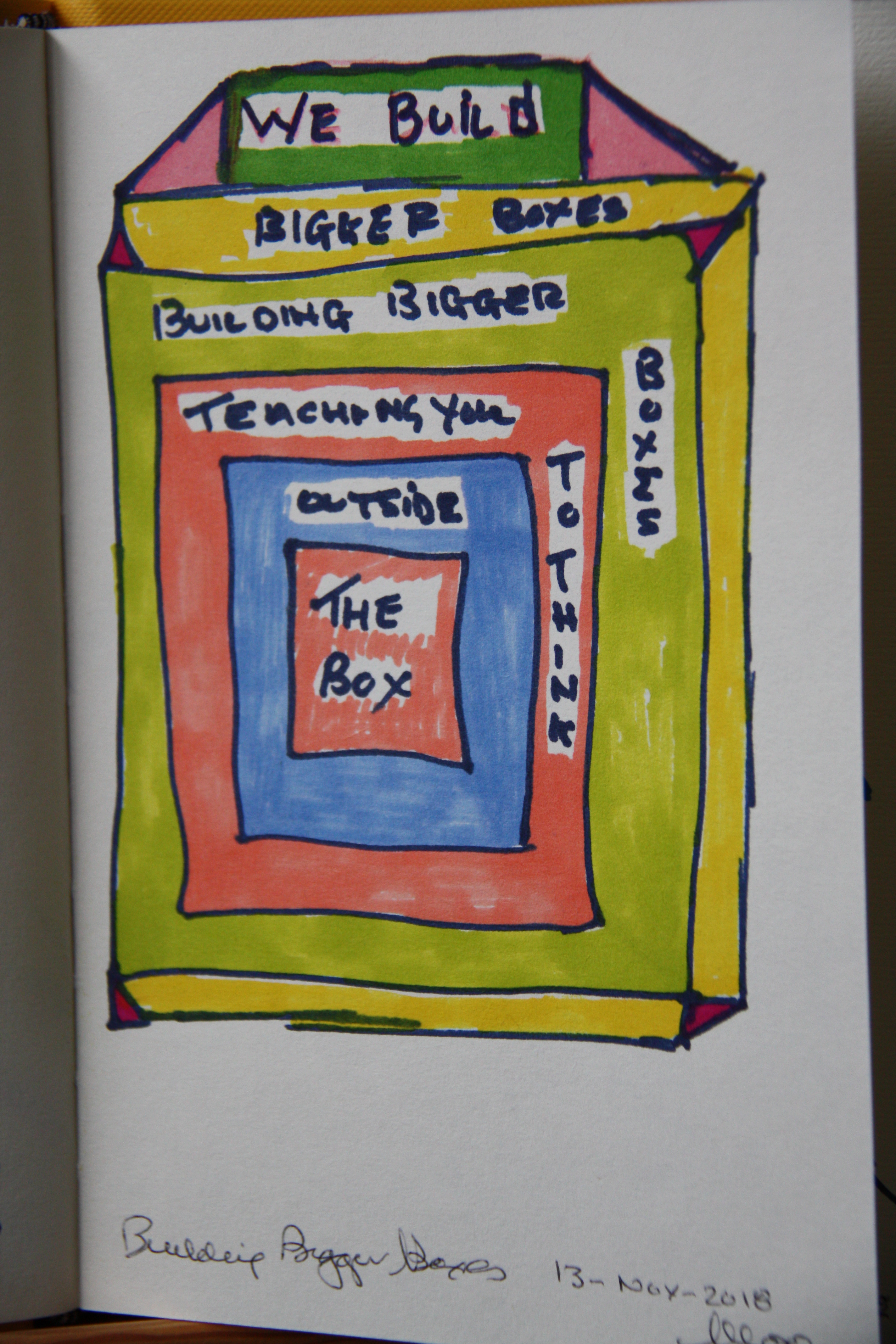
So, if these teachers are teaching their students how to think outside the box, how are they managing to do so? Why by building bigger boxes inside which each student can be safely taught to think, without asking questions, and without looking for independent answers.
Today’s cartoon has two titles: (1) Brave hearts escaping, finding meaning outside the bigger boxes and (2) can the true heart escape its coffin in a bigger box? I love the boxes within boxes and the drawers within each boxed segment into which the young, developing mind can be stuffed and crammed. How do we release those hearts? How do we develop those minds? Certainly not by confining them in bigger boxes. In the battle for hearts and minds, how do we set our students free?
It must be done on the student’s terms, each student, one by one, in co-operation with intelligent, meaningful teachers who step away from cliché and commonplace to enter the learner’s world and to themselves learn how to contact each learner at a mental, spiritual, and intellectual level. Only then will teacher and taught be able to speak of true intellectual freedom. Until that happens, be very careful when your child comes home and announces that today, of all days, that child has been taught to think outside the box. “Verily, I say unto you, open the cage door. Let in the sunshine and the light. Set those children free.” But remember, it must be on a case by case basis, with each individual weighed, assessed, understood, and released to find their own individual way of earning the things they specifically need to know. In true education, one size really doesn’t fit all.
Comment:Another Golden Oldie that suddenly surfaced and, on emerging from the depths, reminded me of another of my callings: that of a teacher of philosophy and a teacher with a philosophy. Retired now, I can no longer help young minds to create and shape themselves. This is doubly true with Covid-19 haunting us, waving at us from the shop-windows, supermarket aisles, and street corners, flapping its wings and trying to fly into our bodies. And remember to distinguish between clichés and things that are not clichés, like ‘Wear a mask’, ‘wash your hands’ (twenty seconds, with soap), and ‘keep a safe social distance’. Do this all the time and hopefully you will avoid thinking inside the bigger box of a six foot pine Covid-19 coffin.
I saw my father yesterday evening. I walked through the zócalo, opened the main cathedral doors and walked in. The doors closed behind me. I looked towards the main altar and there my father stood, motionless. The evening light shone through the engraved glass panels and illuminated him as if he were some long passed saint come back to visit me. We stared at each other, but I couldn’t open my mouth to speak. The hairs on my neck stood on end and my hands shook. When I forced my mouth open, words stuck in my throat. He wore his best grey suit over a light blue shirt and a dark blue, hand woven tie: the outfit in which I had buried him.
Three old women, dressed in black, broke the spell. One stood in front of me and wouldn’t let me approach my father. She held a large bag of knitting in her hands and the wool spilled everywhere as she pushed me away. The second threatened me with a pair of scissors that she held in her left hand and thrust towards my face. The third smacked a tailor’s measuring rod against my father’s head. He nodded, smiled sadly, and they all turned their backs on me and hurried away out of the cathedral and into the square.
Just for a moment, I stood there in silence. Then I pulled the doors open and ran in pursuit of my father. The setting sun filled the square with shadows that whispered and moved this way and that, as if a whole village had come down from the hills to walk beneath the trees and dance in the rays of the dying sun. I stood on the cathedral steps and called out my father’s name, but I could see no sign of him among the cut and thrust of the shadowy crowd.
I ran out into that crowd and pushed at insubstantial people who stood firm one moment and then melted away the next like clouds or thick mist. I came to a side street and saw real people, flesh and blood beings, a group of villagers gathered behind their band. I stopped and as I did the village elder put a live match to the taper of the rocket that he clutched between his thumb and forefinger. The taper caught on fire and the rocket soared upwards with a searing whoosh. The village band marched forward and started to play a traditional dance as the rocket clawed its way into the sky to explode with a loud knock on the door of the gods.
Tired of grasping at shadows and afraid of this living phalanx of men that marched towards me I went back to the cathedral and knelt at the altar of La Virgen de la Soledad, the patron saint of Oaxaca. Real wax candles stood before her altar, not tiny electric lights, and I inserted five pesos in the slot, took a taper, and lit a fresh candle from an ageing one that had started to sputter. I knelt and, for the first time in years, I prayed. I prayed for the soul I had saved from extinction by lighting my candle from another’s flame. I prayed for my father and my mother and, above all, I prayed for myself.
On the way home to my second-floor apartment where I live alone, I bought two litres of mescal, one to send me to sleep, and the other so I would survive the next morning.
Comment: A Golden Oldie that I had forgotten about. I found it among the drafts of earlier work. Monte Alban is also known as Dani Ba in the indigenous language of the region. Click on the link for more on Monte Alban. And click on this link for another piece on my father and Oaxaca. It’s a funny thing about Golden Oldies: sometimes they stick with us and are ‘unforgettable’, but sometimes they were better off left in the pile that gathers dust, like a forgotten book on a forgotten shelf. Speaking of which, have I told you about the time when …
Memories deceive me with their remembered shows, shapes shifting with a click of the magician’s fingers. What magic lantern now slips its subtle slides
across night’s screen? Desperate I lap at salt-licks of false hope that increase my thirst and drive me deeper into thick, black, tumultuous clouds.
A pandemic storm lays waste to the days that dog my mind. Carnivorous canicular, hydropic, it drinks me dry, desiccates my dreams, gnaws me into nothingness.
At night a black dog hounds me, sends my head spinning, makes me chase my own tail, round and round. It snaps at dreams, shadows, memories that ghost through my mind.
Tarot Cards and Tea Leaves are lost in a Mad Hatter’s illusion of a dormouse in a teapot in an unkempt tale. Hunter home from the hill, I return to find my house empty, my body devastated, my future a foretold mess.
Comment: Tough days around us and even tougher ahead. Covid-19 in the schools and people I know, young and old, frightened and in quarantine as a result. People I know and members of my far-flung (thank you, Jennifer, for that long-lost word) family. Funerals to the right of me, funerals to the left of me, of friends I know, acquaintances I hardly know, and many more whom I’ll never know now. “Into the jaws of Covid-19 rode the gallant six hundred, all masked, many falling, fewer of them every minute of every day.” Gallows humor keeps me alive. Last night my favorite teddy bear went AWOL. I got up at 3:00 am and sent out a search party. Sharp eyes spotted the copper band I lost last week. It had been hiding under the pillow. Then, joy of joys, they spotted Teddy’s black velvet band, the one that ties up the hair that falls over his shoulder and gets up my nose and makes me sneeze. They hauled him out from under the bed. I picked up the phone and cancelled the 911 call before the masked men in their jackboots and their PPE could break down the door and strip search the house for a missing bear. Alas, dear Mabel: I would if I could but I am not able.” How those words resound in my ears. Left ear, right ear, and, like Davy Crockett, a wild front ear. I will not give in to morbidity. ‘He who fights and runs away lives to fight another day.” I will survive for another day. Meanwhile, I’ll call for General Worthington, the fellow who can always make the enemy run. “Will you have a VC?” I said “Not me: I’d rather have a bottle of Worthington.” Alas, they don’t make it anymore. And Watney’s Daft Red Barrel has bitten the dust and gone the way of the dodo. And all my friends are in the doldrums, watching, as Admiral Brown abandons ship, mans the boats, and hauls away into fairer weather and cleaner waters. You say you do not understand? ‘Blessed are the poor in intellect, for they shall know peace in these troubled times.’
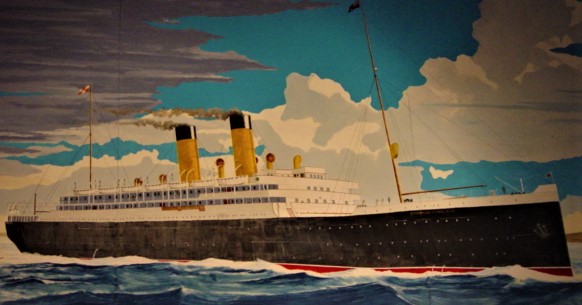
A Survivor from the Empress of Ireland Lights a CandleDuring the Old Latin Mass for the Dead Before the Main Altar at the Sanctuaire Sainte-Anne Pointe-au-Père
1
I am still afraid of fire: in principio erat verbum / in the beginning was the word.
I am still afraid of the loud voice of the match scratching its sudden flare, narrowing my pupils, enlarging the whites of my eyes:
et lux in tenebris lucet / and light shines in darkness.
Booming and blooming, igniting the soul’s dark night.
Voice of fire: et Deus erat verbum / and the Word was God.
Flourishing to nourishment, flames whispering on the flood: omnia per ipsum facta sunt / all things were made by Him.
Wool and water, this sodden safety blanket; and what of the cold plush of pliant teddy bear, the staring eyes of the doll:
et tenebrae eam non comprehenderunt / and the darkness comprehended it not.
2
The lashes of their eyes bound together with salt water, they were doused in a silken mist: hic venit in testimonium / this served as a witness.
Still the patterns pierce my sleep, hauling me from my opaque dreams, holding my wrists in this sailor’s double clasp: non erat ille lux / he was not the light.
Oh! Curse these dumb waters rising! “Not a hair on your head shall be harmed!” he said, hauling my sister up by her hair only to find her staring eyes belonging to the already dead: et mundus eam non cognovit / and the world knew her not.
3
Night waters rising. The moon raising its pale thin lantern glow: et vidimus gloriam ejus / and we saw His glory shining forth upon the waters’ mirrored face.
Comment: I searched everywhere, but I could not find a copy of my poetry book Empress of Ireland. Nor could I find a file containing the poems. Lost, I searched everywhere yet again and then, on an old USB, I found the text of the chapbook M Press of Ire. The above poem comes from that chapbook. Empress of Ireland is available on KDP / Amazon. I had forgotten how much I loved the sequence.
Some people leave indelible impressions memorable moments impressed on memory’s eye or clasped closely to the butterfly heart caged in its chest wings wildly beating as it strives for flight
some people cast shadows on snow leave footprints light as flakes as they walk across our waking dreams or call on us in those midnight hours when their image sears the drowsing mind
Some people set a fire in our hearts allow us to see things out of sight to write what we never thought to write to reach out to the unreachable to teach what we thought was unteachable
Stars in night’s silence they point the way lead us on paths we never thought to tread present us with a thread to lead us through life’s labyrinths and out from the darkness into bright light
Sometimes they cross the rainbow bridge before we do and when they go we know deep down in our hearts that they are there just out of sight waiting for us ready to welcome us when it’s our time to go
Where did all the sighs go?
The love that would last forever?
The tears that stained the letters?
The everlasting? The undying?
The eternally yours? The initials
we wrote on the back of envelopes?
SWALK, OXO, PHTR, RLN, ILYE,
ICWTKY, or was it ICWTMLTY?
I forget so much. But I do remember
how the windows steamed up
in your mother’s car when we sat
together for hours with nowhere to go
and nobody around to disturb us.
Combe Dingle, Wotton-Under-Edge,
Weston-Super-Mare: these were our
favorite places, do you remember them?
Just being together was more than enough
to keep us happy. We don’t hold hands
anymore. It’s not something grown-ups do,
especially in front of the children or the late
night news. Nor do football games inspire
passion and send us into ecstasies the way
the white spot did as it lit up your mother’s TV, with us alone…









 rogermoorepoet