This is now published and in my hands. I do not yet have full details on links and where and how to purchase, but I will put them up as soon as I have them. Meanwhile, I am grateful to my cover artist, who always does such a great job, and to my editor, Dr. Karunesh Kumar Agarwal (Managing Editor) Cyberwit.net. What a pleasure it has been to work with him. The cover picture, incidentally, is An Only Son.
I am now working on my next book, Stars at Elbow and Foot. I am sure many will recognize the title as coming from a line of a man born in the same town in Wales as I was: Dylan Thomas. The island in the picture is the only Island visible in Island View, incidentally. Alas, I do not have a picture of my cat, though I may put one on my next cover.
Ah yes, time to celebrate. I guess we’ll open a barrel of wine tonight. Hopefully we won’t finish it one sitting. I’d be lying if we did. This incidentally is the bodega where I got baptized. If you haven’t got baptized in a Spanish bodega, you haven’t lived. I’ll tell you about it sometime. How I miss that verdejo! Unfortunately, the verdejo didn’t miss me, and that’s how I got baptized. ‘Ya te hemos bautizado!’ “Que sea yo, y no el vino.” And if you understand that, you speak pretty good Spanish or Spanish pretty good … and you probably have an evil mind, just like mine.
Here I am, on the sea-shore, selling C-shells and thinking about my evil mind. But remember, my evil mind is mine, and it’s a one-of-a-kind. You go and find your own. And watch out for those Saint John C-gulls.
Jane gave me the honor of writing the foreword to her book and I did so with great pleasure.
Jane Tims: Niche. KDP. Book Review
Niche, the fourth poetry book published by Jane Tims, is a neat configuration of six segments that elaborate and illustrate the poet’s original definition of the multiple meanings of her title word niche. It is very difficult to separate the author from the act of narration as her keenly observed and skillfully executed drawings, together with their verbal representation on the page, are so autobiographical and so much an extension of her artistic and professional abilities that the objective separation of writer and text is scarcely possible. It is hard to forget that Jane Tims was, and to a great extent, still is, a highly competent professional botanist. The harnessing of the professional botanist, with her unique drawing skills and scientific knowledge, to the poet and auto-biographer is a key factor in the reading and interpretation of this text in which acute observation blends with an intimate knowledge of the observed botanical world, both flora and fauna, and this allows the poet, in her role of poetic narrator and lyrical voice, to weave a network of poems that are, at one and the same time, objective and intensely subjective.
The author emphasizes this when she writes in the Preface that “In biological terms, the niche is the quality of a space occupied by a living thing, the sum total of physical, nutritional, biological, psychological and emotional needs gathered together in one place.” She also reminds us that in human terms “niche can be a metaphor for home, community or personal space” and it is within these metaphoric spaces that the poetry text is elaborated. The text becomes a linked mixture of visual drawings, iterative thematic imagery and associative fields, all centred on the multiple meanings of niche. These terms are both biological and human in nature and the poet’s named world meets at this juncture between the human and the natural.
The section occupying space (1-19) bears the subtitle satisfying need and begins with a setting out of what this means in the following 12 poems and 4 accompanying drawings. The poem ‘apples in the snow’ with its companion drawing stands out for me. The section strategy, subtitled solidifying position (21-43) outlines in poetic terms, how plants, animals, and humans ensure their own survival. The section praying for rain, subtitled, avoiding danger and discomfort (45-68), offers views on discomforts and dangers. It also opens the discussion—relocate or stay where we are? The section mapping the labyrinth or places I have occupied (69-83), which contains the wonderful sentence “When I get lost on the road ahead, I look to the road behind me,” throws open the multiple meanings of home. The section new ways for water, subtitled coping with change (85-98), offers a double landscape, first, external, the things seen, touched, examined, remembered and described, and then the internal landscape that reflects upon them and is reflected in them. Finally, forgetting to move, with its subtitle getting comfortable (99-111), presents an autobiography that links observer (the twin personage of author and narrator) to observed (nature, both flora and fauna, and the added element of autobiography and self) via the symbiotic relationship of botanist to botany.
Two moments stand out for me. (1) Sadness is in seeking the space that is never found. (2) Loneliness is in trying to return to a space once occupied but no longer available. The whole concept of the Welsh word hiraeth is summed up in these two lines. Carpe diem, Jane Tims’ poetry indeed seizes the day and, with its minute, intense observation, it preserves so many precious moments. It also pays attention to that which has been lost, those moments that are irretrievable. They will vary for each reader, but hopefully, like me, you will take great pleasure in discovering them for yourself.
Comment: Brian Henry of Quick Brown Fox picked up this review and published it on QBF. Thank you, Brian and thank you Jane, you both do me great honor. Here’s the link: Niche on QBF 14 March 2021
The autumn leaves: what does it take with it when it goes? And what does it leave behind?
Crazy Glue
Late last night, a fallen star grazed by the lamp-post. A bouquet of golden sparks flew from an iron tree and sanctified the gutter. The gas lamps sputtered patiently in uniform rows. A scarecrow stuttered into the limelight and shook my hand. She was wearing my grandmother’s Easter bonnet, with all the flowers renewed, but she couldn’t keep my heart from last winter’s left over crumbs. Suddenly a tulip thrust through the concrete. It became as red as a robin and flew into the lounge bar of a public house. The bronze leaf necklace circling my throat filled with a flow of springtime song. My heart stood upright, a warped piano in my breast, and my skeleton tarried at the corner to play knuckle-bones with the wind. Torn butterflies of news fluttered round and round and kissed my eyelids when they closed. Yesterday’s horoscope winked its subversive eye and called to the hermit in his lonely cell: “Look out for the stranger with the tin can alley smile. Tie your heart to the tail of the first stray dog that comes whistling down the street and follow it home to the empty house that breathes in and out, moving thin membranes of memory.” That’s where I now live. Upstairs, downstairs, a lonely route I tread while the wind at the window scratches tiny notes. Something breaks loose in the confines of my mind and walks beside me. My twin brother stalks through this silvery sliver of splintered glass, this simian mirror wrinkling our troubled suits of skin. I glimpse the old moon’s monkey face through a broken window. Jagged and thin, it wanders like an itinerant snail, cobbled with clumsy clouds. Once, I descended the playground slide in a shower of sparks. A vagabond in a paving stone sky, I rumbled across metal cracks, a knapsack of nightmares humped on my old man’s back. Tell me: when the snail moves house, who stores the furniture he leaves behind? The hermit crab lurks naked on the beach, seeking new lodgings. Who killed the candle and left us in darkness? Two eyes in limbo watch me roll this snowman’s belly of flab across an unknown, clouded room where yesterday I got lost in the mirror. I know how to swim, but I would have drowned, except the light was too shallow and my feet touched bottom when I let the wheels down. I swam on and in looking for a deserted island on which to build my idle sand castle dreams. Two people said they saw my reflection swimming like a goldfish in the silver of that secret space. They said I stared back out at them with circles of longing ringing my eyes; but I laughed when they said they had seen me, for when I looked in the mirror this morning to shave, I just wasn’t there. My razor dragged itself over an empty space and its sharpened blade scraped white music from the margin of a cd rom that spun on edge like dust rings round a vanished planet. Now there is a black hole where my passport photo used to thrive. Someone plucked me from the circle and cut me out in the dance last night. Today I’m looking for a scrapbook in which to stick myself with crazy glue that never, never, ever comes undone.
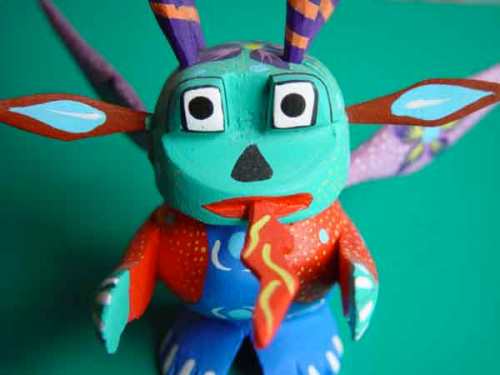
This is one of the first alebrijes I bought in the zocalo (main square) in Oaxaca. He has lost his ears and probably his tongue. They started falling out so we wrapped them up carefully and now we can’t find them. He’s still a happy chappy, hough, and has been in this house for a quarter of a century. Happy Birthday Alebrije!
Alebrijes step out from dried wood and stand in the shower of paint that falls from the brush’s tip. Yellow flash of lightning, pointillistic rain, garish colors that mirror those of the códices. The carvings take the form of fantasy figures, anthropomorphic animals, and mythological creatures. Sometimes one individual selects the wood, carves it, then covers it in paint. Occasionally an entire family takes part in the work of making the alebrije. One person collects the wood and prepares it for carving. Another carves and sands it. A third works on the undercoat, and a fourth applies the final patterns of paint. The great debate: does the form in the wood reveal itself to the carver or do the carvers impose their own visions on the wood? In the case of the team, do the family members debate and come to a joint conclusion? These thoughts, exchanged with wood-carvers in Oaxaca, have led to a series of interesting conversations. What exactly is creativity? Where does it come from? Do we, as artists, impose it upon our creations? Or do we merely observe and watch as new ideas float to the surface of our minds? How does the creative mind really function? And, by extension, how much of the sub-conscious creative sequence can be placed into words?
Alebrijes
Are they half-grasped dreams that wake, wide eyed, to a new day’s sun?
Or are they alive and thriving when they fall from the tree?
Does the carver fish their color and shape from his own interior sea, or does he watch and wait for the spirit to emerge from its wooden cocoon to be reborn in a fiery block of color?
Daybreak: in a secluded corner of my waking mind, my neighbor’s dog greets the dawn with sparks of bright colors born from his bark.
My waking dream: dark angels with butterfly bodies, their inverted wings spread over my head to keep me warm. In the town square, the local artist plucks dreams from my head and paints them on carved wood.
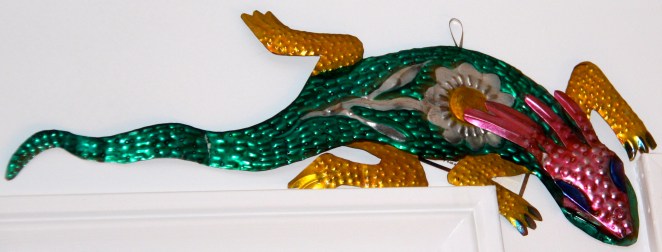
Our house iguana: he is not an alebrije, but is made out of painted metal foil, carved first, and then decorated. He’s the one who guards the front door and falls upon unwanted intruders when they least expect it. Never stay home alone without one, or two, or more. But watch out if you have too many and they get hungry.
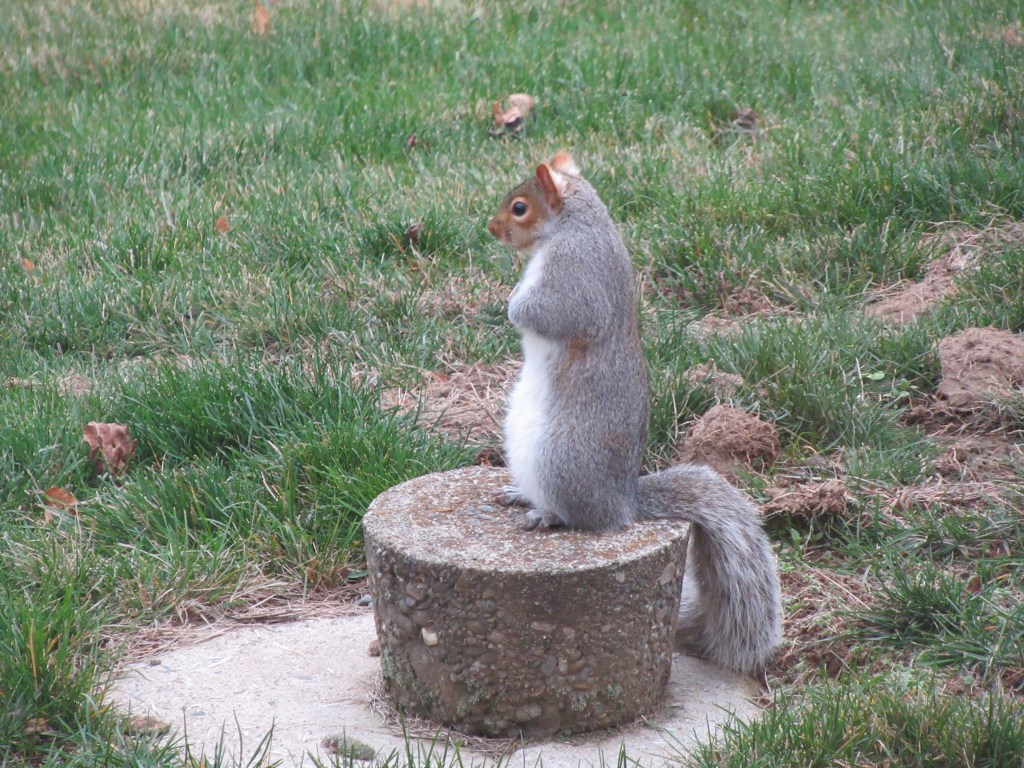
Comment 1: It’s one of those pandemic days when the steam stays in the kettle, the heart rattles, the ribs, and nothing happens. This is the hopeful grey squirrel who sits outside the kitchen window and tries to persuade us to come out and feed him. Look at him: one eye on us and the other on the world around him.
I think he’s looking for his twin, or maybe his twain. But what if the twain never meet? Click on the link below, a real Golden Oldie, and you’ll see what happens when the twain really do meet. As they sometimes do.
Meanwhile, Teddy has a message for you: People who live in glass houses shouldn’t throw stones. Now, now: I don’t want to hear anyone thinking: ‘get stoned you silly teddy bear’. That’s not nice. Remember: “let him who is without guilt” etcetera
Comment 2: When you click on the link, if you click on the link, remember: that was probably my first ever post. Oh I was a novice once upon a time, but never in a nunnery. And I still don’t like taking orders. That’s probably why I never became a bar tender or a waiter. Hey: wait a minute now. I think this pandemic lockdown is getting to you. You are as mad as a hatter or as confined as a teddy bear in a glass house. Oy! Whose is that voice talking to me on my own blog? It’s the other half of your split personality. Oh dear: I guess we are all getting to know that strange, locked up feeling.
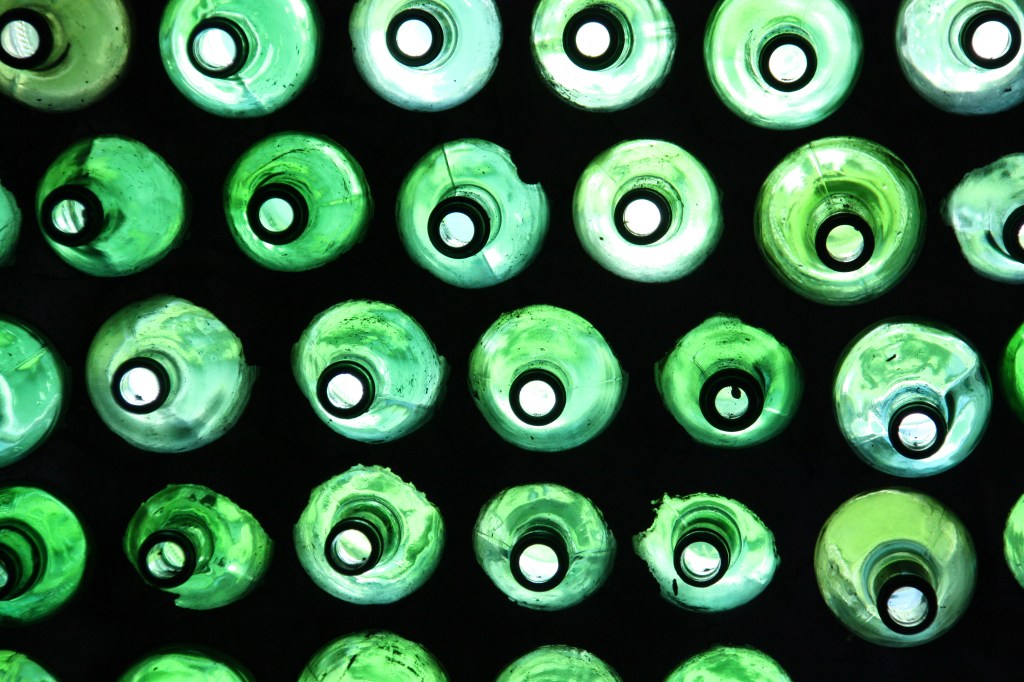
Light through glass, darkly: bottles set in one of the bottle house walls in PEI. The gardens are wonderful and well-worth a visit.
Bottle House, PEI The day begins with flowers: at the entrance, beneath the windows, flowers everywhere, a delicacy of scent. Beyond these flowers, even more flowers, then playthings in the garden: a child’s paradise, these sculptured faces, this glass among the trees, sun and shade, the fountain’s water, this dream of an old man, kept alive now by his children, a dream of health and sanity and peace out by the bay, where the mud red waters roll and the tide’s hand grasps at the land and pulls it down with watery fingers. Everywhere: faces and elements of faces: a nose, eyes, a mouth, open in surprise. Carved wooden faces, glass faces, pottery faces, flesh and blood faces, grandma’s face, grandpa’s face, then the grandchildren. Tourists travelling, old islanders returning to see family and friends, young islanders returning to visit the almost forgotten farms which their families worked a generation or three ago, before their exodus from the land. “This was grampy’s house!” they say or “that was my grandmother’s farm!” as if a life could be reborn in that pointed finger, those casual words. How many memories are snapped in each picture? How many lives are caught in this snapping of the fingers as the past is instantly summoned and perfection is bottled for a second or two in the magic of this house, this garden where the builder’s spirit roams. Sit still awhile. Be silent: you may hear him breathe, glimpse him, for a second, staking out the flowers, extracting a weed, checking the set of the concrete foundations, polishing a bottle, resting on a wooden seat, avoiding the slow snail on the path bejewelled by rain-drops from the trees or spray from the fountain. For where there are flowers, there must be water and rain and peace and happiness and all good things, glimpsed darkly through smoked glass yet grasped so smoothly in the sun’s bright light. This is the house of bottles, the glass house, where rough winds are shunned and the bottles are set in concrete. It is a museum of light and dark, the creation of sun and shadow as sunshine fails and the lighthouse’s flashlight beam reverberates from glass to stone and back again. Shapes, shadows, memories curved and carved in glass, set in glass, this shimmering beacon this glass house, this light house built as a heaven-haven for harboured ships and the soul’s refreshment, here, in these gardens, among these bottles, and at the chapel door, an angel-in-waiting.
Angel or fairy? It doesn’t matter. She was a gift one morning, when we visited. In this photo you can see how the bottles are set in the wall.
Different bird, same question: why? This one is from one of the beaches on the road to North Cape, PEI. Why, indeed?
Why?
In the mud nest jammed tight against the garage roof, tiny yellow beaks flap ceaselessly open.
The parents sit on a vantage point of electric cable, mouths moving in silent encouragement.
A sudden rush, a clamour of wing and claw, a small body thudding down a ladder of air to crash beak first on the concrete. “Why?”
“Wye is a river. It flows through Ross-on-Wye and marks the boundary between England and Wales.”
And the swallows perch on the rafters watching their fledgling as it struggles on the floor: the weakening wings, the last slow kicks of the twitching legs. “Why?”
“Y is a crooked letter invented by the Green Man of Wye.”
Comment: This is the original poem, written back in the eighties, wow, that’s forty years ago. I included it in my first poetry chapbook, Idlewood (published, 1991). It was a slim volume, dark green color, typed and photocopied, very humble, but MINE! A couple of years ago I wrote a prose poem, sort of flash fiction, in one of my Welsh sequences and included the story as part of the text. It came to me as a memory yesterday morning, and I posted it on Facebook. Here now is the story. Hopefully, you have just read the poem: I hope you liked it but, as I know all too well, de gustibus non est disputandum. I would like to know if you prefer the poetry to the prose. Please let me know, pretty please?
Why?
“Where are you going?” I ask. “To see a man about a dog,” my father replies. “Why?” I ask. “Hair of the dog,” his voice ghosts through the rapidly closing crack as the front door shuts behind him. “Why?” I cry out. I recall the mud nest jammed tight against our garage roof. Tiny yellow beaks flap ceaselessly open. Parent birds sit on a vantage point of electric cable, their beaks moving in silent encouragement. A sudden rush, a clamour of wing and claw, a small body thudding down a ladder of air to crash beak first on the concrete. “Why?” I ask. The age-old answer comes back to me. “Wye is a river. It flows through Ross-on-Wye and marks the boundary between England and Wales.” The swallows perch on the rafters watching their fledgling as it struggles on the floor, the weakening wing flaps, the last slow kicks of the twitching legs. “Y is a crooked letter invented by the Green Man of Wye,” my grandfather says. “Why?” I repeat. “I want to know why.” Silence hangs a question mark over the unsatisfied spaces of my questioning mind.
Silence in the garden. A hawk perched nearby. There are so many ways to die.
Death by Devilry
Silence in the garden. A hawk perched nearby. There are so many ways to die.
A cerebral bleed, minor, but enough to send him to hospital and keep him there.
Cured, ready for release, he would need extra care and added attention.
The devil lived in the small print. Too much attention needed now: his care home wouldn’t care for him.
Back to the old folks ward he went. There he lay, waiting for a vacancy in a home that would really care.
One day, Covid came a-visiting, stalked the ward that night, choosing its victims: you, you, and her, and him.
What killed him? A cerebral bleed, a minor stroke? Or a major stroke from the devil’s pen?
Bold words, bare words, a barren ward, another vacant place around a Christmas table.
Comment: Sitting at the breakfast table, with an empty space before me, I penned these words. So tragic, so avoidable. Yet how many families have gone through something similar in the past twelve months? How many empty spaces are there, vacancies that will never again be filled? I look at today’s figures from the USA: 18,466,231 infected and 326,232 already perished, an increase of 227,998 and 3,338 since yesterday. I am reminded of the words of Pink Floyd: “Is there anybody out there?” Blas de Otero also echoes through my mind: “levanto las manos: tu me las cercenas” / I hold up my hands: you cut them off. And yet it is Christmas Eve and there is still the Christmas promise of joy, and hope, and a new year entering. Let us raise our hands in prayer: and let us pray they are not hacked off.
Searching for le mot juste, the exact word that sums it all up, catches the essence of the thing and holds it in the mind forever.
Think flowers. Think scent. Think of the limited ways we describe how daffodils lift and clematis clings.
I look across the breakfast table and see my wife of fifty years, a teenager reborn, walking into that café where we had our first date.
I search my memory and my mind for the words to describe that beauty, that surge of excitement, I still feel when she enters the room:
but find I cannot find le mot juste.
Comment: I shortened this poem from its earlier version. You can click on this link to compare the two versions. I am always puzzled by the dilemma of lengthening or shortening. My thoughts center on the longer and shorter versions of some Raymond Carver stories. Follow the editor’s advice and cut all material down to its essential bones or fill out the skeleton with flesh and blood and expand the creative process further. I also think of the exhortation to ‘stay in the moment’. Anything that takes the reader away from the central experience is superfluous. Experienced writers are aware of that moment and its importance. Writers at my stage are often baffled by it and need to be told yes, this is the moment or no, that is not the moment. I guess the more we write, the more we understand the process. Understand: do we work this out consciously or does it develop in unconscious fashion? Are some people just born with those skills or we must work hard to develop them? Sunt rerum lachrimae: tears are in all things and I guess hard work is all part of the process. As I was told a long time ago: genius is 99% perspiration and 1% inspiration. You have to put in the hard work for that little light bulb to go ‘pop’!