Monkey Presses Delete

Monkey Presses Delete

Monkey loves walking behind the gorillas.
The gorillas break and enter:
and when they do, monkey simply points
and gorillas do their thing:
it’s that simple …

Monkey has a code word
that he took from his computer course.
“Delete!” he says with delight
and the gorillas delete whatever he points to.

Monkey loves burning other people’s books.
He also loves deleting parents
especially in front of their children,
and deleting children in front of their parents
can be just as exciting.

The delete button excites monkey:
maneuvering the mouse
tightens his scrotum
and he feels a kick like a baby’s
at the bottom of his belly
as he carefully selects his victim and
“Delete!”

The gorillas go into action:
ten, twenty, thirty, fifty, seventy years of existence
deleted
with a gesture and the click of an index finger
pointed like a gun.  

Monkey’s Clockwork Universe

Monkey’s Clockwork Universe

Some days, monkey winds himself up
like a clockwork mouse.
Other days he rolls over and over
with a key in his back
like a clockwork cat.

Monkey is growing old and forgetful.
He forgets where he has hidden the key,
pats his pockets, and slows right down
before he eventually finds it
and winds himself up again.

One day, monkey leaves the key
between his shoulder blades
in the middle of his back.

All day long, the temple monkeys
play with the key, turning it round and round,
and winding monkey’s clockwork,
tighter and tighter, until suddenly
the mainspring breaks

and monkey slumps at the table
no energy, no strength,
no stars, no planets, no moon at night,
the sun broken fatally down,
the clockwork of his universe
sapped, and snapped.

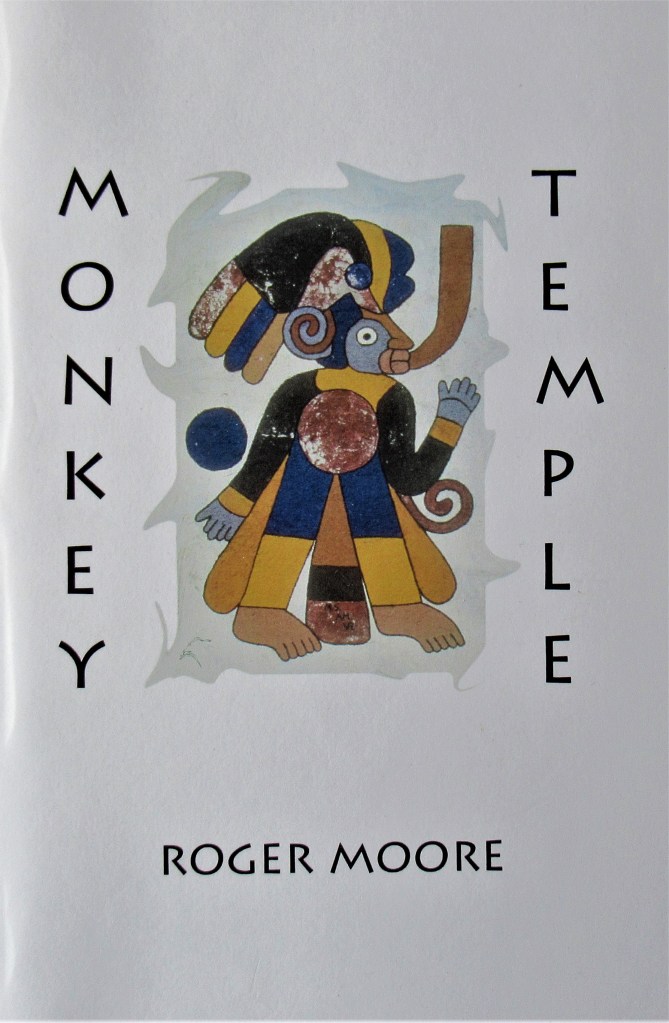
Comment: Monkey Temple is A Narrative Fable for Modern Times written in verse. The poems show strong links to Surrealism and Existential Philosophy. They portray the upside-down world of Carnival and out line Monkey’s Theory of the Absurd in a dystopian world that mirrors that of George Orwell’s Animal Farm, LaFontaine’s Fables, the esperpento of Valle-Inclan, and the witty conceptismo of Francisco de Quevedo. This is a walk through the jungle of the Jungian innermost mind. But watch out for those monkeys: they bite.

Online Edition
First Edition

Click below to purchase Monkey Temple online.

Monkey Temple
paperback

Monkey Temple
Kindle

Full Moon Over KIRA

Spotify
Don’t forget to scroll down to appropriate audio episode.

Full Moon Over KIRA

Who shall dredge this midnight moon
from the shoals of Passamaquoddy Bay?
Gaunt the moon-rakers’ faces, harsh their hands
hauling on nets, heaving her up, rippled and dimpled,
blunt her bite as she emerges from submersion,
raked from water in the traditional ritual.

Upside down, these reflected clouds,
as bright as full-moon fishing boats
distorted from below as the night wind
blows clean dry bones across a mirrored sky
where shadow fish fly wet with moonshine.

Oh pity her, you people, as she’s dragged
from her element and exposed to air and oxygen
that will slowly kill her, make her fade,
frail and fragile, not meant for this world of rock
and stone, flower and field, but destined to walk
in heavenly meadows or to rest in the shallows
where she rocks to sleep in the sea’s endless cradle.

Click on the link below to peruse my books for sale.

Books for Sale

Mirror Image

Spotify
Remember to scroll down to the correct audio episode.

Mirror Image
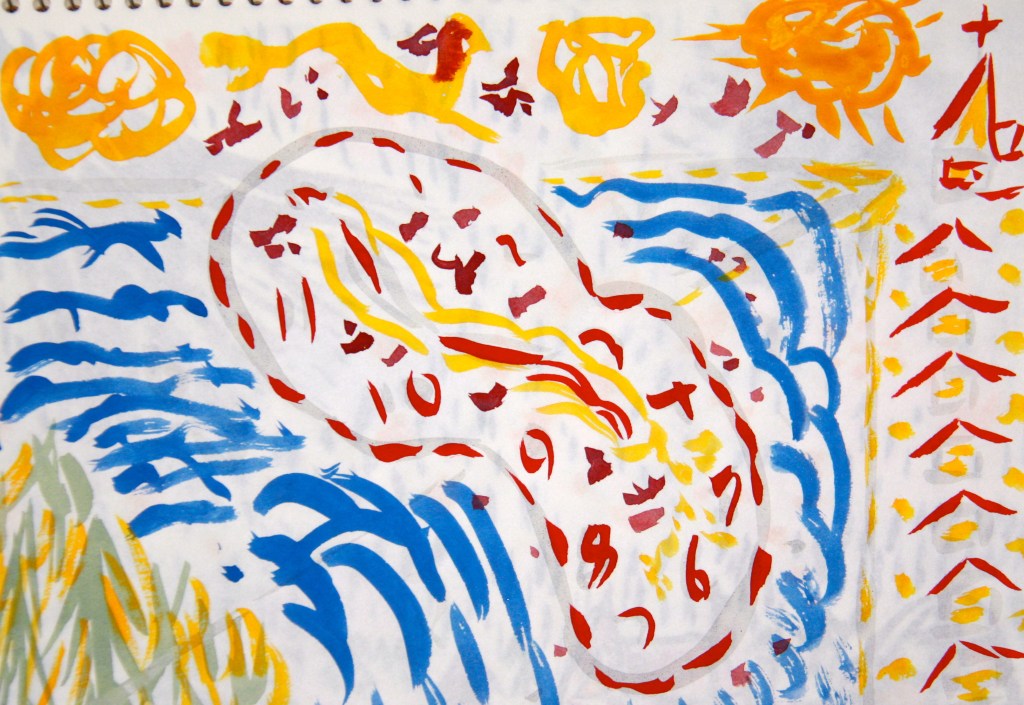
(on seeing the outline
of a painting on the reverse side
of my painted note-book page)

What price these corkscrew lines,
reversed, seen through a glass, darkly,
the wrong side of a tapestry,
all twisted threads and imaginings,
no clear pattern of thought
or design, as if designated by an errant
hand and signed by a man with a mission
to bewilder, confuse, muddle, shock,
turn inside out, back to front, upside down
all our notions of what is what,
and who is when, and why, and where?

Yet there is meaning to this madness,
a sense of a blind man trapped underground
in the labyrinth of his darkened mind
with only a thin thread of belief
to guide him, upwards and outwards,
away from the torrid torment of doused flames,
the damp spark’s midnight glow,
the search for substance in a new world,
insubstantial in a neologism, whirled
through inner spaces and spun, guileful,
out of the back of the hand to spin,
this way, that way, who knows which way,
according to the moment of delivery,
the angle of acceptance,
the untrained brain of the recipient,
tottering on the brink of a world
with a definite end: the suicide of logic.

Click on the link below to peruse my books for sale.

Books for Sale

Dalí ‘s Clock

Spotify

Remember to scroll down to the correct audio episode.

Dalí ‘s Clock
Salvador Dalí

A clock, a sheet hung out, strung out,
on a canvas washing line. No wind,
no pegs, soon to be sun-bleached, dried,
then folded in on itself, corner to corner
the sheet, and the watch, how will it fold?

Face to face, in half circles, perhaps, or
back-to-back with time cut in half, a tick
without its companion tock, a stutter of time,
halved, then quartered, then in an eighth,
a quesadilla of broken springs and tiny
wheels within wheels, all disjointed,
with glass fragmenting, shattering.

While we watch, our clockwork universe
disintegrates before our eyes, in a tiny
explosion as all chronological creation
implodes into a logic of carnival, absurd
our words and world, devoid of meaning,
a pocket-watch going over a waterfall,
a timepiece soon to break into rusty pieces,
painted by a man who dreams he isn’t mad.

Click on the link below to peruse my books for sale.

Books for Sale


Impressions

Spotify:
Remember to scroll down to the appropriate audio episode.

Impressions
(Oaxaca, Mexico)

hard baked loaves of stone
hot cobbles beneath the feet
the burning street forced upwards
through shoe leather to scorch our soles
the sun’s orb an irresistible hammer
beating the strength out of the sweating body
heart sucked dry lungs shriveled

inside massive stone walls
candles crucifixes paintings of saints
statues carved wooden images
outside in the sunlight alebrijes
staring eyes wagging tails protruding tongues
their spirits breaking through the wood
turning from darkness into light

impressions a nose here
a pair of eyes there long black hair
a tree trunk swaying to the music
a black bible banged on a wooden table
a Cubist nightmare of detached body parts

multiple pin balls released in a rush
by an errant slot machine
stained glass reds blues greens
smoke from a candle twisting in air
light filtered from high windows

once open doors slowly closing
keys no longer turning in locks
unwound clocks no longer ticking
cobwebs gathering in forgotten rooms
flowers on the altars nochebuenas
with their single and double petals
crimson and cream cempasúchiles
marigolds lighting their golden
walkway to guide the dead
loved ones returning to visit the living

Click on the link below to peruse my books for sale.

Books for Sale

Tense and Tension

Spotify:
Remember to scroll down to the appropriate audio episode.

Tense and Tension

Your flightless fancies flit
through a darkness of despair,
as awkward as auks,
as clumsy as penguins
stranded in zoo cages
far from their native seas,
as meaningless as the dodos,
as dead as the ashes lying cold
beneath the crematorium’s fire.

A sudden bucket
clatters down the well,
but it draws no water.
Winter ice will not melt.
Desert sands may burn boat and feet
but they will not warm your glacial heart.
The manner of your second coming
brings forth no nourishment.

A spider web on the wall
grows into a mirror.
Face to face, present and past
become ambulant tenses
that foretell no conditional.
No future beckons,
let alone a future perfect.
A dislocation of infinitives
stretches into the infinity of
an invisible futurity of
never-joining railway lines.

Nochebuena

IMG0034_1.jpg
Poinsettia is called nochebuena in Oaxaca.
It also means ‘Christmas Eve’ in Spanish.

Spotify:
Remember to scroll down to the appropriate audio episode.

Nochebuena

Nochebuena / Christmas Eve:
last year, a star fell down the chimney
and landed on the poinsettia.
The cat and the dog stood up to deliver
new versions of their Christmas vision.
Birch bark: ghosts on the snow bank turned
white in the moonlight as they danced,
so slender and so bright.

This year an obsidian knife
hacks through my mind
slicing it into two uneven pieces.
Snowflakes invade its split personality.
Thin ice spreads across glacial fires.
Incarcerated birds sing deep in my rib cage.
A child’s world: with its lost toys lies
buried beneath fresh snow.

Tears freeze in my eyes,
drip from my eyelashes,
and fall to the earth as stars.
Soon I will be an enormous sunflower,
trapped in this wet clay rag of a body.

If I sit here in silence
will the world, like a garden
growing wild, go on without me?
The flowers in my yard close
their mouths and refuse to answer.

Sun and Moon

Sun and Moon
Poems from Oaxaca, Mexico

is available at the following link:
Click here to purchase Sun and Moon

Introduction to Sun and Moon

Oaxaca

A city of legends where the dead walk among the living and the stones beneath your feet come alive and talk to you. A city where the animals have voices and the songs of tree and leaf can be clearly heard. A city of hallucinations and spirits, of mystery and myths, a city, young in itself, built on land so old that memories clutch at you with treacherous fingers and lay siege to your heart claiming you for their own. This is the land of Sun and Moon. Come, enter its world. Join me there, if you dare.

Meeting my father in the main square

I saw my father yesterday evening, in Oaxaca. I walked through the zócalo, opened the main cathedral doors and walked in. The doors closed behind me. I looked towards the main altar and there my father stood, motionless. The evening light shone through the engraved glass panels and illuminated him as if he were some long passed saint come back to visit me. We stared at each other, but I couldn’t open my mouth to speak. The hairs on my neck stood on end and my hands shook. When I forced my mouth open, words stuck in my throat. He wore his best grey suit over a light blue shirt and a dark blue, hand woven tie: the outfit in which I had buried him.
            Three old women, dressed in black, broke the spell. One stood in front of me and wouldn’t let me approach my father. She held a large bag of knitting in her hands and the wool spilled everywhere as she pushed me away. The second threatened me with a pair of scissors that she held in her left hand and thrust towards my face. The third smacked a tailor’s measuring rod against my father’s head.  He nodded, smiled sadly, and they all turned their backs on me and hurried away out of the cathedral and into the square.
            Just for a moment, I stood there in silence. Then I pulled the doors open and ran in pursuit of my father. The setting sun filled the square with shadows that whispered and moved this way and that, as if a whole village had come down from the hills to walk beneath the trees and dance in the rays of the dying sun. I stood on the cathedral steps and called out my father’s name, but I could see no sign of him among the cut and thrust of the shadowy crowd.
            I ran out into that crowd and pushed at insubstantial people who stood firm one moment and then melted away the next like clouds or thick mist. I came to a side street and saw real people, flesh and blood beings, a group of villagers gathered behind their band. I stopped and as I did the village elder put a live match to the taper of the rocket that he clutched between his thumb and forefinger. The taper caught on fire and the rocket soared upwards with a searing whoosh. The village band marched forward and started to play a traditional dance as the rocket clawed its way into the sky to explode with a loud knock on the door of the gods.
            Tired of grasping at shadows and afraid of this living phalanx of men that marched towards me I went back to the cathedral and knelt at the altar of La Virgen de la Soledad, the patron saint of Oaxaca. Real wax candles stood before her altar, not tiny electric lights, and I inserted five pesos in the slot, took a taper, and lit a fresh candle from an ageing one that had started to sputter. I knelt and, for the first time in years, I prayed. I prayed for the soul I had saved from extinction by lighting my candle from another’s flame. I prayed for my father and my mother and, above all, I prayed for myself.
            On the way home to my second-floor apartment where I live alone, I bought two litres of mescal, one to send me to sleep, and the other so I would survive the next morning.


Blue, blue day

Blue Blue Day

Blue, blue day

“My grandfather told me there’d be times like these” and he was right. I wonder about his blue days, down there in the trenches, on the Somme, and on other fronts. He survived. He was a survivor. Sometimes that’s the only thing to be. So how do we survive? How do we ignore the snipers, the whizz-bangs, the star shells, the other things that go bump in the night?

There is no single answer. One of my best friends goes into hospital tomorrow, 6:00 am, buccal cancer. An operation. All may be well afterwards. I certainly hope so. I will be here for him, as my grandfather was there for me, as I have been there for others, as others have been there for me. I will not mention names. A blue, blue day indeed. But what shade of blue? If all goes well, the celestial blue of joy and hope, the blue of Mary’s robe when she crushes the serpent beneath her foot, the joy of the blue sky after the storm.

Not, we hope, the dark blue, almost purple, of the gathering storm, the blue of thunder clouds turning almost into black, the midnight blue of the last chance saloon with its overtones of tragedy and disaster. “I never felt more like singing the blues”… indeed I didn’t. But what shade of blue? And for me, it is always the blue of clearing skies, the blue of Mary’s robe, the blue of hope.

“And still I live in hopes to see, Swansea Town once more,” thus sang my father’s father during WWI. He was gassed, he was wounded, he was decorated, he was mentioned in dispatches, so many things happened to him. But he survived the snipers, Big Bertha, the star shells, the whizz-bangs, and he saw his beloved “Swansea Town once more.” As I hope I will, but my dream of a return to the blues of Swansea Bay may be fulfilled in a very different fashion.

Alas, my beloved Swansea Town is now a city. “And so I live in hopes to see, Swansea City once more.” It doesn’t sound the same, does it? It doesn’t have the same carry, the same rhythm, the same resonance. And what about Town Hill? Has it now been renamed City Hill? I am sure Town Hall, the old Brangwyn Hall where my father used to work, is now City Hall, which my father never entered. Enough, no more for “you can never walk in the same river twice” (Heraclitus).