I forced my characters into the roles that I chose for them. Sometimes they complained and refused to obey me.
Late one night, they came and knocked on the window that opens in my head when I dream.
They started to complain about how I was treating them and demanded that I change my ways.
I listened as they yapped, and yammered, and strewed their growing pains on the counterpane before me.
When I woke up, I remembered what they had told me and I wrote down their stories in their words, not mine. Then they came to life and spoke through me.
Comment: This poem and the next one both came from yesterday’s prompt – what do you listen to? The act of ranting, based on a prompt, often generates imagery that can then be used in either poetry or prose. The secret is to cut away the dross and find the gems that are often hidden within the rant. This leads, in my opinion, to enhanced creativity.
I remember the little electric railway that ran on a single loop around the kitchen table, diddly-da-diddly-da, just like a real train, except no smoke, no puff the magic dragon, no sense of a schedule or arriving and departing when circular time is meaningless, as are the numbers on the sundial when the sun isn’t shining, or the hands on the clock’s blank face when the numbers are missing, and you don’t know whether you are looking in time’s distorting mirror or are standing on your head in the Antipodes, and all the while the clock hands are marching round and round, tick-tock, and there is no track by which time can be tracked.
And the runaway hands go round the track, and the electric train goes round the table, and the ghost train hoots whoo-hoo, as it vanishes into the timeless tunnel, then exits, the engineer, like Rip Van Winkle, grown old with a long beard, and the carriages all covered with cobwebs, and skeletons leaping out of the compartments, then sitting beside the travellers as they snore on their seats.
Comment: Another poem based on a prose prompt. What a great source for poetry those prompts can be, when you don’t take them too seriously and allow your imagination to run riot and your memories to flow. Not automatic writing, but writing that springs from an absurd, surrealist approach to the crazy world that surrounds us. Rain that causes the yucca plant to grow, then falls so hard that it is battered to the ground by the very thing that gave it life. And so it is with my memories of the many trains on which I have travelled and with which I have played. Once upon a time, I couldn’t conceive of life without the railway. Where is it now? I haven’t been on a train for more than fifteen years. Strange how their ghosts flit through my dreams at night: fast trains, slow trains, the wrong train at the wrong time taking me to the wrong place in time. Ah, the poetry of trains yet, “ni temps passés ni les trains reviennent.” And you can give yourself a glow of satisfaction – thank you Tommy Reed – if you recognize the quote, and two more if you know who Tommy Reed is. I use the present tense because, although long gone, he is ever-present in my mind.
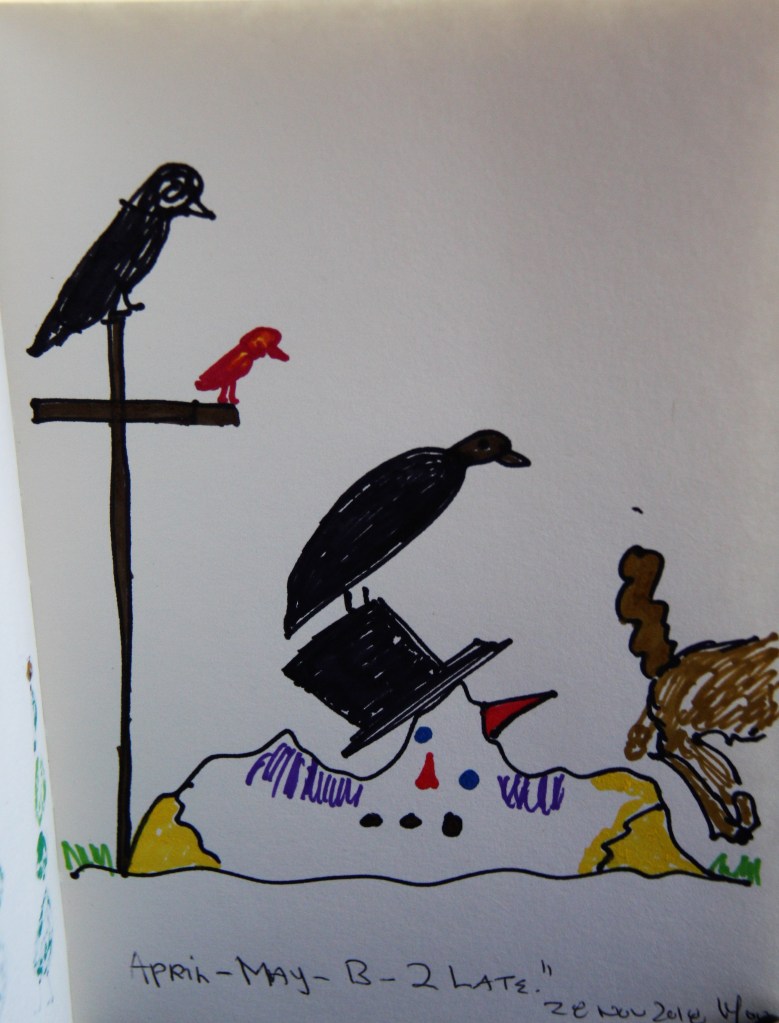
Today’s painting – another gift from my friend Moo.
What if you walked into a church in a foreign country and came face-to-face your dead father? In People of the Mist, Nemo, orphaned as a baby after the suicide of his unmarried mother, seems called to visit Oaxaca, Mexico, the city of the returning dead. Upon arrival, he visits the town’s main cathedral only to encounter his adoptive father, a man he had buried years earlier. Confused by what he thinks is a realistic vision, he seeks the help of a local witch doctor to explain his mirage. The shaman seems to hold the answer and presents him with a broken medallion. He challenges Nemo to find the other half, promising the quest and discovery will reveal the real purpose of the young man being called to Oaxaca.
Brief Biography
Roger Moore, is an award-winning teacher, researcher, poet, and short-story writer. His accolades include being a CBC short story finalist, as well as winning multiple awards from the WFNB. Born in Swansea, Wales, he now lives in Island View, NB, Canada. Between 1995 and 2001, he taught multiple classes in Oaxaca, Mexico, where he first encountered the Mixtec codices.
Aunt Sallies, all of them, sitting there, in front of the camera, virtual statues, three whole rows of coconuts gazing vacantly out of the screen or sitting, mute like swans, with sound and vision turned off so nobody will know that they are there in name only, or perhaps it’s a pseudonym, a nickname, hiding the true identity of the sly persona shying obscurely away from the camera.
Shy, yes, but only at first. The ice breaks. Conversation flows. A jabberwocky of noise breaks over headphones, crackles in ears, meaningless, at times, as the air waves wander, break up, people switch on or off, or, having said their say, go mute and fade away.
I think of monkeys, climbing to the top of the temple steps, sitting there in rows, plucking at the fur of the friend below them, then cracking between thumb and index finger the fleas and other creatures they have found.
And that’s what they will do with the work that other people present to them – nit pick, quarrel, pick minor squabbles, disagree with a noun here, an adjective there, a dangling participle over there, see, quick, give it a flick, a twist of the wrist, that’s what the showman said. There. See? Gone now. And doesn’t that feel so much better?
Now I sit among them, my own effigy staring back at me like a death mask in life’s Madame Tussaud’s virtual wax works, Jolly Roger, another skull-and-crossbones faking it for the camera that tells no lies, even though I despise the shown falsehood – of ‘stand together or we fall alone’ and yes, I feel myself falling, toppling off the saw dust piled into the metal cup, to lie on the ground, battered and broken, but the show must go on, though, for me, that’s the final curtain.
Old Roman Road Puerto de Pico Ruta de la Plata Avila
Shoes and Sox
So, I am in anti-prompt mode this morning. Why should I tell you about my shoes when I want to talk about my socks? They are so closely associated anyway and you can’t have one without the other – well, you most certainly can, but it’s never quite the same thing.
So, I was walking the Camino de Santiago / the Road to St. James, back in the day, just being a Pilgrim and making a quick Pilgrim’s Progress, while on the bus, but a much slower one when I decided to get off the bus, put on my shoes, and walk. No, I didn’t have hiking or walking boots, just a very comfortable pair of sneakers and a very thick pair of socks.
I left the hotel early and set out, on foot, from Leon to Astorga. The sun shone. The heat rose up from the tarmac. I sought the shade from the poplar trees that lined the road and rapidly realized how popular they are for the long-distance walker. And I sweated. I carried my pilgrim possessions in an Army and Navy Stores backpack. It didn’t weight much, but it grew heavier as the day went on. I had expected to meet people along the way, but I didn’t. No other pilgrims. A farmer – I asked him if this was the road – and he said yes. A ragged looking priest from a small roadside chapel who invited me to spend the night. Two dogs that ran down the hill and barked at me and then ran back up again.
By the time I got to Hospital de Orbigo, just down the road from Puente de Orbigo, I was tired. I went into the first hotel I found, asked for a room, and got one. The owner gave me a funny look and let me find my own way to a room, very isolated, at the end of a long corridor. When I got there, I decided to have a shower, and took my clothes off, starting with my shoes. As I took my shoes off, it hit me – and it was a combination of week old kippers, soaked in the Bishop’s Gaiters, and anointed with long-past-it raw milk / lait cru Camembert. My sox had the pox.
I stripped off, left my socks on, and paddled in the shower. It did no good at all. I put shampoo in the toilet bowl, stood in the bowl, stamped up and down as if I were trampling out the vintage where the grapes of wrath were indeed stored – it did no good at all. I flushed the toilet multiple times and still those poxy sox refused to release their ripeness. I took them off, laid them out to dry, to see if that would help, and went down to the bar for supper and a brandy (or two).
When I came back to my room, inspiration struck. I whistled- as if calling my dog. The sox got up of their own accord and – I kid you not – walked towards me. I opened the garbage bag and pointed to it, and the sox walked right in. I tied the bag up with a plastic tie, added two more plastic bags outside the first one, went happily to sleep, got up next morning, and walked to the bus stop, abandoning my socks in their safety blanket for the hotel owner to find.
Moral of the story – if you want to get to your destination, don’t get off the bus until your journey ends.
There I was – with my trusty snow-blower blowing the snow – and I shifted gear to go backwards – and my glove caught – and the snow-blower kept on coming – straight at me – and there wasn’t room to manoeuvre -manoeuver – maneuver – aka I couldn’t get out of the way – and the snow bank behind me caught me just at the back of the knees – and I sat down in the snow – oh dear – luckily I let go of the gear lever and the throttle lever – but the machine was almost on top of me – and I couldn’t get up – so I called for help – but no help came – and I tried to pull on the machine with one hand – and I put the other on an ice patch in the snow and that hand went through – so I am sitting there – can’t stop laughing – and then my beloved appears – and she brings me my walking stick – and she moves the snow blower forward – and then she gives me the stick – in my left hand – lifts me and pushes – while I lift with the left and pull with the right – and I have pulled a cork from a champagne bottle more easily than I pulled myself out of that snow – but together we did it – and oh was I wet – I had to finish the blowing – go inside – and change my jeans – and I am still laughing at the thought of myself – sitting there in that snow – and I needed to pee so badly – as the cold and damp crept in and – what if there had been nobody there to help – or what if it had been windy and my cries had not been heard – and what if we fall – as so many others have done before – fall to rise no more – and what if – “if – if – if – if – onions climbed a cliff – potatoes would rise – with watery eyes – if it wasn’t for if -” and that’s what my grandfather always sang to me when I asked him “what if…?” – so- what if … but don’t answer – because we’ll never know –
“Yes: I am a dreamer. For a dreamer is one who can only find his way by moonlight, and his punishment is that he sees the dawn before the rest of the world.” Oscar Wilde.
“The dreamers by day are dangerous people, for they are the ones who make their dreams come true.” T. E. Lawrence.
Two interesting and contrasting quotes on dreamers. They seem to contradict each other – but do they? How do we dream? What do we dream of when we dream? What does the word ‘dream’ really mean? How can it change, that meaning when a person announces in a sharp, sarcastic voice: “In your dreams.”? Were the Everly Brothers right when they sang their version of dream, dream, dream?
There is no right and wrong with dreams. Some dreams come at night. They rise from deep within our resting – restless minds, asking questions, answering questions, doubling down on what we did, or didn’t do. Some dreams are obsessive and occur again and again. These are individual to each sleeper and cannot be interpreted, en masse, by a dictionary of dreams. Other night dreams creep in through the bedroom window. These may not be our dreams – they may be the dreams of other people, come to disturb us as we sleep. These can be dangerous dreams, disturbing moments, and that’s why the indigenous have created dream-catchers that will snare those dreams and prevent them from entering.
Other dreams come by day. Day-dreaming is a rite of passage for many young children, trapped in boring school rooms with an ageing teacher droning on and on. “Knowledge is that which passes from my notes to your notes without going through anyone’s head.” I woke up enough from my day dream during that particular first-year lecture to note those words in my notebook. They were the only notes I took in that class and I day dreamed my way though a year of that man’s pseudo-lectures.
But the dreams we dream by day – yes, they can indeed be dangerous – because we can make them happen. One person dreams of being a doctor and, against all the odds, that person becomes one. Another visualizes – another form of day-dreaming – breaking a world record. And does so – such people fulfill their day-dream. Some, like Don Quixote, dream the impossible dream. These are fantasists whose dreams will never come true, for they are based on unrealities, and not founded on the essential truths of real life.
“Yes: I am a dreamer. For a dreamer is one who can only find his way by moonlight.” Much as I love this quote, I am disturbed by the adverb ‘only’. It is so limiting. Dreamers, as I have tried to show, can find their way by day as well. “His punishment is that he sees the dawn before the rest of the world.” This, too, I find enigmatic and disturbing. Why should dreamers be punished when they can also be rewarded? Why is seeing the dawn a punishment? Why is seeing the dawn before the rest of the world a sort of double punishment? And why does the dawn punish people? In order to answer that question, we must define the dawn! Maybe we’ll do that in another post.
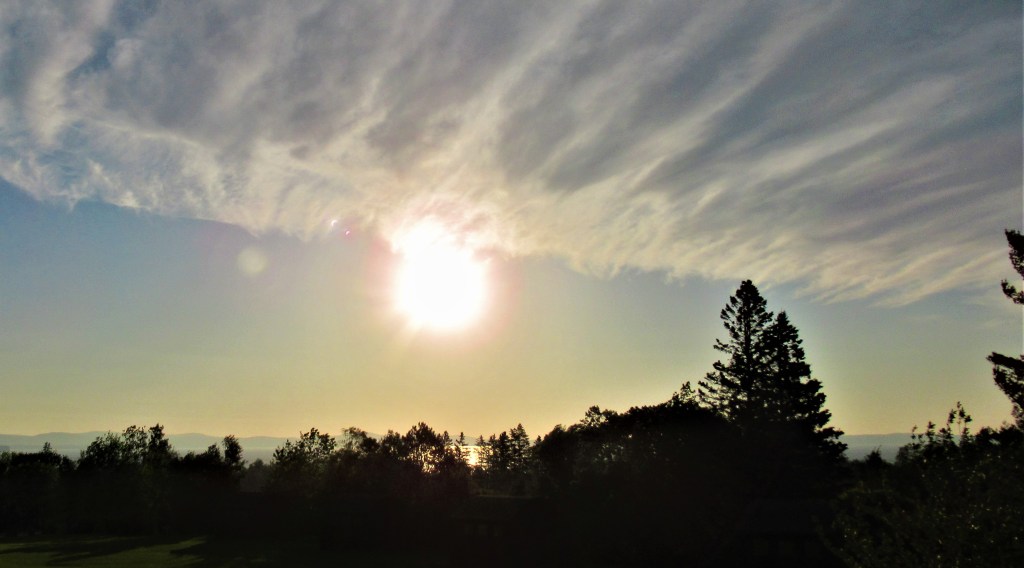
Was it a total eclipse, or just a partial eclipse, that sky the likes of which I will never see again?
I do not want to see, let alone experience, the mushroom cloud that descends from the skies, then swells up again to embrace them, leaving my ashen body, a bleak, black shadow on a brick wall.
Meanwhile, back in my kitchen, in the lull before the storm, I wait and wonder if my world and all within it will be eclipsed.
“Oh what a tangled web we weave when we first practice to deceive.”
But who are we deceiving, us or them, ourselves for believing our own propaganda or them for being deceived by what they hear?
Propaganda, properly goosed, and the goose wrung by its neck and strung up to dry before we pluck it, season it, and cook it in its own grease for a heavy Christmas dinner so much cheaper than a chicken or a turkey, unless we breed them ourselves.
Or would you rather duck? What’s that flying over there? I don’t know. Here comes another one. Flying low. “Duck!”
Or, as the duck said at Christmas: “Peace on earth: but put an end to peas, please.”









 rogermoorepoet