Discourse Analysis

Discourse Analysis – Original Question –

I have a question for you. Recently I purchased a book by Forrester- The African Queen. I enjoyed the movie years ago and thought I would like to read the story. The main actors were great. The book highlighted that it showed what it was like being a female during the war, (1) which when I look back on now is one of its main points.

My question or thought on this book is tied around the library system. When I lived in Fredericton I wanted to give a bunch of books to the library, their first question to me was, “How old are the books? I told her and she said anything over five years in not being accepted. (2)

I wondered about this and the fact that many books in school are being removed, (3) how can we tell how much we have progressed? (4)

I don’t like prejudice but it seems we are throwing out too much. (5) Any thoughts on this. I don’t mind some of the history being trashed (6) because for Canada the consentation is for Quebec and Ontario.

Roger’s Response

(1) It’s also about the role of the nun in society. How do ‘holy women’ function in a male society? It sets some of the many questions we are now being faced with, but doesn’t really give any answers. It’s a long time since I saw that film. I don’t think I ever read the book – the themes might well change in print. They are present (some of them) in The Handmaid’s Tale.

(2) The library system seems to have rules and an etiquette all its own. When I donated books to the library, they accepted some for their collections, but set others up for sale on the book tables by the door. My guess is that certain books are ‘best sellers’ and will be read, others are ‘dust gatherers’ and won’t be. They want the former, not the latter. They also have specialized collections. If the books fit the specialized collections, great. If they don’t, then they hit the unwanted category and are moved on. This is particularly true of the UNB Library System.

(3) This is an entirely different question, and one with very deep roots. It deals, in part, with the question of control – quis custodiet ipsos custodies – who shall guard the guards, who shall program the programmers? By controlling what people read, you control their thoughts. One of the worst signs of this was the book burnings of the Spanish Inquisition (15th – 16th – 17th centuries). The Jews were expelled from Spain in 1492. (And the Arabs / Moors, in 1609). Prior to that, these people were ‘processed’ by the Inquisition. The original Inquisition was Papal, aimed at instructing the priesthood in Rome in how to interpret the Catholic Catechism. It was corrupted in Spain (under Fernando and Isabelle) by the Spanish Inquisition, a sort of secret police, which worked rather like the Gestapo in WWII. One of their jobs was to ensure that people who had converted to Catholicism, to avoid deportation, stayed converted and didn’t revert to their old religion, even in secret. Another was to ensure that reading material, religious material, and cultural material, particularly after 1527 (Martin Luther and his 97 theses) when the Reformation started, were all in line with the accepted Catholic thoughts of the time. All books about to be published were sent to the Inquisitorial Censor who vetted them and either approved them, or asked for changes. If he (they were all men) saw the slightest sign of dissent or heresy. Don Quixote, Book One, Chapter Six (DQ,I,6), deals with the book burnings of DQ’s personal library. In certain of the States (down south) books are already being banned. A similar ban, in certain States, that touches us closely, is the banning of Margaret Atwood’s The Handmaid’s Tale.

(4) “There is no earth, no heaven, no extended body, no magnitude, no place and that nonetheless I perceive these things and they seem good to me. And this is the most harrowing possibility of all, that our world is commanded by a deity who deceives humanity and we cannot avoid being misled for there may be systematic deception and then all is lost. And even the most reliable information is dubious, for we may be faced with an evil genius who is deceiving us and then there can be no reassurance in the foundations of our knowledge.” René Descartes (1635)

Descartes expresses this much better than I can. It is one of the major dangers of the age in which we live. How do we distinguish between reality and alternate realities? Which reality is the real reality? What is, or isn’t, fake news? How do we tell? Who do we believe? And why do we believe them?

(5) Another part of the problem is that ‘certain people’ – who don’t believe in science and who exploit people’s scientific ignorance to their own advantage – are willing to destroy the foundations of our knowledge. Burn everything down, they say, and start again. The new starting point is to impose what they believe upon everybody around them. This is a huge and crucial problem that threatens us, as individuals. It also threatens the foundations of our knowledge, as well as the very world in which we live – climate change vs denial of climate change – profits over people, versus government of the people, for the people, by the people. Once one starts asking such questions and looks at the AI systems with their immense persuasive powers and their seemingly uncontrollable spread of Mis-information and Dis-information, then one starts to realize how serious the problem is.

(6) Those who ignore history are doomed to repeat it – Santayana (the Spanish philosopher, I think). However, we must, in certain circumstances, adjust our current beliefs to current realities. Immigration is a major issue – as is how we deal with people, like me, who come from different cultures and beliefs? Not everything written in the past suits our current world view.

I have been looking at old Westerns – “The only good injun is a dead one” (John Wayne). Really? I know some wonderful people in our first nations communities and I have taught them and worked with them and have often been taught by them. “Shoot first and ask questions afterwards.” Really? I won’t comment further on that one, without reflecting on the number of automatic weapons floating around in our socuiety. So many people are being killed by them.

All of this comes down to the big question – freedom of information or the release of just enough information to persuade other people of what we believe and what we want them to believe. Power and Control. Knowledge is Power – Michael Foucault. Control that knowledge and you have power over the people. Noam Chomsky has written widely on this – and his books have been banned in the USA. Bertrand Russell too – The Meaning of Meaning, for example, and his establishing – along with A. J. Ayer – of the doctrine of logical positivism – the removal by means of mathematics of all the emotional content of words.

My friend, you have opened a can of worms.
Long may they wriggle and squirm.
Are there things you try to practice daily to live a more sustainable lifestyle?

Daily writing prompt
Are there things you try to practice daily to live a more sustainable lifestyle?

Are there things you try to practice daily to live a more sustainable lifestyle?

Let me begin by asking a straightforward question – what on earth does this question mean? Permit me to begin with the word lifestyle. I googled it and got the following – 1. a set of attitudes, habits, or possessions associated with a particular person or group. 2. such attitudes, etc, regarded as fashionable or desirable. Let me now google sustainable. Here’s what I found – 1. able to be maintained at a certain rate or level – “sustainable fusion reactions”. 2. able to be upheld or defended – “sustainable definitions of good educational practice”. 3. Sustainability is ability to maintain or support a process over time. Sustainability is often broken into three core concepts: economic, environmental, and social.

This is all very interesting indeed. So, what can I practice daily that will allow me to maintain “sustainable fusion reactions”? Answers via snail mail, trained snails please, via the North Pole, to arrive by Christmas, if the snails can maintain the pace. What can I practice daily to “uphold or defend sustainable definitions of good educational practice”? Good question as a retired former teacher, I have to admit that there is very little I can do about an academic world, already moribund, that I left fifteen years ago. As for the three core concepts of economic sustainability, environmental sustainability, and social sustainability, well, I really don’t know what to say.

Economic sustainability – I look at the growing number of homeless and the multitude of retirees who are forced out of their homes or apartments and onto the streets by rising rents, and I feel fear and dismay. I watch prices rise and my savings fall – you tell me, pretty please, what can I do about it? Hope? Pray? Petition? Buy less? I already do that. Eat less? I already do that. I can control a certain amount around my own house and home, but there’s little I can do about homelessness and the stock exchange and the cost of living.

Social sustainability. Covid brought shutdown (2020) and shutdown meant a great many friendships and connections were broken. It is hard, at my advancing age, to establish new friends, begin new relationships, or renew connections with friends who are happy to remain disconnected. Besides which, a year or more of masking, not meeting, not leaving home, changes one’s lifestyle. It is hard, as I say, to gear up and start again.

Environmental sustainability. “Drill, baby, drill.” What can I do, on a daily basis, to stop drillers drilling, miners mining, polluters polluting, forest fires burning? I certainly try to pollute as little as possible on a daily basis – but – I do not own an open cast mine, an oil refinery, nor do I have an oil field to exploit, nor a space ship to launch like a modern day Noah’s Ark, to escape the deliberate destruction I am doing to the earth. Clearly, I try not to play with matches, especially on a hot dry day. But that’s mainly a cross between courtesy and common sense. To phrase it another way, I certainly didn’t guzzle up all the cod on the Grand Banks, or allow the sewage from a major sewage works to overflow into rivers, lakes, and seas in order to save money and make larger profits for my friends and shareholders.

Given my limitations, yes there are things I do on a daily basis to live a more sustainable lifestyle. I eat less. Go out less. Exercise and stretch more. Try to recycle as much as possible. Try not to over indulge and to make my daily bread stretch as far as possible, sometimes into a second or third day. I would, if I could, buy seven loaves and five fishes, go out into a central square, and feed a multitude. But, alas, something like that is really way beyond both me and my pension level.

Son Spots

Sun Spots

A painting and a poem dedicated to an only child who, in spite of all his achievements, was never good enough to earn the love of his parents.

Emptiness

The emptiness of air
          leaves the birch standing there,
framed by a space
          that will fill with chatter
and a flock of birds.

When evening comes,
          darkness frames the ash.
It sparkles
          with the gold dust of stars,
that swim through space.

Beneath snow’s empty page,
          grass and flowers root.
They will grow green tongues
          and rage next spring
at the coverlet
          keeping them in place.

A touch of warmth.
          Tiny flowers start to show.

What language do they speak
          as they spread their petals
and let fresh spring words flow?

My head fills with emptiness.
          My mouth is a silent space.

I sit and wait for words
          to break like sea waves
and create, who knows what,
          when they fill that empty place
within my heart and head.

What is your career plan?

Daily writing prompt
What is your career plan?

What is your career plan?

“Pull the other one, it’s got bells on,” as the comedian said on our old black and white TV back in the late fifties when the television shows first started. My grandfather bought that TV in 1953 in order for us to watch the Coronation of Elizabeth II. I was nine years old at the time. Now I am – hold on – “How old am I? Let me count the days” – as Shakespeare might have written, if he had actually written his own plays and poems. Or were all those glorious words written by a conspiracy of authors who then had their work claimed by some else aka Willy the Shake? Snake oil, all of it, or as they say in some parts of Wales – blydi hel.

I wonder how many of my readers know how to play Tute, a Spanish card game, slightly akin to whist? Well, in it you score by singing – Canto las veinteo canto las cuarenta – well, I am well on my way to winning my game of Tute because Canto las ochenta!

So, at eighty years of age, after fifteen years in retirement, what sort of career plan can anyone have? Plan – is it a detailed proposal for doing or achieving something? Or might it be – an intention or decision about what one is going to do? As for career – is it an occupation undertaken for a significant period of a person’s life and with opportunities for progress?

So, in my retirement, what opportunities are there for progress when I seem to be regressing most of the time? And what plans can I make when the unplanned knocks on my door at irregular, uncomfortable intervals?

And that’s the problem with prompts and life in general – one size designed to fit all and I do not fit in. Never have. I no longer have a career. I no longer have any plans. I drift with the winds and the waves “as idle as a painted ship upon a painted ocean.”

I guess my only plan is to stay afloat for as long as possible and to avoid, if I can, that deadly dive down, down, down, into Admiral Brown, and down to Davey’s Locker.

Solar Eclipse

Solar Eclipse

(Devil’s Kitchen, PP. 118-120)

            … with my angels … face to face … the ones I have carried within me since the day I was born … the grey-one … winged like a whisky jack who arrives in dreams… the white-one that hovers dove-like as I lie asleep … the multi-colored-one who wraps me in his feathered wings when I am alone and chilled by the world around me … the black-one who flaps with me on his back when I can walk no further and who creates the single set of footprints that plod their path through the badlands when I can walk no more …
            … ‘the truth’ my black angel says to me … I say ‘he’ but he is a powerful spirit, not sexed in anyway I know it … and yet I think of him as ‘he’ …awesome in the tiny reflection he sometimes allows me to glimpse of his power and glory … for, like Rilke, I could not bear meeting his whole angelic being face to face … as I cannot bear the sun, not by day, and not in eclipse … not even with smoked glass … this is the moment of truth when human values turn upside down and earth takes on a new reality … wild birds and bank swallows roosting at three in the afternoon … and that fierce heat draining from the summer sky … I remember it well … and the dog whimpering as a portion of the angel’s wing erased the sun until an umber midnight ruled … a simple phenomenon, the papers said … the moon coming between the earth and the sun …but magic … pure magic … to we who stood on the shore at Skinner’s Pond and sensed the majesty of the universe … more powerful than anything we could imagine … and the dog … taking no comfort from its human gods … whimpering at our feet …
            … during the eclipse I saw a single feather floating down and knew my angel had placed himself between me and all that glory … to protect me … to save me from myself … and I saw that snowflake of an angel feather bleached from black to white by some small trick of the sunlight … and knowledge filled me … and for a moment I felt the glory … the magnificence … and there are no words for that slow filling up with want and desire as light filters from the sky and the body fills with darkness … and I was so afraid … afraid of myself … of where I had been … of where I stood … of what I might return to … of my lost shadow … snipped from my heels …
            … I don’t know how I heard my angel’s words … ‘the time of truth is upon you’ … ‘all you have ever been is behind you now’ … ‘naked you stand here on this shore’ … ‘like the grains of sand on this beach’ … ‘your days are numbered by the only one who counts’ … I heard the sound of roosting wings … but I heard and saw nothing more … I felt only midnight’s cold when the chill enters the body and the soul is sore afraid …
            … ‘it is the law’ my angel said … I saw a second feather fall … ‘and the law says man must fail’ … ‘his spirit must leave its mortal shell and fly back to the light’ … ‘blood will cease to flow’ … ‘the heart will no longer beat’ … the spirit must accept the call and go’ … ‘do not assume’… ‘nobody knows what lies in wait’ … ‘blind acceptance’ … ‘the only way’ … ‘now’ …  ‘in this twilight hour’ …  ‘now when you are blind’ … ‘only the blind shall receive the gift of sight’ … ‘all you have’ … ‘your wife’ … ‘your house’ … ‘your car’ … ‘your child’ … ‘everything you think of as yours’ … ‘I own’ … ‘and on that day’ …’ I will claim it from you and take it for my own’ … ‘now I can say no more’ …
            … the sea-wind rose with a sigh and one by one night’s shadows fled … the moon’s brief circle fell away from the sun … light returned, a drop at a time, sunshine flowing from a heavenly clepsydra filled with light …
            after the eclipse … birds ceased to circle … a stray dog saw a sea-gull and chased it back to sea … and the sun … source of all goodness … was once again a golden coin floating in the sky …

… on my shoulder a feather perched … a whisper of warmth wrapped its protective cloak around my shoulders … for a moment, just a moment, I knew I was the apple of my angel’s eye … and I knew that one day I would meet him again … and understand …

Devil’s Kitchen
Short Stories and Flash Fiction

Click here to purchase this book.

What makes you laugh?

Daily writing prompt
What makes you laugh?

What makes you laugh?

The current state that the world is in. Seems like a strange answer, doesn’t it? Wars, famine, plagues, diseases, fire, flood, earthquakes, drought, what is there to laugh at? All of it, of course. Because if I didn’t laugh at it, I would cry. And crying – well, there just aren’t enough tears, are there? Anyway, as the Reader’s Digest used to say “Laughter is the best medicine.” So, if we want to heal the world, we must first learn to laugh at it.

In fact, there are many things we should be laughing at – politics and politicians, for one. Or is that two? Chuckling away – it’s hard to tell them apart nowadays. In fact, if we laughed right out loud at the folies bergeres who masquerade as wise men, can-can dancers who actually can’t-can’t, and decision makers who really can’t decide, then that laughter would be the last straw that would break the camel’s back and dump them all on their backsides in the desert where they belong. There, they would be voices ‘crying in the wilderness’, crying indeed, for deprived of their privileges, none of them would be laughing. But we would. And we’d probably be a great deal better off.

New words also make me laugh. Homicide, femicide, domicide, ecocide, countrycide – tell me, who makes up these names? Who keeps popping them into the dictionary? And if they mean what I think they mean, we should all be on our knees, praying and weeping. It’s like fake suicide. That happens when push comes to shove, and the subsequent defenestration is deemed a suicide.

Look at Moo’s painting, Burning Birbi. Now that is something to really make you cry. Moo tells me he was going to call it Burning Bush, but then he remembered all the poor birbis who were burned to death in the Australian Bush Fires. They ascended the eucalyptus trees for safety, and there, of course, they met their sad and tragic fate, while trying to escape the conflagration. I can laugh many things off. But not the fate of those cuddly little Koalas, brought to the edge of destruction by our treatment of their natural habitat.

Welsh proverb – “Laugh and the world laughs with you. Cry, and you cry alone.” So, I am laughing at it all. I have to – or else I will suffer a break down. So, laugh with me, and let the real losers cry in the wilderness, hermits all, abandoned to their lonesome own-somes.

How has technology changed your job?

Daily writing prompt
How has technology changed your job?

How has technology changed your job?

I suppose I must begin by saying that, having retired fifteen years ago, I no longer have a job. So, Technology has not changed my job at all. However, when I was actually working full time, technology made an enormous impact on my work.

Keeping up with the Jones’s! I travelled to Oaxaca, Mexico, on a faculty exchange program in 1995 and was astonished to find that the Escuela de Idiomas of UABJO, had better computer and technology features than I did in my home university. I was way behind the Oaxacans in what I taught and how to deliver it. How to catch up, that was the question!

In 1996, I started a Multi-Media Certificate at the University of New Brunswick, completing it in 1999. As a result of this certificate, my beloved and I built our first web pages and produced our first Quevedo Online Bibliography. This also enabled me to start teaching a course entitled Mexico Online. This course took place in the university’s computer laboratory and, instead of requiring written papers, it asked the students to create their own web pages and to do their own online research.

This was the first step into the brave new world of WebCT, Blackboard, and the many other web platforms that rapidly became available, often at great cost to the student. Student costs – well, they skyrocketed. So, I did my best to cut them down. Texts, especially literary texts, in online format, for free. A formal course outline, online, discussed with the students each term, and changed in accordance with each class’s particular needs. This guaranteed that teaching and learning were both flexible, and did not become bogged down by the trap of the one course, set “in electronic stone” for all eternity. This is a trap into which far too many teachers fall. The everlasting course, as it was in the beginning, is now, and ever shall be, taught without further changes and with no end, amen. No thought, no development, and knowledge a static state.

But technology also changed the teaching environment. We began with the static classroom with rows and rows of desks looking down on the stage where the professors, at the podium, performed their annual circus acts of passing knowledge from their notes to the students’ notes, without it passing through anybody’s head, as my first prof in my first university once told the class.

Then we moved to the chairs and tables classroom, where the professors could, if they chose, wander among the students, get to know them by their names, and create a dynamic small group teaching environment in which each individual received increased professorial attention if and when needed.

Enter Technology. The Computer screen replaced the black, green, white board (I have scrawled with chalk and marker pens on all of them). Classrooms became fixed spaces again. And the computer program doubled with, or replaced, the formal lecture. Static knowledge delivered to stationary students sitting and passively watching.

They were called smart classrooms. My favorite moment of the day? When I stood up and asked the class if this was indeed a smart classroom. Yes sir, they always replied. I would tap on the wall and ask the wall – “What’s two plus two?” The class would wait and wait. No answer. I would ask again. No answer. “Not such a smart classroom, then,” I would tell them.

Technology is great, as a tool for genuine teaching and learning. But it brings problems with it, as we are beginning to find out. Brainwashing, false information, erroneous material that misleads, quite often deliberately … Quis custodiet ipsos custodies? Who shall police the police? Who shall program the programmers? Perhaps the Romans, all that time ago, had it right. Caveat emptor – buyer beware.

Spirits

Spirits

Neon Orange, the tube said. I tried it out last night and this is what emerged. I call it Spirits, but that is really short for “We are spirits in the material world.” I have always loved that idea. So, how many spirits can you count in this painting? “Big ones, small ones, some as big as your head” – whatever that means. This is certainly a very different palette for me and the start of another set of experiments.

I have often wondered what that spirit world would look like. Perhaps they are all present in our material world? No wonder this planet of ours is so over-crowded! Or maybe they are spread across the universe and that is why the universe is expanding, to make room for them all, and even more of them in the making and on their way.

Is speculation as much fun as peculation? I can certainly do the former, but I’ve never done the latter. So, I guess I’ll never know. Never mind – life long learning – if somebody gifts me with enough of their money, one day I may speculate and peculate, and then I’ll find out, if I’m not found out first.

In the meantime, I guess I’ll stick to being a free spirit in a world that gets more materialistic every day. And this is my slogan – “Free spirits of the world, unite!” If there were enough of us, we could take it over, the world. Freeing it is one thing. Managing it afterwards might not be so much fun. I guess I’ll stick to speculation!

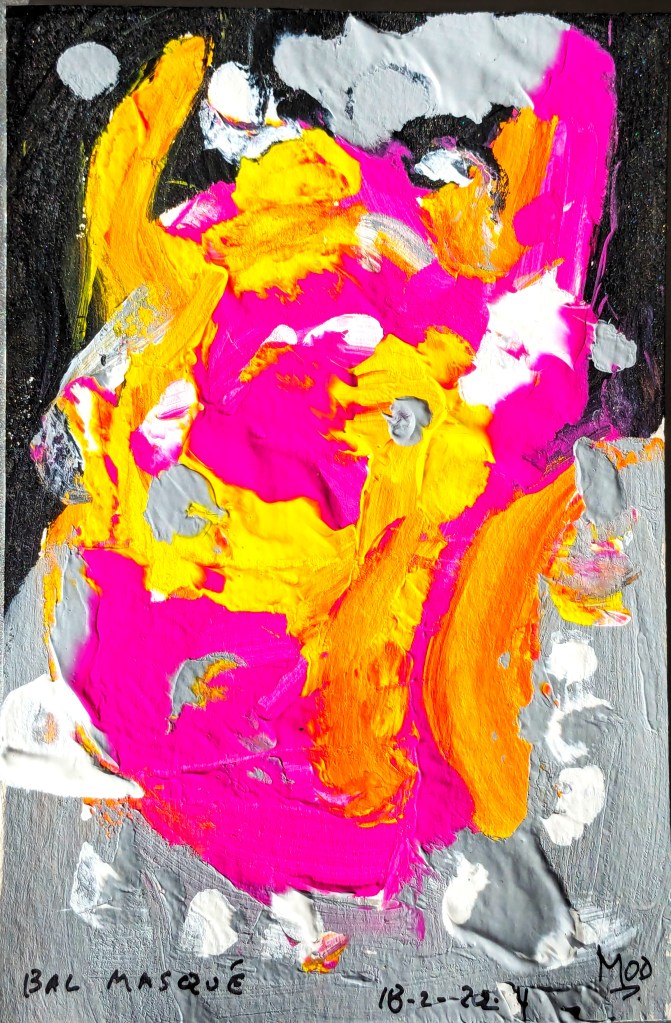
A Masked Ball

Masked Ball

After a two-week lay-off, the Dance of Colors returns. What caused the lay-off? Absolutely nothing. I grew tired of posting, of writing, of throwing my paint on the waters of the web and waiting to see what, if anything, happened. Well – nothing happened.

Steven King, On Writing, says “Paper your walls with rejections.” And I have done, pages and pages of them. The secret is ‘never surrender’ – ‘never give up’ – or, in the language of the WWII Prisoner of War Camps – Nil carborundum illegitimi. You can Google the meaning, if you can’t read Latin. It is a euphemism for ‘never despair’.

Rejection is one thing. Silence is something else. When I check my notebooks I find submissions, some sent several years ago, that are still unanswered. There is simply no response. It is as if the writer – submitter – does not exist, is not even worthy of a form letter.

I ran into that wall of silence during this two week lay-off. Does it matter? Probably not. The creation of art is as much a monologue as it is a dialogue. Bakhtin calls it ‘a creative artist’s dialogue with his time and place.’ I think of it as ‘this creative artist’s monologue with his time and place.’

Footsteps – I leave them here, I leave them there, you can find those footsteps anywhere. But beware the footsteps left on the beach at low tide. You will not find them on the beach the day after you leave them. The tide will have risen and washed them all away. In spite of that, some footprints are here to stay.

Hope Springs Eternal

Hope Springs Eternal

And it does, as you can see from today’s painting. Well, last night’s really. I left it drying overnight and this morning it was almost ready. Not even signed as yet. Oh dear. Still, I lay claim to it. And it’s definitely my style, with a few neat little changes. A change of palette, too. And manner of application.

“Paper your wall with rejections.” This is what Stephen King tells me to do. And I do just that. More rejections, and even more. Yet still I submit my poems and stories, and till they come back, rejected. Mainly form letters – but with an occasional helpful nudge like. “Nice writing. Not for me / us. Try somewhere else.” It used to get me down, but I am now so used to the negative that it is just water off a duck’s back. Splish, splash, and so what.

What really ruffles my feathers is the submissions that fall into the deep pit of silence. Not even a rejection slip with which to paper my walls. Not that I can do much with an e-rejection anyway. And I refuse to waste paper by printing them out and papering.

Still, who knows? One of these days, somebody may say “yes – we love it, and we’ll publish it.” As they say, “Hope springs eternal.” Maybe it does. But my time is beginning to run out.