If the words won’t come, don’t worry. Sooner or later, they will arrive, driving down in flurries. Think wind-driven leaves or the soft white whisper of snaking snow.
There is a moment when all sounds cease and you can be at one with your inner self, there, where summer sunshine twinkles and soft rains bring forth clarity and joy.
What are words anyway, but soap bubbles emerging from an iron ring to rise in child-hood’s skies, soaring, dying, around the cloudy thrones of sun-kissed clouds.
We, their so-called creators, are left below, building cotton-wool castles spun from air.
Comment:
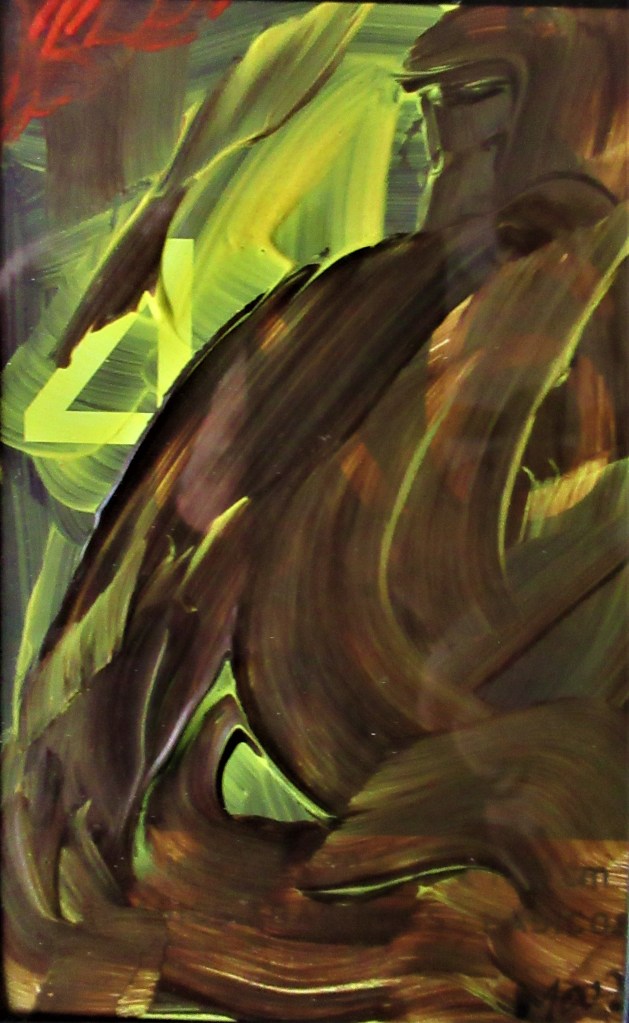
The painting, animales de fondo, comes from a book by Juan Ramon Jimenez in which he describes human beings as ‘animals living at the bottom of an ocean of air’. I have tried to capture the concept both verbally and visually.
This is buy a book by a New Brunswick Author time, sponsored by the Writers’ Federation of New Brunswick (WFNB). Alas, so many New Brunswick authors are almost faceless to the wider world beyond the Province and the Maritimes. It gives me great pleasure, therefore, to highlight one of the books that I dearly love from a New Brunswick author, Jane Tims.
Here is my review of Jane’s book, first published (the review) on Brian Henry’s Quick Brown Fox (14 March 2021). Thank you, Brian, for the work you do in assisting and developing writers all across Canada – and beyond – and a special thank you for all you have done to help me over the years.
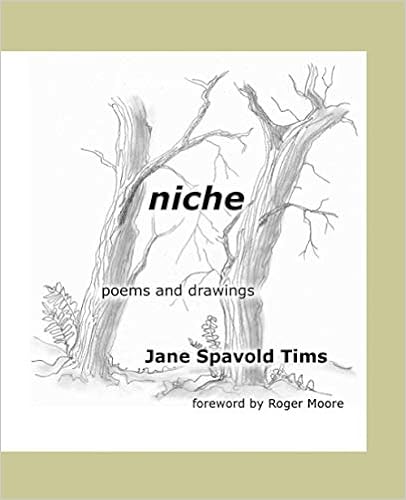
Niche, poems and drawing by Jane Spavold Tims, reviewed by Roger Moore
Independently published. Available from Amazon here.
Niche, the fourth poetry book published by Jane Tims, is a neat configuration of six segments that elaborate and illustrate the poet’s original definition of the multiple meanings of her title word niche.
It is difficult to separate the author from the act of narration as her keenly observed and skillfully executed drawings, together with their verbal representation on the page, are so autobiographical and so much an extension of her artistic and professional abilities that the objective separation of writer and text is scarcely possible. It is hard to forget that Jane Tims was, and to a great extent, still is, a highly competent professional botanist. The harnessing of the professional botanist, with her unique drawing skills and scientific knowledge, to the poet and auto-biographer is a key factor in the reading and interpretation of this text in which acute observation blends with an intimate knowledge of the observed botanical world, both flora and fauna, and this allows the poet, in her role of poetic narrator and lyrical voice, to weave a network of poems that are, at one and the same time, objective and intensely subjective.
The author emphasizes this when she writes in the Preface that “In biological terms, the niche is the quality of a space occupied by a living thing, the sum total of physical, nutritional, biological, psychological and emotional needs gathered together in one place.” She also reminds us that in human terms “niche can be a metaphor for home, community or personal space” and it is within these metaphoric spaces that the poetry text is elaborated. The text becomes a linked mixture of visual drawings, iterative thematic imagery and associative fields, all centred on the multiple meanings of niche. These terms are both biological and human in nature and the poet’s named world meets at this juncture between the human and the natural.
The section occupying space (1-19) bears the subtitle satisfying need and begins with a setting out of what this means in the following 12 poems and 4 accompanying drawings. The poem ‘apples in the snow’ with its companion drawing stands out for me.
The section strategy, subtitled solidifying position (21-43) outlines in poetic terms, how plants, animals, and humans ensure their own survival.
The section praying for rain, subtitled, avoiding danger and discomfort (45-68), offers views on discomforts and dangers. It also opens the discussion—relocate or stay where we are?
The section mapping the labyrinth or places I have occupied (69-83), which contains the wonderful sentence “When I get lost on the road ahead, I look to the road behind me,” throws open the multiple meanings of home.
The section new ways for water, subtitled coping with change (85-98), offers a double landscape, first, external, the things seen, touched, examined, remembered and described, and then the internal landscape that reflects upon them and is reflected in them.
Finally, forgetting to move, with its subtitle getting comfortable (99-111), presents an autobiography that links observer (the twin personage of author and narrator) to observed (nature, both flora and fauna, and the added element of autobiography and self) via the symbiotic relationship of botanist to botany.
Two moments stand out for me. (1) Sadness is in seeking the space that is never found. (2) Loneliness is in trying to return to a space once occupied but no longer available. The whole concept of the Welsh word hiraeth is summed up in these two lines. Carpe diem, Jane Tims’ poetry indeed seizes the day and, with its minute, intense observation, it preserves so many precious moments. It also pays attention to that which has been lost, those moments that are irretrievable. They will vary for each reader, but hopefully, like me, you will take great pleasure in discovering them for yourself.
Jane’s interview with Allan Hudson, another excellent NB author, can be found by clicking this link – South Branch Scribbler. The work of all NB authors should be celebrated over the first weeks of this month. Allan, thank you for supporting us – and you, too, Brian Henry. Living in NB, we need all the enthusiastic support we can get.
My friend Allan Hudson re-posted this blog entry yesterday. It is always wonderful to be remembered by my friends. Allan does a great job with the South Bank Scribbler – and he is one of the best. Long may he and his blog work continue to support New Brunswick writers.
I look forward to working again with both Allan and Jane. Best wishes and many thanks to both.
Click on the link below for Allan’s interviews with Jane and I. And don’t forget to go down all the rabbit holes that appear in Allan’s articles. There is a great deal of information within those little burrows.
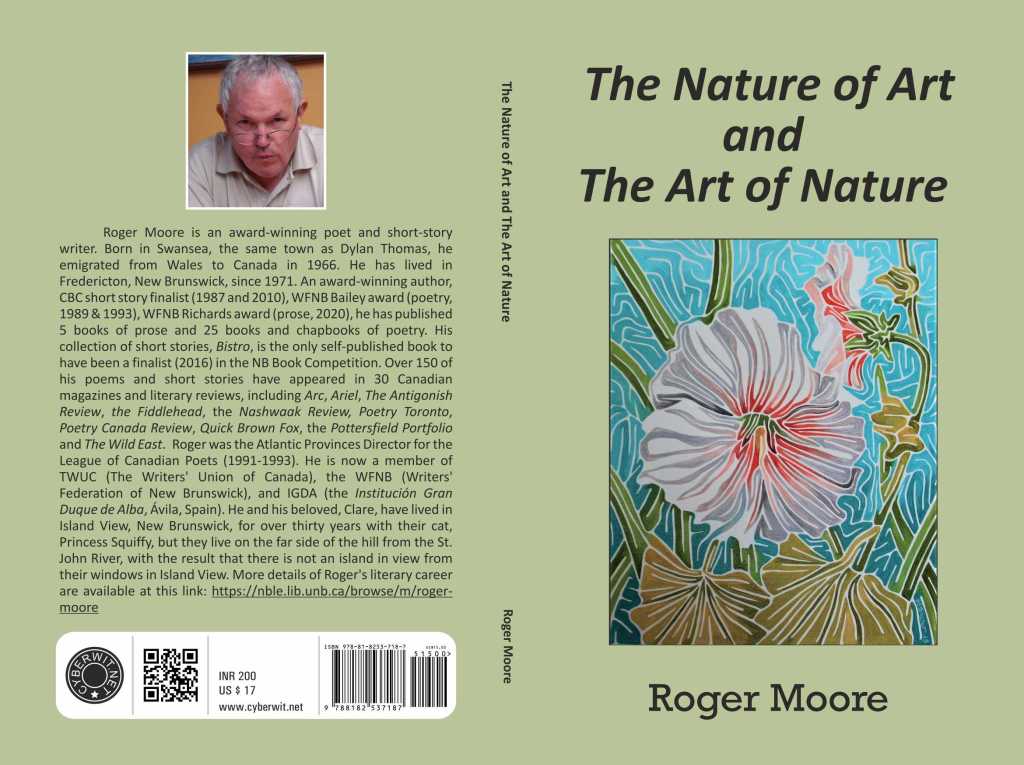
I love it when a special friend reads one of my books and then takes it to the place where it was composed, and sends me a wonderful photograph of the book cover and the exact spot, at Hopewell Cape, where the cover was drawn. Wow! That is so special. Thank you, Sara, my friend and accomplice, for making even more art out of art and involving nature in the process.
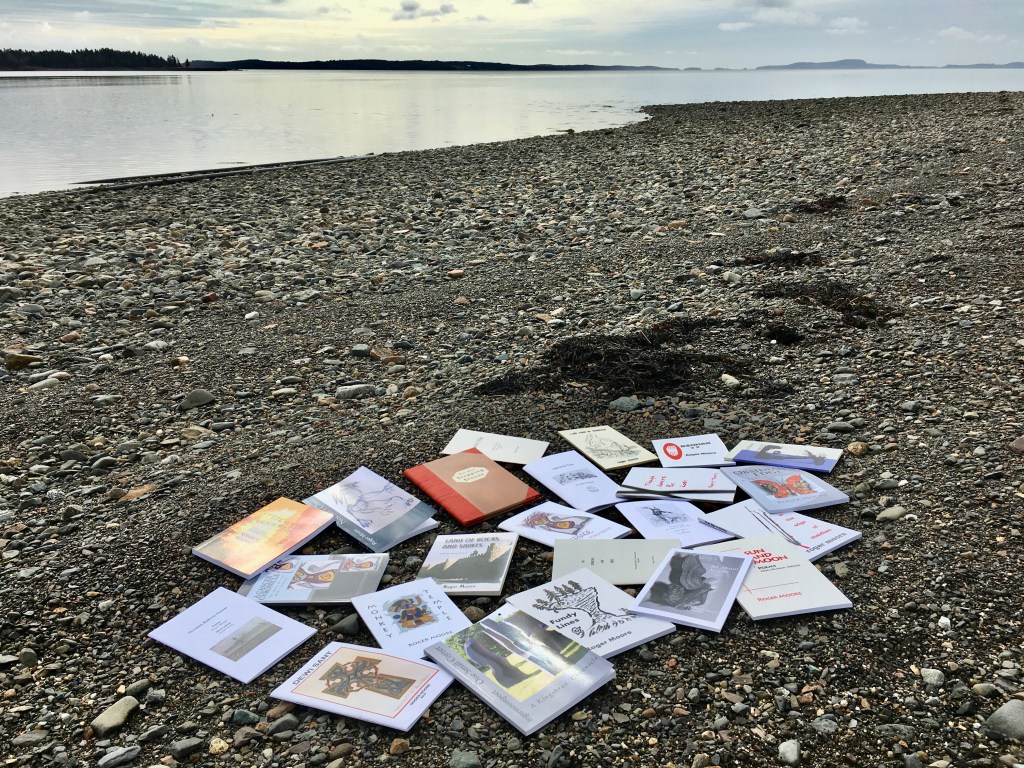
Other friends have done similar things. Here is a collection of my books on the sea shore at Holt’s Point. And yes, Fundy Lines is in there as well. Can you spot it? Another very good friend, Geoff, contributed this very meaningful photo. So much of my life, there, upon the sea shore, waiting for the tide to come in.
This book, and its cover, are also very special indeed. And here’s why.
Still Life with Hollyhock Geoff Slater
How do you frame this beaver pond, those paths, those woods? How do you know what to leave, what to choose? Where does light begin and darkness end?
Up and down: two dimensions. Easy. But where does depth come from? Or the tactility, the energy, water’s flow, that rush of breathless movement that transcends the painting’s stillness?
So many questions, so few answers. The hollyhock that blooms in my kitchen is not a real hollyhock. Intertextuality, visible and verbal: this is a poem about a painting of a digital photograph of a hollyhock, a genuine flower that once upon a time flourished in my garden.
A still life, naturaleza muerta in Spanish, a nature morte in French, a dead nature, then, portrayed in paint and hung alive, on display, in this coffin’s wooden frame.
So, what do I enjoy most about writing? Everything – for whenever creative people create they draw in others into a web of intertextuality that spins its way from mind to mind and, especially in Canada, links shore to shore to shore.
What change, big or small, would you like your blog to make in the world?
Looking around me and seeing the way that the world I know is so totally divided, and knowing that words and ideas will bounce off people’s backs like rain off a duck’s back, I do not expect my blog to make any changes, big or small, to the world. Would I like it to? Yes, I would. But whether it will or not is a different question.
My blog consists of several elements. Let us start with the poetry. If I can reach out and touch somebody with one or more of my poems, then I will be very happy. This is, after all, a poetry blog. And part of that blog is a continuing discourse on creative writing and poetic creativity. If one of my articles / posts on creativity can help one person, just one, to improve their creativity, then I will feel justified with all the hard work and thought I have put into the posts.
I also write about Discourse Analysis, the meaning of words and texts. In our current, doubt-ridden world, it is often the loudest voice that carries the most weight, and he wildest ideas that get the most attention. I always remember that still, small voice that comes after the fire and the thunder: “What doest thou here, Elijah?” Alas, I am not an Elijah, nor am I a prophet, nor am I out to make a profit. But if someone, somewhere, recognizes my voice as a still, small, voice speaking a little bit of sense in this wilderness of wild words, then I will be satisfied. My creative prose comes next. It is mostly composed of flash fiction, memoirs, and short stories. If I can bring tears or laughter to the eyes and the heart of just one reader, then again I will feel that I have done my work.
Then there is my art work. I have always been told that I am useless at art. Mind you, I think those people came from the same school of thought that told me, as a teenager, that I would never go to university – except on a train. However, I discovered Matisse and his words ‘making meaning out of color and shape’. Then came Dali – ‘I don’t know what it means, but I know it means something.’ Out of those words have come cartoons and paintings, some funny, some sad, and all of them unique. Again, if one reader / viewer finds joy in them, then I will be happy. And if my own work persuades one battered, belittled artist that he or she can paint, create, make meaning out of color and shape, then I will have achieved the minor miracle of helping to change someone’s life for the better.
As for these prompts, I have only just started to be prompted into doing something. Why? I am not sure why. I just think that I have a different view of the world from most people. If I can offer that alternative view of reality, a joyous reality, I might add, to one, or maybe even two people, then once more, I can feel that yes, my blog has made one, small change to the world around me. And I cannot ask for more than that.
Meanwhile, I think of the studies I did on the Spanish Civil War (1936-1939). The right kept moving further right. The left kept moving further left. The middle ground where discourse, creative thinking, and debate can flourish, slowly vanished. Then, when positions and thoughts became so deeply entrenched that there was no room for mainoeuvre / manouver / maneuver, whichever way you wish to spell it, then shooting broke out and people went to war and found, all too often, their often-violent deaths. I would not wish that fate on any person, government or country. If just one person would read that powerful and bitter history, and learn from it, then the world might be a better place.
To talk to one person at a time, that’s what I want from my blog. Then I want that person to talk to another person, and the third one to a fourth, and so on and so forth, until we have established, one person at a time, a linked chain that may, just may, be long enough and strong enough to help lighten the darkness and head off the dangers into which we seem to be steering.
The fairground’s distorting mirrors distort. I change as I walk past one and then another.
Rage, rage against that hump-backed shape that looks back at me from the bottle-glass.
Magic: eye of a newt, eye of a toad, cat’s eyes at night lighting the road to bed.
Bedlam all around me. Absurd this world, gone carnival mad in the blink of an eye.
I need a white stick to walk through this fog that clings to my clay-bound soul.
This wine I drink, these thoughts I think, life’s fountain pen soon runs out of ink.
Watch the tides as they ebb and they flow. When your time runs out, pack up, and go.
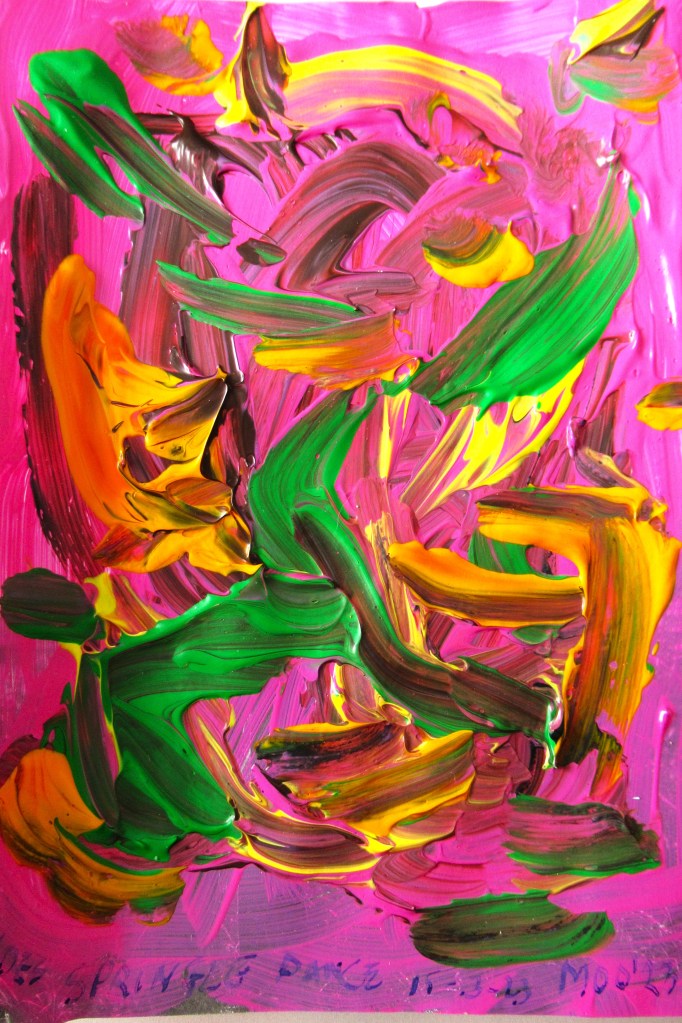
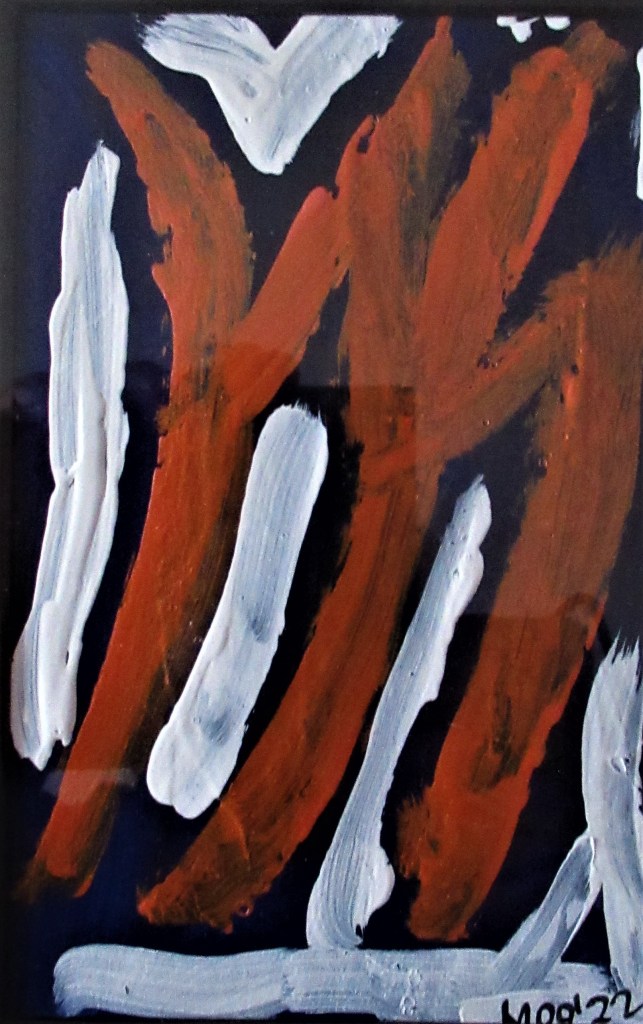
Comment: My friend Moo did himself proud with the above painting. What is it? I asked him. Dunno was his reply. I have shown it to several friends and speculation is rife: the dancer and the dance, dancer and diver, a blur of three figures, headless mermaid (I love that one). And yes, life is absurd (Albert Camus), a carnival (Bakhtin) in which knowledge is power and civilization is mad (Foucault).
Originality and imitation – how many genuinely original ideas are there? Very few. And the same goes for poetry – original poems are very rare. Most of our ideas come from elsewhere, even if we do not know it. The title of the above poem comes from Petrarch. It’s structure is traditional – a sonnet. Its ideas are borrowed from Camus, Bakhtin, Foucault. And yet, shuffle the cards (Cervantes) throw the dice (Mallarme’) and this poem and this post have both achieved a kind of originality and uniqueness by linking disparate ideas in a new unity.
“You can’t write about life if you haven’t lived it.” Words of wisdom from the poet who wrote The Old Man and the Sea.
“But,” I hear you say, “what did he know about writing? He never took any courses that taught him how to write, nor held a certificate from a prestigious school that guarantees quality. Nor was he a poet, he only wrote prose.”
And yet, the prestige of that ivy-covered, ivory tower leads poets… I pause for a moment… – to where exactly? Into debt, of course, and also down the paved path of their own destruction.
What kind of life do they live, those writers, who only exist within their cerebral boxes, and never step outside them unless they are ordered to build an even bigger box?
Have they walked with street-walkers in Madrid? Have they sat beside the poorest of the poor, in Oaxaca, shivering in thin cotton clothing beneath falling snow? Have they visited Madrid’s Plaza de España, stepping high to avoid the blunt, bloodied needles, shared, to take away the pain? Have they pan-handled in Yorkville or slept in sleeping bags, by the Royal York, in the snow, at 40 below, on the gratings above the Subway?
“The unexamined life is not worth living,” some say Socrates said. But what I think is ‘the unlived life is not worth examining.” Tear down the walls that inhibit and limit you. Go out into the world and see what others see and feel. Only then, come back, stab your pen into your veins, fill it with your blood, and set before us what was done to you, what you experienced, how you survived, and what you felt.
Comment: Once again I thank my friend Moo for his illustration – Building Bigger Boxes. It goes well with the theme of this rant, or is it a poem? A verbal rant to echo a visual rant, perhaps, or vice versa.
They lie there, lifeless, in their little black coffins. They refuse to pick up their beds and walk. Powerful as you are, you are powerless now. You are unable to grace them with the gift of life.
Listless, disappointed, you turn away. Don’t look, but now, while you are not watching them, they move. A gesture here, a wink of the eye, a tiny smile, a broken tooth, a scar from a dog bite, and they come alive.
Now they stand before you, dressed in the clothes you wove for them, from their own words. When you listened, they spoke. They didn’t want to be forced into falsehoods, forged from your fake words.
True to their own natures, they now walk and talk, naturally, in the words you heard when you let them speak.







 rogermoorepoet