Smileys

Scowlies

Smileys
Scowlies
Wanderer
El Árbol de Tule
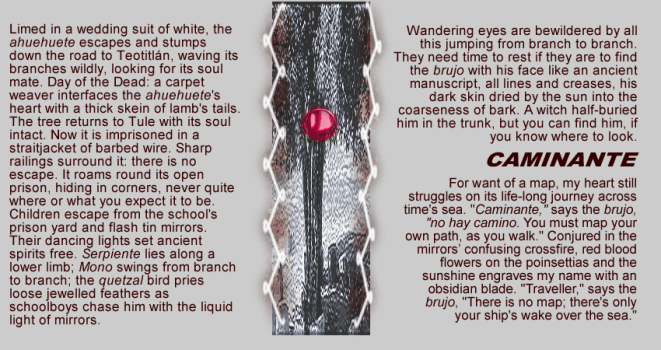
So many tales are told about the árbol de Tule, that thousand year old tree standing outside the city of Oaxaca. Hernán Cortés is said to have sat beneath it when he came to Oaxaca in 1525, or thereabouts. And it was old then, and famous in folklore. The tree is also famous for the pictures that nestle in trunk and branches. For small change, the little boys, released early from school, will point their mirrors up, into the tree, and spotlight with reflected sunshine the features that you seek. A thousand years, or more, have produced a thousand images, or more. Even the face of Hernán Cortés himself is said to be captured somewhere along the tree-trunk’s art gallery, if you can only find it.
Like Borges’s eternal library, your own portrait can be found there, somewhere. You must search patiently for it, staring into the tree bark until it takes on your features. Then you can move on, knowing that whatever happens you will be caught forever in the life of one of the world’s wonders: el árbol de Tule. But beware of imitations and avoid the plastic imitations and the photos from cheap camera’s that will trap your soul forever, leaving no trace of you in the real world. Ignore these warnings at your peril, or you too will be locked into your cell phone and sentenced to life imprisonment within those digital walls.

Face to Face
Such a lovely phrase and so suggestive of so many things. “I turned a corner and there was my wife [daughter, cousin, mother, mother-in-law, very best friend, fiancée, all with so much potential] face to face with a complete stranger.” “The bull loomed out of the early morning mist, and they we were, face to face, the bull between me and the gate, and me with a broken stick in my hand.” [Actually happened. Mushrooming with my grandmother. I was about 8 years old.] “They lay there, face to face.” [I do like the possibilities inherent in that one.] “If I have something to tell you, I’ll say it to you, face to face. If you have something bad to say about me, tell me now, face to face, and stop spreading rumors behind my back.” [Loads of potential here, too.]
If the longest journey begins with that first step, how many stories begin with that first sentence, and how many works can we write when once we have made that first verbal foot-print. “In a place in New Brunswick, whose name I have no wish to recall …” [Don Quixote, slightly adapted.] “She was the worst of friends, she was the best of friends …” [Charles Dickens, after his emigration to Toronto … hey, it could have been a man … he … he … or should that be hee, hee!]
Such potential in words. So much potential in a cliché turned upside down and inside out. Language waiting to make friends with us, needing our company, and us, alone in the world when we lose or forget our relationships with words. I looked up and found myself face to face with HOW and WHY?
Face to Face. Go on, click on the link. You know you want to. Whatever could be just a click away, waiting to meet you, face to face.

Commentary:
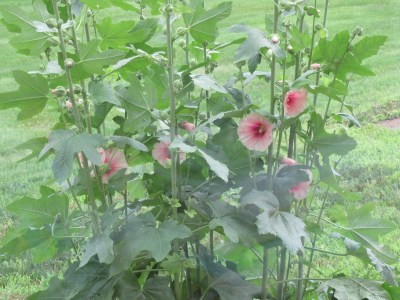
How can I write about gardens without beginning with my own garden? Last year’s single stem hollyhock has this year turned into a hollyhock ‘bush’ with ten separate flowering stalks. Yesterday, only one flower adorned the plant, today some seven to ten blossoms have appeared. I am amazed by the presence of so much beauty. Never before have hollyhocks graced our garden. Now I can do nothing but give thanks.
But there are other gardens. Kingsbrae Gardens for example have been mentioned on this blog before, and I have written a book about them. Many of you will have seen the video we made. If not, the video One Small Corner can be seen by clicking on the link, as can the gardens and the book.
That said, welcome to another set of gardens. Click on the link, and you will be able to discover them and visit them for yourself. Come along, play the game. You know you want to!

Commentary:
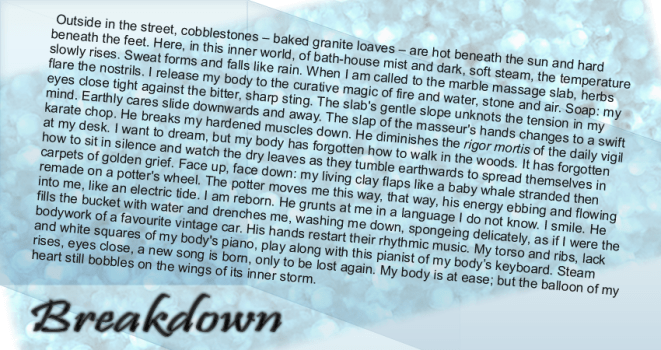
This was the first time I had been to the baths in Oaxaca. These came highly praised by family and close friends and the combination of mist, steam, and herbs, combined to loosen the body and soothe the soul. The Mixtec baths and massage are very highly regarded, incidentally, and one can go to the equivalent of sweat lodges in order to enjoy a day at an ancient historic spa. The masseur himself was incredible. I lay face down initially. When he want to turn me over, he got a bucket of cold water, threw it over me and flipped me in mid-air as I reacted to the ice cold water. Hard to believe now. I also remember having to buy a small bar of paper-wrapped soap. And locking my valuables up in a little chest to which only he had the key. These baths feature in my novel, People of the Mist. Unpublished, alas, but I may get around to revising it one day. All I need is some encouragement!
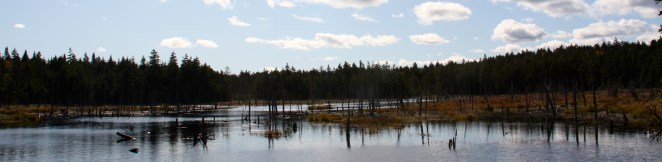
Oh-oh, wrong Beaver Pond. That’s the Beaver Pond in Fundy National Park. Naughty, naughty! So, if you want to see the REAL Beaver Pond at Mactaquac, you’ll have to click on one of the links and see where it leads. “Oh what a tangled web we weave, when first we practice to deceive” … except this isn’t the first time I have made a mistake, and no, I wasn’t trying to deceive anyone. This is fun, though. I’ll be interested to see what you think of this little sequence. Let me know.

Commentary:
Nine o’clock in Oaxaca is the ‘witching hour’. That’s when the young children go home and the balloon lady packs her bags and walks with her balloons out of the square. She really does build a castle. She stacks her balloons around her and lives within its walls selling balloons to children. Each Oaxacan child receives a balloon on his or her birthday and name day. These balloons are cherished, held carefully by their strings, walked like aerial dogs through the square.
The State band practices most nights int he central square and the balloons are moved by the music, especially that of the wind instruments, and then they wander to and fro. Sometimes they take on a life of their own and escape, skip away, go absent with out leave, and seek the freedom of the open skies. Sometimes they get caught in the trees. Then the strings are jigged and older children, experts in the art, place sticky tape on their own balloons and send them upwards in rescue missions which can be surprisingly successful. Oh what joy when the errant balloon returns to earth, stuck to its new mate. Oh what wailing when a birthday balloon bursts and the deprived child must persuade its parents to purchase another!
I can see them now, those colored balloons, floating skywards, sailing freely into the freedom of those blue Oaxacan skies. Up and up, level with the cathedral roof, ascending the cathedral tower, up, up, and away … soaring like souls into the innocence of a sky blue heaven.
Commentary:
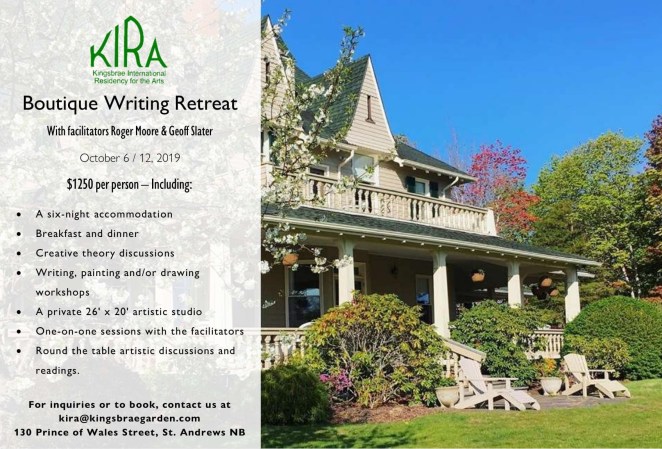
This is the new advertisement for the KIRA (Kingsbrae International Resdencies for Artists) Fall Session (October 6/12, 2019). Geoff Slater and I will be again facilitating a week of creative workshops, including drawing and painting (Geoff) and writing (Roger, both poetry and prose). These will take place in the KIRA Residence, just beside Kingsbrae Gardens. Residential enrollment is limited to five people. Just send us an e-mail if you are interested in attending this workshop. If you click on the KIRA link in the first line (above), be sure to watch the opening video. Pictures speak louder than words and the video will help you to understand what Creativity at KIRA is all about.

Wednesday Workshops
New Projects
03 July 2019
New Projects … how do you choose them, these new projects? Simple answer: I really don’t know. So much depends on you and your work habits. In my own case I have a back log of projects. I have been writing and creating for years. As a result I have a whole set of files that I can turn to and select from. Two novels, about fifty short stories organized into two or three as yet unpublished manuscripts, a couple of hundred poems, organized into three separate thematically organized manuscripts, a set of writings on facilitating creative writing …
Projects … do the work and then choose the order in which you will publish it. I look at the hollyhock that suddenly appeared last year in my garden. Do the work: the birds (in all probability) seeded it. The hard work: the hollyhock grew itself. I should add that my beloved nearly tore it out on the grounds that she didn’t recognize it and it looked like a weed. But she left it, and it grew into what it was meant to be: a hollyhock. One stalk. So many buds. We didn’t know which would blossom first. And it didn’t matter. One after anther they all blossomed. The hollyhock knew what it was doing [we didn’t]. It had belief and faith [we didn’t]. But we had hope.
The Hollyhock Project: This year the hollyhock has eight [yes, eight] different shoots. It’s no longer a single flower, it’s become a bush! It has also shed seeds further afield [I should really write abed, since they’re all in the same flower bed.] I wonder in what order they will blossom. It doesn’t matter really: I am just confident they will bloom. And the sunflowers have rooted below the bird feeders. They have their own projects and I know they will grow as and how they will. And the yucca has four shoots that will flower, how and why I just don’t know. But each flower has its project(s) and I am confident they will all flower and flourish.
My own projects: When June came in, I didn’t know what to do, nor did I know in what order to do it. Then Time-spirits came together. Geoff gave me some drawings and I chose one for the cover. I took the manuscript to the printers, got an estimate, and received a mock-up. The text had shifted in the transfer from computer to computer. My 70 page text had grown to 132 pages. I spent the next 72 hours rewriting everything, eliminating words, lines, poems, dropping the text back down to 70 pages. It is now published. I wondered what to do with the McAdam Railway Station poems. Geoff came to see me on Sunday, 23 June, and told me that he would be celebrating his birthday the following Friday. He also told me that the McAdam Railway Station would be unveiling his mural the following Sunday (June 30). The McAdam railway poems were published on Saturday, 29 June, and I took them to McAdam in time for the ceremony.
Trust: Trust yourself, trust your projects, trust the universal spirit [Northrup Frye’s Spiritus Mundi], under whichever name you acknowledge it). And remember, genius is 99% perspiration and 1% inspiration. Put in the mileage, put in he hard work, believe, and trust. ¡Qué será, será! Whatever will be, will be.


tin bath in the kitchen
filled with hot water
for when the shift ends.
After supper,
beer for a coal-dust throat,
then the wife, and sleep.
Next day,
a knock on the window,
a pulling on of clothes,
clogs clattering on cobbles,
a tin box sparse with food,
then down to the dark pit
of whatever mine has agreed,
at a price, to bury us alive.

