Writer’s Block
(For Kentucky Blue Angel)
This is a golden oldie that I am re-posting. Today, several people talked to me abut writers’ block. Here are my thoughts on the topic.
Every day, well, almost every day, I meet people who tell me that they cannot write anymore. They have abandoned their current project. They sit in their work space and stare at blank screens or empty walls. They have come face to face with the dreaded Writer’s Block.
While some consider Writer’s Block to be an actual illness, others flaunt it like a flag or a badge of honor:
“Don’t touch me — I’ve got Writer’s Block: I wouldn’t want you to catch it.”
“I’m having a bad week: I’ve got Writer’s Block.”
“Sorry, I can’t make the writer’s meeting, I’ve got Writer’s Block.”
According to Wikipedia, “Writer’s block is a condition, primarily associated with writing, in which an author loses the ability to produce new work or experiences a creative slowdown. The condition ranges in difficulty from coming up with original ideas to being unable to produce a work for years. Throughout history, writer’s block has been a documented problem.”
We have probably all experienced the sensation of being unable to write, unable to think, unable to continue. As an academic, I found that something similar happens frequently in examinations with young students whose minds suddenly go blank when faced by a white page and an awkward question. This form of Writer’s Block comes at the most unfortunate times. Students need to be switched on just when their minds switch off. And something similar happens to writers.
Examination Block can be overcome. In many cases careful preparation for an exam will reduce or eliminate examination block. These preparations may well include correct note-taking and relevant revision procedures. There should be no last minute all-night study the night before the exam and a good night’s sleep, proper food, and water are essentials. Appropriate physical exercises before the exam starts are also useful as these make the heart beat and the blood flow. All these things prepare both body and mind and free the student for that most important task: the struggle with the blank page and the awkward question.
Will a similar set of preparations work for those who suffer from Writer’s Block?
In order to answer this question, I would rather take a different approach. Instead of seeing Writer’s Block as a physical / mental presence that stops us writing, why not look at it as an absence that can be overcome? What can we call that absence? Personally, I look upon it as an absence of creativity. If the creativity isn’t there, then writing creatively won’t happen. So what do we do?
Let us define creativity. For me, creativity is the expression of the creative principle that dwells within all of us. It is there, within us. We may suppress it or we may let it be suppressed. We may ignore it or we may deny it: but it is still there. It is always there. Sometimes it is beaten out of us; or we think it is. But it is still there, beneath the surface, waiting to be called on. The Roman poets spoke of it as Deus est in nobis … the god that dwells within us.
Creativity, for me, is like a river that vanishes underground and then reappears: it will be back.
The most important thing in my opinion is what you do when you’re not writing, what you do when you’re faced with that wall of blackness, what you do when you stare at that blank screen and nothing makes your fingers dance on the key board.
Here’s what I do. I make up my mind not to force myself to be creative. Forget about writing. Do something else. Ignore all idea of Writer’s Block, or the End of the World, or the Imminent Disaster of not being able to write. It may take a mental effort, but forget about it.
Now do something else, something positive. Different people respond to different stimuli. Here’s what I do.
(1) I read books
I read other people in their creative moments. I love reading people who write in other languages that I speak and read, because my own mind tries to recreate their images, their stories. This re-creation is a form of creation in itself. New words, new ideas, new combinations, rise to the surface of the mind, like bubbles on a river.
(2) I color and draw
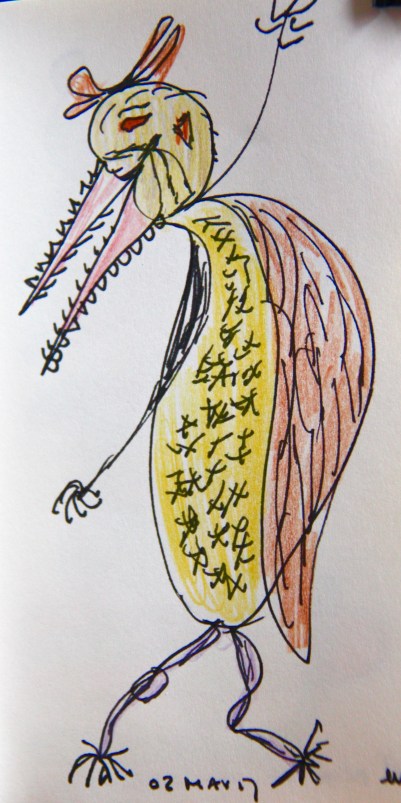
As any who have seen my drawings know, I cannot draw. However, I can take a line for a walk. And that’s what I do. Then I color the spaces I create. My friends thought I was wasting my time and I believed them until I read one of Matisse’s sayings: “My ambition: to liberate color, to make it serve both as form and content.” Voilà: I have my raison d’être. Nature abhors a vacuum. When you create a space, color and meaning rush in.
(3) I take photos
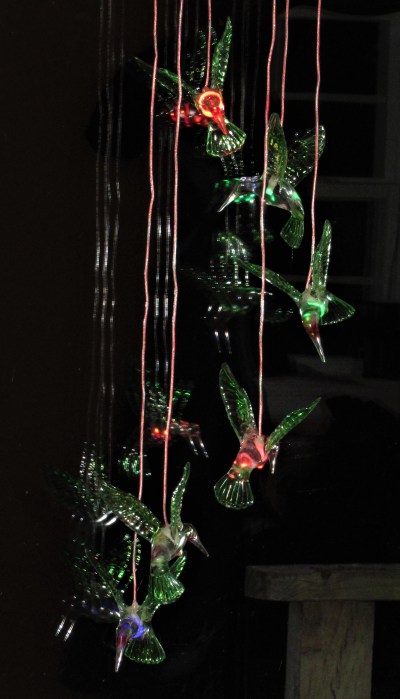
The capturing of a moment: a sunset, a new bird at the feeder, deer wandering through the garden, a black bear visiting, rain on a spider web, sunlight through a prism, a cat made out of cherry stones … the re-creation of the moment is the creation of the memory. More bubbles flow on the surface of the stream.
(4) I go for a walk, look at nature and the world around me, people too
It is incredibly important to do this. A visit to the local coffee shop, a walk around the super-market or corner store, a seat in the park on a sunny day … just be yourself, believe in your existence, watch things as they happen, relax, look and listen, empty yourself, let the world flow back in … look at the ducks on the lake or the goldfish in the tank … more bubbles on the water, more ideas floating down the stream …
(5) I listen to music
De gustibus non disputandum … we can’t argue about taste. Where music goes, each person must make their own choices. The music I like fills my mind, relaxes me, flows out when it ends, takes my mind for a walk and leaves … a vacuum … into which dreams and colors, words and ideas, build like clouds …
(6) I cook
Cooking has always relaxed me. Sometimes the repeating of an old recipe helps clear my mind. Sometimes I have a need to invent something new. Hands and mind occupied, the secret, sacred underground river of creativity flows on …
(7) I sew
Last summer, an unexpected event led me to join a quilting group … oh what fun … a man quilting among a dozen women … I learned so many things … so many different ways of looking at the world … so many concepts that I would never have dreamed of on my own … Sewing runs in the family: I still have my grandfather’s sewing kit … darning and sewing needles that served him for two years before the mast … that darned his socks as he survived in the trenches of the First World War … it bears his name and I use it with pride … and what memories arise in my mind as I choose the needle … his needle … the one that will lead me into the next adventure, be it quilt, button or patch …
(8) I keep a journal
… and come hell or high water, I write in it every day and have done so since 1985. That’s 31 years during which I have scarcely missed a day. The writing maybe banal, it may be nothing but a note on the weather or a comment on a sporting event … but it’s there … a vital challenge to the idea that Writer’s Block can take me over and stop me writing. This journal is 95% drivel … maybe more … but bobbing along the stream of words are ideas, verses, rhyme schemes, choruses, stories, flashes of inspiration, jokes, memories, magic moments, falling stars, … the secret is to catch these falling stars, to recognize these rough diamonds and to return to them and polish when the moment is ripe … and it will be, sooner or later … for bubbles are buoyant and will lift you to the stars.
(9) Free Writing and the Creation of Metaphors
I also use the journal for free writing and automatic writing. These techniques, drawn from the Surrealists, allow the mind to wander at random. While wandering, the mind creates an interior monologue or a stream of consciousness that in fact turns up a series of delightful metaphors that can be polished and re-used at will. When I use this style of writing, I am reminded of Dalí’s saying (again and as always, from memory): “I don’t know what it means, but I know it means something.” My own theory of metaphor is that the metaphor is defined by two (sometimes more) points and rather than settling on one or the other (as in a simile), the mind moves and flickers sub-consciously between the two extremes so that meaning is sensed, but rarely can be grasped or stated in definitive terms. Thus, the marvelous line from André Breton, quoted by Mr. Cake, “The wolves are clothed in mirrors of snow” has, according to my theory of metaphor, four defining points, namely, wolves … clothed … mirrors … snow. All four of these defining points creates an image, a very personal image, in the reader’s mind. The mind moves quickly between each defining point and meaning is lost in the rapid shift from image to image. Quite simply, “the hand cannot grasp it, nor the mind exceed it.” This means we have to return, as readers, to the unconscious level where the metaphors were first created. Then: “when we no longer seek it, it is with us.” This same analytical exercise can be performed for each line of Breton’s poem. When we indulge in free writing, much of what we write can be abandoned. The secret is to recognize and rescue the little gems we so often find.
(10) I believe
Through all this runs a thread of belief … belief that the black cloud of despair will not win. The Writer’s Block will go. Creativity will never be not lost. It is there, beneath the surface, always ready to be contacted, waiting to rise and take you over again. And all too soon and quite unexpectedly, one form of creativity slips into another and the creative writing (it never really went away because of the journal) comes back.
Writer’s Block: it does exist. It’s how we deal with it that’s important. Creativity rules: forget Writer’s Block and let creativity and the multiple ways back to creativity grow and flow. Sooner or later the clouds will lift, the sun will return, the block will unblock and the words will flow again.
Remember the words on the Roman sundial: Horas non numero nisi serenas … I count only the happy hours. And remember: the clouds will lift, the sun will return.
Trust me.
And believe.