Empty

IMG_0228 (2)

Empty

Empty now the house, clean the floors where she
spattered food and scattered her toys, polished

the tables, grubby no more, where small hands
clattered fork and spoon, her breakfast not wanted.

Empty the bathroom, the tub where she bathed.
Dry the towels, full the toothpaste tubes she

emptied in ecstasy. Where now her foot
-prints, her laughter and tears, the secret

language she spoke that we never understood?
Empty too my heart where, a wild bird, she

nested for the briefest time, then flew, yet
I possess her still, within my empty hands.

Commentary: The lead painting is the one Finley painted for me. I received it as a Christmas present, a couple of years back when she was 3 or 4. When asked if she wanted to add some more to the painting as the canvas wasn’t full, she replied: “No, it’s finished. That’s just how I want it.” Picasso once said that he spent the first half of his life learning to paint and the second half learning to see again as children see. Sometimes we complicate our art so much that we kill our inspiration and our vision. Some poets necessitate a dictionary in order for a reader to understand their words, yet when the meaning emerges, we find that the poem is convoluted, stilted, almost meaningless and even emptier than it was before.

Question: why do we try to gild the lily? Why do we lead to the slaughter the gift of the goose who lays the golden eggs? Are we writers or assassins? Are we not capable of putting meaning on paper with the directness and simplicity of a child? Good questions all. Sometimes I think that poets are like the existentialists of Albert Camus’s novels: they are the assassins of language and the murderers of direct and clear writing. And who are the victims? The words, images, metaphors, feelings that are strangled in the cradle or forced into captivity behind prison bars of jumbled lines and scattered thought.

Original ideas? No, not at all. This is the basic argument that Francisco de Quevedo (conceptismo) had with Luis de Góngora (culteranismo) in the Spanish literary salons of Madrid between 1613and 1627. The literary insults they wrote to each other are still a scandalous joy to read. These two seemingly separate styles of writing, which are actually very similar on many levels, eventually blended together and led to a total renewal of the Spanish literary language.  This in turn was bastardized by second-class imitators who did not have the skills of the original ‘super’ artists. And thus the pendulum swings: innovation > standardization > parody and satire of a worn out language > fresh inspiration and innovation.

As for me: how I would love to regain the clarity of vision and the joy of words that I experienced when I was a child. Back then, the world was a magic place, the pen and pencil were magic wands, and the empty page was a blank canvas to be filled with wonder. Alas: then I was sent to school. Rules were set. Bars were installed. Blinkers were inserted. Doors and windows were locked. Creativity ended. I will say no more.

KIRA Creative Quarantine

image1 (53) - Copy

KIRA Creative Quarantine

The Kingsbrae International Residencies for Artists (KIRA) requested its alumni to consider creating a ten minute video of themselves offering an instructional lesson based  on themselves working in their specialist areas. You can click on the above link to see all the creative videos currently available. Note that two more are added each week. Here is a link to my own video on Writing a Poem. It is designed for people of any age and I hope that anyone who sees the video will enjoy it and be inspired to start putting together their own poems.

The photo above was taken by Geoff Slater, the Artistic Director at KIRA. He placed a selection of my books on the beach at Holt’s Point and Bingo: instant art from a master artist. My book Fundy Lines now sunbathes on a beach that has ready access to the beautiful Bay of Fundy.

Midnight

IMG_0225

Midnight

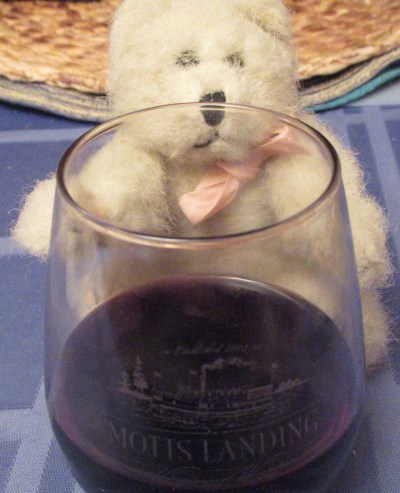
Primary red, this label, and the wine, fresh-drawn,
plucked from the bottle, tumbling tinto, into the glass.

Swirled, streaked ruby by overhead lights, bubbles
bright with hints of garnet, purple, brick at meniscus.

Sniffed, it smells of warm autumn days, scintillating
leaves, just crisping, turning color, and fruit all ripe.

Tasted: fruit bursts into hints of raspberries,
strawberries, spices, a touch of garrigue, mysterious.

Wine descends like water on a dry, hot, dusty day,
or rain after drought, when thirsty lands lap up

liquids, and rejoice in moisture’s blessings.
Raised now the glass, vineyard and vintners toasted,

midnight greeted, saluted the old day past and gone,
welcomed the fresh day walking in, swaddled, new born.

Pots and Pans


F1020017.jpg

Pots and Pans
St. Teresa of Ávila

A dusty highway. This woman riding
side-saddle on a hard, wooden seat, eyes
turned heavenward for inspiration. Frail,

fragile, she has never been strong, yet has
had enough strength, shoe-less, not soul-less,
to create her order of Discalced Carmelites

and found a hundred convents, safe havens
where woman can live in poverty, peace,
and prayer. Snow falls in high mountain passes.

Rivers rush downhill in springtime spate.
Mules rebel against cold waters. Bed bugs
bite … her God created them, so she suffers

in silence their indignities. Wounded heart
and soul, often doubting, faith always backing
her thoughts, words, deeds, she believes,

and that belief, as strong as this mule, as
solid as the San José corner-stone she laid.
She knows all too well that God often walks

and works his wonders for her faithful nuns
in convent kitchens cooking and washing
doing the small things, among pots and pans.

Comment:También anda Dios en la cocina entre las pucheras / God also walks in the kitchen among the pots and pans.” St. Teresa of Avila (1515-1582). It’s funny how, in times of stress, the little things in life come back back to haunt and help us. I have written of St. David, “Gwnewch y pethau bychain mewn bywyd / do the little things in life,” and here is St. Theresa of Avila saying more or less the same thing, nearly a thousand years later, this time in Spanish, not in Welsh. Intertextuality: in this way, I am able to talk, through my eyes, with Dewi Sant and Santa Teresa. And, through me, you too can indulge in this saintly dialog.

Avila 2007a 035 (2).jpg

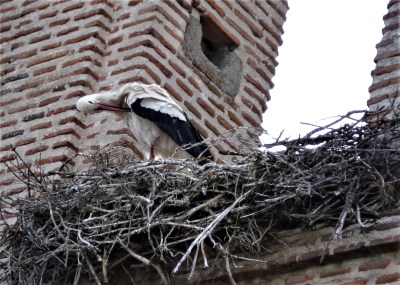
In my blog post, Triumphs, I wrote about how doing the little things in life can be so rewarding and so important for us as we age. No, I will never climb Mount Everest, but climbing up the stairs to my bedroom every night is, for me, a journey to the roof of my world and every ascent is a personal triumph, as is a safe descent each morning. I will never compete in a marathon, even though, back in my youth, I raced over ten miles and completed a half marathon. None of that now matters. What does matter is that I get my daily walk around the house, around the garden, around the block. My Olympic Goal is not to “own the podium”, a phrase I have always found slightly odious, but to win my daily wrestle with myself to just get my exercise done. Do the little things in life. In these troubled times, routine is important. Belief is important. Doing the little things that keep us alive is of paramount importance. And here’s a photo of a magnificent stork, in Avila, doing the little things in life.

Avila 2007a 087 (2).jpg


Triumphs

Avila 2007a 105 (2)

Triumphs
Luis de Góngora

Waking to birdsong in the morning,
making it safely to the bathroom
without tripping on the rug in the hall,
shaving without cutting my face,

getting in and out of the shower
with neither a slip nor a fall,
drying those parts of the body
that are now so difficult to reach,

especially between my far-off toes,
pulling my shirt over wet and sticky
patches still damp from the shower,
negotiating each leg of my pants,

tugging the strings of the plastic sleeve
that helps my socks to glide onto my feet,
forcing swollen toes into under-size shoes,
hobbling to the top of the stairs,

lurching down them, cautiously,
one step at a time, on guard for the cat,
the edge of the steps, the worn patches
where my stick might catch or slip …
one more step, triumph, I’ve made it.

Comment: “Cada pie mal puesto es una caída, cada caída es un precipicio / Each ill- place footstep means a fall, every fall is a precipice.” Luis de Góngora (1561-1627). I have reached the age of fragility and futility: every day that passes without an accident or a fall is a triumph. I re-read Luis de Góngora with increasing pleasure, the Polifemo (1613), above all, but also the later poems about the difficulties of ageing. When I read them I realize that I am not alone, that others have aged before me, and then I think of Jorge Manrique dead at the age of 39. And what poems he wrote, as did Góngora with a whole poetry movement named after him.

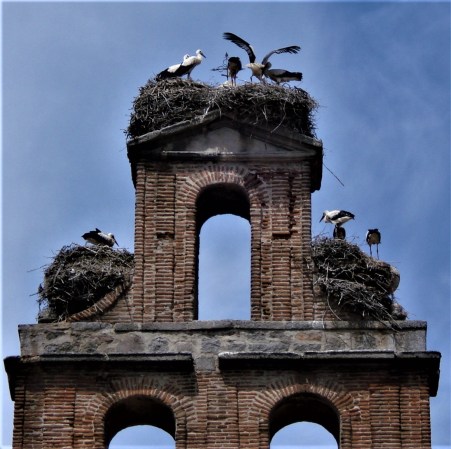
As for the photo: young storks in Avila, Spain, ready to fly. The one at the top is bouncing up and down, waiting for the breeze to get under his wings and lift him to sun and stars. High in the sky above him, almost unseen, his parents wait, ready to swoop down and assist him when he gets lift off. Uncertain he may be in those first few triumphant wing strokes, but down they come, place their wings below his wings and show him how it’s done. For him, it is the world that awaits him.

For me, and people my age, the world shrinks, walls close in, the daily process of living becomes more difficult. My joy: not in the lift off, but in the painstaking processes, getting up, getting washed and shaved, getting dressed, going downstairs, the early morning taste of fresh-brewed coffee, each sip a pleasure … and out in the garden, spring robins calling, a phoebe whistling, rose-breasted nuthatches, American Goldfinches, and the wondrous joy of just being here, sitting in the sunshine, lapping up the warmth, and every moment of every day a triumph renewed.

IMG_1060 (2)

Word without end

IMG_0937 (2)

Word Without End
Antonio Machado

Tree: rowan, mountain ash, larch, tamarack,
hackmatack, spruce, birch, maple, passerines
flying from branch to branch. Birds: more words,

woodpeckers, downy, hairy, pileated, cardinals,
finches, purple, house, golden, rain-rusted robins,
crows, aerial magicians, wondrous in flight.

Spring: fresh branch tips, tiny fox gloves, leaf buds,
folded fiddleheads soon to open their spring magic.
Open: hearts worn on sleeves, open to the world,

wounds, eyes, everything open to beauteous
sun-warmth, snow’s slow disappearance, rising river,
freshet flow freshening this Renaissance,

every day a rebirth, a new beginning,
fresh starts, the world reborn beneath a rising sun,
its yellow disc growing, the new day glowing.

The word as it was in the beginning, head in hands,
heart in mouth, words without meaning, words whirling
golden autumn leaves, words caught in a whirligig,
words all powerful in a word-world without end.

Comment: “La palabra: una palptiación honda del espíritu / The word: a deep palpitation of the spirit.” Antonio Machado (1875-1939). In The Meaning of Meaning, Bertrand Russell discusses what words mean and how they construct, with their endless associative fields, a net of emotions that take us beyond logic into new realms of meaning. As poets and creative artists, we are conscious of the emotions we attach to each word we use. If the poetry is good, then that network of emotional associations reaches out to a wider audience and draws them into our own world view. If we are less skillful, then the emotions are trapped in our own claustrophobic words and fail to reach out, to lift up from the page, to achieve take-off. As we develop as poets and writers, we become more and more aware of the ways in which the microcosm, our own world in miniature, reaches out to the macrocosm, that wider world outside. When we achieve a blend between those two worlds, even if it be in nothing more than a metaphor, nothing more than a felicitous phrase or a delicately timed rhyme, then we reach a new level, a level that we strive to retain and attain anew every time we create.

For me, many of the secrets of poetry can be found hidden in the rhythm of words, the music of their joining, the harmonies they create when they play off each other, old and older meanings reflecting off the newer meanings we give them as we shuffle them anew and put them through their paces.

img_0146-3

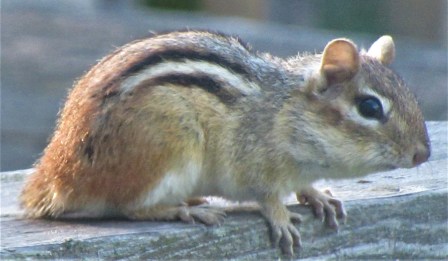
Yesterday, my beloved placed seeds on the back porch, and a chipmunk, her pet chipmunk, came and sat on her foot as he chomped the seeds. Today, this first chipmunk was followed by a second chipmunk. Patience my friends. Keep writing. Keep striving. Keep experimenting. Keep your faith and your creed. Your words will one day reach out, like seeds to chipmunks, and will sow themselves in the mind’s of your readers. And those readers will beget other readers, much as one chipmunk plus one chipmunk will eventually equal many more than two chipmunks. Oh the joy of words, the loving search for le mot juste and the meaning of meaning. In the words of the immortal Cervantes: Paciencia, y barajar / patience, and shuffle your words. The results will creep upon you one morning, unaware and, like the chipmunks, they will catch you by surprise.

Duende

F1000008

Duende
Federico García Lorca

It starts in the soles of your feet, moves up
to your stomach, sends butterflies stamping
through your guts. Heart trapped by chattering teeth,
you stand there, silent, wondering … can I?
will I?what if I can’t? … then a voice breaks
the silence, but it’s no longer your voice.

The Duende holds you in its grip as you
hold the room, eyes wide, possessed,
taken over like you by earth’s dark powers
volcanic within you, spewing forth their
lava of living words. The room is alive
with soul magic, with this dark, glorious
spark that devours the audience, heart
by heart. Magic ends. The maelstrom calms.

Abandoned, you stand empty, a hollow shell.
The Duende has left you. God is dead, deep
your soul’s black starless night. Exhausted,
you sink to deepest depths searching for that
one last drop at the bottom of the bottle to save
your soul and permit you a temporary peace.

Comment: “Todo lo que tiene sonidos oscuros tiene duende / All that has dark sounds has duende.” Federico García Lorca (1898-1936). García Lorca, an inspired and inspirational vocal performer, well understood those dark artistic powers that rise from a combination of earth, air, and fire to possess artists as they weave their magic, be it musical or verbal or a combination of both. Those who possess it know that they never really possess it, for it comes and goes with a will of its own and possesses them, body and soul, taking them over. Deus est in nobisit is the god within us, wrote the Romans with their understanding of the power of performance. And they are right. Those who possess it are changed by it, no longer know themselves, turn into something other than what they are and becoming something special. “Ah would some power the giftie gie us, to see ourselves as others see us” (Robert Burns). But what happens to us when the wondrous gift is taken away, when drab reality takes over from the glory of the stage, the spotlight, the performance of the play? That indeed is the question. And the answer varies with each of us.  I look with dismay on the comedians who, for one reason or another, when deprived of their audiences, have chosen the darkest of exits. The hollow shells of the performers who have given their all are sad things to behold. The existential emptiness that is left when the powers drain away is difficult to live with. That is why so many, faced with this darkness, akin to St. John of the Cross’ Noche Oscura del Alma / Dark Night of the Soul, chose not to live. That is not a choice that I will ever make. And I encourage all my friends to wait, to wait in patience and hope for the light, the glorious light and fire of the Duende, the Spirit that will return, will pluck us from the depths, and will raise us to the heights again.

White Wolf

IMG_1843 (2)

White Wolf
Rhodri Mawr

Winter’s white wolf
shakes ice from her coat,
makes snowflakes fly,
blanches our world.

Nose pointed skywards,
she howls a North wind
straight down from the Pole
as we shiver indoors.

Snow gathers in the air,
thick as winged moths,
then drops to the ground,
plays dead in deep drifts.

Snow banks climb higher,
blotting out light.
Soon, Arctic cold will wrap us
in its endless night.

Avila 2008 381 (2).jpg

White Wolf  in Island View


Comment: Y blaidd gwen yn y gaeaf / The white wolf in winter, translated from the original Welsh of an anonymous Gŵyr poet, circa 1613. Oh I do love messing about with images and words. I don’t have a photo of a white wolf, so instead I have posted a photo of my lapdog, Tigger, who weighs in at 115 lb. Tigger, of course / wrth gwrs, is a delicate champagne color rather than white. When he sheds hair in the summer known in the doggy trade as ‘blowing his coat’, it is like a snow storm coming off the back porch. The nesting birds and the chipmunks and squirrels can be seen carrying chunks of his fur back to their nests. They will keep wonderfully warm, wrapped in the raggle-taggle gypsies torn from coat. There are several jokes and pieces of misinformation or weird humor, woven into my poem. I wonder how many you can spot? Each of my poems is a puzzle, in one way or another, so have fun solving the riddles!

The Origin of the World

IMG_0265

The Origin of the World
Gustave Courbet:
L’Origine du monde

The origin of the world and where I came from,
her deep, moist cave that cast me from dark to light.
She loved me, she said, depriving me of her warmth,
leaving me to go back to her lover, loving him more.

Was it guilt that drove her to drinking whisky?
A forty-ouncer a day at the end, sometimes more.
She would wake in the night, wander the house,
banging against chairs, tables, walls, and doors.

She ran up bills in local shops, and the keepers
would dun me for the money she owed. She also
borrowed cash and some days her fingers were bare.
She left pawn shop IOUs on the table and I drove

 into town to redeem her rings. Once, in a drunken
frenzy, she cursed her only child. A mother’s curse is a
terrible thing. A living albatross, it claws lungs and heart.
Its weight drove me to the bottle. I too sought oblivion.

Reborn each day, mornings cast me back from dark to light.
Joy came when blackness descended, the albatross flew,
amniotic waters rocked me in warmth and comfort,
and my body’s boat floated once again on an endless sea.

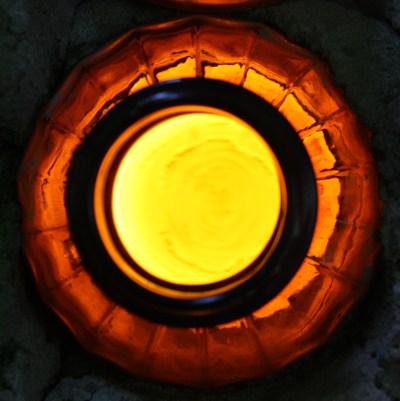
Comment: The photos show light shining through bottles in The Bottle House on Prince Edward Island. There is something very special about sunlight shining through stained and colored glass. Color distorts, speckles hands and face with a pointillistic magic, and the circular framework becomes a sun in its own right. As for Courbet’s painting, it still has the power to shock the viewer as it sets the eternal conundrum of the power relationship between the viewer (male) and the viewed (female). And remember: El ojo que ves no es ojo porque lo ves, es ojo porque te ve  / the eye you see is not an eye because you see it, it is an eye because it sees you, as Antonio Machado tells us. As for the poem, it stands or falls on its own, as does the painting. Visual shock or verbal shock: take your pick, but I hope you do not walk away unmoved.

IMG_0251


Still Life with Hollyhock

IMG_0206

Still Life with Hollyhock
Geoff Slater

How do you frame this beaver pond,
those paths, those woods? How do you
know what to leave, what to choose?
Where does light begin and darkness end?

Up and down: two dimensions. Easy.
But where does depth come from?
Or the tactility, the energy, water’s
flow, that rush of breathless movement
that transcends the painting’s stillness?

So many questions, so few answers.
The hollyhock that blooms in my kitchen
is not a real hollyhock. It is the painting
of a photo of a genuine flower that once
upon a time flourished in my garden.

A still life, then, a nature morte, a dead
nature, portrayed in paint and hung alive,
on display in this coffin’s wooden frame.

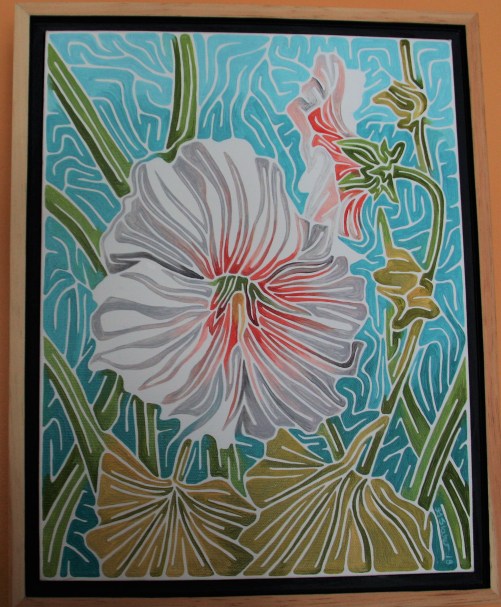
Comment: I love the way language changes the way we look at life.  A still life painting becomes nature morte in French and naturaleza muerta in Spanish. Still life becomes dead nature. Fascinating. I also love the way in which the camera captures nature and the natural world. We think it is an accurate depiction, but really it isn’t necessarily that accurate. Filters, light and shadow, mood: they all fluctuate and sometimes we capture that which we never saw and sometimes that which we saw is never captured. Oh the subtle enigmas of creative art.

IMG_1005 (3)

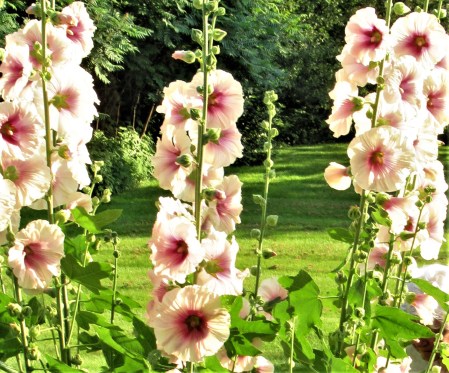
And it is the same with the hollyhock, my hollyhock, Geoff’s hollyhock. At the top of the page is Geoff’s painting of my hollyhock. The above is a photo of my hollyhock. Which bloom did Geoff capture and reproduce in paint? Language: and what do I mean when I say ‘my hollyhock’? My indicates possession, ownership. How and in what way does one own a hollyhock? How does one possess a garden, a flower bed, a tree? Are they not free, living, beings with a life and maybe even a mind of their own? Does one hollyhock talk to another hollyhock as the trees are said to converse with the trees? Do the trees in the garden possess a soul and if they do, in what sense do they possess one? And what is a soul anyway? I guess it depends upon the church and creed to which you belong. Certainly the garden has a life of its own and we discover that every spring when the grass and flowers grow back and the dandelions return.

image5

Questions: dangerous things, questions. Several of the questions posed above could have landed me in an Inquisitional institute in Spain in the 1500’s and 1600’s. That is a frightening thought. Alas, the philosophy of all that is way too deep for this poor poet and apology for a philosopher. One thing I do know, though: I love the garden going on outside my window and it is a privilege to be allowed to watch it, admire it, and follow its progress as the sun returns and the draws the birds back with it.

IMG_0198

¡Vale! Hail and fare thee well.