Magnolia

Magnolia

She stands there, at the garden gate, waiting for me.
I can see the scene, the flower beds, the magnolia
bleeding, in Wales, its soft, spring snow of ivory pearls.

Some fall on her head, crowning her with a beauty
more precious than frankincense or myrrh. Petals
also perch their pure, ermine cape on her shoulders.

She walks towards me, eyes shining, arms open.
Then, the vision fades and she drifts away, leaving me
alone, my face bathed in the tears of her passing.

For pass each other by, we did. Ships in the night,
trains rushing through a tunnel of darkness, bathed,
for an instant, in the constellation of a station’s light.

Now, when I try to go back and to recreate that scene,
I find an empty garden, fallen leaves, and winter’s cold.

Comment:
I have been struck recently by the number of published articles that speak of post-Covid loneliness and the difficulties of re-establishing old friendships that fell by the wayside, let alone establishing new ones. It seems to get harder and harder, as we age, to leave our post-Covid isolation, to get out of our new comfort zones – sometimes so limited and limiting – and to make new friends. As we age, our minds go backwards and we return to earlier days and happier memories. Yet all too often those memories are tinged with the sepia sadness of old photos, from a non-digital age, faded and stained.

Bay of Santander – 1963

Bay of Santander
1963

I stood there
on the sea wall
calling out to the dark
“Help!” “Save me!”

Moon hid her face
behind veiled clouds.
All hope denied
I called out to the tide,

outgoing, to take me
with it, out to sea,
past the island
and the lighthouse,

out to where the waves,
stronger than anything
I ever knew, would thrust
strong fingers under my arms

and lift me up,
then drag me down,
so I could finally rest
in peace, and drown.

Comment:
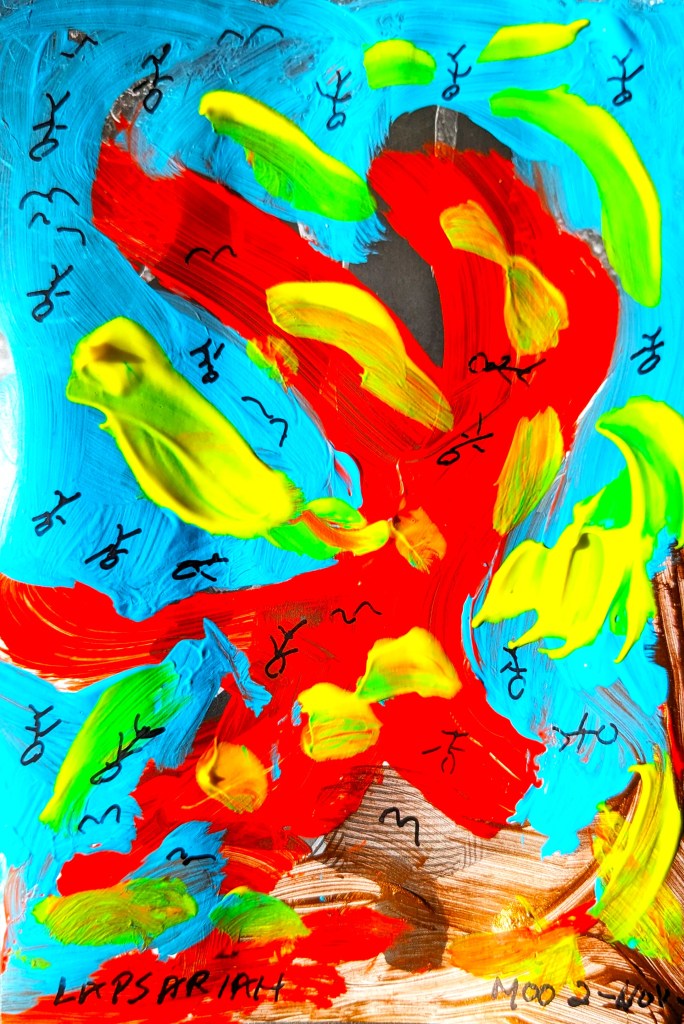
This painting is called Picking at Scars. Some scars run so deep that they are always there. When they itch, you scratch them, and they bleed afresh. The scar of loneliness is one such scar. Alone, in a foreign land, learning their language, the culture, their customs, feeling not just unaccepted, but unacceptable, and the moon at night shining on a land, a bay, a city, to which you know, deep in your heart, you will never belong. That loneliness walks with me still and, sixty years later, it still leaves me desolate.

Limbo

Limbo

I live with my head in the clouds.
What clouds you ask – Alto-Stratus,
Nimbus, Cumuli-Nimbus?

No, I reply, none of those.
At one level I build cloud castles,
in Spain, as they say in French.

But, at another level,
I find myself lost in the medieval
cloud of unknowing, this mental limbo.

Here, grey mists weave spider-webs
of doubt that glisten with dew, and sparkle
with the two-edged sword of thought.

Here, I feel my life-web tremble
and I realize that I alone can walk
this way and try to understand

how frail threads catch small flies,
how words tell stories, but not the story
of all I know, nor where my world will go.

Comment:
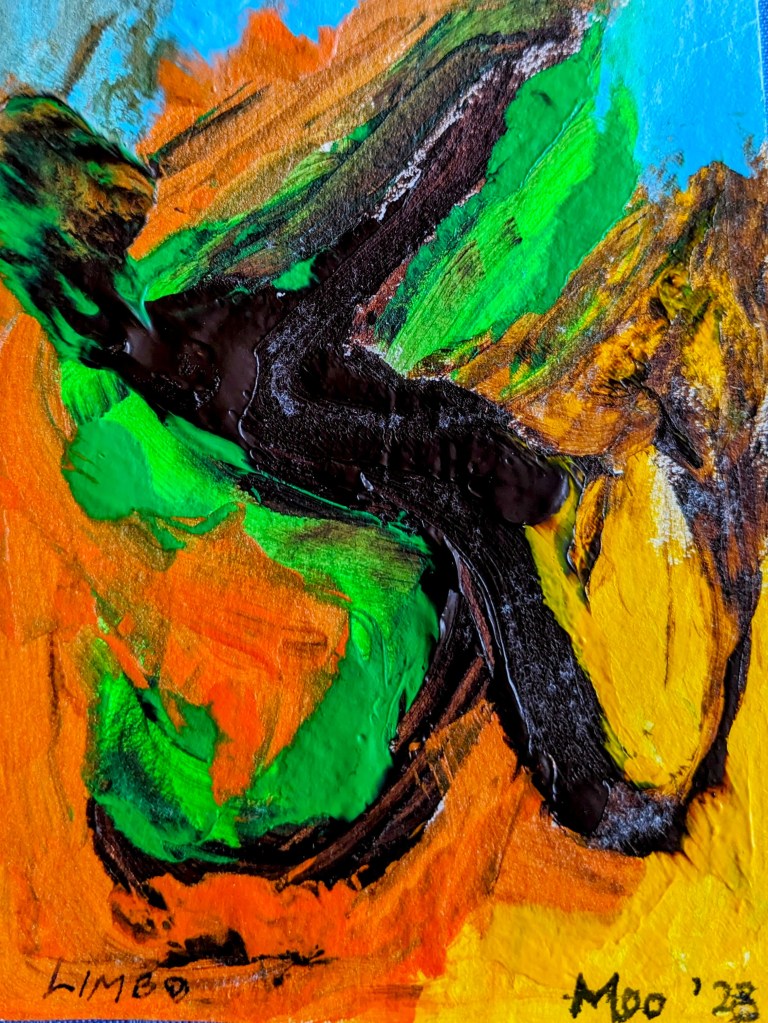
Once more I have linked verbal and visual images. Moo’s painting above – thank you, Moo, – called Limbo, depicts a limbo dancer while my poem expresses the reality of that internal space in which creative spirits sometimes find themselves. It is a sort of Limbo of the mind, in which thoughts appear, dance along the frail threads of the mind’s web, yet never really materialize into formal verse or poetic patterns. This is also the lost world of the dreamer. But remember, the dreamers of the day are dangerous people, because sometimes they make their dreams come true.

On Writing Poetry

On Writing Poetry

I sit here writing poetry
and, head in hands, I cry
at all the things I’ve left unsaid,
and then I wonder why
I wasted so much time on things
that perished before my eye.

Outside the night is dark and cold
and shadows flit and filter by.
I know that I am growing old,
that soon my story will be told,
and when it ends, I’ll die.

I know that death is not the end,
yet I do not want to die.
I want to paint the autumn trees,
the clouds that float on high,
with evening lights that stain the sky.

But rhyming is not all I do.
I’ often write in prose, with words
that wound and sow dark seeds
that root and flourish, grow like weeds,
and nourish other people’s needs.

Alas, I know not what I do,
nor yet what I have done,
nor when, nor where, the seeds
were sown, nor if they aided anyone
to turn away from the dark inside
and walk in the light of the sun.

Candles

Candles

Candle-light

Three candles burn at my table.
Outside,
the night wind howls like a dog
and scratches its pelt on my roof.

The wind has torn
branches from the trees
and polished the evening frost
until it sparkles
like eighteenth century silver.

A moth circles and sizzles
in a sacrifice of flame.

I keep my vigil at night’s altar
and place a wrinkled palm
into the candle’s liquid flame.

Put out a candle, put out a child.
Who would put out a dog
on a night like this?

Outside,
playing tag between dark trees,
the wind runs wild.

Bird

Bird

The bird came to me
   on the wings of Hurricane Lee.

Carried along by stronger wings
   he perched in my tree.

A new species, he was unknown to me.
   Our own power lost, the usual ways
               of searching were denied me.

He moved from the tree
   to the window feeder and gazed at me,
               eye to eye, as the hurricane’s eye
                           passed overhead.

Free. To come and go at his will,
   but there is little free will
               when the hurricane blows.

A sudden, strong gust
   whisked him away.

Unknown, and a stranger still,
   he soon was lost to me.

Comment:

All my good will and new resolutions went down the proverbial plughole when Hurricane Lee swept in, washed away one of the roads near to me, and left us without power for 52 hours. We lit candles, as much for warmth as for light, and, when dark descended outside, gathered in their flickering glow. The time has come, the Walrus said, to indulge in simpler things. Water saved in the bath upstairs and in an assortment of pots, pans, and buckets, served for the washing of hands, the flushing of toilets, washing the dishes. Food was served cold – but we indulged ourselves with perishables that needed to be finished quickly. The morning face wash and shave, in cold water, no shower, was a throwback to old times. The experience brought us closer together. Neighbors with generators dropped round with hot food and drinks, and all went well. After two days of picnics, we got a bit bored. I managed to write lots of poems though. The creativity of that experience will live on in words.

Monkey’s Clockwork Universe

Monkey’s Clockwork Universe

Some days, monkey winds himself up
like a clockwork mouse.
Other days he rolls over and over
with a key in his back like a clockwork cat.

Monkey is growing old and forgetful.
He forgets where he has hidden the key,
pats his pockets, and slows right down
before he eventually finds it
and winds himself up again.

One day, monkey leaves the key
between his shoulder blades
in the middle of his back.

All day long, the temple monkeys
play with the key, turning it round and round,
and winding monkey’s clockwork,
tighter and tighter, until suddenly
the mainspring breaks

and monkey slumps at the table
no energy, no strength,
no stars, no planets, no moon at night,
the sun broken fatally down,
the clockwork of his universe sapped,
and snapped.

Comment: a big thank you to all who have reminded that yes, I did write this book, and yes, it is one of my favorites. Oh those naughty little monkeys. For those of you who have read the book or heard me reading poems from Monkey Temple, all is well in Monkey Land and the King of Harlem, with a wooden spoon, still gouges out the crocodile’s eyeballs and beats the monkeys on their backsides, with a wooden spoon. I thank my old friend, Federico Garcia Lorca, for that wonderful vision from his own book, Poet in New York.

King Canute

King Canute

I imagine King Canute, sitting on his throne,
at the seaside, surrounded by his court
as he tries to turn back the rising tide.
Or is he just proving that it can’t be done?

In vain we struggle against the rising waves.
We piss into the wind and try to drown
the thunder with our pitiful, impoverished farts.

Some preachers preach that we are immortal,
but mortal we are, facing such adversaries
as wind, rain, thunder, and the rising tide.

Who nailed us to this cross of cloudy doubt?
I hear crass crows cawing for tomorrow, but
it never comes, and if it does, it becomes today.

Today we must count the cost of every footstep
that leads us again into the Darkest Ages,
and back to the Stone Age, sent there by a rain
of unstoppable destruction, unleashed in our pride.

September Song

September Song

In the gathering autumn shadows
summer flares as bright as the berries
adorning the Mountain Ash.

Beads of blood,
they hold late evening light,
as do the Black-eyed Susans
growing wild beneath my window.

Rain wet, wind swept some nights,
yet still they glow
with their bottled sunshine.

Fairy lights, Christmas garlands,
ash rosaries will circle another tree,
enlightening wrapped presents,
lighting up the vacant crib
waiting for that little child,
soon to be still-born.

Comment: Poetry is where you find it. The inspiration for today’s poem came from the Poem of the Week in The Guardian. Inspiration, I found it in two places – 1. the photograph at the head of this blog and 2. in the analysis of the poem, not in the poem itself. The twilight of this autumn world is indeed wonderful.

Les croulants

Les croulants

That’s what they called the older
generations, in Paris, in 1963, when
I lived there, in St. Germain-des-Près.

Now, a member of that generation,
I remember those words and see myself
crumbling, failing, falling slowly down.

A façade, it’s all a façade. Here I am,
white-haired, wrinkled, watching time’s
oxen plowing furrows in my face as
winter’s snow layers a silvery thatch
of patchwork hair upon head and chin.

How much longer can I sustain my life,
exist in this metatheatre of give and take,
where each day takes its toll, and I give
away bits of myself, slowly, reluctantly,
sloughing them, snake-like, to dance,
then vanish, into the gathering dark.

Author’s Note
I used this painting as the cover for my novel People of the Mist.

People of the Mist
A Poet’s Day in Oaxaca

Click here to purchase this book.

Themes from this poem can be found in my poetry collection Poems for the End of Time. It is a series of metaphysical meditations written while listening to Messiaen’s Quartet for the End of Time. It is followed by Lamentations for Holy Week, a sequence based on the Spiritual Exercises of St. Ignatius of Loyola, as imitated by Francisco de Quevedo (1601 – 1613) in a series of poems composed during Holy Week. This poetry is written from the heart and expresses the authenticity of the poet’s being. Here, the poet indulges in a dialog with his time and place – much in the manner outlined by Mikhail Bakhtin in his theory of Chronotopos. This poetry is not written for the simple minded. Rather it invites the reader to explore the nature of the world, the philosophy of time and place, and the metaphysical exercises necessary to prepare for the inevitable end of time.

Poems for the End of Time
and
Lamentations for Holy Week

Click here to purchase this book.