Spotify: Remember to scroll down to the appropriate audio episode.
Passerines
Light dances and reduces spring’s snow. Tiny white islands float in a rising tide of green.
The late spring sun carves charcoal lines of shadow. What remains of the winter is no longer smooth, but dimpled and wrinkled, glowing with a million tiny dots of color.
Dew point: occasional snowflakes float down — feathered parachutes.
Dots of refracted sunshine spin out from the sun- powered crystals that turn in my window. They cut through the heavy air that the hyacinths weight with their redolence.
The soft white flowers of the cyclamen respond to the dancing points of light, the curved edges of its leaves soak up the sun.
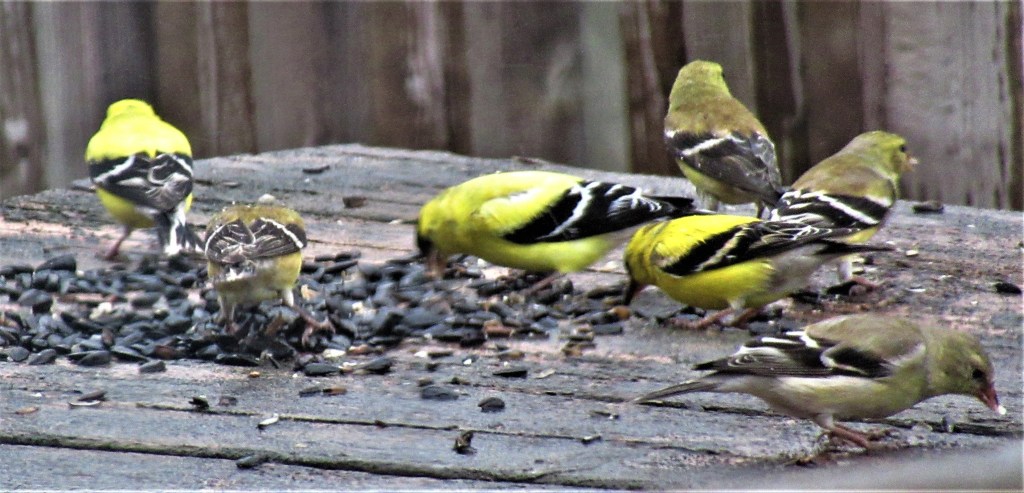
Returning passerines jostle and shove, greedy to approach the feeder.
They are random, like thoughts, flighty, and totally untamable.
Grosbeaks
Light dances and reduces spring’s snow. Tiny white islands float in a rising tide of green.
The late spring sun carves charcoal lines of shadow. What remains of the winter is no longer smooth, but dimpled and wrinkled, glowing with a million tiny dots of color.
Dew point: occasional snowflakes float down — feathered parachutes.
Dots of refracted sunshine spin out from the sun- powered crystals that turn in my window. They cut through the heavy air that the hyacinths weight with their redolence.
The soft white flowers of the cyclamen respond to the dancing points of light, the curved edges of its leaves soak up the sun.
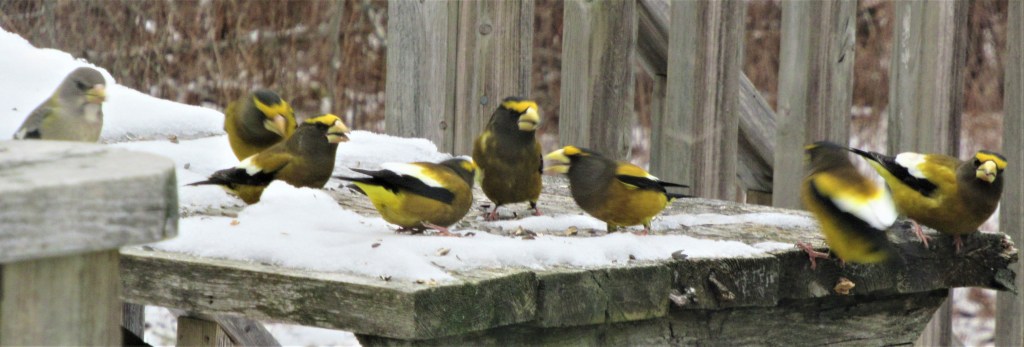
Grosbeaks, greedy for sunflower seeds, jostle, shove, and push, to establish their pecking order at the picnic table.
They are random, like thoughts, flighty, and totally untamable.
Comment: What’s in a name? Change the birds and the poem changes. The same poem? Or is it? Does only the title change? I’ll let you decide. Do you have a preference? Please tell me.
Spotify: Remember to scroll down to the appropriate audio episode.
Sharp-Shin
She surveys her empire from our back porch steps into space plunges her body’s weight into fragile air.
A feathered arrow, she makes contact, feet first, bowling the unsuspecting robin over on the ground. His shrill shriek emerges from a beak shredding failing air.
The hawk’s claws clench. Her victim’s movements weaken, eyes gaze into darkness.
One final spasm, a last quick twitch, and the robin is gone, one wing dragging, borne skywards in the hawk’s claws.
The poems which have come together to form the Empress of Ireland were begun in Ste. Luce-sur-mer, Quebec, in May 2002. It was off-shore from Ste. Luce, in the early hours of the morning of the 29th of May, 1914, that the Empress of Ireland collided, in dense fog, with a converted Norwegian collier whose bows had been strengthened for ice-breaking. There were approximately 15 minutes between the moment of impact (1:55 am) and the moment the Empress caught fire and sank (2:10 am). Although the disaster has received little international attention, more passengers perished in this accident (840) then in the loss of the Titanic (832) or the sinking of the Lusitania (791).
I first heard voices in the cries of the sea birds on the beach at Ste. Luce-sur-mer.
Borne on the wind, over the sigh of the waves, they seemed high-pitched, like the voices of children, or of men and women in distress. These were lost voices, the cries of people alone and frightened by the dark. I heard them calling to me.
That night, there were knocks at my cabin door and finger nails scratched at my window. Tiny sounds, almost beyond the range of human hearing: the snuffling of puppies when they turn over in their sleep and tug at each other, whimpering in their dreams.
“Who’s there?”
I started from my sleep. But there was only the wind and the waves as the tide’s footsteps climbed a moonbeam path to ascend the beach. When I walked on the sand next day, at low tide, there was a whispering behind my back. Little voices crying to be set free.
“Who’s there?”
A lone gull flew past my head and battered itself against the wind’s cage with outraged sturdy wings. That night, the mist descended. The church stepped in and out of its darkness and shadows gathered, persistent, at my door.
I walked out into the night and saw a lone heron surrounded by gulls. It was as if an adult, clamoured at by children, was standing guard over the beach. Then I saw the shadows of little people searching for their parents, the shapes of mothers and fathers looking for their off-spring, lost among the grains of sand.
Beyond them, on the headland, the church stood tall above the shadows. I saw grandmothers and grandfathers, their lips moving in supplication, kneeling before the granite cross which stands above the sea. As I approached, they turned to me, opened their mouths, mouthed silent words, then disappeared. When I went back to bed, faces and voices visited me in my dreams. When I got up next morning, they came to me in the speech of birds hidden in the foliage, in the words dropped by the osprey’s wing, in the click of the crab’s claw as he dug himself deeper into the sand.
“Release us”
“Speak for us!”
“Set us free!”
The words of the M Press of Ire are not my words. They could never be my words. Foundered words, they are, rescued from the beach, and dragged from the high tide mark with its sea weed, carapace, charred wood, old rusted iron, and bright bones of long dead animals polished by the relentless action of wind, sea and sand.
This is now published and in my hands. I do not yet have full details on links and where and how to purchase, but I will put them up as soon as I have them. Meanwhile, I am grateful to my cover artist, who always does such a great job, and to my editor, Dr. Karunesh Kumar Agarwal (Managing Editor) Cyberwit.net. What a pleasure it has been to work with him. The cover picture, incidentally, is An Only Son.
I am now working on my next book, Stars at Elbow and Foot. I am sure many will recognize the title as coming from a line of a man born in the same town in Wales as I was: Dylan Thomas. The island in the picture is the only Island visible in Island View, incidentally. Alas, I do not have a picture of my cat, though I may put one on my next cover.
Ah yes, time to celebrate. I guess we’ll open a barrel of wine tonight. Hopefully we won’t finish it one sitting. I’d be lying if we did. This incidentally is the bodega where I got baptized. If you haven’t got baptized in a Spanish bodega, you haven’t lived. I’ll tell you about it sometime. How I miss that verdejo! Unfortunately, the verdejo didn’t miss me, and that’s how I got baptized. ‘Ya te hemos bautizado!’ “Que sea yo, y no el vino.” And if you understand that, you speak pretty good Spanish or Spanish pretty good … and you probably have an evil mind, just like mine.
Here I am, on the sea-shore, selling C-shells and thinking about my evil mind. But remember, my evil mind is mine, and it’s a one-of-a-kind. You go and find your own. And watch out for those Saint John C-gulls.
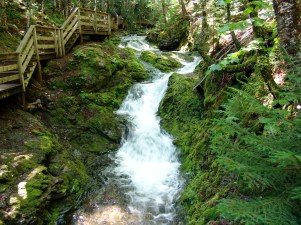
What is it about running water that it explodes like long, blonde hair over moss and rock frothing with sunlight the diamond sparkle, the freckling sound, light flickering downwards, fine threads of angel hair tumbling from above, falling,
white, over earth’s rocky shoulders, pillowed across soft green quilts
poured down from heaven’s skies watering the earth’s dark throat,
sinking through the soil emerging in rivulets and brooks until all waters are one and the rains join hands to splash, rejoicing,
dryads and naiads bathing together in deep, cool pools, nymphs reborn, acrobats over rocks as water falls to seek the sea.
I buy two liters of white mescal, cheap and rough, without the second brewing: fire water, not smooth. Two liters: she sells them in an old Coke bottle she’ll seal with cellophane, and a rubber band. Six worms I buy. Bedraggled fighters dragging smoky trails as they plummet through a yellow sea.
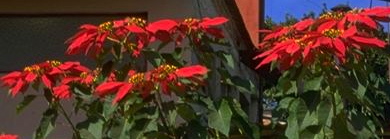
In the shop next door I buy poinsettias. When I get home, I put them in a vase and watch them, red-eyed, watching me. Bloodstains scratching a white-washed wall.
Misshapen gems in a ceramic prison, their beauty breaks me down: a fragmented world, decimated words, metaphors born from worms and mescal.
The eyes I see are not eyes because I see them: they are eyes because … twin brown ovals … they watch me as they float in a liquid mirror within the upraised glass held by my hand.
Outside, beyond the balcony, sun -blood melts like sealing wax. The bougainvillea strains sharp stains through a lonesome slice of sunlight giving birth to flamboyán and tulipán.
My lemon tree leans over to listen. Glistening pearls of dew embellish its morning throat. Christmas decorations these postage-stamp minstrels, thronging each branch, filling me with song.
Butterflies, winged flakes of archaic paint, flutter from temple walls leaving them barren. Church towers, strong when terra firma shakes, quiver insubstantial. Mescal melts the morning, a miracle, this quiver of shimmering air.
Five reasons why a Teddy Bear is much better for you than a Kitty Cat. I know, I know: cat lovers will go wild. They think cats are such lovely cuddly things. And they believe strongly that nobody can resist a warm, loving, darling, purring bundle of fur. Well, I can resist cats. And I can give you five good, sound, solid, 25 carat reasons why Teddy Bears beat Kitty Cats any day of the week.
One Teddy Bears do not need to be fed on a regular basis. In fact, one piece of kibble will last a Teddy Bear for a very, very long time. And you can’t say the same for your cat. So less expense, no need to feed, don’t have to put that fresh water down every day, no constant fawning attention when hungry or just plain greedy, don’t have to worry about treading on the cat’s tail … In fact, a Teddy Bear wins out every time.
Two “Don’t mention cleaning out the kitty litter. Promise?” “I promise. I won’t mention it.” “Word of honor?” “Word of honor. Fresh Walnut and all that.” “You just mentioned it.” “Mentioned what?” “The kitty litter.” “I didn’t.” “You did: you said ‘Fresh walnut.’” “So?” “So that’s what keeps the kitty litter from smelling.” “Does it smell much?” “Quite a bit. I hate cleaning it out.” “Why?” “It’s so smelly, filthy, grainy, lumpy, stinking …” “So, why do you do it, then? What you need is a nice, clean, environmentally friendly Teddy Bear. There’s no cleaning up after a Teddy Bear. Who’s ever heard of Teddy Bear Litter?” “You said you wouldn’t mention it.” “Mention what?” “Kitty litter.” “I didn’t, you did.”
Three Teddy Bears don’t have off-spring. You don’t need to neuter them, and they don’t need taking to the vet. Nor did they sit and wait in family groups for their photos to be taken. What we have below is a fake photo placed there by the unscrupulous enemy for their own pro-cat propaganda purposes.
Four Teddy Bears are very obedient. If you tell a Teddy Bear to “sit” or to “stay”. He does so. Immediately. And he stays where you put him. There’s no clash of wills and egos, no conflict at all. Teddy Bears are easily trained and very obedient. Also, they don’t want to go out in the garden and wander beneath the bushes to shriek and whine when the moon is full. Now, if you have cats and you want them to sit and stay still, you must give them something to watch or to play with. Chipmunks and garden birds aren’t cheap, you know, and they are less trainable than cats. How long do you think it takes to train a chipmunk to just sit there quietly to entertain your cat? Especially when it’s being hissed at and the cat is bouncing the window with anguish? Also, Teddy Bears don’t climb on furniture, nor do they break ornaments, nor sink their claws into your hair as you pass beneath them, nor do they drop on you, unexpectedly, from great heights.
Five Five and finally, when there’s a moth, a fly, or a mosquito on the ceiling at night, you can’t train your kitty cat to fly into the air and snatch it off the ceiling. But as for Teddy: grab him by one leg, preferably the back one; give him his commands “Ready, Teddy, Go!” and hurl him skywards. With a little practice, he’ll nail that nocturnal buzzing monster every time.
No: all things considered — and I promise I won’t mention, you know what, that little box the cat sits in — there’s nothing better than a Teddy Bear. Wise, silent, friendly, cuddly, obedient, friendly (did I say that?), needs no training, always there when needed, waits patiently for you when you’re away, never stalks off with tail in air, never gets out and hides in the garden where you can’t find him, adorable, cuddly (did I say that already?) … Give me a Teddy Bear anytime.
Looking back at my old photos from Oaxaca I am amazed at the contrasts between sun and shade, light and dark. I will never forget that ultimate glory: a sunbeam through a stained glass window, casting fragmented light.
San Pedro Oaxaca
A single sunbeam descends. Sharp blade of a heliocentric sword, it shatters the chapel’s dark. Fragmented light stains me with glazed colors.
A pallid lily truncated in the dawn’s pearly light, Peter, the young widower, kneels in prayer.
His head wears a halo. His pilgrim palm presses into the granite forcing warming fingers into a cradle of cold stone.
His flesh clings to the statue’s marble hand. A mingled maze: marble and human veins.
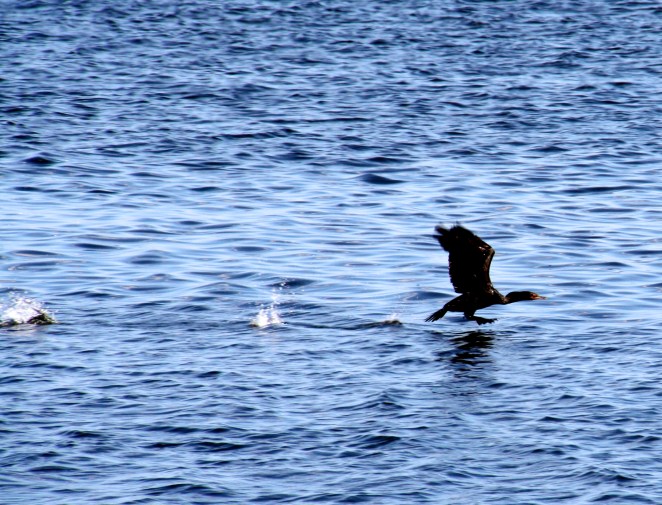
Luck, sometimes, just being in the right place at the right time. One step, two steps, and up he went and look at those footsteps. His flight, a step of faith, two steps of faith, and away he goes, fait accompli.Another golden oldie. I do love rediscovering them. The photos, too.
Flight of Fancy
Just by chance, I caught this cormorant. “Behind you, quick,” said Clare. I turned and ‘Click!’
Such a miracle: the first steps of flight taken over water. That first step heavy, the second one lighter, and the third one scarcely a paint brush pocking the waves.
The need to take flight lies deep within me. Fleeing from what? Running towards what? Who knows?
All I know is that the future lies to the right of this photo and the past lies to the left, and I don’t know the meaning of either.
But I do remember the words of Antonio Machado: ‘Caminante, no hay camino, sólo hay estela sobre la mar.’ “traveler, there is no road, just a wake across life’s sea.”
Comment: I revised this poem a few minutes ago and cut it down to its essentials. If you want to read the original and check the revisions, click on this link to the earlier poem. Any comments on the rewrite and the revision process would be welcome.










 rogermoorepoet