Carved in Stone 65 & 66

Carved in Stone
65

Flames flow sparkling waters,
a cataract of fire,
down church walls
as the Castillo burns.

Fireworks claw upwards
to knock on heaven’s door
and waken the sleeping gods
reminding them
not to forget their people.

A knife edge slices sun
from shadow, heat from cool,
solombra, Paz calls his neologism
with its combination
of sun and shade / sol y sombra.

66

I will never forget the taste and smell
of my own sweat as I walk beneath
the heaviness of a midday sun,
its heat falling vertical
and rebounding in waves
from concrete and cobbles.

I recall the roughness
of hand-hewn stone
heated by that burning sun,
the smoothness of silk
contrasting with the harshness
of tares in hand-woven wool,
marketed in the central square.

Commentary:

Fireworks claw upwards to knock on heaven’s door. The celebrants would buy their rockets in groups of 3, 6, or 12. When the first rocket went up – whoooosh – BANG! – we would wait for the fourth. When the sixth rocket went up, same thing – do they have a full dozen? And when the seventh rocket goes up, indeed, we know they do. Sometimes, we would be woken up in the early morning, as the joyful people returned home after a night of reveling. When that seventh rocket flew skywards – we knew it was useless to try and go back to sleep!

I remember leaving the zócalo one night, turning into a side street, and being met by a wall of people. A whole village, with its accompanying band stood there, waiting. Up went the first rocket, the band started to play, and the dancing broke out. No sleep for the gods that night. Their people needed them and had come knocking on the door. I was always amazed by the way the old gods stood shoulder to shoulder with the new gods of Christianity. The number of people who worshiped both also surprised me.

I last visited Oaxaca in 2001. I wonder how much has changed. I hope the dancing trees never change. Inside them, young children, their eyes peering through the bark, followed the band music. Occasionally, one of them would stop, open his or her tree, and invite you in. Alas, I never had the courage or the skill to accept the invitation. Even by 2001, the traditional carnival figures – monos – were gradually being replaced by Donald Duck and Mickey Mouse. Tragic, in so many ways. I hope they keep the traditions of the rockets and the music and the trees.

People of the Mist
A Poet’s Day in Oaxaca

If you want to read more about Oaxaca
Click here to purchase this book.

Carved in Stone 64

Carved in Stone
64

I cannot bring you
the sounds and smells
of my own backyard,
let alone those of Oaxaca.

The pungent odour
of the first drops of rain,
falling from a blue sky
into dry dust.

The tang of bees’ wax candles,
burning in the cathedral’s darkness
where la Virgen de la Soledad
clad in black velvet sequined with stars
stands on guard in her small side chapel

Nor can I bring you the high notes
sung at the golden altar
in Santo Domingo
by the old woman, dressed in black,
who sings here every day.

The central market
is a bustle of bursting scents,
rooftop goats snicker above me,
my neighbor’s German Shepherd
patrols the roof-garden
and growls in my ear.

Commentary:

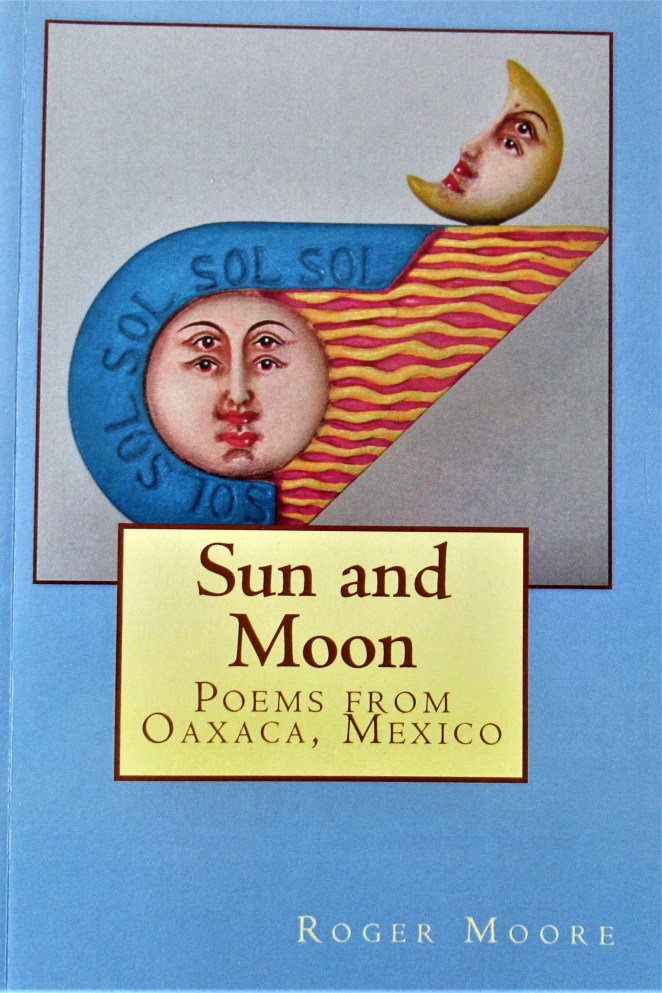
Sun and Moon is the first book in the Oaxacan Trilogy – Sun and Moon, At the Edge of Obsidian, Obsidian 22. I travelled to Oaxaca for 6-8 weeks each year between 1995 and 2001. I taught there and also researched the language, the culture, and the Mixtec Codices. Quite simply, my Oaxacan experiences changed my artistic, linguistic, educational, and cultural life. How? I earned to distinguish between what I could, and couldn’t do. A simple lesson, but one that needs to be understood at the deepest level of understanding.

The lessons took in all of my five senses – touch – dry dust, carved wood and stone, the tares in woven blankets -, taste – mole, flor de calabaza -, sight – the castillo burning -, sound – animals, goats and sheep, herded to the market-, smell – the central market is a bustle of bursting scents – hearing – rooftop goats snicker above me. A select few that blended with music of guelaguetza and the dancing that accompanied the village bands. But the experience(s) went beyond that. I began to realize, deep down, who I was, what I was, and, perhaps more importantly, what I wasn’t, what I could never be a part of, what separated myself from the other, the other whom I loved, who loved me, but who could never be a part of me.


Carved in Stone 21 & 22

21

Goodrich Castle – Civil War tore down
its curtain walls, fired its stables,
drove horses and people mad with fear,
all destroyed, a way of life, gone overnight.

I stand in the ruins of the solarium
beneath towering columns
empty now of the stained-glass
that would have kept out the rain
and retained the sun’s heat.

I imagine standing there,
speckled in sunshine,
coloured diamonds covering me.

22

I stop in the ruined quad
to sniff the air, to imagine the panic,
to smell the crackle of burning,
to hear the high-pitched screams
of dying horses, trapped in the stables.

Sometimes, at night,
fate mans the pumps of my blood,
and sends fire alarms surging
through my veins.

I do not want to die alone,
defenseless, besieged by memories
that gnaw away my remaining days,
like flames.

Commentary:

Memories burn away my remaining days, like flames. Fire controlled, stolen from the gods by Prometheus in Greek Mythology, by Zopilote, the Trickster, in Oaxacan Mythology. I will always recall those early mornings in Oaxaca, standing on the azotea (rooftop) doing my morning exercises in the half light. High above me, Zopilote slowly spiralled. His wings glowed red in the sun that had not yet penetrated to the earth below. As he descended, he brought the sun fire down with him and gifted it to humans.

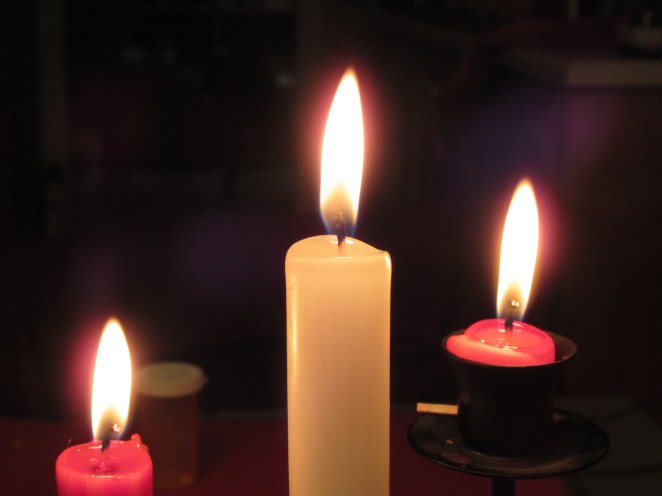
Fire and flames, under control, in the candle on the table, on the birthday cake, in hearth and fireplace, a life-giving source of heat, light, and energy. Fire and flames, uncontrolled – wild fires in the woods, blazing out of control. It happened last summer. A severe drought, and the woods so dry. A lightning strike – and fire and flame soon raged, out of control. Smoke darkened the skies and the smell of burning hung around for days. So many people evacuated, moving out of their houses with three days, two days, one day’s notice. Sometimes it was so much less. Three hours, two hours, one hour … our community newsletter contained details of what to have ready to cover each of those situations. Very sobering and thought-provoking.

Back now to Goodrich Castle. The occupants trapped inside the walls with no place to go. Horses and livestock trapped in the stables, and those life giving flames now bringing death and misery. “Man hands on misery to man. It deepens like a coastal shelf. Get out as early as you can.” Hands up all of you who recognize the author of those lines, a great English poet who is possibly not as well recognized as he ought to be. I know who he is, but I’ll leave you guessing and googling! Go on, Google him. I know you want to!

Slipping Away

Slipping Away

Some days I feel you are slipping away, sliding
slowly into yourself, losing all thoughts and feelings
in your mind’s twisting maze of secret ways.

It gets harder and harder for me to drag you away
from the color tv and back into the black and white
realities of the daily life we used to share.

I do my best. I drive you out for a daily walk
in the local park. I do the shopping on my own,
selecting the groceries I think will please you.

I pick up your prescriptions from the pharmacy.
I prepare a croissant sandwich for your lunch.
Every night, I cook you the supper of your choice.

The possibility of losing you starts to affect me.
Already I am feeling alone and desperate and I grieve
for that which I might lose, your active presence.

What is happening to us? Is it just old age?
The longer it goes on, the more it seems that you are
like a sailing ship at sea, diminishing in the distance,
or like early November snow, slowly fading away.

Commentary:

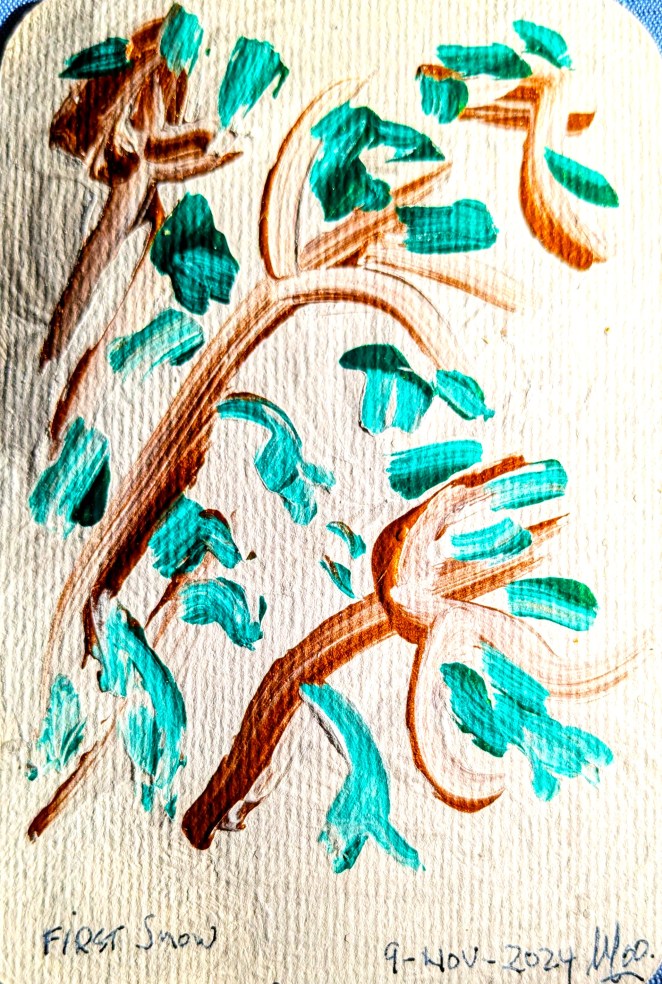
Moo liked this poem. He thought that First Snow was an excellent choice for the painting. This is Canada. We all know how that first, early snow storm can suddenly drift away into nothingness. The original poem ended with the line ‘like a sailing ship at sea, diminishing in the distance’ but Moo begged me to add another line – and so I did ‘or like early November snow, slowly fading away’. Good old Moo, he mothers me like a mother duck with only one duckling. He has some good ideas, though, and I love some of his paintings. It’s Thanksgiving Monday in Canada today and yes, we can all give thanks for Moo and his paintings! Well, I can anyway. So, here goes – thank you Moo.

Not that there’s any early snow here. Not yet, anyway. Frost yes, but last year I only used the snowblower on three occasions. That is a crazy winter. We used to get nine feet of winter snow here in Island View, and when the spring melt came, our black Labrador retriever could swim around the block in the flooded ditches. Now we scarcely get enough water to fill the aquifer and we live in fear of a water shortage that may, next year or the year after, dry up our wells. “De Nile ain’t just a river in Egypt.” No water shortage yet this year – but we are being very, very careful with our water usage. The St. John River is lower than anyone can remember – four feet down at least as it descends towards the sea. And that is not good news for anyone. “Those who have eyes, but will not see until the river fails to reach the sea.”

Many of us care. And we all do our little bit. No watering the lawns. No washing the car. No watering the flowers. Use the dish-washer once every few days, one weekly load, not multiple daily loads. Don’t leave the tap running while you brush your teeth. When they stayed with us, our friends from Oaxaca looked on in astonishment at the amount f water we wasted. We learned a great deal about water conservation from them. I must include them in my Thanksgiving Thanks as well.

Inquisitor

Inquisitor
Sun and Moon

He told me to read,
and plucked my left eye from its orbit.
He slashed the glowing globe of the other.
Knowledge leaked out, loose threads dangled.
He told me to speak and I squeezed dry dust
to spout a diet of Catechism and Confession.

He emptied my mind of poetry and history.
He destroyed the myths of my people.
He filled me with fantasies from a far-off land.
I live in a desert where people die of thirst,
yet he talked to me of a man who walked on water.

On all sides, as stubborn as stucco,
the prison walls listened and learned.
I counted the years with feeble scratches:
one, five, two, three.

For an hour each day the sun shone on my face,
for an hour at night the moon kept me company.
Broken worlds lay shattered inside me.
Dust gathered in my people’s ancient dictionary.

My heart was like a spring sowing
withering in my chest
It longed for the witch doctor’s magic,
for the healing slash of wind and rain.

The Inquisitor told me to write down our history:
I wrote … how his church … had come … to save us.

Commentary:

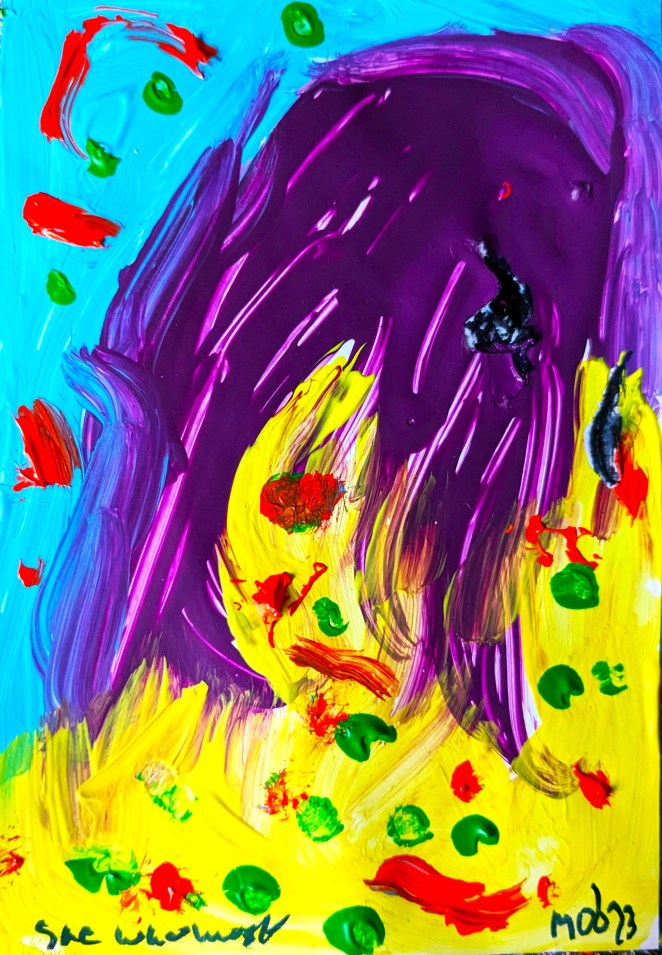
No wonder the little girl in Moo’s painting looks so sad. She must have read this poem and understood how the exercise of power and authority, be it religious or secular, can effect those upon whom it is exercised. Times change, but so many things remain the same. The pendulum swings, and it moves from chaos to order and back again. The meaning of meaning – how we define chaos and how we define order define who we are.

Birds of a feather flock together. Manners maketh the man. Wonderful sayings. But fine words do not necessarily make for fine men or women at that. Serpents and senators, both can speak with forked tongues. It is up to us to apply discourse analysis and distinguish between what they say and what they actually mean. As my friend Jean-Paul Sartre once said – “L’homme n’est rien d’autre que ce qu’il fait.” A man is nothing more than what he does. His deeds reveal his true inner self – and remember – the plumage doesn’t necessarily make the bird.

Gaia

Santo Domingo
Worshipping Gaia before the great altar
in Santo Domingo

If the goddess is not carried in your heart
like a warm loaf in a paper bag beneath your shirt
you will never discover her hiding place

she does not sip ambrosia from these golden flowers
nor does she climb this vine to her heavenly throne
nor does she sit on this ceiling frowning down

in spite of the sunshine trapped in all this gold
the church is cold and overwhelming
tourists come with cameras not the people with their prayers

my only warmth and comfort
not in this god who bids the lily gilded
but in that quieter voice that speaks within me

and brings me light amidst all this darkness
and brings me poverty amidst all this wealth

Commentary:

A Golden Oldie from Sun and Moon – Poems from Oaxaca. The Church of Santo Domingo in Oaxaca, Mexico, contains approximately six tons of gold and gold leaf. Incredible. I visited it regularly, but rarely saw anyone else in there. The local people seemed to avoid it and tourists with cameras were the main visitors. I refuse to take pictures inside churches, for several reasons.

It has always amazed me that the Spaniards built their churches on the sites of previous places of religious worship. This is partly because the indigenous appreciated the sacredness of certain sites, and partly because it was to these sites that the indigenous had traveled prior to the arrival of the Spaniards. Interesting, too, that the Spaniards call their arrival the Discovery while the indigenous call it the Conquest. History – a coin with two different sides – and it is sometimes difficult to look at both sides at once. Malinche – heroine or traitress? Cortes – hero or murderer? And, as they used to say in Northern Ireland, during the troubles, one man’s freedom fighter is another man’s terrorist.

Spin the coin of history, by all means. But beware of seeing only ‘heads’ and forgetting that there are ‘tails’. And never reduce those ‘tails’ to mere ‘tales’. Neither the written tradition nor the oral tradition is infallible. Many people, quiet and secretive as they may be, have long memories. And remember too that all that glitters is not necessarily gold.

Water

Water

Here, in Island View, my lawn’s parched grass
longs for water, long-promised but never drawing near.
Do my flowers remember when the earth slept without form
and darkness lay upon the face of the deep?

The waters under heaven gathered into one place.
When they separated, the firmament appeared.
Light sprang apart from darkness
and with the beginning of light came the word,
more words, and then the world …

… my own world of water in which my mother
carried me until her waters broke
and the life sustaining substance drained away
throwing me from dark to light.

In Oaxaca, water was born free, yet everywhere
lies imprisoned in bottles, in jars, in frozen cubes,
its captive essence staring out with grief-filled eyes.

A young boy on a tricycle pedals the streets
with a dozen prison cells, each with forty captives:
forty fresh clean litres of drinkable water. He holds
out his hand for money and invites the villagers
to pay a ransom, to set these prisoners free.

Real water yearns to be released, to be spontaneous,
to trickle out of the corner of your mouth,
to drip from your chin, and fall to the ground.

It is a mirage of palm trees upon burning sand.
It is the hot sun dragging its blood red tongue across the sky
and panting for water like a great big thirsty dog.

Commentary:

This year, spring came with lots of rain. At one stage it looked like the waterlogged plants in our flower beds would all drown. Then, just before summer came, the rain went away and we suffered day after day of unbearable heat followed by nights during which the temperatures scarcely dropped.

As a result, the woods dried up and dry lightning strikes started fires. At one stage close to forty wild fires burned, many out of control. Entry to the woods was forbidden by law. Gradually, the fire-fighters fought back, extinguished the fires, one by one, and reclaimed control. I hope everyone realizes the enormous debt we owe to those brave men and women who risk their lives to save not only our lives, but our houses and our properties.

The fires have gone now. We had a day’s rain, 11 mms fell, but it’s not enough. We need more, a great deal more. We need to soak the trees, the grass, and to feed the streams and rivers. We also need to refill the aquifers on which life on earth, as we know it, depends. We need deep ends in our pools, not the shallow ends of depends, when it depends on whether or not the skies open and the heavenly waters fall.

CBC radio last night – farmers say they have lost their winter hay. How will the animals survive our winters with the hay fields burned and dry? One farmer said that, having no hay himself, it would cost him a minimum of $55,000 to bring in hay – if he could find anyone to sell it to him. Unfortunately, the same is true across the Maritimes – drought, forest fires, and a lack of winter hay. Spare a thought (and a prayer or two) for all those poor creatures, born to die, who will suffer this winter on account of this summer’s heat.

What sacrifices have you made in life?

Daily writing prompt
What sacrifices have you made in life?

What sacrifices have you made in life?

Oh dear, so many, many sacrifices. Here, let me count the ways. This morning, for breakfast I sacrificed a banana, followed by an orange. Last night, for supper, I sacrificed a lobster – and it was lovely. I thanked its spirit for allowing me to nourish myself upon it. Then, for lunch, I sacrificed three eggs and cooked them in an omelet. You know what they say “You can’t make an omelet without breaking eggs”. Nor can you be a robber baron without breaking legs. Sorry. Wrong post. That belongs under “Have you ever broken any bones?” To which my answer is – “Only those of other people.” Maybe I’ll write that one later. But for now, two poems for your entertainment!

Squeezed Orange

Clock greets the hours
with hammer blows,
on a quivering anvil.

Rooster crows
his thick, rich cocoa rico:
morning provides
smells of roasting beans.

Squeezed orange –
glass fills with a golden liquid,
as fierce and sweet
as sunshine on a branch.

A wasted globe,
this orange bath robe,
spent and exhausted,
soon to be transubstantiated.

Breakfast

Yesterday,
I sacrificed a chicken.

Unborn,
it lay within
it’s calcium cocoon,
dormant,
a volcano sleeping
beneath thick snow.

Tap, tap, tap,
the silver spoon
bounced off
the hairless skull:
a sudden crack,
a spurt of orange blood.

Note: This poem is taken from my poetry collection Obsidian’s Edge – From Morning to Night: A Day in Oaxaca

Describe a man who has positively impacted your life.

Daily writing prompt
Describe a man who has positively impacted your life.

Describe a man who has positively impacted your life.

Does it have to be a man? Many women have impacted my life in a positive fashion. My Welsh grandmother taught me how to cook. She would stand me on a small stool placed beside the stove and I would watch as she explained what she was doing and why she was doing it. She allowed me to stir the various mixtures, to help beat the eggs, and when she baked, she always gave me a small piece of cake mix or dough so that I could create something for myself and bake it in the oven with the all the other things. It is hard to beat that type of impact. The small stone she threw still sends ripples through my kitchen and that of my daughter and granddaughter.

When I think of kitchens, I think of the many, many kitchens that I visited when living in France, Spain, and Oaxaca, Mexico. In each of them I picked up so many hints and ideas. In Santander, how to make a tortilla espanola / Spanish omelet. Every evening, my first landlady would leave, on the kitchen counter, one egg, one potato, and one onion. That was my supper – but I had to make it myself. I have made Spanish omelets for 60 years now. Some are simple, others combine different ingredients. All come from the kitchens I have visited in Spain.

In France, I learned the Parisian way to scramble eggs. Again, my landlady taught me how to scramble them her way, the only correct way. My scrambled eggs, learned as I was perfecting my knowledge of French language and culture, are still the talk of the table, when I serve them. Oaxaca was a total revelation, as I have said on many occasions, as was Oaxacan cooking. The first thing I learned – how to prepare quesadillas. Alas, there are no offerings of flor de calabaza with wish to garner them, not here in Canada, not that I have seen, anyway. Next came pico de gallo, that inimitable blend of cilantro, onion, jalapeno, tomato, lime, and salt. All of these recipes came, verbally, and practically, from the wonderful women who have enriched my world, as did the bacon and eggs, on a tortilla, with salsa mexicana, and the eggs scrambled in orange juice. And we won’t talk about the chapulines, grass-hoppers fried in garlic, nor the avocado with tuna delicacies.

Of course there have been men as well. Mon, the friend who spent twenty-three years in a Franco jail as a political prisoner, and survived. He built his own boat, powered by an old engine from a bakery that he adapted, and together we fished the Bay of Santander, every Sunday, for three consecutive summers. He taught me the secrets of the bay, where the fish were, where they hid, how they moved with the tides. He would encourage me to jump over the side, in deep water that lifted me up with the surge of the Biscay, under my armpits, and wouldn’t let me back on board until I could name every part of the bote. I became a very quick learner, especially as he was eating the omelet and drinking the wine as I was speaking. It was another incredible enrichment.

 Juanra, from Avila, was another such teacher. He would take me on his Sunday excursions to buy the week’s wine for his hostal-restaurante, and together we would visit La Seca, and other local wine-growing regions. I remember the day he and the lady who owned the vineyard we were visiting baptized me. We stood, thirty five feet underground, beside a wooden barrel, one of twelve in that cellar, that contained 5,000 litres of white wine. Juanra climbed a six foot ladder, and stood beside a tiny feather that acted as a plug to keep air out of the barrel. The lady, who performed the role of high priest, gave me a glass, showed me where to hold it, beneath the spigot, so that the wine would fill it and I could taste and test it. She turned the tap on – but no wine came out – then she held my hand ‘to keep it and the glass steady’. “Ahora / Now!” she gave the command. Juanra withdrew the feather, the wine flowed, and the lady jiggled my arm and soaked me from wrist to elbow, shrieking with a high-pitched laughter that blended with Juanra’s bass guffaw. “Ya te hemos bautizado,” they cried in unison. “Now we have baptized you.” And there I stood, a child of the vineyard and an adopted son of the land.

Just one? Only one? How could you be so cruel? I remember with great fondness one of my rugby coaches. Many of the people who surrounded him thought he was a clown, and told me so behind his back. But he had a certain something – and I wasn’t sure what it was. One day, at a national coaching conference, he took me on one side. “You already know everything that people here can teach you. But, somewhere, there is one piece of gold. You may find it here, or there, or in the bar. But that one piece of gold is what you will take home with you.”

When I coached the provincial junior team, one summer, I invited that coach to visit and to help me coach. We walked onto the field together. “Leave this to me,” he said. I asked him what I could do to help and he said – “Nothing. Just sit in my back pocket. See what I see. keep quiet. Ask questions later.” He started with a warm up game of rugby, which he refereed. “Whenever I blow the whistle three times – like this peep! – peep! – peep! – I want you to stop wherever you are. Don’t move until I tell you to.”

Then followed the most wonderful master coaching session I have ever witnessed. A ruck – peep! – peep! – peep! – – “Who was first to arrive?” No answer. he pointed. “You were. What did you do? Why did you do it?” This went on and on – scrums, lineouts, kick-offs, penalties, 25 yard drop outs – we weren’t metric yet. “Peep! – peep! – peep! – What did you do? Why did you do it? What else could you have done? Why didn’t you do that?”

They had called him a clown, the ones with the papers, and the coaching certificates, and the education, behind his back, and to them he was clown. But to me, he was a master coach. He taught me how to look, to listen, to see, to ask questions, and never to judge anyone until I had walked in a person’s shoes, or sat in their back pocket, not just for a mile, but for a whole wonderful weekend. He had a wonderful sense of humor and the clown left everyone laughing. Clown? He might have been the Prince of Clowns, but I have never forgotten what he taught me, nor how he taught it.

People of the Mist

People of the Mist

Cover Painting

Pale Face by Moo

Back Cover Synopsis

            What if you walked into a church in a foreign country and came face-to-face your dead father? In People of the Mist, Nemo, orphaned as a baby after the suicide of his unmarried mother, seems called to visit Oaxaca, Mexico, the city of the returning dead. Upon arrival, he visits the town’s main cathedral only to encounter his adoptive father, a man he had buried years earlier. Confused by what he thinks is a realistic vision, he seeks the help of a local witch doctor to explain his mirage. The shaman seems to hold the answer and presents him with a broken medallion. He challenges Nemo to find the other half, promising the quest and discovery will reveal the real purpose of the young man being called to Oaxaca.

Brief Biography

Roger Moore, is an award-winning teacher, researcher, poet, and short-story writer. His accolades include being a CBC short story finalist, as well as winning multiple awards from the WFNB. Born in Swansea, Wales, he now lives in Island View, NB, Canada. Between 1995 and 2001, he taught multiple classes in Oaxaca, Mexico, where he first encountered the Mixtec codices.

Click here to view on Amazon