Carved in Stone 6 & 7

6

At Westbury White Horse,
I wandered among unkempt mounds,
forgotten graveyards,
ancient barrows, their secrets
buried deep underground.

I walked to the horse’s eye,
stood there, then sat on the hill’s edge
to watch the sun drown
in a river of blood that turned
the White Horse red.

Shadows encroached.
A creeping chill came over me.
I started to shiver, not with cold,
but with the icy fear that someone,
something, evil and powerful,
long dead, but risen again, lurked,
hidden in the ground mists,
that rose as I fled,
not daring to look back.

7

But that fear,
deep-seated as it was,
could not match the terror I felt
as the sun set
over Badbury Rings.

An ancient horror
reigned over that place.

Mist warriors, visible
only from the waist up,
their weapons drawn,
charged towards me.

I felt chill fingers
clutching my heart, gripping it,
and tightening their hold.
I fled from them in the half-light.

Ancient powers linger long
in spite of charms, spells,
and exorcisms.

No wonder so many ancient tribes
shattered the legs of their dead
so they could not rise up
and walk again.

Commentary:

According to Wikipedia, the Westbury White Horse or Bratton White Horse is a hill figure on the escarpment of Salisbury Plain, approximately 1.5 mi (2.4 km) east of Westbury in Wiltshire, England. Standing at the northern edge of Bratton Downs, on a steeply sloping hillside below an Iron Age hill fort, it is the oldest of eight white horses in Wiltshire. The white horse has long been revered in European mythology. In Celtic traditions, it was associated with the Otherworld, acting as a guide between the realms of the living and the dead. In many myths, the white horse represented purity, power, and the ability to traverse spiritual boundaries.

I love visiting these sites. However, they need bright sunshine and warm weather. When the light starts to fail and the day grows cold, strange feelings emanate from the ruins. Many people have commented on this phenomenon and there are reports of sightings, such as the one that I associate with my visit to Badbury Rings. I went there late one afternoon, and as the evening drew in and the air grew colder, I and my companions felt a sudden (and totally inexplicable) fear. One look, and we ran as fast as we could back to the car park, got into the car, and sped away. None of us have ever forgotten that strange experience.

An Allegory for Gaia

Sponge in Water
an allegory for Gaia

She is in me
as I am in her –
I the sponge,
she, the water.

Our essences blend
with the promise
of an ample life
full of movement.

Eau de vie:
the water of life.

It causes me
to blossom and flourish,
to wither and perish
when her waters fail.

How lonely would I be
if she abandoned me?

What would she be,
what would she do
without me?


Commentary:

A summer without rain led to an early autumn drought. Slowly, water grew in importance. Wells in our neighborhood ran dry. We were lucky and were not affected. But we took great care not to waste water. Eau de Vie – the water of life – the water that brings life and causes life to blossom and flourish.

Without water, we are nothing. We cannot live. Then, when the rains came down, we rejoiced. We walked out into the yard and stood with our faces to the rain, looking up at the sky, mouths open, letting the water renew our hope and faith.

I took the photo, incidentally, from the dining table in my kitchen during a heavy rainstorm. Looking out into the garden, I saw a rush of water, so thick and heavy. Incredible. The photo hardly does it justice.

Carved in Stone 4 & 5

Carved in Stone 4 & 5

4

Maiden Castle –
Rome’s victorious Legions
sought out the main gates,
broke them down,
and placed their altars
to Mars or Mithras
on the ruins of the pagan temples
they desecrated.

What were they, those Romans,
but pagans themselves?

Their false gods
replaced the fake gods,
worshiped there long before
the legions’ arrival.

5

Later, the Saxon sword-song
superseded them
and the Roman Empire fell,
with a pendulum swing
that led to another set of gods.

How did they know
which was the true god?
Was it the belief in miracles
or the military might
that resolved the issue?

Bonfire night.
The sacred texts go up
in fire and smoke.

Brave is the man
who risks his hand in the fire,
defying the flames
to hold on to his truth.


Commentary:

“Brave is the man who risks his hand in the fire, defying the flames to hold on to his truth.” It appears that the Congregation of the Holy Office, aka the Inquisition, threatened to hold Galileo’s right hand in the fire unless he recanted and denied his scientific observations. Church theory held that the universe was terra-centric – the sun moved round that earth and the earth stood still – while Galileo showed that it was actually heliocentric – the sun stood still and the earth moved around it. Old and sick, he recanted in public, but was heard to mutter eppur si muoveyet it still moves.

Bonfire Night celebrates the discovery of the Gunpowder Plot. Barrels of gunpowder had been placed beneath the Houses of Parliament in Westminster, but they were discovered on November 5, 1605 and removed. Bonfire Night is also called Guy Fawkes Night, Guy Fawkes being one of the key plotters to remove the English Parliament. Leading up to Bonfire Night, young children in the UK place a ragged scarecrow, called a Guy, around the streets begging for “a penny for the Guy”! With these pennies they buy fireworks. Then, on November 5, the Guy is set atop a large bonfire and the fire is lit. This autumn burning is accompanied by fireworks.

Bonfire night also refers to the old medieval book burnings of texts that were anathema to whatever religion or regime was in control. Cervantes refers to them in Don Quixote, I, 6 (1605).

Carved in Stone 3

3

Death is everywhere.
It rides a pale horse
in the lands
where Odin reigned.

Sleipnir, his eight-legged steed,
carried him round the world.

It also carried the god
to the underworld,
and brought him back,
one of the few to enjoy
a return ticket.

Purity, innocence, power,
the White Horse rules
these Wiltshire hills,
a symbol of hope and renewal.

Above the horses,
hill forts in high places,
lie hidden.

Wave after wave
of earth-wall and ditch
blend into the landscape
making the forts
invisible from below.

Commentary:

Odin > Wodin > Wednesday, in English, not Mercredi (French) or Miercoles (Spanish). English, via Anglo-Saxon, often goes back to the Nordic gods of the invaders. Not so in Welsh for Wednesday in Welsh is Dydd Mercher, the word breaking down into “Dydd” (day) and “Mercher” (which is named after the Roman god Mercury). Alas, it is all too easy to reduce language to its most basic level. But dig below the surface and the wonders of language, history and culture, adoption and rejection, complication and simplification, are all there to be seen.

Our language links us, binds us, holds us across our culture and history. And remember ‘to lose our language is to lose ourselves.’ While to learn another language is to grow another heart and soul.


Carved in Stone 2

2

How many free thinkers
stumble up the gallows’ steps
or take that short walk,
candle in hand,
to the executioner’s block?

Some take a longer trip,
in a tumbril along French streets
lined with howling,
slogan-chanting citizens,
en route to the guillotine.

Heads, already severed,
welcome them with sightless eyes,
a strange harvest for straw baskets.

Hearken to the swish of stone
against steel as the executioner
sharpens the blade that will swiftly fall,
then rise, only to fall again.

The horse-drawn cart
creaks towards its inevitable end,
filled, standing room only,
with unfortunates trapped
by whatever rising tide
hurled them against the razor rocks
of their imminent mortality.

Commentary:

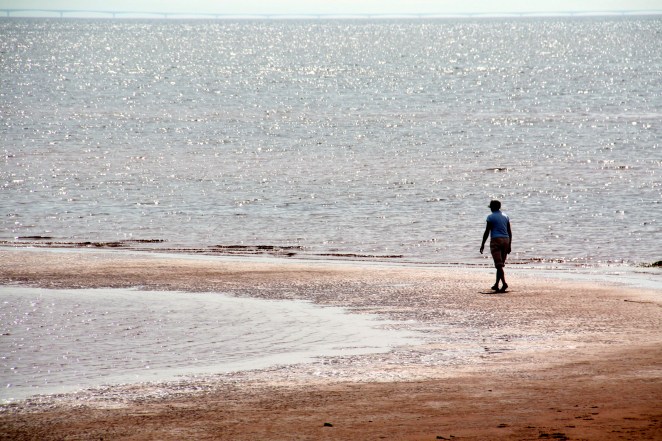
Flower Pot Rocks along the Fundy Coast. One of the most beautiful spots in New Brunswick, a province with so many other beauty spots. It’s hard to believe that I was standing on the seabed when I took that photo. It’s also hard to believe that the Fundy Tide, one of the highest, if not the highest, in the world, rises to the tree line, at the top of the photo, way above the sand.

If you go to the Fundy, consult the Tide Tables with care. You do not want to get stuck in the Fundy mud. Nor do you want to be one of the unfortunates trapped by whatever rising tide hurls you against the razor rocks of your imminent mortality.

Carved in Stone 1

My very own hand-carved verraco
Del Rincon (Avila) a Roger

Carved in Stone

1

Behold me here,
filled with a sort of shallow,
hollowed-out wisdom
accumulated over decades
while listening with my eyes
to the words and thoughts
of writers, long-dead.

Imprisoned in book pages,
do they bang their heads
against walls that bind,
or hammer with their fists
at the barred lines
of their printed cages?

These spirits long to break free,
but they choke on library dust
and pollen from verbal flowers
that bloom unseen.

Those old ones avoided
the traps of temporal power,
or, once trapped,
gnawed off a precious limb
to limp into freedom

Commentary:

Carved in Stone is the second dialog (Chronotopos II) in my Bakhtinian Dialogs with my time and my place. Clepsydra is the first Dialog. You can follow it, in its entirety, starting with this first, introductory post.

Reception Theory – I write, you read. Any meaning that you extract from my poetry will depend on your own culture and background. Tolle, Lege – Take and read. Read slowly, and with care.

I am a poet, a dreamer, if you will. These are my dreams. Tread softly on my dreams, for when you enter my world, you mingle your dreams with mine. The result, I hope, will be an interesting intellectual blend of new creativity.

The hand-carved verraco, in the photo above, was given me by my friends in the Rincon (Avila) where I spent four happy and creative summers. Never forgotten. Blessings and pax amorque.

Clepsydra 49 & 50

49

… I am walking backwards
     a step at a time
          into my second childhood


my face in the mirror
     is no longer that of the little boy
          I used to be


I open so many boxes
     stored in my mind’s attic
          but find only dust and ashes
               the burnt-out remains
                    of long-gone days …


50

… sitting in the car
     waiting for my beloved
          to finish her shopping

who are they
     these faceless people
          these ghosts
               who look at me
                    then avert their eyes

I see their faces
     distorted in the puddles
          left by last night’s rain

why don’t they speak to me
     why do they always
          avoid my eyes

is it the blue sticker
     in the windscreen …  

Commentary:

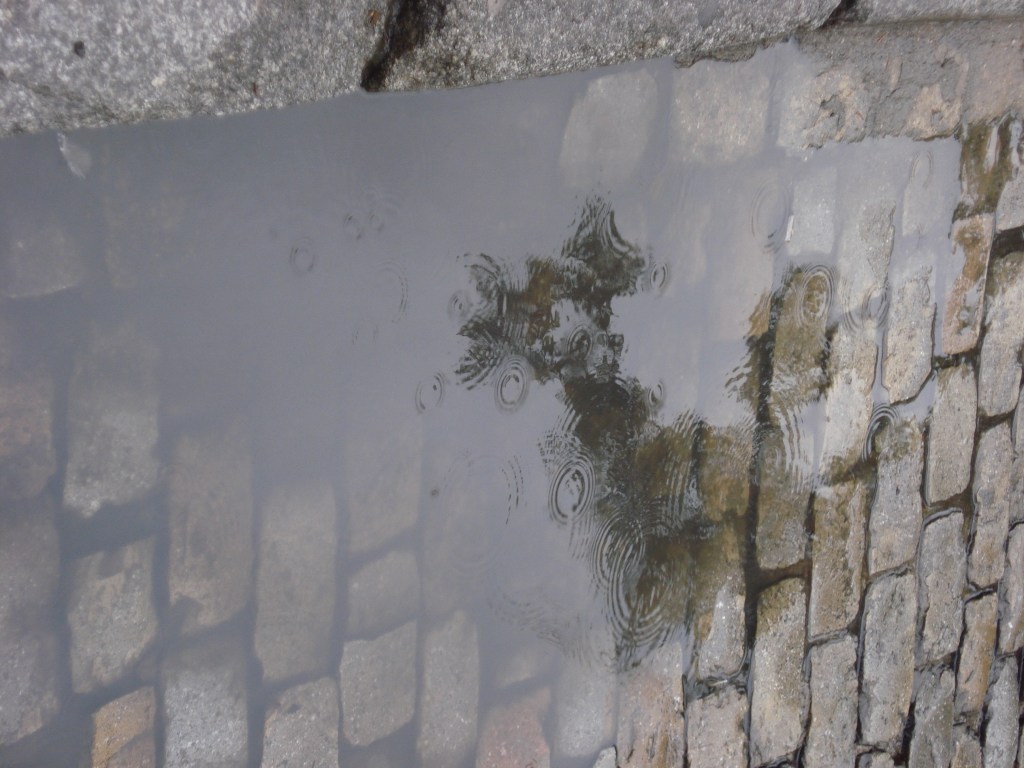
I see their faces distorted in the puddles left by last night’s rain.

Clepsydra 47 & 48

47

… the baited fish-hook
     the tidbit swallowed
          by an eager young gull
 
then reeled in
     by the young boy
          who winds the bird down
              
I wish
     I could control the words
          that appear in my mind

but I cannot I tie them to a hook
     and use them as bait
          for anyone gullible
               that I can reel in


I must leave so many gulls
     to float on the wind
          to hover soar and fly
               in their element

the lonely sea
     and the sky …

48

… I listen to the heartbeat
     of this old house
          hearing an occasional creak

I inhale
     exhale
          listen to my body sounds


my heart rate slows
      the faint tick
          of a distant clock
               no footstep
                    on the stair

a dust mote dances
     on a moon beam

I swim in an amniotic silence
     broken only
          by the beating
               of my mother’s heart

and my own heart
     throbbing
          in response …

Commentary:

So little to say. The poem now says it all. “The lonely sea and the sky. My heart throbbing in response.”

Clepsydra 45 & 46

45

… I enter ancient rooms
     on the walls
          pale ghosts walk
               flickering shadows

why am I tongue-tied
     why do I struggle
          a fly in a spiderweb
               to make myself heard

I long for
     the freedom of flight
          for culture restored
                    for a return
                         to my own lost world

I grasp at shadows
     reaching out
          for the ones I know
                         are no longer there …

46

… how deeply time’s wounds

     have cut and carved
          through my flesh and bone

               into the embers
                    of that slow-burn fire
                         they call the heart

some days those wounds
     neither ache nor itch
          but in moments of madness
               a knife-edged finger nail
                    careless in the dark
                         opens them up

they throb again
     and begin to bleed afresh …

Commentary:

” … on the walls, pale ghosts walk flickering shadows – I grasp at shadows, reaching out for the ones I know are no longer there …” Vanity of vanities, all is vanity. For in much wisdom is much grief, and he who increases knowledge increases sorrow.

” … the embers of that slow-burn fire they call the heart … ” Pulvus eres et pulvus eris. Just another shadow on life’s wall.

Clepsydra 41 & 42

41

… fire flares on the water
     rivers and lakes blaze
          that sound is a monster
               a dragon descending
                    breathing fire

so swift so powerful
     come sudden
          from nowhere
              yet another disaster
                   with its ravenous roar         

the dragon refuses to move on
     until sated
          but who could satisfy
               that monster
                    destroy its will
                         defeat its power

will Lac Megantic
     ever be the same
          after all these years
               of grief and tears

will fading memories
     be all that remain …


42

… a stillness between words
    tranquil movements
         the world suspended in space
               soundless the night
                    drenched in silent light

 Aurora Borealis
     draws gaudy curtains
          across the night sky

I can hear my heart beat
    as time softly sifts

a celestial hour glass
     this sky filled
          with unimaginable light
               breaking coloured waves

lit up
     with mysterious flowers
          so graceful
               when decked out
                    in light

 the moon returns
     turns into a mirror

          its silver boat
               suspended in space

silent its light
     enlightening
          the heart’s dusky craters

dawn’s silent glory
     will be here soon
          pointing the silent path
               to even more light …

Commentary:

Ten years or so since the disaster at Lake Megantic. I am sure it affected everyone who followed the news, saw the pictures, and bore witness to the power of conflagration. Moo offered me his painting called Burning Birbi. A Birbi is a Koala Bear in one of the Aboriginal Languages. When the fires hit New South Wales, the Eucalyptus Trees started to fire. When in danger, the Birbi climbs the eucalyptus trees, higher and higher, followed, of course, by the fire. A fate inescapable. Just like the Megantic Disaster. Word has it that it could, and should, have been prevented. I cannot (will not) comment on that here. I will just stress the fear that we all have, those of us who live in a drought stricken province (New Brunswick) surrounded by trees.

The closest wildfire to us, in Island View, was about 31 kilometres away. The closest trees are about 30 feet away from the house. Much too close for comfort. Curtains of flame and smoke, rising up to stain the skies. And the smell of burning also inescapable. Stay indoors, I say. Shut the windows. And hope that nothing comes your way!

Fire, controlled, brings heat, warmth, light. The Northern Lights bring spectacular light flooding down from the skies, not rising up. You can almost hear the sky crackling as the light curtains shift and shimmer and dance their way across the horizon. Fire and Fire Light – beautiful when we can control them, but oh-so-destructive when they flame and flare, out of control.

Do not despair. Just remember we need each other, all of us, each one of us. Together we can overcome most things. Isolated and alone, like the lone koala at the top of his tree, it is much, much more difficult to survive. Select your friends carefully. Maintain contact with them. And be there for each other in times of need, for, as we say in Wales – “a friend in need, is a friend in deed.”