What’s the most money you’ve ever spent on a meal? Was it worth it?

Daily writing prompt
What’s the most money you’ve ever spent on a meal? Was it worth it?

What’s the most money you’ve ever spent on a meal? Was it worth it?

The real question is not, how much money did you spend, but was the meal worth it! Think hamburgers – they can vary in price from a couple of dollars to twenty or thirty dollars, each. Is a good hamburger at $2.00 worth more than a rotten hamburger at $20.00? Of course it is. However, if you get a rotten hamburger at $2.00, even those dollars seem to be a waste of money, in the stomach pains of post-gobbling regret.

The same question and answer can be applied to most things – a sweater, a suit of clothes, a dress, a diamond ring… What we are really talking about is value for money. One of the best meals I have ever eaten was at a small restaurant outside the railway station in Lisbon. I arrived early for the overnight train to Madrid, checked my luggage in the left-luggage office, and walked down the road to this wonderful restaurant. I had plenty of time.

When I arrived a plate of hors d’oeuvres appeared before. These were meant to be snacked on before I placed my order. I asked for the menu of the day and chose pork tenderloin cutlets, with patatas bravas (hot spicy fried potatoes). After this came a small omelet, with fines herbes, French style, and this was followed by a lettuce, tomato, onion salad, in an oil and vinegar dressing. A fresh loaf of bread accompanied the meal and red wine was served throughout. Dessert was half a melon, hollowed out, filled with ice cream and soaked in cherry brandy. Afterwards, came a cigar (I smoked occasionally in those days), and a glass of brandy, with espresso coffee. It was simply delicious. How do you valley such a meal? I asked for the bill and reached for my traveler’s cheques (these were indeed the old days, before the ubiquitous credit card). I was ready to pay what the waiter demanded.

When the bill came, I couldn’t believe my eyes – $25, $50, $75, $100? No such luck. $4.50 and $5.00 with the tip added on. I didn’t need my traveler’s cheques. I pulled my wallet out and gave the waiter the equivalent of $10. What a wonderful meal. Totally unforgettable.

I have eaten in five star restaurants, in Michelin recommended restaurants, in restaurants owned by the friends of friends, and I have been ripped off, left right, and centre / center – whichever way you want to spell it. I have often found that the simple restaurants, with home cooking, and a simple menu were better than the over-rated, highly expensive, glitzy showpieces.

In Santander, we used to regularly visit a small restaurant that specialized in fish. The owners had their own fishing boat. They would net fish at sea, but line fish on the way back to port, genuine trawling, the old-fashioned way. The fish they caught was fresh, unbruised from the nets, and, at their restaurant, always cooked simply and well. Family and friends, we all shared the bounty of the sea. And the prices were low, while the quality and love was high.

Discourse Analysis – look at the question. Think about the words and ask what they mean. Search beyond them (and the simple answer) for the true values by which you wish to live your life. Do you crave the $100 cigar, or the free one delivered to your table after a wonderful meal? The $100 sauces that cover up the taste of the rancid meat or fish, or the simplicity of family food, hand picked and as fresh as fresh can be?

Oh yes – and I remember waiting two hours for my meal at one restaurant, a tiny one in a small community in Northern Spain, that nestled by a fish-filled stream. The trout, fried with bacon, were on special. The owner’s son had been sent to the stream to catch them, but they were slow to bite that day. The wine and tapas were free until the meal arrived. And arrive it did, dripping wet and still wriggling slightly. Twelve delicious trout, four each between the three of us. Who’s for fast food? Not me. I want the simple life – shared with friends and filled with love – any day of the week, no matter the cost. But when you look well and seek wisely, it will not cost that much – and it will be unforgettable.

And look at the paella I made for my beloved and I – in the photo above -. Warm for supper and cold for lunch the next day. Simple, relatively quick, and four round meals (they really weren’t square) served at about $2.oo a plate. Unbeatable. Unforgettable.
Do you still sleep in your childhood bedroom?

Do you still sleep in your childhood bedroom?

Good question. A better one might have been – “Did you have your own bedroom as a child?” The answer is “No, I didn’t. Not that I can remember.” As a war baby, I was moved around quite a bit in my childhood. I remember sleeping in three different bedrooms in our first house. Then we moved in with my maternal grandparents, and I slept in three more bedrooms, often in the same bed with one or other of the grandparents, sometimes on a makeshift bed on the floor. Later, or it may be around the same time, those early childhood memories are so hazy, I went to live with my parental grandparents – three more bedrooms there – same conditions. The family also had a bungalow close to the beach on the Gower peninsula. It had three bedrooms and I slept in all of them, under similar conditions, and seldom alone, until my later years.

I was bundled off to boarding school while I was still a child. Two dormitories at the first boarding school. I was between six and eight years old, and the memories of that school are not sharp, though I recall with total clarity the canings and the shaming of myself and the other young children. It was a religious school. And I need say no more on that subject.

My second boarding school , a preparatory school, saw me inhabiting four dormitories that I can remember. My clearest memory of that place is running away one night, only to be brought kicking and screaming back to the place. Both my parents worked. During the holidays, I was shipped around to various members of the family – aunts, uncles, and grandparents. When I left that school, for the last time, age eleven, my grandparents drove me to my new forever home in a city far from my birthday place. There, three bedrooms witnessed my sleeping habits.

My third boarding school, the Junior School of a larger college, provided me with two dormitories, one per year while I was there. This was the time at which I started to travel with my mother during the vacations. A coach tour on the continent once saw us visiting six countries in two weeks, and that wasn’t the only coach tur I did with her. A succession of hotel bedrooms, then, and no nocturnal stability at all.

I stayed in my fourth boarding school, the Senior School of that Junior School, for five years and received a new dormitory each year. From there I went to study in Paris – more bedrooms – then down to Spain for the summer courses at the International University in Santander, but by now, age eighteen, my childhood was over.

So, a quick count shows that I slept in at least twenty-five bedrooms during my child. And that’s without counting holiday hotels, flats, apartments, and other forms of lodgings, including Youth Hostels.

So, remind me – what was the question? Ah yes, I remember now. “Do You still sleep in your childhood bedroom?” Well, my friends and readers, the answer is a very loud “NO!” Think about it – how could I have? I am not sure that I even had a childhood bedroom!

Write about your first crush.

Daily writing prompt
Write about your first crush.

Write about your first crush.

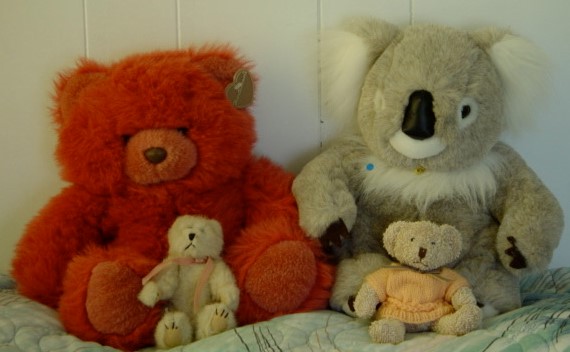
No. No, I can safely say that I have never had that sort of crush, except on a teddy bear or a little poo-pee aka puppy. I guess my first real crush was an orange crush. And no, again, not that orange crush either. I guess I have never been a fan of the Denver Broncos. But, as a child, I loved Orange Crush and Dandelion and Burdock, the former suitable for children and the latter looking remarkably like grown aka groan up beer.

During my time at university, I fell victim to several crushes. One was at the bottom of a collapsed scrum while playing rugby. Never much fun that sort of crush. All those sweaty, smelly bodies. Another came in an attempt to beat the Guinness Book of Records under the achievement – how many people can you get inside an English Telephone Kiosk? This was in the sixties, when England actually had telephone kiosks. If you have never seen a real English telephone kiosk, there’s one down in Kingsbrae Gardens, and I highly recommend a visit to that antiquity – almost as good as the statues in the gardens.

Anyway, one day in rag week, a group of Bristol University students, me among them, started crowding into a telephone kiosk. We entered upright, tried kneeling, others kneeling on our shoulders. We managed about twelve.

Doors open or doors closed? This baby came with no instructions. Poor parents, even more miserable single parents. And they are almost always young women, aren’t they? Come to think of it, maybe we should have invited some female students to join us – much lighter in weight and far less smelly – in the bad sense!

So, we tried a different tactic. If the first measure was a crush, and indeed it was, well, the second measure??? Judge for yourselves. One of us held the door open, the rest of us lay down like logs, feet outside the door, and the newcomers lay down on top of us. Ingenious indeed. But those at the bottom could scarcely breathe. They were the victims of a real crush.

Like the finger in the woodpecker’s hole, we reversed it – feet in, heads out. We got up to twenty-seven students. Then we ran out of student volunteers. Revolting. We asked passers-by to help us. But to no avail. Reversed and removed. Equally revolting. Sent our efforts in, with photos. There was no response. We didn’t make it. I still don’t know what that particular crush record is.

In Cassis-les-Calanques, 1960, I was one of eight people standing in a Citroen Deux Chevaux. That was quite a crush. But, in Santander, Spain, 1970, Clare and I watched 11 people, yes, eleven, get out of a SEAT 600, a 600cc Spanish four-seater car, otherwise known as a bullet / bala, and with about as big an engine as your lawnmower. They exited, one by one, and proceeded to enter the local church for Sunday mass. Can you imagine 11 people riding on your lawnmower?

Maybe that wasn’t a crush at all. Maybe it was just a (Morris) minor miracle.

Which food, when you eat it, instantly transports you to childhood?

Daily writing prompt
Which food, when you eat it, instantly transports you to childhood?

Which food, when you eat it, instantly transports you to childhood?

That’s an easy one – diolch yn fawr / thank you very much – and the answer is Bara Lawr / laverbread of course.

What does laverbread taste like? I must thank Wikipedia for the answer below.

Welsh Laverbread (PDO) | Business Wales - Food and drink

Welsh Laverbread is made from cooked laver (seaweed) which has been plucked by hand from the Welsh coastline. It has a unique texture and salty flavour which provides a taste of the fresh, Welsh sea. Laver or Laver porphyra umbilicalis is the only seaweed which is only one cell thick.

And click on the link for a video from YouTube on the Traditional Welsh breakfast.

Laverbread could be found all around the Gower Peninsula in my childhood. When I was very young, you could buy it at Swansea Market for three pence a pound. Later, the price went up to sixpence a pound. When I lived in Cardiff, back in the early sixties, it sold at a pound per pound. Later, as the coast around Wales became more and more polluted, the sea weed had to be imported from the West of Ireland, and that certainly drove the price up – five pound a pound in the eighties.

But laverbread has two histories – the scientific / culinary one, and the personal one. Laverbread, on the plate, looks suspiciously like a cowpat. So much so, that when the cows visited the bungalow field where we had our summer home, the cowpats were called laverbread. “Don’t step in the laverbread, dear.”

Field rolling was a childhood joy. Start at the top of the slope and roll all the way down to the bottom. Born and bred in a laverbread field, we would plot our route between the patties before we rolled. Alas, our London cousins, with their cockney accents, were city and street wise, but not laver bread wise. Down the field they rolled, without looking, right through the laverbread patches. I leave the ensuing scene to you imaginations – and remember that the bungalow had no electricity in those early days, and no running water.

I remember the first day my beloved came to visit us at home. My mother served her fresh hot laverbread. Of course, she had never seen anything like it, except genuine Somerset cowpats. She picked around her food, left the laverbread on her plate until it cooled and – “Hold on a moment,” said my mother, “your laverbread’s cold. Here – I’ll warm it up for you.” Poor Clare. I am ashamed to say, I ate her helping while my mother was looking elsewhere – just devoured the extra portion, enjoying every moment, and Clare was so happy to see it disappear.

Here, in New Brunswick, while Clare was away one weekend, Becky and I decided to make laverbread from dulse. We followed the recipes and they worked. The laverbread was delicious – but – ah yes, there’s always a but – but the house stank of the sea shore at low tide and the first thing Clare said when she got home was – “What is that awful smell?”

I remember, opening a closet to get a clean shirt, about six weeks later, and that familiar whiff of the seashore immediately assaulted my nostrils. Alas, Becky and I love our laverbread, but -there’s that word again – but making it in our house long been banned.

If humans had taglines, what would yours be?

Daily writing prompt
If humans had taglines, what would yours be?

If humans had taglines, what would yours be?

I really only want a one word tag – poet, and that’s the name of my blog – rogermoorepoet.com.

An award-winning teacher, researcher, poet, and short-story writer, I was born in Swansea, the same town as Dylan Thomas, the famous Welsh poet, whom I emulated in my youth. I wrote poetry throughout my childhood, but I never took lessons, nor was I known as a poet.

Early in 1962, I sent a sonnet to the poetry competition of the Stroud Festival of Religion and the Arts. I left school and was studying in Paris, when the results came out and I discovered that I had won first place in that competition. In my absence, a deserving boy from my school was sent to pick up the award, a book of poetry, signed by Ursula Vaughan Williams. The poem was published in Trydan and I have a copy of it somewhere.

Throughout my undergraduate career (1963-1966), I wrote poetry. Much of my early work appeared in my university’s student arts review, The Nonesuch Magazine – the Flower of Bristol that giveth great light. Alas, I was not studying English, and only the English students seemed capable of being called poets, so I was always called something else. I wrote a lot about nature, back then. One day, when I hand delivered my poetry submission, the editor of Nonesuch, an English student, asked me if I was a pantheist. “Good heavens, no,” I told him. “I’ve got a girl friend.” This answer did nothing in university circles to affirm my wanna be status as a poet.

Some of these poems survived and a couple appeared in Stars at Elbow and Foot. Here is one from Last Year in Paradise.

St. Mary Redcliffe

Time and Temple Meads
have begrimed your wand-thin spire,
the tallest in England.

You waved goodbye
to the Cabot boys,
Nova Scotia bound,
as they set sail.

Starlings lime your belfry,
gift and inspiration
of Merchant Adventurers,
that gentlemen’s company.

Worms wriggle and gnaw
at your ship’s figure-head,
harbored now, bare-breasted,
sturdy in your oak-beam nave.

Rust rustles and creaks
at the Edney Gates,
wrought to last centuries
by Bristol ironmasters,
themselves apprenticed
to learn time’s laws.

I call myself a poet. I think of myself as a poet. In Santander, Spain, I was known as the mad Welsh poet! What an honour it would be to have Roger Moore Poet as my tagline. I’d rather leave the ‘mad Welsh’ out.

But why stop at one tagline? I am also an award winning teacher and researcher. And a long-term rugby coach. How would they be as tags? Roger Moore Coach? Roger Moore Teacher? Roger Moore Researcher? Not quite the same thing. No resonance and I can produce no links to attach to those names. They are much more run of the mill. Anyone can be a coach, a teacher, a researcher. Not everyone can be a poet, let alone a famous poet, like Dylan Thomas. Besides which, I live in Idlewood, not Milkwood.

There is one other alternative, however. Roger Moore 007. Alas, that one belongs to someone much more famous than me, even though we share the same name. But I might go one step further. How about 3M-007? That would do at a pinch – pretty unique – there aren’t many of them about! I love it. So there we go – a choice of two taglines, either of which fit – Roger Moore Poet and Roger Moore 3M-007.

Which one would you choose for me? “A rose by any other name would smell as sweet.” But remember, I ain’t no rose. So please don’t tread on the tails of my all-disguising, multi-colored 3M-007 poetry coat.

Solar Eclipse

Solar Eclipse

(Devil’s Kitchen, PP. 118-120)

            … with my angels … face to face … the ones I have carried within me since the day I was born … the grey-one … winged like a whisky jack who arrives in dreams… the white-one that hovers dove-like as I lie asleep … the multi-colored-one who wraps me in his feathered wings when I am alone and chilled by the world around me … the black-one who flaps with me on his back when I can walk no further and who creates the single set of footprints that plod their path through the badlands when I can walk no more …
            … ‘the truth’ my black angel says to me … I say ‘he’ but he is a powerful spirit, not sexed in anyway I know it … and yet I think of him as ‘he’ …awesome in the tiny reflection he sometimes allows me to glimpse of his power and glory … for, like Rilke, I could not bear meeting his whole angelic being face to face … as I cannot bear the sun, not by day, and not in eclipse … not even with smoked glass … this is the moment of truth when human values turn upside down and earth takes on a new reality … wild birds and bank swallows roosting at three in the afternoon … and that fierce heat draining from the summer sky … I remember it well … and the dog whimpering as a portion of the angel’s wing erased the sun until an umber midnight ruled … a simple phenomenon, the papers said … the moon coming between the earth and the sun …but magic … pure magic … to we who stood on the shore at Skinner’s Pond and sensed the majesty of the universe … more powerful than anything we could imagine … and the dog … taking no comfort from its human gods … whimpering at our feet …
            … during the eclipse I saw a single feather floating down and knew my angel had placed himself between me and all that glory … to protect me … to save me from myself … and I saw that snowflake of an angel feather bleached from black to white by some small trick of the sunlight … and knowledge filled me … and for a moment I felt the glory … the magnificence … and there are no words for that slow filling up with want and desire as light filters from the sky and the body fills with darkness … and I was so afraid … afraid of myself … of where I had been … of where I stood … of what I might return to … of my lost shadow … snipped from my heels …
            … I don’t know how I heard my angel’s words … ‘the time of truth is upon you’ … ‘all you have ever been is behind you now’ … ‘naked you stand here on this shore’ … ‘like the grains of sand on this beach’ … ‘your days are numbered by the only one who counts’ … I heard the sound of roosting wings … but I heard and saw nothing more … I felt only midnight’s cold when the chill enters the body and the soul is sore afraid …
            … ‘it is the law’ my angel said … I saw a second feather fall … ‘and the law says man must fail’ … ‘his spirit must leave its mortal shell and fly back to the light’ … ‘blood will cease to flow’ … ‘the heart will no longer beat’ … the spirit must accept the call and go’ … ‘do not assume’… ‘nobody knows what lies in wait’ … ‘blind acceptance’ … ‘the only way’ … ‘now’ …  ‘in this twilight hour’ …  ‘now when you are blind’ … ‘only the blind shall receive the gift of sight’ … ‘all you have’ … ‘your wife’ … ‘your house’ … ‘your car’ … ‘your child’ … ‘everything you think of as yours’ … ‘I own’ … ‘and on that day’ …’ I will claim it from you and take it for my own’ … ‘now I can say no more’ …
            … the sea-wind rose with a sigh and one by one night’s shadows fled … the moon’s brief circle fell away from the sun … light returned, a drop at a time, sunshine flowing from a heavenly clepsydra filled with light …
            after the eclipse … birds ceased to circle … a stray dog saw a sea-gull and chased it back to sea … and the sun … source of all goodness … was once again a golden coin floating in the sky …

… on my shoulder a feather perched … a whisper of warmth wrapped its protective cloak around my shoulders … for a moment, just a moment, I knew I was the apple of my angel’s eye … and I knew that one day I would meet him again … and understand …

Devil’s Kitchen
Short Stories and Flash Fiction

Click here to purchase this book.

When you were five, what did you want to be when you grew up?

Daily writing prompt
When you were five, what did you want to be when you grew up?

When you were five, what did you want to be when you grew up?

I attended an international research conference on Quevedo, a long time ago, when I was teaching full time. A senior researcher, at the reception, heard me speaking and spoke to me – “Excuse me, and forgive me for asking, but I love your accent. Where did you grow up?” The question took me by surprise and, slightly off-balance, I replied – “I don’t think I have yet.” I assume the laughter was provoked by whatever my fellow academics were quaffing at the time.

Yet the answer lies very close to the truth. When I was four or five years old, one of the local priests asked me a similar question – “What do you want to be when you grow up?” At that stage of my life, I lived in a very strange world. All around me, my family seemed to fight like cats and dogs. I watched my dog chasing cats, and thought that women were cats and men were dogs. And all they ever did was chase one another and fight. I didn’t want to live a life like that. “I never want to grow up,” I told that priest. “You have to grow up,” the priest replied. “Everybody has to grow up.” “Peter Pan didn’t,” I said. “And I won’t either.”

I have tried, like Picasso, to see worldly things through they eyes of that child who has always lived in me. Sometimes, it is not easy to do so. The bitterness of the adult world creeps in and my world is flooded by those same old conflicts that have been there ever since I can remember. Fray Luis de Leon wrote about them when, after five years, he was finally released from imprisonment by the Spanish Inquisition.

“Aqui la envidia y mentira / me tuvieron encerrado,” he penned. “Here, envy and lies / kept me imprisoned.” Rather than the rat race of the adult world, he chose to follow the “hidden path trodden by the few wise sages who have lived in this world.” He also chose to be surrounded by simplicity and the child-like pleasures of a solitary life in which he found himself “ni envidiado, ni invidioso” / “neither envied nor envious.”

And there you have it, drawn from the mind of a five year old child and framed in the words, more or less, of a an excellent Spanish poet, whose work, dating from the 16th. Century, borders on the mystical nature of pantheistic theological thought.

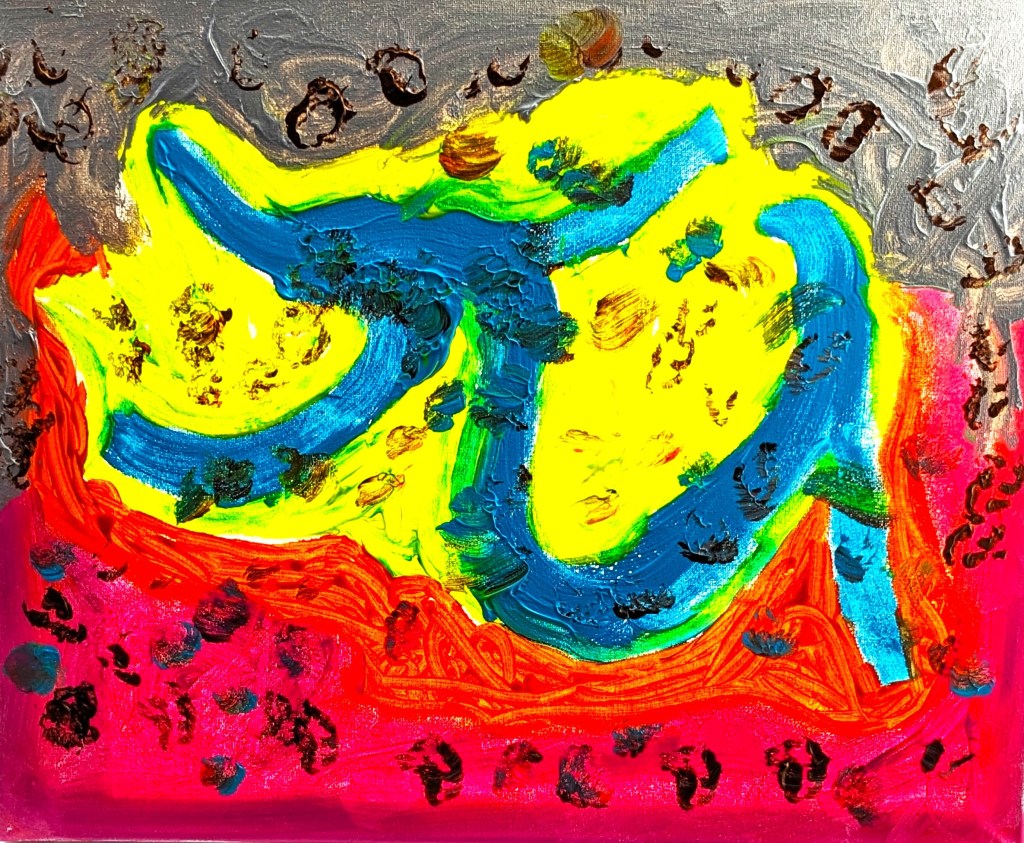
The painting, incidentally, is by my artist friend, Moo, and he calls it Pi in the Sky. You can think what you like about that and interpret it in any way you want. I hope Moo never grows up either.

What movies or TV series have you watched more than 5 times?

Daily writing prompt
What movies or TV series have you watched more than 5 times?

What movies or TV series have you watched more than 5 times?

How do you define a TV series? If you mean ALL the episodes of, let us say, Coronation Street, I have to admit that I haven’t watched the whole series once, let alone five times. However, since I can recall Ena Sharples, Minnie Caldwell, and Martha Longhurst, and since I can also recall Ken Barlow as a schoolboy, I guess I have seen more than five, individual episodes over the last sixty years or so. I remember watching it on our black and white tv, very grainy, during the school holidays. Lots of strange, new advertisements, and ITV the only rival to the BBC.

Other TV series, of which I have seen at least five separate episodes, include Dr. Who, Last Tango in Halifax, Doc Martin, Midsomer Murders, and many others, including Watch With Mother, The Woodentops, Muffin the Mule, Sooty, Bill and Ben, and The Magic Roundabout. I can’t imagine watching Sooty hit Harry Corbett with a hammer five consecutive times! In the same show, yes, but I don’t think Harry Corbett, or I would survive watching a continuous loop of the series five times. “Oh no, Sooty. Don’t hit me with the hammer.” Whack! “Ouch!”

The same with films. I used to love going to the movies with my daughter. I took her to see Bambi one night. That movie was sold out so we watched Rocky instead. I can’t remember what number it was, but I do remember us chanting Bambi! Bambi! Bambi! as the blows in the boxing ring flew thick and fast. We were still chanting it when we drove home.

Another movie that we watched several times – The Time Bandits. I still have dreams of the horse breaking through the bedroom wall and into the child’s sleeping room. Scrooge, in one of its many reinventions, is a Christmas favorite, as is The Sound of Music, and A Child’s Christmas in Wales. I guess I might have seen them more than five times, though I usually get bored with the repetition and take a break and move away. Stagecoach is another family favorite and I have seen it in black and white as well as in color. But whether I have seen it more than five times is a good question.

Having said all of that, the one movie that my daughter and I did see on at least ten separate occasions was Labyrinth. I was researching in Spain at the time. We went to see it several times in Madrid. Then, when we moved to Granada, we saw it there, at least three times. At the beginning, I had to translate every phrase. “What are they saying now, dad?” But during our ninth viewing, in Almeria, I started to explain something in English and my daughter said: “Hush, dad. I’m trying to listen to the movie.”

So, there you are. Labyrinth wins, hands down, with ten full viewings, all in Spanish. But I have never seen it in English. And that’s today’s trip down memory lane. Thank you for reading this far (if you have) and goodbye.

Kipper Kapers

Kipper Kapers

Old Welsh Intelligence Test Question: “Does a kipper swim folded or flat?”

5-4-3-2-1 –
Time’s up, Ladies and Gentlemen.
So – what’s your answer?

Yes? No? Maybe? I don’t know?
It’s a trick question of course / wrth gwrs. And Kippers can play tricks on you too as they flipper and flapper, and flip and flop. Especially if you eat them late at night.

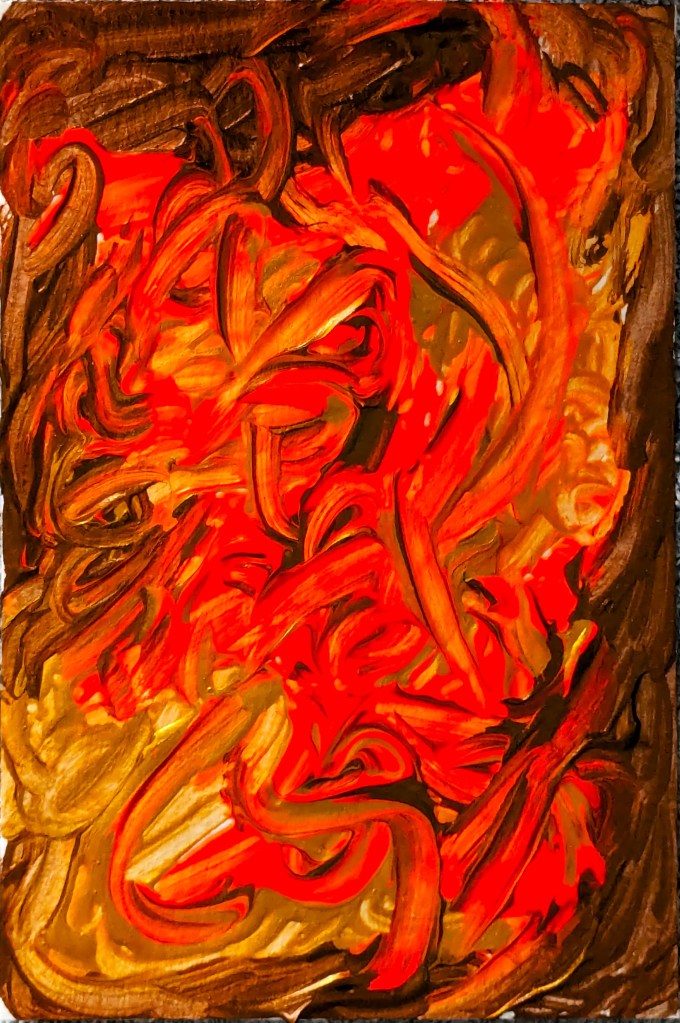
So this is a painting of a midnight Kipper Kaper Attack, when you want to sleep, but can’t, because you don’t know the answer to the kipper IQ test and all those little kippers are capering around and making fun of you and mocking you.

How do you avoid a Kipper Kaper Attack when the bad dreams start and the Kippers Kaper? Well, you answer this next Welsh IQ test question. “Adam and Eve and Pinch Me when down to the river to swim. Adam and Eve got drowned. Who do you think was saved?”

And if you answer “Pinch Me!” Then I will, and when I do, you’ll wake up, and you’ll be safe from another Kipper Kaper attack until the next time you eat them.

There – simple isn’t it?

Islands

Islands

Bewildered
by the rush hour
surge of traffic
we peer at street signs,
slide slowly round
roundabouts
sprung up overnight,
mushrooms
grown to confuse us.

Swept along by the main
street’s vibrant flow,
we fail to recognize
new shops standing
where we remember
old cracked paint
and the woman who sold
curiosities.

A face in the crowd
holds us for a moment.
Grey hair, unshaven,
clothes ragged,
a scarecrow on the street,
was that the man
who once ruled our world?

That old woman,
hunched, wrinkled,
her face a Hallowe’en mask,
her limp, her canes
and dragging feet:
is that the dancing queen
who ruled beside him?

Lights change.
Cars move on.
Another island
beckons
as we pull away
from the past
and drive
into the future.