Closed and Open Images

Open and closed blossoms on the geranium

Closed and Open Images
Wednesday Workshop
28 July 2021

            A closed image is one that leads the reader in a specific direction and offers a fixed vision of the world. For example, “White moths wing their snow / storm through the night” (Cage of Flame, below). One summer evening, a long time ago, when I was in Chatham, N.B., now Miramichi City, I saw white moths swarming beneath a street light. The air was thick with them and they circled and dazzled like falling snow. A reader may not catch this image first time through. However, after a couple of readings and a little thought the image makes perfect sense. Now add the personal dimensions. Have you had a similar experience? What associative fields do you structure around white moths > wing > their snow storm >? This is where the image opens up and becomes more personal. You may not have been in Chatham that night, but you may well have experienced something similar.

            An open image is one that leads you outwards into your own world. “Now you are a river flowing silver beneath the moon” (Cage of Flame, below). Now the image is more open and asks questions of the reader. Who is the you referred to in the second word? Is it the reader? Is the narrator speaking to a third person? You are a river: how can a person be a river, more, can we be sure this you refers to a person? What else could it refer to? You are flowing silver: there is no sense of concrete meaning here. This is not a piece of information to be processed as you would process a headline in the newspaper (print or digital). What does it mean? I don’t know but, as Salvador Dalí said of one of his own paintings “I don’t know what it means but I know it means something.” And that something is the essence of poetry. That one word, river, will conjure up different images for each individual who reads the poem. River: which river does the poet mean? Is he referring to the Miramichi, the St. John / Wolastoq (Wəlastəkwewiyik means “People of the Beautiful River,” in Maliseet), the Thames / Támesis (to the Spanish who lived in London in 1560-1580), the Severn / Sabrina (to the Romans who invaded Britain in 55-54 BC) that divides Wales from England? And what happens when we restore the old names to the rivers that former generations, some of them our forefathers and foremothers named? How does it change our picture of the permanence of rivers and the impermanence of names and people?

            Metaphors are always hard to understand. This is because they have no exact meaning and vary with each reader. Take a metaphor like icy fire. We know that ice can seem to burn the skin, but what does icy fire mean? Think of those drawings in which a vase becomes a face and the face metamorphoses into in a vase. Most people can see each image separately, but it is difficult to hold both shapes in the mind’s eye at the exact same time. The image flits between them with the result that the reader’s determining mind, the one that yearns for le mot juste, the exact meaning of words, is trapped between two mirrors and moves from the one to the other without being able to settle on either.  This is what happens with metaphoric meanings: a flickering between the different terms of the metaphor and an inability to settle. Take this couplet, for example: “there is nothing so hot as the female desire, / as cold as new snow yet it burns you like fire” (In Praise of Small Women, El Libro de Buen Amor, Arcipreste de Hita, circa 1283 -1350, my translation). Such metaphors have been around for a long time, as has the juxtaposition between hot and cold, the Petrarchan ice and fire, used as a poet’s description of lovers.

            No, poetry is not, definitely not, an exchange of information. It is more an exchange of dreams, cultures, multiple meanings, each constructed, de-constructed, re-constructed in the space between the minds of reader and writer. A poetry book is very similar to a river. You must take it on its own terms, adapt to it, work with it, run your fingers and hands in its waters, paddle in it, swim if you want to. You must do all of this on your own terms and in your own way. Whatever you do, don’t, don’t get out of your depth. And please, please, don’t let yourself drown. Just lay back on the water, look at the clouds in the sky, choose the ones you want to follow, and float a few minutes of the day away.

Poetic Structures

Poetic Structures
Wednesday Workshop
21 July 2021

External Structures

            Roman Armies, men and words, were structured, highly structured. Poetic structure can take many forms: external structure, the sonnet, for example, with its 14 lines and its 4+4+3+3 verse form which can also be 4+4+4+2 or 5+5+4, or 5+4+5 or 2 x 7 or 3+3+3+3+2. I have experimented with all of these sonnet forms, and many more, at one stage or another in The Nature of Art. Milton Acorn, the Governor-General’s Poetry Award Winner for poetry, wrote a book called Jackpine Sonnets. His Jackpine Sonnets are wild and beautiful, growing this way and that, totally individual and out of shape, just like wind-swept jackpines of Tara Manor in St. Andrews on the East Coast of New Brunswick, Canada, where I penned some of these poems.

Internal Structures

            In the same way that poems can be given a formal structure, so can lines. Structure can be external, flowing from line to line in an unbroken sequence, or it can be internal, limited to each line. Some of my poems include stanzas where the individual line flows into the stanza and the result is an amalgamation of both the individual and the whole. Individual lines can be structured by syllable count, 10, 11, 12 or more per line. They can also be structured by stress, the stress of normal speech or the stress of forced rhythm. Structures can have Greek or Latin names, English ones too. Or it can be the structure of simple, everyday speech. Fray Luis de León, (1527-1591) wrote that he counted his syllables when he spoke and he wrote prose and poetry the same way he spoke. Syllables, a strange term nowadays, not understood by all. Try the ‘beat’ of music: “You can’t always get what you want” (Rolling Stones) or “All you need is love,” (Beatles). Simple really, but it is all too easy to complicate these concepts.

Comment: Clearly this is a simplification of what can be an intensely scientific and academic subject. We have only to think of the books of rhetoric, with their long lists of Greek names for the different syllables, long and short, and the different line lengths that run from Iambic Pentameter to Hymns Ancient and Modern. However, the purpose of these thoughts is to simplify and not to complicate. More important, perhaps, rhythm, in one form or another is akin to structure and many of us have an innate sense of verbal rhythm, whether we count our syllables on our fingers, as I do, or count them not, as is the modern trend in some poets. Think daisy petals: she loves me, she loves me not, I count them, I count them not. Yet still the rhythm is there and that, in many ways, is one of the key secrets of our unique poetic voices: we all speak and write in different fashions and that is one of the things that makes us unique.

The Musicality of Words

The Musicality of Words
Wednesday Workshop
Bastille Day
14 July 2021

            The Roman armies marched all over Europe and, as they marched, they sang marching songs, traces of which lingered, along with the Latin language, everywhere they went. Think of the poems in his book as songs, each with its own special rhythm. You can find music in a single word, in a group of words, in a single line. You can hear and feel it too when you follow the punctuation and move with the words across adjoining lines. Unfortunately, far too many of us have become used to slogans and advertisements: three words repeated incessantly, two verses of a song that loop continuously. Many of us have forgotten how to read anything other than newspaper headlines and simple sentences. We have also forgotten how to listen to words, how to gain multiple meanings beyond the simplistic message of slogan, sound byte, scandal, and news. Diversity of meaning is what you learn when you read poetry, for poetry is more, much more, than the delivering of a simple message. To read a poem is to set out on a personal journey of exploration, into your own memories and mind, as mediated by the poet’s words. It is also to explore the vast treasure trove of our personal relationship with our language. Remember: a poetry book is a dream you hold in your hands.

Comment: Words have meaning, but they also have music and the musicality of meaning must never be forgotten for when music an meaning combine, a new set of meanings is formed that depend as much upon the ear as they do upon the decoding mind. This is all a part of what we refer to as the poet’s voice and remember this style of poetry is not to be found in newspaper headlines nor on the radio and television news, scaled down as they are to the lowest common denominators of language.

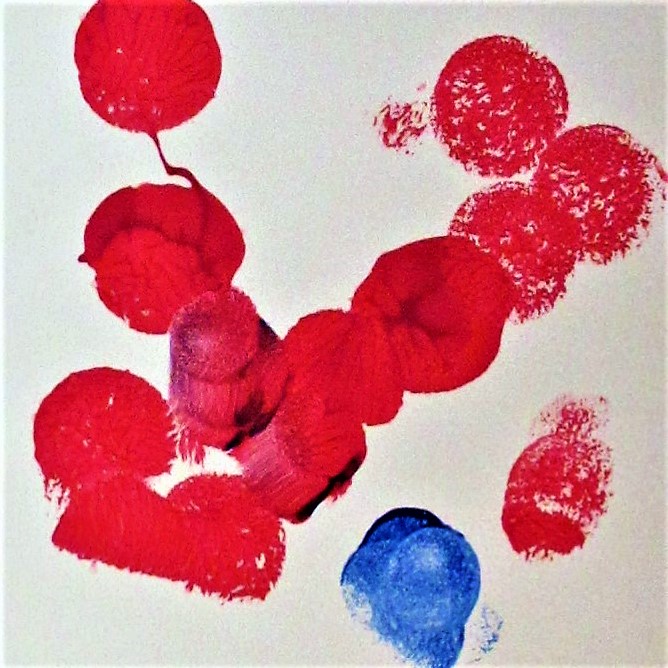
Look carefully at the painting that heads this Wednesday Workshop. Look at the movement and the musicality of linked forms and colors in a still, silent, two-dimensional space. Meaning takes on different meanings and becomes something different when we look at these words of color, these soundless sounds, these rhythmical movements of color. Beauty is in the eye of the beholder. Indeed it is, and in poetry, it is also in the musicality of the words and the flow of the ideas that bind the words and change their meanings.

Terza Rima

Terza Rima
Apologia pro carmina mea

Dear reader who reads my poems: sometimes
I say what I do not mean to write
and write what I don’t mean to say. Rhymes

make things clearer, for I puzzle what I might
say, and plan ahead so an awkward word
will not intrude. Words, birds in flight,

bright as postage stamps across the absurd
white snow of a page or a digital screen.
When I think about it, I assume about a third

of what I say, I really mean. Who has seen
the early morning wind drifting our thought-cloud
across the lawn, moving shadows cast on green

blades of grass, as we think our thoughts aloud,
each thought a pea in a pod, as some we clasp
between finger and thumb while others crowd,

and the loud, uneasy word slips from our grasp
to wound or injure or otherwise to hurt and maim.
It’s not my aim to do this. My word is not an asp

or a viper or a screw to be driven. I lay no claim
to hurt and yet sometimes a word slips sideways
and does not say what I mean it to say. I aim

to please, to tease, to provoke, in so many ways
and yet I often hurt where no hurt is intended.
If I have done you wrong and my word displays
unintended ends, forgive me: let all rifts be mended.

Letters and Words

Sometimes there are no words!

Wednesday Workshop
30 June 2021
Letters and Words

            Words are formed from a combination of letters and sounds. Join them together and they will march like Roman soldiers, in groups of meaning. A cohort, ten words, ten men, commanded by a Decurion. One hundred words, a century, commanded by a Centurion. Six thousand words, a legion with six thousand possible implications attached. I use the image of the Roman Legion because meanings in poetry are Legion and our Western Poetry tradition, of which I am a part, goes back more than two thousand years to Roman times and beyond. Tolle, lege: Latin for take and read. Sortes Virgilianae: fortune telling by chance words drawn, originally, from Virgil’s Aeneid and now from this poetry book. Choose your words and sentences at random. Interpret them as you will.

Associative Fields

            While each word has an individual dictionary meaning, words are much more powerful than the dictionary. Each word is surrounded by a network of associations, called an associative field, and those connections are different for every reader. This means that each word and its associative field have very personal emotional strings attached. When you understand this, you will also understand that each reading, each interpretation, is your own and nobody else’s. This is not a grade school classroom. Here, there are no poetry thought police to tell you that you are wrong, that you are mistaken, that you do not understand what the teacher is telling you.

Take the word ‘grandmother’. The dictionary meaning is clear. Your grandmother is the mother of your father or the mother of your mother. Each of us has, if we are lucky, two grandmothers. Some of us have more than two. The emotional ties between you, as reader, and your own ‘grandmother(s)’ will determine your own personal version of the word’s emotional and poetic tones. Now you must apply these individual meanings to each word you read. Reading poetry in this fashion will allow you to create your own personal world of tone, meaning, associations, and emotions. This is what poetry brings to you, not a handful of information to be scanned for knowledge, but a series of sights, sounds, memories, all personal, that are triggered in your mind by the impact of the poet’s words.

Comment: Wednesday Workshops are my attempt to express some of my ideas and theories on writing in general and on poetry in particular. Hopefully, the will encourage other writers to think about their writing and to deepen their knowledge and understanding of what we do best: think and write. By all means add your own thoughts to what I have written here.

How to read poetry

How to read poetry
A Wednesday Workshop

The Nature of Art and the Art of Nature is a book of poems each one of which celebrates humanity’s relationship both with the natural world and the way that world is recreated by artists in so many different forms. In order to read these poems and receive full value from them, it would help to know how to approach them.

Preparing to Read

First, de-clutter the mind. Poetry cannot be hurried or rushed. Remember, it is better to read one poem a hundred times than to read one hundred poems once. Prepare yourself mentally and physically for your reading. Sit down. Make yourself comfortable. Close your eyes. Concentrate your mind on something you find peaceful: a sail on Passamaquoddy Bay, a rose in Kingsbrae’s Rose Gardens, a butterfly in the Butterfly Garden, or a fine white cotton cloud in a cerulean sky. Breathe in and then breathe out. Now slow your breathing down. Breathe in, count up to four, slowly, breathe out, counting up to six. Breathe in, count up to six, slowly, now breathe out, counting up to eight. Breathe in, counting up to eight, and breathe out, also counting up to eight. How long will you sit there? When your breathing has slowed and your mind is clear, you will be ready to start. You will know when that is.

            Open your eyes. Take your book and begin to read. Don’t start on page one and rush through. Dip in, here and there, find a title or a first line that you like, and read that poem. Read it two or three times. Then move on, randomly to another poem. Select individual lines, phrases, sentences. Savour the words. Roll them around in your mind. Read them to yourself, quietly. Then read them out loud. Try to capture their essence, their rhythms. Taste them, as you would a fine Spanish Manzanilla wine. Select another word, another line, another poem. Seek and you will find some sequence that you like. Return to it often.

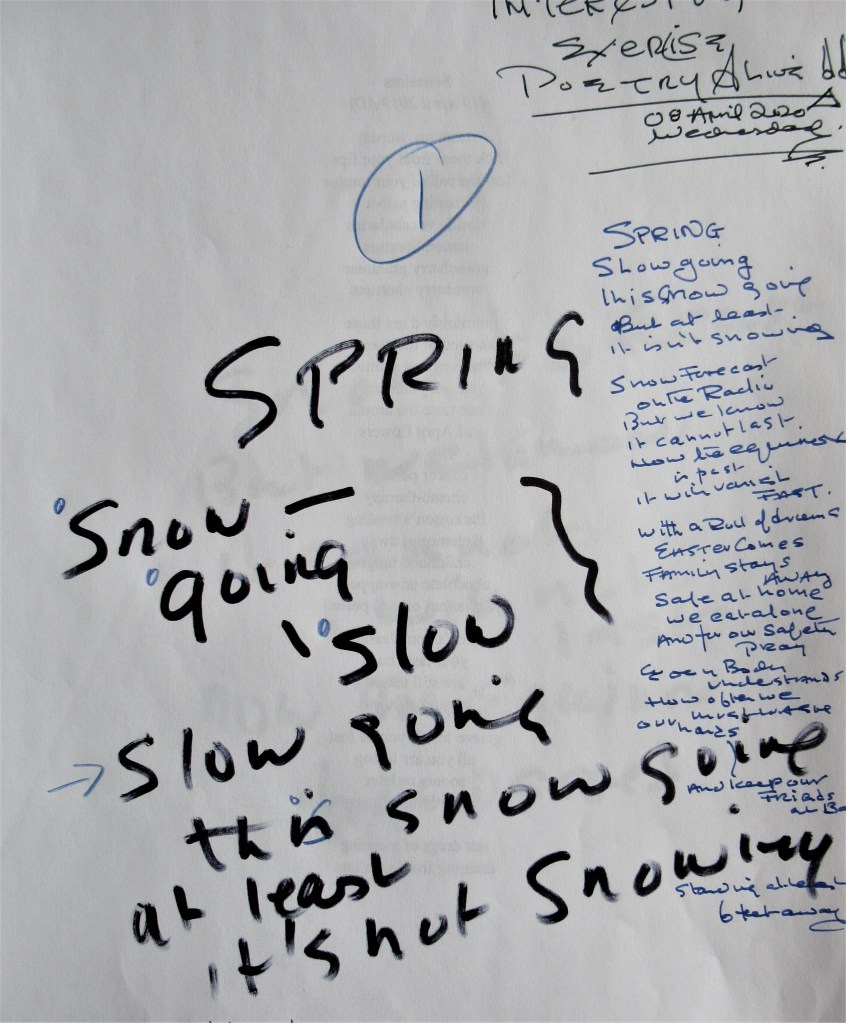
Comment: I will restart my Wednesday Workshops. The Nature of Art, the manuscript on which I am currently working, has an Introduction on The Nature of Poetry. I will put this up in installments. The handwritten opening page comes from an online video on Creativity and Writing Poetry during the Pandemic. This poetry video is the first one in the series. Click here for link. Other workshops on writing can be found by searching Writing Workshops on the Blog search (top right hand corner) or by going to this link Poetic Creativity and Thoughts on Writing

Painting the School Outing

Spotify
Don’t forget to scroll down to appropriate audio episode.

Painting the School Outing
Beaver Pond, Mactaquac

The yellow of the school bus is easy, but
what colors do you give the rain of school
kids descending? And how do you portray
their energy, their noise, the tones of French
and English? What colors are their vowels,
their consonants, their high-pitched voices?

You can sketch their orderly rows as they snack
on the top-hat magic pulled out of backpacks.
But it’s not so easy to paint the pop of Pepsi cans,
the scent of chocolate bars, or the crackle of chips
released from packets and popped into mouths.

Running round after lunch, they drive the wild
birds wild with their unorganized games of tag,
their impromptu dances, their three-legged races,
their winners and losers, their joys and sorrows.
Fishing nets are produced from nowhere. Girls,
boys wander to water’s edge in search of prey:
incipient frogs, newts, tadpoles, bullheads, but
how do you paint the wet and wriggle of them?

Try painting this. Whistles sound. Kids regroup.
The bus reloads and goes. Now paint the silence.
Sketch the tranquility of woods, bird-calls back,
of the beaver pond with its lilies stretching their
green necks skywards towards a pale blue sky
where cotton clouds cluster together in celestial
flocks. A pastoral scene, this painter’s paradise.

Click on the link below to peruse my books for sale.

Books for Sale

Mirror Image

Spotify
Remember to scroll down to the correct audio episode.

Mirror Image
(on seeing the outline
of a painting on the reverse side
of my painted note-book page)

What price these corkscrew lines,
reversed, seen through a glass, darkly,
the wrong side of a tapestry,
all twisted threads and imaginings,
no clear pattern of thought
or design, as if designated by an errant
hand and signed by a man with a mission
to bewilder, confuse, muddle, shock,
turn inside out, back to front, upside down
all our notions of what is what,
and who is when, and why, and where?

Yet there is meaning to this madness,
a sense of a blind man trapped underground
in the labyrinth of his darkened mind
with only a thin thread of belief
to guide him, upwards and outwards,
away from the torrid torment of doused flames,
the damp spark’s midnight glow,
the search for substance in a new world,
insubstantial in a neologism, whirled
through inner spaces and spun, guileful,
out of the back of the hand to spin,
this way, that way, who knows which way,
according to the moment of delivery,
the angle of acceptance,
the untrained brain of the recipient,
tottering on the brink of a world
with a definite end: the suicide of logic.

Click on the link below to peruse my books for sale.

Books for Sale

Potholes and Portholes

Spotify:
Remember to scroll down to the appropriate audio episode.

Potholes and Portholes

My poems are drawn from my life,
not from the lives of others.

I live my words,
drawing them wriggling
through the holes
punched by others in my flesh.

Pot-holes,
portals to the underworld,
so many cars
slithering in spring’s freshet
melt of tarmac and metal flesh.

Portholes:
so many ships,
leaving port,
sailing away
into unknown seas
well beyond my ken.

Spring

Spotify:
Remember to scroll down to the appropriate audio episode.

Spring

Slow going
this snow going,
but at least
it isn’t snowing.

Snow forecast
on the weather show,
but we all know
it cannot last,
now the equinox
is past.

With a roll of drums
Easter comes,
but friends and family
stay away.

So all alone
and safe at home
we’ll spend
our Easter day.

Everybody understands
how often we must
wash our hands.

Don’t go unmasked,
even when asked,
and all our friends
must safely stay
at least six feet away.

Comment: I just received this poem as a memory on Facebook. Interesting. I remember writing it, online, a year ago today, and what a fun time I had. Here’s the link to the video. I loved being involved in the creative experience. It was my first poetry video. I do hope you like it.