

How do you relax?
I take a relaxative.

What was the last thing you searched for online? Why were you looking for it?
The last thing that I searched for online was a prompt that I wished to be prompted by, but I promptly lost it before I could respond to it. Then I went looking, but still couldn’t find it, even though I searched everywhere I could think of.
I grow forgetful as I age, and now I can’t remember what the prompt asked for, and that’s a pity because I remember that I had a lovely answer. Now I can’t remember my answer either. So I am stuck in a sort of one-way street, going in the wrong direction, as I draw near to a roundabout that will lead me back the way I came.
I am afraid some Minotaur or other will seek me out, because I am lost in a labyrinth without the thread of Theseus to lead me out. And its no good searching online, because I no longer know what I am looking for. And that’s a bit like my life at the present time – a pointless search for meaning as I wander, amazed, through a baffling maze of days, seeking, I know not what, and never finding it. I don’t want to give up on it yet, because I know that the answer lies just around the corner, lurking like the last sardine in a sardine can, or the last piece of squid, cowering blackly in its own ink, in the tin, not wanting to be eaten.
Life leads me a merry dance, as king-like, a one-eyed man in the kingdom of the blind, I rule my world. For, en el reino de los ciegos, el tuerto es rey / in the kingdom of the blind, the one-eyed man is king. And no, I didn’t search for that online. It came to me in a sort of dream because, as Goya says, el sueño de la razón produce monstruos / when reason sleeps, monsters are born. And now I see them everywhere, those monsters, and I search online for solutions, but none appear. And so I continue on my merry-go-round way, leading my ragamuffins around those ragged rocks.
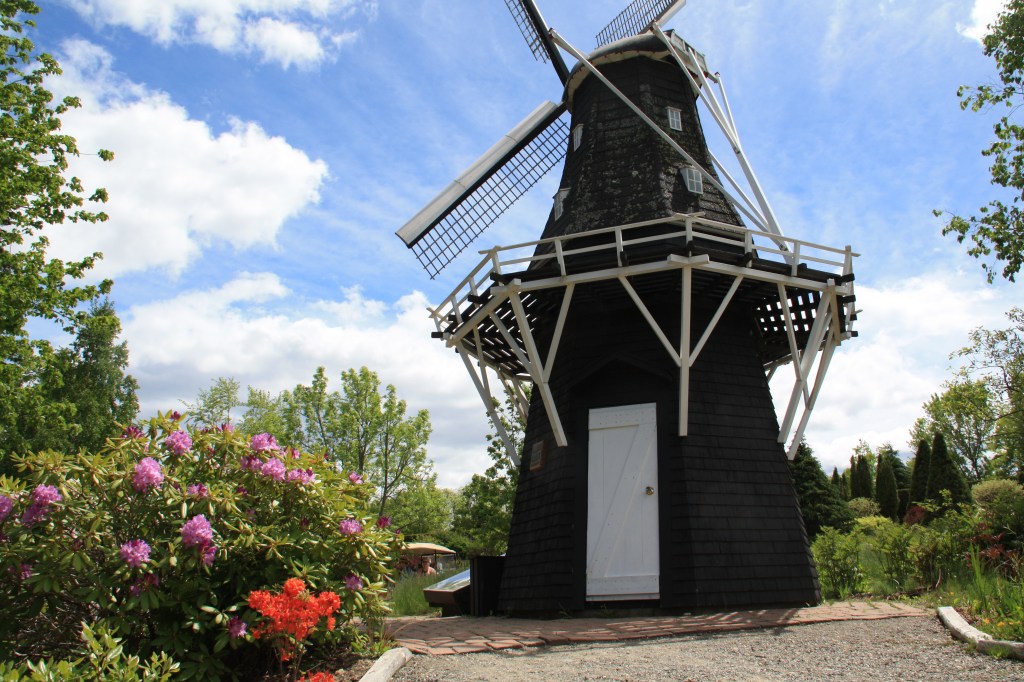
Windmills
Only the pendulum clock
disturbs the silence
as the slow stars circle
and the moon hides
its face beneath
seven excluding veils.
Tranquility finds me,
seated here, head in hands,
contemplating the complicated
dance steps of a terra-centric
universe where planets weave
an intricate back and forth
to justify the falsehoods
of misguided mistakes.
Men, confident in their wisdom,
know that all is well,
that their faith in the old gods,
the old books, the words
that were written, in stone,
before the modern world began,
need no rethinking.
Those whirling sails,
imprinted on the questing mind,
are a giant’s arms, those sheep
an enemy army cloaked
in dust, coats of arms visible
only to the far-sighted
whose eyes defy vision’s laws.
Right, they were then.
Right they are now.
Nothing changes. Nothing
can possibly change.
Sheep are the enemy
and windmills wait to invade
the unsuspecting mind.
Comment: The history of Don Quixote and its reception in Spain is quite interesting. I was very sorry to read that Cervantes’s language is now considered so antiquated that interpreters are needed. I actually have a cartoon version of his quests – a picture reader, so to speak, very brief, because each picture is worth a thousand words. I have not yet seen the simplified text, rewritten with today’s reader in mind.
Don Quixote still holds many lessons for this modern world of ours and is definitely worth re-reading for, as Soren Kierkegaard (1813-1555) wrote: “There are two ways to be fooled. One is to believe what isn’t true; the other is to refuse to believe what is true.” Don Quixote, the character, threads a narrow path between those two extremes, as do many of the other supporting characters, some of whom use metatheatre for their smoke and mirror Wizard of Oz trickery. And remember, or forget at your peril, nihil sub sōle novum – there is nothing new under the sun. And yes, history does repeat itself, as you will see if you read (or re-read) Cervantes’s master piece.

Skype or Zoom
I sit and watch the grandfather clock,
listening to every tick and tock.
So slow, the sullen pendulum swings
as time limps by on leaden wings.
When they arrive, the house will fill
with youthful joy and much goodwill.
Age will flee for a week or two,
then we’ll be alone, just me and you.
Watching the telly, watching the clock,
counting each tick and every tock.
We will be lonely, left here alone,
waiting for them to telephone.
The very best thing to lighten the gloom
is to see them again on Skype and Zoom.

List 30 things that make you happy.
The first thirty dots I add to a dotty painting. As we all know, pointillisme drives one dotty. So, start counting each little dotty – when you get to thirty you can stoppy – and you’ll be as happy as a poppy. I do hope poppies are happy. I know poo-pees are. They wag their tales when they are hippy, happy, hoppy.
Oh yes, counting the ten toes on my feet when I have a double-trouble bubble bath. Then counting the ten toes on my grandson’s feet – that makes twenty. Then counting the toes on my other grandson’s feet. That makes thirty. Bubble, bubble, toil and trouble, hard to see those toes when the bubble baths bubble. Pinch each bubble, make them pop. When you get to thirty you can stop. Okay, okay, I hear you laugh – and that’s the joy of a bubble bath.

Apologia
pro vita mea
The fairground’s distorting mirrors distort.
I change as I walk past one and then another.
Rage, rage against that hump-backed shape
that looks back at me from the bottle-glass.
Magic: eye of a newt, eye of a toad, cat’s
eyes at night lighting the road to bed.
Bedlam all around me. Absurd this world,
gone carnival mad in the blink of an eye.
I need a white stick to walk through
this fog that clings to my clay-bound soul.
This wine I drink, these thoughts I think,
life’s fountain pen soon runs out of ink.
Watch the tides as they ebb and they flow.
When your time runs out, pack up, and go.
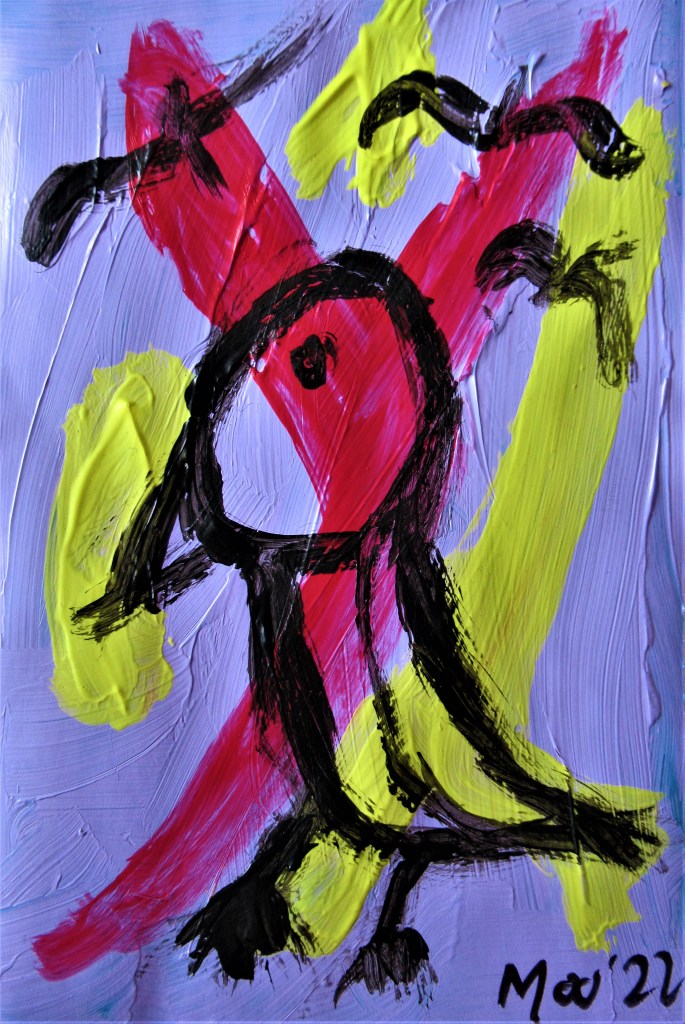
Comment: My friend Moo did himself proud with the above painting. What is it? I asked him. Dunno was his reply. I have shown it to several friends and speculation is rife: the dancer and the dance, dancer and diver, a blur of three figures, headless mermaid (I love that one). And yes, life is absurd (Albert Camus), a carnival (Bakhtin) in which knowledge is power and civilization is mad (Foucault).
Originality and imitation – how many genuinely original ideas are there? Very few. And the same goes for poetry – original poems are very rare. Most of our ideas come from elsewhere, even if we do not know it. The title of the above poem comes from Petrarch. It’s structure is traditional – a sonnet. Its ideas are borrowed from Camus, Bakhtin, Foucault. And yet, shuffle the cards (Cervantes) throw the dice (Mallarme’) and this poem and this post have both achieved a kind of originality and uniqueness by linking disparate ideas in a new unity.

Describe one habit that brings you joy.
Creativity. I was told, a long time ago, that genius is 99% perspiration and 1% inspiration. When I started creating – poetry, mainly – I waited for the muse to arrive and lamented when she didn’t. Then I tried to force her to visit me – and that didn’t work either. Then, in 1985, I started a journal. I wrote in it every day that year and, as I wrote, I realized that most of what I was writing was gibberish. But – and it’s a big but – a few literary gems gleamed out from the rubbish. The question then became – how to recognize them. The answer to that has come more easily, the longer I have worked at writing. It’s not the muse who needs persuasion, it’s the artistic eye and mind that need to be trained so that they can see the creative art in the surrounding world.
Now, after 38 years of regular journaling – and I try not to miss a day – I can distinguish easily between art and rubbish. My poetic creativity, often via a streak of surrealism, has wormed its way from poetry, into poetic prose (short stories and novels), and from there into my style of quasi-surrealist, quasi-expressionist paintings.
Where is the joy? The joy lies first, in the work itself, the contemplation of the blank page, then the slow tidal flow of words that fill the empty spaces. Then comes the joy of recognition, followed by the joy of selection, followed by the joy of polishing, and eventually, the joy of publication. The same is true of painting. Here, the empty canvas, like a beach with the tide coming in, fills up with color and shape and, like Matisse, I try to make meaning out of those colors and shapes. Am I great artist? Of course I’m not. I’m a dibbler and a dabbler, unknown and unrecognized, but joyous in my joy of creating something that will stand, for a little while, against time’s rising tide.

What traditions have you not kept that your parents had?
What traditions have you not kept that your parents had?
To the best of my knowledge, my parents only had three traditions. I have not kept any of them.
Tradition 1: They took two weeks holiday every year in August. Both were hard-working, and that holiday was always a precious break from work. Being employed in academia and a life-long inhabitant of the Ivory Tower, I have not had holidays forced upon me by a 9 to 5 work schedule. Research and creativity do not function according to a 9 to 5 clock. I realize how fortunate I am, and I give thanks every day for my intellectual and creative freedom.
Tradition 2: They fought like cats and dogs at every opportunity. It was so bad that, at one stage, in my innocence, I thought that cats were females and that dogs were males, and that was why they opened instant hostilities whenever they saw each other. Luckily, I have no siblings to challenge this view of events, and my parents are long gone, so they won’t be worried either.
Tradition 3: My maternal grandmother’s birthday was just before Christmas. On her birthday, every year when I was a child, my mother would come home early from work, but my father wouldn’t. He often didn’t come home at all. Office parties. My mother would hang around the house for a while, consoling herself. Then she would get angry, tell me to pack a bag, pack one herself, and call a taxi. This would take us to the railway station or the bus station, and off we would go to grandma’s house to celebrate her birthday. My father, looking sheepish and hang-dog, would arrive late Christmas Eve, or early Christmas morning. On Boxing Day, the gloves came off, and they were at it again. That’s why it’s called Boxing Day. Well, that’s what I thought anyway.
So there you have it. Three traditions that my parents had and that I have never kept.

Was today typical?
So, I Googled the meaning of typical and here are some of the synonyms that appeared. Standard, normal, stock, representative, usual, conventional, characteristic, regular, orthodox. Following the meanings offered, yes, today was typical. Dark at midnight, dawn breaking about 5:30 AM, full sun by 7:30 AM, noon – dead on 12 o’clock, as usual. And so it goes on. The weather may change, but the basic structure of the days, although also cyclical, growing longer then shorter, in terms of daylight hours, does not change much. Therefore, yes, by this definition, it was a typical day. But was it?
For creative people, each day is different and each moment, minute, hour of each day is different. Creatives listen, observe, feel, touch, delve beneath the surfaces of things, and see things in a lateral multiplicity that means everything is evolving, changing, growing, decaying. Creative people look and listen (with or without mother). They imitate, and from that imitation they create and re-create. And creativity moves way beyond the standard, normal, stock, representative, usual, conventional, characteristic, regular, and orthodox. If it doesn’t, it’s not creative, it’s just standard, normal, stock, representative, usual, conventional, characteristic, regular, orthodox.
Was today typical? Well, it’s not over yet. But up until now, it has only been typical in terms of its intimate creative typicality. The light has changed with the changing sky and clouds. Rain fell, and changed the tones of the colors around. The light changed, but so did the scents that arose from the warm earth with its carpet of grass and the tarmac and concrete, its heat suddenly cooled. The ground glistened, spider-webs sparkled, birds sang when the sun returned, flowers tossed their heads, in slightly different ways from yesterday, when the wind was warm. Now, damp and shining, their dance-steps and rhythms also changed. Now the world is wet. The trees are waving their fans and have caused a slight wind to arise and rustle their leaves. This day is full of creative magic – but only for those who have ears to hear and eyes to see. For too many people, alas, yes, this is, after all, just another typical, humdrum, boring old day. As W. H. Davies wrote: “What is this life if, full of care, we have no time to stand and stare?” Creatives make that time – and they live among the blessed.
How would you describe yourself to someone?
I wouldn’t. Why should I? I might give them a self-portrait, or a painting of me, by my friend Moo. Or I might give them a poem or a book of poems or short stories. That way they could see me for themselves or read about me and make a decision about me that way.
“Ah, would some power the giftie gie us, to see our selves as others see us.” Robbie Burns, if I remember correctly. For those who don’t follow the Scottish accent – the giftie gie us = give us the gift. I don’t have that gift. What I see in the mirror when I shave is not the same as what people see when they look at me with their own eyes or, with their own ears and minds when they read my words or hear me read.
Meanwhile – I invite you to read this. There’s a little bit of me in there somewhere. If you can find it before it floats away down the plug-hole.
Self-Portrait
I smell. I whiff. I gloriously stink.
My arms, my feet, my crotch, reek with beauty.
This is me. I am still alive. I’m rank.
The time has come, the Walrus said, to take
a shower. I strip. I weigh. I obey.
Hot water streams. Bathroom steams up. I draw
faces on grey glass, smiling, glum. Soft soap
works its miracle turning Japanese
nylon into a rough body cloth that
rubs and cajoles all putrid dirt away.
Butterfly from its chrysalis, I step
from the shower, sniff with caution, and stench
no more. I am clean. I no longer pong.
My body has been taken over by
perfumes no longer mine. Who am I now?
I am no more myself. I am no more
my own gorgeous underarm muscular
ripeness. I have left my odor circling
in the soap suds and drifting down the drain.
What a pain. It will take me a week or
more to start smelling like myself again.


 rogermoorepoet