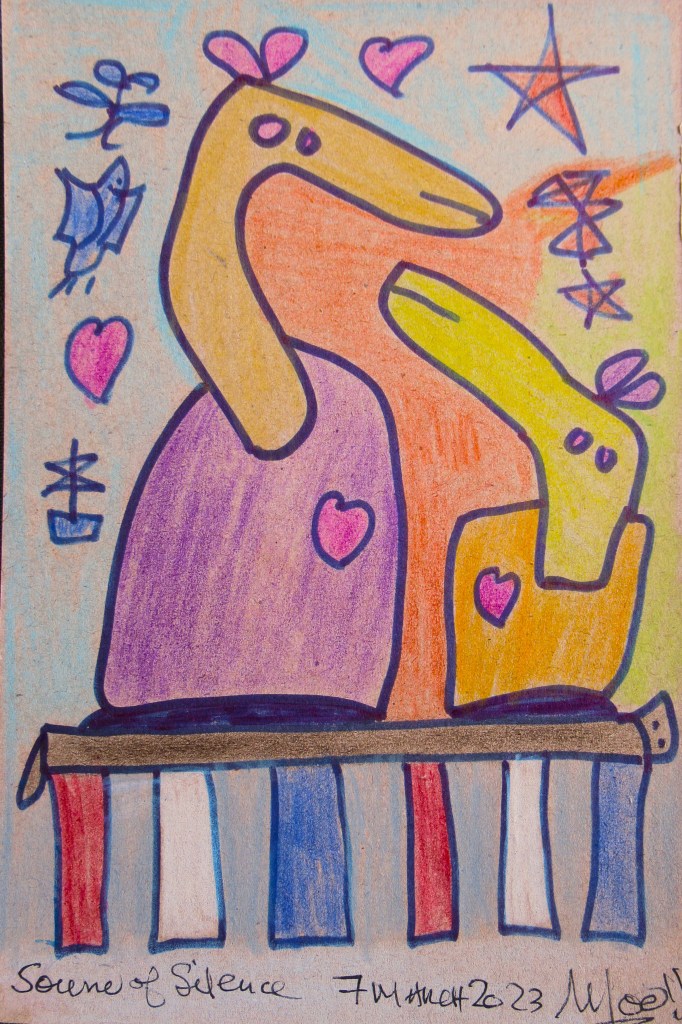
What do authors do when they send manuscripts to agents or presses? They have several choices. For example, they can listen to the sound of silence. Listen carefully to the paining above. What does it say to you? Absolutely nothing. Quite. It doesn’t communicate. It’s the sound of silence.
Another choice, they can read and re-read Beckett’s Waiting for Godot. Alas, in this case there are many Godots out there and all of them are super-busy gazing at their navels – and I don’t mean oranges. Some indulge in the wonderful world of “Mirror, mirror, on the wall…” and we all know what the answer is to that question. And we know what happened to Narcissus when he saw himself in the river water. Or have we forgotten? Our failure to share cultures is also a sound of silence – two solitudes, gazing at each other, neither one having anything in common with the other one, except maybe the weather. And we can’t always agree on that.
A third choice, they can climb into their dustbins, Queen’s English for garbage cans, and stand there waiting for someone to put the lid on so they can go back to sleep. Allusion / elusion – you don’t know what I am talking about? Well, maybe we are living in two separate solitudes. It wouldn’t surprise me in the least.
A fourth choice, they can take up painting, and scribbling, and drawing, and doing all sorts of things. But, if the phone rings and you don’t recognize the number – don’t pick up the phone. It’s probably a fraudulent scam call. And if you don’t know the e-mail address, put it in Spam and then block it. It’s probably some bot from another country trying to trap you into giving them your bank account details and signing your savings away. Whoever it is or they are , I doubt if it’s an agent or an editor!
I searched for the blog prompt, but I couldn’t find it. Not by name and I don’t remember the number, nor do I know how to search for it. So – here I am, on the sea shore, stranded, looking for something I may never find. Yet an echo of it has found me.
I googled ‘candy’ to find out what it meant because when I think ‘candy’ I think of Candy Floss, that long, thinly-spun web of sticky pink sweetness sold at the fairgrounds and the ice-cream stalls of my childhood beaches, back in Gower. Barred and banned it was, and seen as a source of cavities and visits to those much-to-be-feared, brutal, ex-Armed Forces dentists who terrified our childhood while working in those days in the NHS.
Candies, in my Olde English language, were called sweets. In post-war Britain, where rationing was the unwelcome rule, sweets were rare, for they cost us coupons, and were therefore, very, very precious. In those days, my grandfather had many friends and his friends were priceless. On Saturday mornings he would take me to Swansea Market, the one that had been bombed during the war. It had been rebuilt but, in those days, remained roofless. There he would work a shift at Green’s Sweet Stall while someone took a break – and I helped him. We would take the orders, count and weigh the sweets, take the cash, count it, check it, place it in the till, and hand over the correct change along with small, white paper packets that contained the hand-made sweets.
We received no money for this pleasurable work. However, when our duty was done, I would be given my choice of hard-boiled sweets. My favourites were those red and white striped sweets, called winter warmers, laden with the lusty tang of cloves that lingered long in the mouth. We held competitions to see who could make their sweet last longest. And woe betide the losers who cracked them, or swallowed them whole, for they were mocked and forced to watch, minute by minute, the lucky ones whose sweets dwindled on and on, shown off, paper thin, on tongue tip, for all to see.
But better than any candies were the Cockle Women in their tall black hats and red Welsh shawls who came all the way from Penclawdd on Saturdays with their baskets of cockles and their buckets of laverbread – bara lawr – at thruppence a pound. Laverbread – Welsh Caviar, Richard Burton used to call it, a delicacy to be savoured for breakfast or lunch and sweeter to the enthusiast and devotee than any candied sweets, even winter warmers.
There I was – with my trusty snow-blower blowing the snow – and I shifted gear to go backwards – and my glove caught – and the snow-blower kept on coming – straight at me – and there wasn’t room to manoeuvre -manoeuver – maneuver – aka I couldn’t get out of the way – and the snow bank behind me caught me just at the back of the knees – and I sat down in the snow – oh dear – luckily I let go of the gear lever and the throttle lever – but the machine was almost on top of me – and I couldn’t get up – so I called for help – but no help came – and I tried to pull on the machine with one hand – and I put the other on an ice patch in the snow and that hand went through – so I am sitting there – can’t stop laughing – and then my beloved appears – and she brings me my walking stick – and she moves the snow blower forward – and then she gives me the stick – in my left hand – lifts me and pushes – while I lift with the left and pull with the right – and I have pulled a cork from a champagne bottle more easily than I pulled myself out of that snow – but together we did it – and oh was I wet – I had to finish the blowing – go inside – and change my jeans – and I am still laughing at the thought of myself – sitting there in that snow – and I needed to pee so badly – as the cold and damp crept in and – what if there had been nobody there to help – or what if it had been windy and my cries had not been heard – and what if we fall – as so many others have done before – fall to rise no more – and what if – “if – if – if – if – onions climbed a cliff – potatoes would rise – with watery eyes – if it wasn’t for if -” and that’s what my grandfather always sang to me when I asked him “what if…?” – so- what if … but don’t answer – because we’ll never know –
I once asked my grandfather, a decorated soldier from WWI, if he was worried about dying. “No,” he replied. “Why not?” “Well, Roger, we’re all going to die. We just don’t know when. So, if I worry, I will die. If I don’t worry, I will die. So, why worry about it?” I was about five years old at the time and we were standing outside the Swansea Hospital, as was, by the seat where the old men used to sit and gossip. I didn’t realize it at the time, but that was my first lesson in Stoicism.
“The day I was born, I took my first step on the path to death.” Francisco de Quevedo (1580-1645), Spanish Neo-Stoic, among so many other things. Thinking like that tends to put things into perspective, for death walks with us every day. Death is our twin sibling, brother or sister. We face his shadow every time we look in the mirror and that shadow follows us around all day. “Death is a law, not a punishment, so why worry about it?” Also Quevedo. Dying is a different matter and yes, there are so many ways to go, some of them, especially nowadays, with the advent of life-preserving medicines, slow and unpleasant. Yet, mors omnia solvit – death solves everything. And it brings a release from all pain and suffering.
The lead photo shows a plaque in Avila (Spain). La Calle de la Cruz (1660) -The Street of the Cross. It is also known locally as La Calle de la Vida y de la Muerte – The Street of Life and Death. Why? It is rumored that here, turning left outside the main cathedral, duels were fought. Two men entered, but only one emerged alive. It is interesting to meditate on the close proximity of life and death, always there, side by side.
So, for the fun of it, let’s change the question: what is life? “What is life? A frenzy. What is life? An illusion, a shadow, a fiction. And the greatest good is small, for the whole of life is a dream, and dreams are nothing but dreams, after all.” Life is a Dream, Calderon (1600-1681). Looked at from this point of view, what is death? Is it the shutting down and the turning off of the cerebral computer or is it the great awakening from the sleep of life? You can think of it either way but, either way, it’s pointless worrying about it. As my grandfather also told me: “If there’s nothing afterwards, I’ll just fall asleep and that will be the end of it. But if death is the great awakening, then I will be very happy to wake up in a new reality.”
Robert Bly, in The Sibling Society, writes of the lateral movement that now embraces society with its grip of instant pleasure, instant gratification, instant happiness. As a result, we have strayed far from the vertical knowledge that sustained us for centuries. We have abandoned the wise words of our ancestors. Now the old are no longer the keepers of wisdom and the guardians of culture, the institutional memories of the race, if you like. Now they are foolish, clumsy, out of date with the world’s most rapid advances. Only the young, and their siblings, can keep up with the ever changing instants of life as presented to us.
But all is not lost. “What a peaceful life, that of the wise man who withdraws from this noisy world and follows the hidden path along which the world’s wisest people have always walked.” Fray Luis de Leon (1527-1591). We can move far from the madding crowd. We can construct our own realities. We can base them on the words of wisdom handed down to us over the generations. Switch off the TV. Watch the sun as it moves across the cathedral face (Monet) or the walls of your house (Moo). Live each moment of each day. Do not fall into despair. Above, don’t worry – it does no good at all.
Sun Absence Depression – People complain about the absence of the sun – and so do I. Five sun appearances between early December and the end of January. A sun glimpse, so to speak, pale coin between clouds, a sudden shadow that appears on the wall and vanishes before you can catch it. Do these count? Sun glimpses, mind you, and even less sunny days.
Snow, Sleet, Ice Pellets, Freezing Rain – Take your choice. The snow itself isn’t too bad. The snow blower takes care of that. But not when it rains on top of the snow, then freezes. Not when ice pellets weight it down and make it the consistency of wet sand on a wintry beach. My neighbor broke his snow blower trying to shift the mess. I was willing to risk the snow blower, but not my health. I couldn’t even get the blower out of the garage and into the mess that masqueraded as snow. I sat on the back bumper of the car, huffed and puffed, and decided not to risk it. And as for the freezing rain – my beloved had to put crampons on her shoes to be able to walk the ice and take the garbage to the end of the drive. As for blowing the ice that had fallen on the snow – the snow blower grunted, and groaned and complained as it slipped and slid all around – and so did I.
Rejection – Dejection – “Paper your walls with rejections.” Well, I won’t do that as we have just had the walls repainted. That said, when I checked my progress files this morning, out of 95 submissions, 93 had been rejected. Does the 2% make up for the 98%? Well, 5 more rejections and I’ll let you know.
Inflation – Gas. Luxury foods. Alcohol. You name, it and I will complain about it. And if I don’t, every day I go out shopping I see and hear someone complaining about the rising cost of just about everything out there. Being on a more or less fixed pension doesn’t help much either. Luckily, we don’t have to make choices yet, like some pensioners, and working people, are doing in the Untied Kingdom [sick]. Eat or heat? Food or medicine? Dog food or cat food? They have been staples for pensioners in the UK for a long, long time. Cheap and nourishing, though prices are rising, and taste disguised in a nice curry sauce. I kid you not.
Top Ten – well, I guess I could go on and on. But I won’t. Four reasons to cry are enough. Today, the sun is shining (positive). The overnight temperature was -25C / -13F, but it’s rising in the sunshine -15C / +5F as I type (positive), and I don’t have to go out in the cold (very positive), and I don’t have to snow blow today (very, very positive). So, may we all walk on the sunny side of life, find a silver lining to each and every cloud, and carry on regardless. It’s better than the alternative.
“Yes: I am a dreamer. For a dreamer is one who can only find his way by moonlight, and his punishment is that he sees the dawn before the rest of the world.” Oscar Wilde.
“The dreamers by day are dangerous people, for they are the ones who make their dreams come true.” T. E. Lawrence.
Two interesting and contrasting quotes on dreamers. They seem to contradict each other – but do they? How do we dream? What do we dream of when we dream? What does the word ‘dream’ really mean? How can it change, that meaning when a person announces in a sharp, sarcastic voice: “In your dreams.”? Were the Everly Brothers right when they sang their version of dream, dream, dream?
There is no right and wrong with dreams. Some dreams come at night. They rise from deep within our resting – restless minds, asking questions, answering questions, doubling down on what we did, or didn’t do. Some dreams are obsessive and occur again and again. These are individual to each sleeper and cannot be interpreted, en masse, by a dictionary of dreams. Other night dreams creep in through the bedroom window. These may not be our dreams – they may be the dreams of other people, come to disturb us as we sleep. These can be dangerous dreams, disturbing moments, and that’s why the indigenous have created dream-catchers that will snare those dreams and prevent them from entering.
Other dreams come by day. Day-dreaming is a rite of passage for many young children, trapped in boring school rooms with an ageing teacher droning on and on. “Knowledge is that which passes from my notes to your notes without going through anyone’s head.” I woke up enough from my day dream during that particular first-year lecture to note those words in my notebook. They were the only notes I took in that class and I day dreamed my way though a year of that man’s pseudo-lectures.
But the dreams we dream by day – yes, they can indeed be dangerous – because we can make them happen. One person dreams of being a doctor and, against all the odds, that person becomes one. Another visualizes – another form of day-dreaming – breaking a world record. And does so – such people fulfill their day-dream. Some, like Don Quixote, dream the impossible dream. These are fantasists whose dreams will never come true, for they are based on unrealities, and not founded on the essential truths of real life.
“Yes: I am a dreamer. For a dreamer is one who can only find his way by moonlight.” Much as I love this quote, I am disturbed by the adverb ‘only’. It is so limiting. Dreamers, as I have tried to show, can find their way by day as well. “His punishment is that he sees the dawn before the rest of the world.” This, too, I find enigmatic and disturbing. Why should dreamers be punished when they can also be rewarded? Why is seeing the dawn a punishment? Why is seeing the dawn before the rest of the world a sort of double punishment? And why does the dawn punish people? In order to answer that question, we must define the dawn! Maybe we’ll do that in another post.
“If one cannot enjoy reading a book over and over again, there is no use in reading it at all.” Oscar Wilde
A good friend of mine once told me that her creative writing writing prof in the MFA program told the class: “We are not writers. We are re-writers.” Our mission in life, then, is not just to rewrite, but to think and to revise. The art of writing lies in analysis, research, thought, and thinking carefully about (a) what we are about to write and (b) what we have just written. As a great Spanish writer once said “I write as I speak and when writing I count my syllables.”
So can the same principle be applied to reading? In my undergraduate poetry courses, one of my wiser profs announced that “It is better to read one poem a hundred times, than a hundred poems once.” Is re-reading better than reading? Good question. But it is what I call a swimming pool question: it has shallow ends and deep ends. Joke – it depends, you see, upon the quality of the material one is reading. For example, does a single reading of the Bible suffice? I read it through, page by page, when I was twelve years old. Was that it? No, I still return to it – the good book – from time to time, selecting, remembering, checking, looking for comfort, advice, or sometimes, pure joy in the sound of the language – King James version, of course.
What other books have I read and re-read? Lazarillo de Tormes, Don Quixote, The Hobbit, The Lord of the Rings, The first book in the Harry Potter series – it reminded me of elements of my own childhood, especially the cupboard under the stairs. Been there, done that, got the tee shirt. The Wind in the Willows, Gongora’s Polifemo, Quevedo’s Metaphysical Poems and his Cycle to Lisi. Octavio Paz’s Sunstone / Piedra de Sol, Lorca’s Romancero Gitano, his Poet in New York, and his plays. Platero y yo. Charlotte’s Web. Several of Shakespeare’s plays, including McBeth, Henry V, King Lear, and a couple more. Rudyard Kipling’s Kim and Stalky and Co. Mary Gentle’s Golden Witchbreed. Robert Bly’s Morning Poems, Iron John, The Sibling Society. Unamuno’s The Tragic Sense of Life and his Niebla. Enough, no more. It is not as sweet now as it was before. And there are so many more to which I have returned, again and again.
So, think about all the time wasted on trivial books, books that remained unfinished, books that have never been opened. One person’s vegetarian or vegan’s fare is a carnivore’s poison [sick]. Sometimes a book mirrors our thoughts. Sometimes it challenges us to rethink our lives and our philosophies. Sometimes it comforts us or takes us back into our childhood. And sometimes it just bores us and we cannot finish it.
A rose is a rose is a rose. A book is a book is a book. Or is it? We are not readers – we are re-readers. And if we aren’t, we ought to be. Think about that. Carefully.
“We are all in the gutter, but some of us are looking at the stars.” Oscar Wilde
Another beautiful quote from Oscar Wilde. I look at the world around me and I see two different spheres – the celestial one where, on a clear night, Orion patrols the winter skies, his faithful dog star at his heels. These are nights of great beauty, fields where mythical animals wander their ways, clothed in sparking suits of light.
Then I open the newspapers, read the news, and wonder what we are all up to. Up to? Down to, rather, for I have that sneaking feeling that so many of us are indeed lying in the gutter, somewhere, thrown out of a moving car, and abandoned, like some dead deer in a roadside ditch. Everywhere, the news is dark and dreary – wars, rumors of war, shootings, beatings, corruption, lies – or terminological inexactitudes, as Winston Churchill called them, the word ‘lies’ not being permitted in the Mother of Parliaments.
The Mother of Parliaments, indeed. And what a non-sensical mess that has become. To repeat the litanies of nonsense spouted in the English Parliament nowadays, I hesitate to call it ‘the British Parliament’, is to risk rusting and ruining my computer keyboard with the salt tears I shed.
So many of them, then, literally lying- the word has multiple meanings – in the gutter. So many of us dragged down with them. But, each night, when the skies are clear and the clouds move away, I find myself, once again, looking up at the stars. Per ardua ad astra – through hardship to the stars.
Our world can sometimes seem to be a very dark place. Early yesterday morning, sitting on the back bumper of my car, breathing heavily, unable to shift the weight of snow, rain, freezing rain, ice pellets that had accumulated in our drive, I was gripped by the cold hand of old age and despair.
I remembered the talk show quiz games in which one option was to call a friend. So I did. He turned up after work, started the snow blower and did for me what I was no longer able to do for myself. He cleaned the paths round our house, at the back, to the bird feeders, and down the front the heat pump at the side.
He brought light and joy back into my world, made me realize I was not alone, and I gave him, as a token of my gratitude, this painting: Luminescence.
Those of us who are still capable of bringing light and joy to others must continue to do so. Whatever we do, we must not let the dark side and the shadows take over.
And that’s how it is this year. Partly by choice. We decided against the stress of a turkey. Is it cleaned out correctly? Is it stuffed properly? Will we put bacon on top? Is it cooked to perfection? What about the trimmings? Stuffing (inside and out)? Bread sauce? Cranberry sauce? And the vegetables? And the Christmas Pudding? Will it be ready on time? Does it look nice? Have we laid the table properly? There are only two of us now. How much turkey can two people eat anyway? So we’ll have none of that this year. No stress. No cooking. No washing up. No leftovers. No turkey. The poem – The Twelve Days of Turkey – makes this clear.
As for the presents, well, that’s a sad story. We don’t really need anything. The house looks like a cross between a junk-shop and a museum gone mad. As Dylan Thomas said of Swansea Museum: it looks like a museum that belongs in a museum. And that’s what the inside of our house is beginning to look like. A crazy place inhabited by two crazy people and a crazy cat. Well, the cat would have loved some wrapping paper to play in, if it were a normal cat, but it’s not. So even the wrapping paper won’t be missed. No presents means no disappointment and that means that the Poem of Lower Christmas Expectations does not have to be written.
As for the tree, well, we don’t have a living tree, chopped down, and fed water daily, so that it can sprinkle its needles steadily over the carpet before it’s time to go. And the, on the way out, it drops the lot. Then we must vacuum clean, Hoover, Dyson, brush up, do the necessary, whatever it is, to make the place clean again. And oh, that cold January air when we open the sliding door to force the tree out. Force it out indeed – after 12 or so days inside, it doesn’t want to go out in the cold and freeze. And neither do we.
So, it’s a minimal Christmas. Three LED trees from past years. Clare’s Auntie’s artificial tree from her old shop in Cheap Street, Frome. Some strings of lights. Everything inside the house and nothing outside. And inside we have warmth, light, a fire in the stove, and for dinner, a tourtière, Acadian, all nicely spiced. With a selection of trimmings, to be determined later. Bread sauce and cranberry sauce probably. Oh yes, and we have a variety of puddings that can steam while we are eating. A minimal Christmas, then. No high expectations. The Christmas Mangers from Mexico and Spain all in place. And Christmas music, also from Mexico, on the disco and ready to go.
And yes, this will be the best Christmas ever. Because it is taking place within our hearts. And all best wishes for a wonderful day and an even better year to follow, to all of you, too.






 rogermoorepoet