Crossing the Bridge

Crossing the Bridge

When I got to there, I couldn’t cross it.
I sat in the coffee shop, over-looking
the River Severn and ordered a cup
of cafeteria tea. Time limped slowly by
and I let my untasted tea grow cold.

What was there for me on the other side?
Empty stood the house where I was born.
Sold, the bungalow, built by my father
and his father, the summer home I loved
so much. Lost the kitchens I remembered
so well, kitchens in which I had come of age.

I tried to picture the ghosts of Christmases
past walking the logs that flamed in the fire.
Ghosts? They inhabit my mind, share my life,
dwell in my days, dream with me most nights
when a golden moon sails past my window,
and silver stars fill my dreams with light.

What change, big or small, would you like your blog to make in the world?

Daily writing prompt
What change, big or small, would you like your blog to make in the world?

What change, big or small, would you like your blog to make in the world?

Looking around me and seeing the way that the world I know is so totally divided, and knowing that words and ideas will bounce off people’s backs like rain off a duck’s back, I do not expect my blog to make any changes, big or small, to the world. Would I like it to? Yes, I would. But whether it will or not is a different question.

My blog consists of several elements. Let us start with the poetry. If I can reach out and touch somebody with one or more of my poems, then I will be very happy. This is, after all, a poetry blog. And part of that blog is a continuing discourse on creative writing and poetic creativity. If one of my articles / posts on creativity can help one person, just one, to improve their creativity, then I will feel justified with all the hard work and thought I have put into the posts.

I also write about Discourse Analysis, the meaning of words and texts. In our current, doubt-ridden world, it is often the loudest voice that carries the most weight, and he wildest ideas that get the most attention. I always remember that still, small voice that comes after the fire and the thunder: “What doest thou here, Elijah?” Alas, I am not an Elijah, nor am I a prophet, nor am I out to make a profit. But if someone, somewhere, recognizes my voice as a still, small, voice speaking a little bit of sense in this wilderness of wild words, then I will be satisfied. My creative prose comes next. It is mostly composed of flash fiction, memoirs, and short stories. If I can bring tears or laughter to the eyes and the heart of just one reader, then again I will feel that I have done my work.

Then there is my art work. I have always been told that I am useless at art. Mind you, I think those people came from the same school of thought that told me, as a teenager, that I would never go to university – except on a train. However, I discovered Matisse and his words ‘making meaning out of color and shape’. Then came Dali – ‘I don’t know what it means, but I know it means something.’ Out of those words have come cartoons and paintings, some funny, some sad, and all of them unique. Again, if one reader / viewer finds joy in them, then I will be happy. And if my own work persuades one battered, belittled artist that he or she can paint, create, make meaning out of color and shape, then I will have achieved the minor miracle of helping to change someone’s life for the better.

As for these prompts, I have only just started to be prompted into doing something. Why? I am not sure why. I just think that I have a different view of the world from most people. If I can offer that alternative view of reality, a joyous reality, I might add, to one, or maybe even two people, then once more, I can feel that yes, my blog has made one, small change to the world around me. And I cannot ask for more than that.

Meanwhile, I think of the studies I did on the Spanish Civil War (1936-1939). The right kept moving further right. The left kept moving further left. The middle ground where discourse, creative thinking, and debate can flourish, slowly vanished. Then, when positions and thoughts became so deeply entrenched that there was no room for mainoeuvre / manouver / maneuver, whichever way you wish to spell it, then shooting broke out and people went to war and found, all too often, their often-violent deaths. I would not wish that fate on any person, government or country. If just one person would read that powerful and bitter history, and learn from it, then the world might be a better place.

To talk to one person at a time, that’s what I want from my blog. Then I want that person to talk to another person, and the third one to a fourth, and so on and so forth, until we have established, one person at a time, a linked chain that may, just may, be long enough and strong enough to help lighten the darkness and head off the dangers into which we seem to be steering.

Write about a random act of kindness you’ve done for someone.

Daily writing prompt
Write about a random act of kindness you’ve done for someone.

Write about a random act of kindness you’ve done for someone.

Sir Alex Ferguson, one of soccer’s greatest managers, once said that it wasn’t the victories he remembered, but the defeats. So it is with my own coaching career – it’s the losses I recall. Same thing with random acts of kindness. There have been many, too many to count. I will not paper my e-walls with glowing memories of past kindnesses. But what about those random acts of kindness I failed to do? Here’s one of them.

            Crave More: I hate those words. I always choose a cart with the shop’s name on the handle. I can handle that. I can’t handle a shopping cart that screams Crave More at me every time I stoop down and place another item in the wire grid. If stores were honest, they would inscribe their shopping carts with a sign that said Think More, Crave Less, and Save Your Money. I bet that would quickly cut into profits.

            Anyway, there I was, in La-La-Land, leaning on my cart, still half asleep, when this ghost drifted towards me. “Help me,” it said. “I’m hungry. I need food.” I woke up from my dream, looked at the ghost, tall, skeletal thin, cavernous eyes and cheekbones protruding, gaps in the teeth, grey face drawn and lined. The single word “Sorry” came automatically to my lips. Then I felt shame. I looked at him again. “I only carry plastic.” The excuse limped heavily across the air between us. I saw something in his eyes, I knew not what, and I turned away.

            Then, as I walked away, I added 100 lb of muscle to the scarecrow frame. Took forty years away. Filled his body with joy and pride, and remembered how he played when I used to coach him, hard and fast, but true. I ran my hand through the card index of former players that I had coached. I knew their moves, and attributes, the way they played the game, their stronger / weaker side, their playing strengths, their weaknesses. I remembered him holding up the Champion’s Cup. But I couldn’t remember his name.

            I pushed the cart all over the store in a frantic search for him. I went to the ATM and took out cash. I could hand it to him. I could tell him he had dropped it. I went through a thousand scenes. I could invite him to the snack bar. I could tell him to buy what he needed and follow me to the check out lane where I would add his purchases to my cart. I looked everywhere. He was nowhere to be seen.

            A single opportunity. One chance. That’s all we get. Miss it, and we blow the game. Take it, and we win the Championship and hold up the Cup.

How would you describe yourself to someone who can’t see you?

Daily writing prompt
How would you describe yourself to someone who can’t see you?

How would you describe yourself to someone who can’t see you?

Well, that would depend on why they couldn’t see me. “Those who have eyes, but cannot see.” Many have stood beside or before me, looked into my eyes, as I looked into theirs, and never saw me. “The most difficult role in the play is that of the fool,” said Don Quixote, “for he who would play the fool must never be one. So many people saw me deliberately playing the role of the fool and forgot the above quote. They also forgot what Antonio Machado wrote: “The eye you see is not an eye because you see it, it is an eye because it sees you.” And there you have it: why would I bother describing myself to people of that ilk, so stupid and blind with their own limited wisdom, that they couldn’t see me anyway.

Keenan’s Well, by Seamus Heaney, is a wonderful poem. It tells us about Rosie Keenan, his blind from birth neighbor, who played the piano and sang all day. She let them touch her books, like books of wallpaper, and feel the letters of braille by means of which she was able to read. They allowed her to touch their faces with her oh-so-sensitive fingers, and she said she saw them, as well as knowing them by their voices. When he read her a poem about Keenan’s well, she told him that she, blind from birth, ‘could see the sun shining at the bottom of it now.”

How would you describe yourself to someone who can’t see you? I wouldn’t waste my time and energy trying to do so.

What traditions have you not kept that your parents had?

Daily writing prompt
What traditions have you not kept that your parents had?

What traditions have you not kept that your parents had?

What traditions have you not kept that your parents had?

To the best of my knowledge, my parents only had three traditions. I have not kept any of them.

Tradition 1: They took two weeks holiday every year in August. Both were hard-working, and that holiday was always a precious break from work. Being employed in academia and a life-long inhabitant of the Ivory Tower, I have not had holidays forced upon me by a 9 to 5 work schedule. Research and creativity do not function according to a 9 to 5 clock. I realize how fortunate I am, and I give thanks every day for my intellectual and creative freedom.

Tradition 2: They fought like cats and dogs at every opportunity. It was so bad that, at one stage, in my innocence, I thought that cats were females and that dogs were males, and that was why they opened instant hostilities whenever they saw each other. Luckily, I have no siblings to challenge this view of events, and my parents are long gone, so they won’t be worried either.

Tradition 3: My maternal grandmother’s birthday was just before Christmas. On her birthday, every year when I was a child, my mother would come home early from work, but my father wouldn’t. He often didn’t come home at all. Office parties. My mother would hang around the house for a while, consoling herself. Then she would get angry, tell me to pack a bag, pack one herself, and call a taxi. This would take us to the railway station or the bus station, and off we would go to grandma’s house to celebrate her birthday. My father, looking sheepish and hang-dog, would arrive late Christmas Eve, or early Christmas morning. On Boxing Day, the gloves came off, and they were at it again. That’s why it’s called Boxing Day. Well, that’s what I thought anyway.

So there you have it. Three traditions that my parents had and that I have never kept.

Words of Wisdom

Words of Wisdom

“You can’t write about life if you haven’t
lived it.” Words of wisdom from the poet
who wrote The Old Man and the Sea.

“But,” I hear you say, “what did he know
about writing? He never took any courses
that taught him how to write, nor held a certificate
from a prestigious school that guarantees quality.
Nor was he a poet, he only wrote prose.”

And yet, the prestige of that ivy-covered,
ivory tower leads poets… I pause for a moment…
– to where exactly? Into debt, of course, and also
down the paved path of their own destruction.

What kind of life do they live, those writers,
who only exist within their cerebral boxes,
and never step outside them unless they are
ordered to build an even bigger box?

Have they walked with street-walkers in Madrid?
Have they sat beside the poorest of the poor,
in Oaxaca, shivering in thin cotton clothing
beneath falling snow? Have they visited Madrid’s
Plaza de España, stepping high to avoid the blunt,
bloodied needles, shared, to take away the pain?
Have they pan-handled in Yorkville or slept
in sleeping bags, by the Royal York, in the snow,
at 40 below, on the gratings above the Subway?

“The unexamined life is not worth living,” some say
Socrates said. But what I think is ‘the unlived life is
not worth examining.” Tear down the walls that
inhibit and limit you. Go out into the world and see
what others see and feel. Only then, come back,
stab your pen into your veins, fill it with your blood,
and set before us what was done to you, what you
experienced, how you survived, and what you felt.

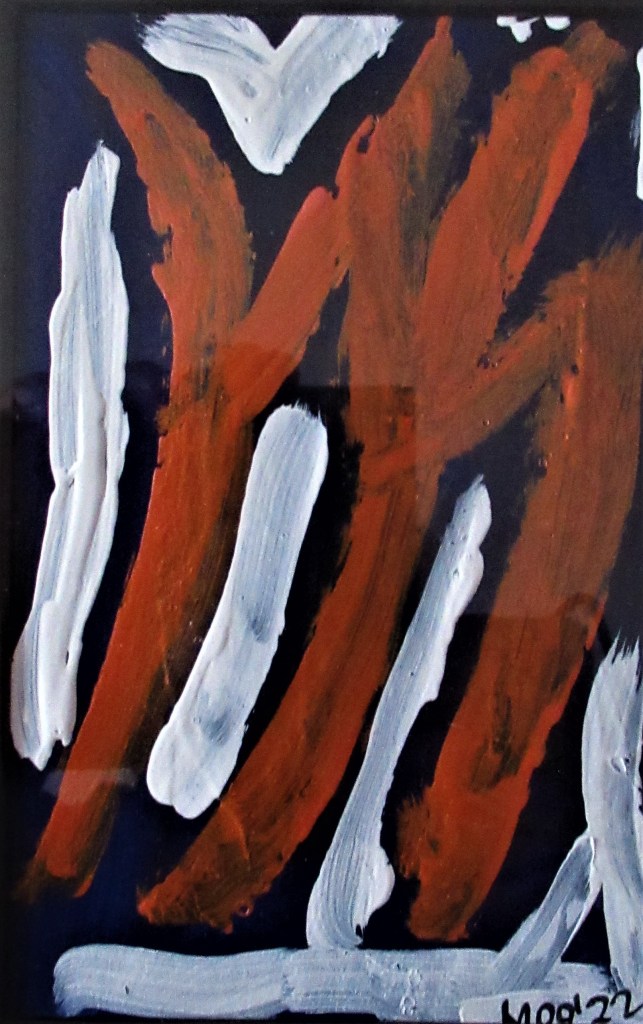
Comment: Once again I thank my friend Moo for his illustration – Building Bigger Boxes. It goes well with the theme of this rant, or is it a poem? A verbal rant to echo a visual rant, perhaps, or vice versa.

Heartbreaking

Heartbreaking

How many have broken their hearts,
reading what I have written, as I have
broken mine, reading what others wrote?

My words reach out, naked, stripped
of false trappings, fake images,
my flesh and blood damp on the page.

Who knows where my words will land,
on fertile ground, on desert sand, or will
they lie on dry, stony paths, infertile?

So many people now scorn living words,
preferring those dull dry three-word chants,
fists clenched, or raised, that hypnotize.

Their love of words, thoughts, ideas, life
have been coffined in confining boxes,
cardboard castles, corrugated cans,
that they lock, then throw away the key.

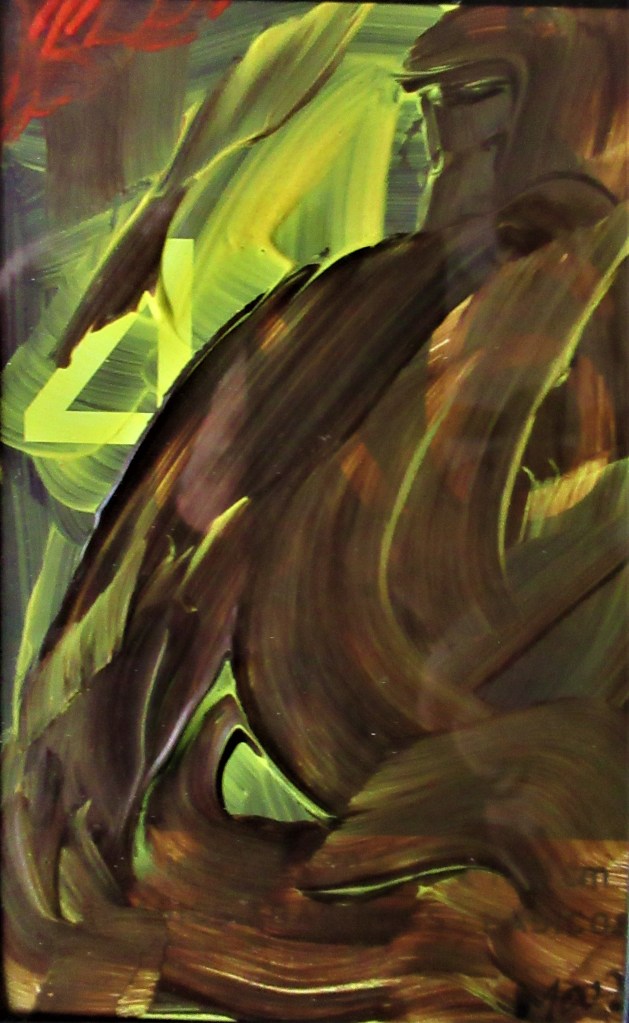
Comment: Thank you Moo for your painting – Words fall like leaves and drift away. It make a fine companion to the poem.

Modern Society

Daily writing prompt
What would you change about modern society?

What would you change about modern society?

Good question – what indeed? First, define society. It’s not as if a single society dominated the world. Do we then distinguish between the world, this geoidal planet on which we live, and the multiple societies that inhabit this world? If we do, then what right do you, or I, or any other individual have to change any or all of the world’s cultures and societies? And how do we change them?

Many ways have been tried in the past, very few successfully. The Spanish Inquisition burned many books and censored others. Other book burnings and spurnings have taken place, and in some places, they are still happening. But are they effective in the long term? Good question. Short term, maybe. Long term, I am not so sure.

Do we limit education, and by extension, knowledge, to a few , limited people, who believe what we believe, and do what we want them to do? That has been tried as well. Short-term successes, but long term disasters. As well as depriving people of education and books, we can also enslave them. This is still happening in many places.

So, another definition: what do we mean by change? Change for the better? Change for the worse? Change for change’s sake? Change for the betterment of our own selves and the devil take the hindmost? And what do we mean by modern? So many questions – so few answers.

Albert Camus once wrote that he was ‘optimiste, quant au monde, pessimiste quant a l’homme‘ – an optimist where the world is concerned, a pessimist where humankind is concerned. Personally, I am not sure that this particular thought stands up any longer. Is it still possible to be optimistic about a planet that we are capable of blowing to smithereens, a planet, moreover, that is currently suffering from wind and rain, fire and flood, famine and war, pandemic and a pollution like none we have ever seen before?

How can I change the world? I am just a single human being. Well, I am a married one, actually. But I only have one vote. I rather fear that single vote (votes don’t marry and produce offspring) will have little effect on my ability to make any change at all to modern society.

Pass the soap and a towel, please, as a certain person said a long time ago. I want to cleanse my hands and purge my soul. I am too old a dog to try and learn new tricks.

What foods would you like to make?

Daily writing prompt
What foods would you like to make?

What foods would you like to make?

Walking round the supermarket the other day, I was astonished by the high prices now written on labels. Meat is virtually unaffordable, especially the good cuts. Butter at $9.00 a lb is a shock to the system. Eggs are up to $6.00 or more for a dozen. Wow! So much of what I used to cook I can now no longer afford. So What foods would I like to make?

Good, wholesome, cheap, nourishing foods. Foods that could be distributed to the city’s poorest people, at very little cost. Foods that would support those who are struggling with high rentals or rapidly climbing mortgages. Foods that would give a genuine opportunity to do both, to those who are wondering whether they should heat or eat . Foods that would allow people to stay on their medication and not be forced to choose between eating, heating, or skipping their pills.

Now, with these enormous heatwaves, house-cooling is also a priority, as is clean air, and clean water. Our food preparation, sooner or later, will have to take so many different factors into account. ‘Brother, there’s a reckoning comin’ in the morning’ – the spiritual says it well and speaks true – ‘better get ready ‘cos I’m giving you the warning’.

And remember, the percentages of people who can no longer afford to live a decent, respectable life is rising, not falling. Food Banks are on the rise and more people are using them. Soup kitchens too. In the United Kingdom, now known as the Untied Kingdom, it is rumored that government is cutting sponsorship to food banks so that more people will return to their daily gigs and fulfill their duties of supporting themselves financially by seeking multiple employments at minimum wage or less. Alas, even then, with multiple jobs and moonlighting, they cannot necessarily sustain a decent life-style.

So, what foods would I like to make? Good, cheap wholesome foods that would support a maximum number of people for a maximum span of time. Pax amorque.