The Spanish Civil War – one brother pro-Franco, and the other, imprisoned for a quarter of a century.
They locked him, with two dozen men, in a deep cell below the convent of San Marcos de León.
All save him were executed. He spent our time together telling me how guilty he felt because he survived.
20
So many died standing blind-folded with their backs to unforgiving stone walls, because they refused to believe what the enemy told them to believe.
Nobody spoke for them. Who can speak for those who carry the candle or board the tumbril, or see the hooded executioner draw near?
The axe approaches. The gallows draw closer. The guillotine falls. The single eye of each rifle stares at the victim’s chest.
Commentary:
I find it hard, very hard, to talk about these two stanzas (19 & 20). I remember two of Goya’s paintings, The Second of May and the Third of May. The Third of May says everything that I cannot say. So, I will just leave you with two paintings to google and one photo of an unforgiving stone wall, with the gateway filled in. Pax amorque – we all need peace and love – I can say that, for we all need it.
… but the light cannot last forever so where do I go when the door in my head slams shut
then I know I have lost the key to my mind’s labyrinth I struggle but I realize there’s no escape
Ariadne’s thread the one that should lead me out of the labyrinth turns into a woven web trapping me leading nowhere
the minotaur half-bull – half-man bellows stifles all thoughts
my heart turns to stone indigestible in the throat’s gorge or the stomach’s pit and my mouth’s too dry to spit
in this starless night when fear descends with the dark a guillotine slices its way through muscle and bone to sever all hope
no glow worm can worm its way into my mind to enlighten the path …
Commentary:
“… the minotaur, half-bull, half-man, bellows and stifles all thoughts …” I asked Moo for a painting of a Minotaur, but he didn’t have one. So I pottered about and found this photo of Los Toros de Guisando, a pre-Roman set of sculptures, in the Province of Avila, carved by the Celts. Not exactly a Minotaur, but certainly a set of taurine images that baffle with their size, silence, and presence. Indeed, they conjure up the images of the poem’s next verse ” … stone, indigestible in the throat’s gorge or the stomach’s pit …”
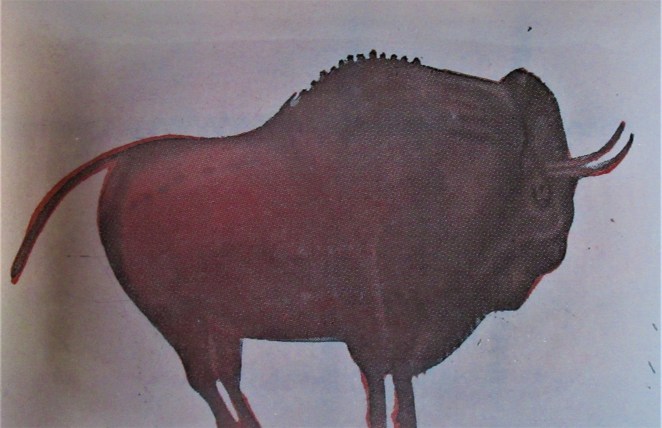
This is the cave painting, circa 5,000 BC of a bull, as found on the wall of the Caves of Altamira. Alas, he cannot bellow. Or should I say, Thank heavens, he can neither bellow nor pursue us. He stands silent on his cave wall. This photo comes from a glass ash tray my father purchased as a souvenir when we visited those caves (circa 1963-65, before they were closed to the public). Intertextuality – this bull as text and the long history of his multiple appearances. Metaphor and magic, mysterious and marvelous.
The idea that “religion is a glow-worm that glows in the darkness” is a metaphorical observation on the nature of faith. Its most famous expression comes from the German philosopher Arthur Schopenhauer. The statement suggests that religion appears most valuable and needed when people are in a state of ignorance, uncertainty, or despair.” Wikipedia – AI Generated. Our poet, that’s me, in case there are any doubts, refers back to this idea when he writes “no glow worm can worm its way into my mind to enlighten the path”. This too links back to the poetry of St. John of the Cross and his references to the dark night of the soul when hope seems lost and we despair of everything. Then we link to Goya’s etching – The Sleep of Reason – “when reason sleeps, monsters are born.”
However dark the night, someone has walked this way before us. We can follow in their footsteps and hope for the dawn. When it arrives, we can rejoice. But never forget the law of circularity, what goes round, comes round. Night will come back, the way will again be dark, but the light will always return once more. Images and symbols, metaphors and mystery, even the unspeakable can be spoken in the ways in which the ancient artists, sculptors, painters, saints, and philosophers have shown us.
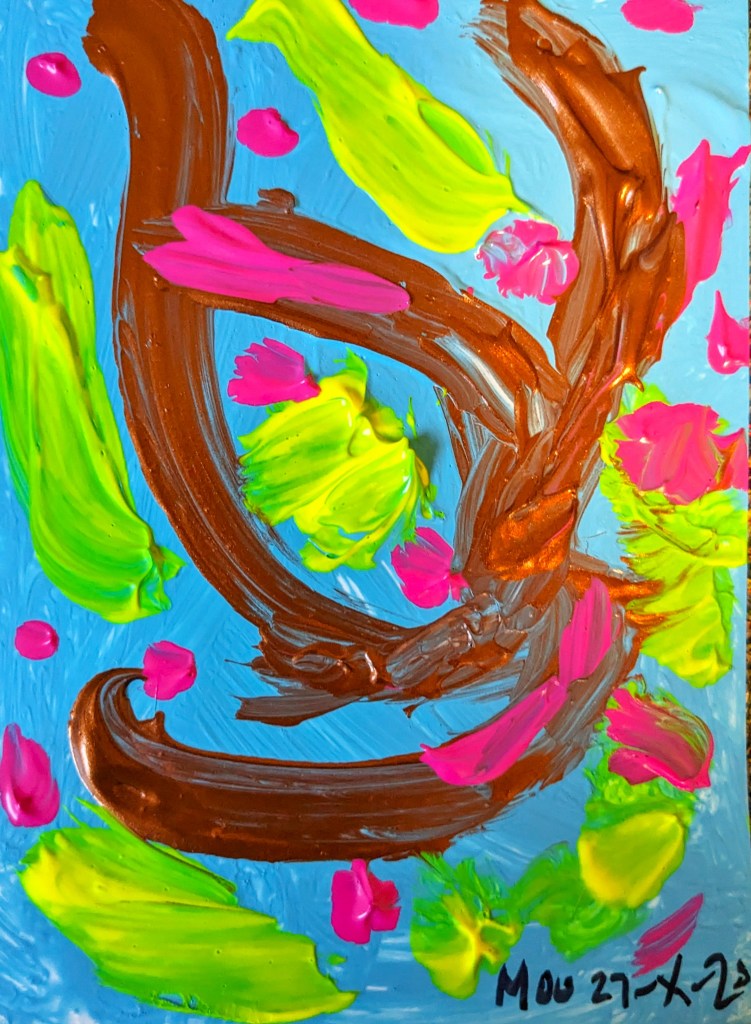
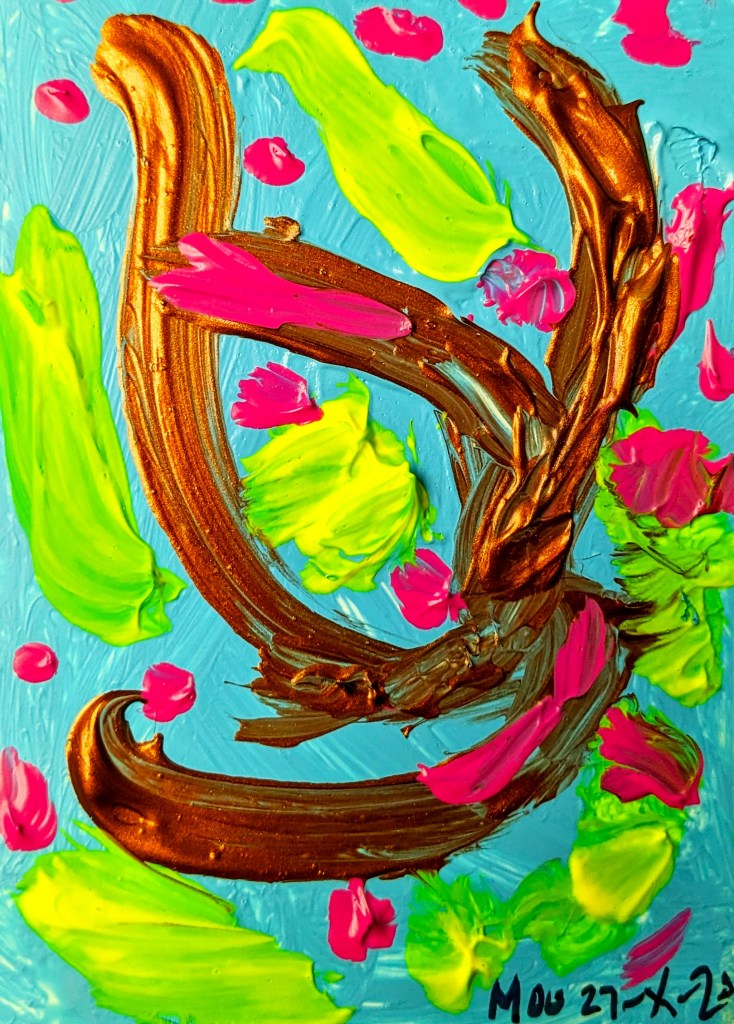
“And time has ticked a ribbon round the stars.” Dylan Thomas, sort of, but a perfect title for this painting that I completed this morning. The acrylic paint is still wet! I brought it downstairs, looked at it in the light from the kitchen window, and the colors had all changed. I angled the painting, then re-angled – it was a chameleon changing color in the shifting light. Then I turned the large ceiling lights on – and this is what I saw.
Exactly the same painting – or is it? When I was studying in Madrid, a long time ago, I visited the Prado every afternoon. Each day I would visit a different room and stay there for the duration of my visit. The tourists who flitted in and out amazed me with the brevity of their visits. A minute or two to see all the paintings by Hieronymous Bosch, for example. I sat in front of just one of them for half an hour – and I could have stayed longer.
When I visited Las Meninas, it stood in a room by itself. It had a full size mirror opposite it, on the far wall. I should add that this was long before it was cleaned and renovated. I looked at it from every possible angle. I drew close and squinted at the lace and wondered at the quality of the brush-strokes. I lay on the ground in front of it. Stood at the side. Watched it change as I changed my position. I discovered art as a living being, not a static moment in time. Imagine me, for a moment, kneeling on the ground, watching the young prince’s horse soar over the top of me, as it would have done, if it had occupied its original spot, angled above a doorway. Change the angle, change the perspective, change the painting, and watch it come alive.
I will never forget my days with Goya. His Disasters of War – wow – such an incredible sequence – took up several afternoons. And the Pinturas Negras – the Black Paintings – they still haunt me, as do the Disasters. Man’s inhumanity to man – not a dead set of etchings but living portraits of an evil that goes on and on. “This I have seen!” “And this!” Indescribable scenes. Words cannot do justice to the depth’s of the feelings generated by such works of art. When will we ever learn? I taught a great variety of students for most of my life and I know all too well that some lessons can never be learned. Like an endless loop on a news tape, people are doomed to repeat them, again and again, and again.
As the BBC Lion said as he finished his supper – “That is the end of the gnus.” TWTWTW.
I went to the pharmacy today for my regular shots, booster and upgrade. The pharmacist asked me if I was allergic to anything. “Yes,” I replied. “I am allergic to stupidity.”
Stupidity is a singular thing, but it comes in many forms. The car driver who weaves his car through thick traffic, breaking the speed limit, threading a narrow pathway, overtaking on the inside, the outside, turning a two way street into a three way street by adding a third lane, even though there is oncoming traffic in the new lane he has built for himself. Such people rely on the charity of others to give way and make space.
Then there are incompetent teachers. Not all teachers are incompetent. Some are wonderful, kind, friendly, and comforting. Others are martinets, escaped from the army cage, and strutting the classroom, using the ruler to beat the students into submission. ‘My way or the highway,’ they claim, and what they say goes, even if it climbs to the height of stupidity or falls to the bottom of the well of incompetence.
Goya illustrated the nature of various kinds of stupidity in his wonderful etchings. Witches flying, donkeys braying, simple people worshipping the expensive clothing but never seeing the corruption it covers. So, turn to the Caprichos and the Proverbios, or, if you want to receive a real lesson in man’s inhumanity to man, look at the Desastres de la Guerra, the disasters of war.
Stupidity – a simple word – but with multiple meanings. What bothers me, and why? Stupidity, plain and simple, in its multitudinous forms.
Wrapped in his blanket of silence, the painter paints. He pays no attention to the shrieks, screams, prayers, curses, doesn’t even hear them. He sees their staring eyes as the bull’s eyes at which anonymous soldiers, heads down, backs to his easel, fire. He sees their mouths as black holes, slashed across their faces. He sees the priest with his rosary, but never hears the rattle of the beads or the firing squad’s guns going off, filling the canvas with smoke, the square with blood.
Back home, in the Quinta del Sordo, his deaf man’s house, he sits at the supper table, dwarfed by his painting of Saturn, devouring one of his children. Beside him, old women, hags themselves, suck soup silently from wooden spoons, or fly soundless, black bats in the starless sky, on the back of goats or on their witches’ brooms.
The great, open wounds of his paintings speak to us of his hushed suffering, of the calamitous world that spawned such violence, plague, famine, and fear. Plundering armies, guerrilla warfare in back street and alley, torture, pillage, rape, and suffering, pits filled with the dead and dying, famine walking the streets, and all of it inaudible, the nightmares of a little child, seen, but never heard. His paintings speak to us, and they allow us to reconstruct in our imagination, the many things that the painter, deaf, but never dumb, could never hear, yet reproduced using his paintbrush and his taciturn palette as a tongue.
This has been a time when words have failed me. Thanks to the presence of Finley in the house, my painting and drawing has been restored and I have once again begun to see a new world of shape and color through the eyes of a small child. Small? She is tall for her age and very, very visual. This morning we did online jigsaw puzzles – all art and patterns – and fractals!
Words may fail, but they are ever present. Bas bleu, well we all know what that means in the world of French academia where I once lived, a long, long time ago. Bas bleu clair – well they are light blue, aren’t they? And, like the revolutionary sans culottes, my figure walks barefoot, à pieds nus, that is to say, without shoes, sans chaussures.
I don’t know who started playing with words and cartoons, but Goya was a master at doing so, in his etchings. So words and visions linked, all in a playful game of allusion / elusion. What a wonderful world, that of the childlike, playing mind.
stones once thrown
can never be brought back
nor words once spoken
nor the bullet
once released
from musket or gun
here lies who knows who
face down in the dust
shirt soaked in blood
body pierced with lead
nor water time nor love
can ever flow back
beneath that bridge
some kneel some pray
some raise their eyes
to uncaring skies
every one of them dies
shooters
those waiting to be shot
even the soldiers
reloading their guns
never understand
how time’s tide runs
ebbs and then flows
until everyone goes
this you
lying face down
on cobble stones
well know
Comment:
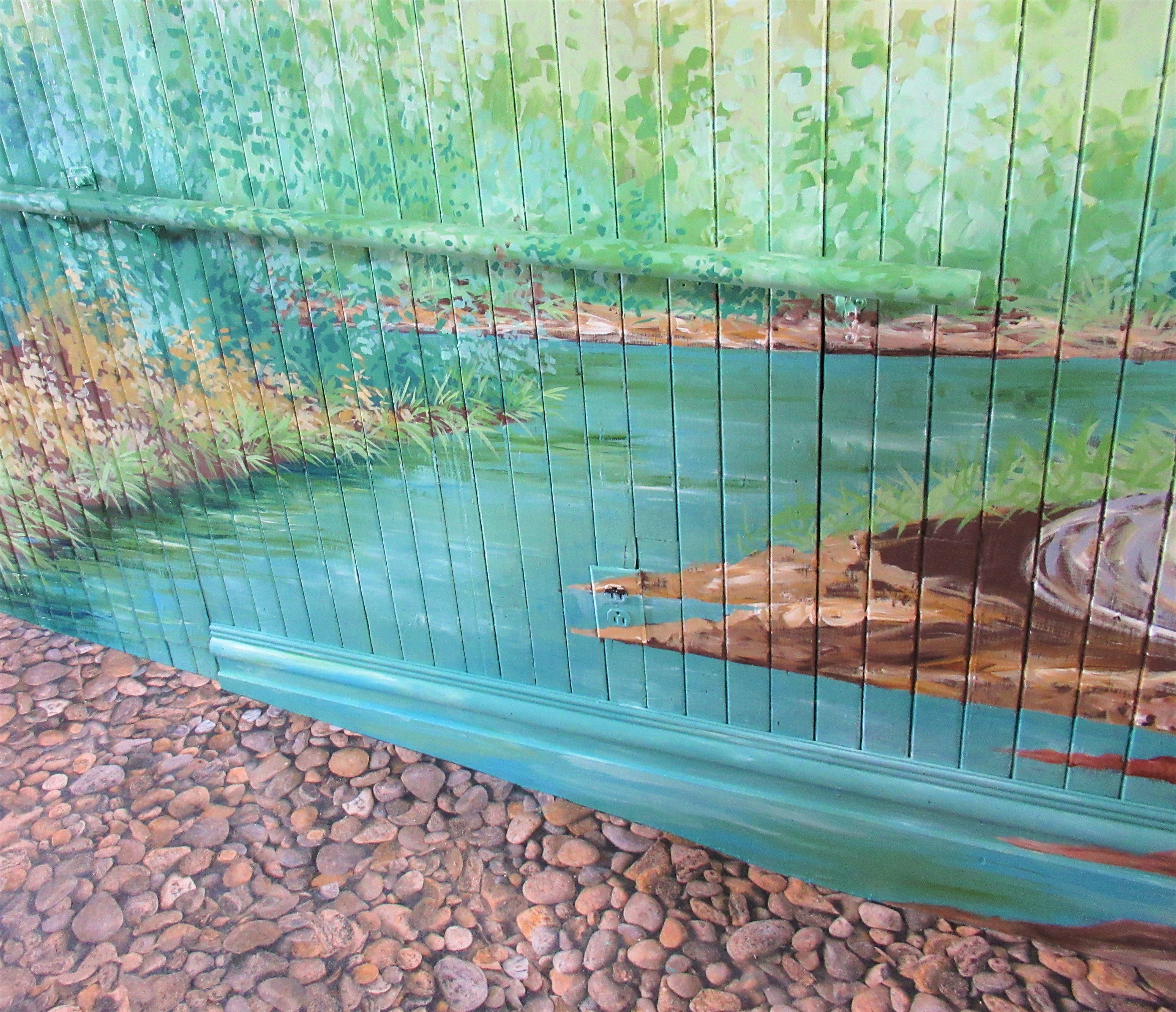
The poem is drawn in part from the Goya painting of the shootings, El tres de mayo de 1808. The painting above is a close-up of Geoff Slater’s latest mural, still in progress, at Macadam Railway Station in New Brunswick. “If only the stones could speak, what stories they would tell.” This re-post was inspired by a visit to Seasons of the Witch on Mr. Cake’s Cake or Death site with its images of Goya’s Black Paintings. So, we have a continuing Goya mini-Fest, May the Second and May the third.
bottle tops unscrewed
tighter than the tightest
oyster refusing to open
pointed knife and scissors
plastic this many layered
onion-skin’s pliant defiance
waging its guerrilla war
against arthritic fingers
words tongue-twisted
damning dark mouths
white picket fences
midnight the faces
lightning the teeth
felonious figures
grimy with grimaces
Mother Hubbard’s
cupboard empty hearts
robin redbreasts
battering heads wings legs
against stony cobbles
if only stones could speak
what stories they would tell
this city this sunny square
anywhere
Comment:
El dos de mayo, 1808, marks the start of the Spanish War of Independence. The people of Madrid rose up against Napoleon’s Mamelukes and Goya painted that encounter in his Dos de Mayo. On the third of May, 1808, Goya also bore witness to the shootings when Napoleon’s troops took hostages and shot them. Two great and wonderful paintings which we can celebrate today and tomorrow. Also well worth a visit, today and tomorrow, is Mr. Cake’s Cake or Death site with his blog on Seasons of Witches and his introduction to Goya’s Black Paintings. Another site that merits serious attention is Geoff Slater’s art site.










 rogermoorepoet