Listen!

Listen

When I cannot write,
I take a paint brush,
and start to paint.

When I paint, I listen
to the brush as it moves
itself over the canvas.
I listen to the colors
as they demand attention
and tell me where to place them.

I listen to the paint as it says
‘just here, not too thick,
not too thin, a swirl please,
gently now.”

I also listen to flowers, trees,
the wind in the willows,
the songs of falling leaves,
and the voices of birds
that mourn their empty nests,
abandoned on the branches.

Comment:

This poem also came from yesterday’s prompt – what do you listen to? The act of ranting, based on a prompt, usually generates imagery and ideas that can then be used in either poetry or prose. For me, the secret is to cut away the dross and to search for the gems that are often hidden within verbal outpour. This leads, in my opinion, to enhanced creativity.

What do you listen to while you work?

Daily writing prompt
What do you listen to while you work?

What do you listen to while you work?

While I was actually working, although I never called it work, because I thought of it as a vocation, I listened to the complaints of the administration (often about my way of work). I also listened to my students (all too often their complaints about the system and the way they were being taught and treated). And then I listened to the problems that were daily laid before me in my office by these same students. These, problems and students, were many and varied. One day, I designed a label for my door that announced: Office of Creative Solutions. And yes, I provided many innovative and creative solutions to problems that, to young people, especially my students, seemed almost impossible to resolve.

Then I retired. At least, like an ageing horse, or an unwanted donkey, I was put out to grass. And in that clover-filled meadow, I grazed at leisure and worked no more. But I did have time to write and so I became a creative writer. At first, when I started creative writing, I forced my characters into the roles that I had chosen for them. Sometimes they complained. Then, one day, or maybe it was one night when I was dreaming, a host of my characters, minor and major, came knocking on my door. They carried a big arrow that had, written upon it, Office of Creative Solutions. They pointed it at me and began to complain about how I was treating them. I remembered the poem I had memorized as a child – The owl, he was a wise old bird, the more he spoke, the less he heard. The less he spoke, the more he heard. There never was such a wise old bird.

I remembered how I had listened to my students and how, by listening, I managed to find creative solutions to their problems. So, I listened to those characters as they yammered away. One by one, they told me their woes, and their problems. Then, the following day, I rewrote everything I had written previously and wrote the stories down in their own words, instead of mine. When I listened to them, I allowed my characters to tell their own stories, and to speak for me and through me.

Sometimes, when I run out of voices that come in the night and tell me what to say, I cannot write. Then I take a paint brush, and I start to paint. What do I listen to when I paint? I listen to the brush as it moves itself over the canvas. I listen to the colors as they demand attention and tell me where to place them. I listen to the paint as it says ‘just here, not too thick, not too thin, a swirl please, gently now.”

Now, when I am not working, I listen to flowers, trees, the wind in the willows, the songs of the falling leaves, and the voices of birds.

What’s your favorite [card] game?

Daily writing prompt
What’s your favorite game (card, board, video, etc.)? Why?

What’s your favorite [card] game?

Well, it’s so easy to get bored with board games, so my favorite card game is sending and receiving e-cards for all sorts of occasions. Costs nothing, other than the initial membership / subscription fee, arrives almost instantly, often elicits an unexpected response, keeps me in touch with my friends all over the world, no quarreling over who is winning or losing, because when card and reply arrive, we are all winners, and there is very little lost in the post, like those letters that are still turning up from the WWI trenches. Missing, believed lost in action, didn’t refer only to those poor souls who strayed into no man’s land and never returned.

And let’s go back to counting the costs for a moment. While I love real cards sent by mail, and I just love opening them and reading well-known hand-writing, there is something incredibly sapping about the rising cost of stamps. the ever-longer delivery delays, the enormous rise in the cost of the card itself.

And the delivery delays? Well, I sent myself a card, the other day, by the old-fashioned method. It took nearly ten days to arrive. I think that it was sent by a slow sled driven by half-starved, rebellious huskies, to the north pole, and back, possibly via one or all of the -lands – Greenland, Iceland, Ireland, or Newfoundland. Two of those places I have visited, which, by a simple sum of subtraction, means that there is at least one that I haven’t. Oh dear. I was never very good at maths or math or mathematics, or spelling either by the look of it.

And the one really unbeatable thing about playing the game of sending e-cards by e-mail: you never have to lick the banana flavoured gum on those horrible envelopes. Remember that taste? Now gone forever, though the taste lingers on in my memory.

Ghost Train

Ghost Train

I remember the little electric railway
that ran on a single loop around
the kitchen table, diddly-da-diddly-da,
just like a real train, except no smoke,
no puff the magic dragon, no sense
of a schedule or arriving and departing
when circular time is meaningless,
as are the numbers on the sundial
when the sun isn’t shining,
or the hands on the clock’s blank face
when the numbers are missing,
and you don’t know whether you are
looking in time’s distorting mirror
or are standing on your head
in the Antipodes, and all the while
the clock hands are marching round
and round, tick-tock, and there is
no track by which time can be tracked.

And the runaway hands go round the track,
and the electric train goes round the table,
 and the ghost train hoots whoo-hoo,
as it vanishes into the timeless tunnel,
then exits, the engineer, like Rip Van Winkle,
grown old with a long beard, and the carriages
all covered with cobwebs, and skeletons
leaping out of the compartments,
then sitting beside the travellers
as they snore on their seats.

Comment: Another poem based on a prose prompt. What a great source for poetry those prompts can be, when you don’t take them too seriously and allow your imagination to run riot and your memories to flow. Not automatic writing, but writing that springs from an absurd, surrealist approach to the crazy world that surrounds us. Rain that causes the yucca plant to grow, then falls so hard that it is battered to the ground by the very thing that gave it life. And so it is with my memories of the many trains on which I have travelled and with which I have played. Once upon a time, I couldn’t conceive of life without the railway. Where is it now? I haven’t been on a train for more than fifteen years. Strange how their ghosts flit through my dreams at night: fast trains, slow trains, the wrong train at the wrong time taking me to the wrong place in time. Ah, the poetry of trains yet, “ni temps passés ni les trains reviennent.” And you can give yourself a glow of satisfaction – thank you Tommy Reed – if you recognize the quote, and two more if you know who Tommy Reed is. I use the present tense because, although long gone, he is ever-present in my mind.

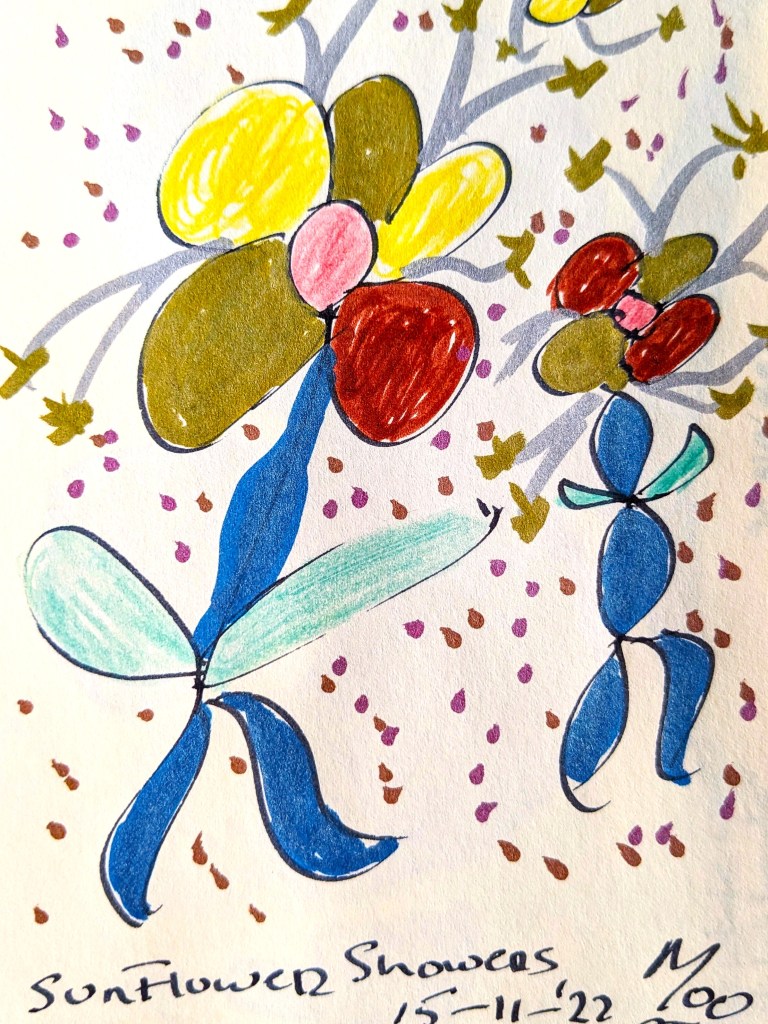
Today’s painting – another gift from my friend Moo.

Patience

Patience


“Patience achieves everything.”
St. Theresa wrote this in Spanish,
back in the old days, when patience
was a virtue that few possessed.
Patience has vanished nowadays.

It is as dead as a doornail,
as dead as the proverbial dodo,
as dead as whatever cliché
springs to mind in the laziness
of the instant possession of each
passing cloud, each new slogan
marketed madly on the TV.

Turn off the TV. Go out, barefoot,
and walk on rain-wet grass
or walk on sea-wrinkled sand
out into the sun-warmed waves,
there where the sandpipers
stitch their secret messages
and the crows walk barefoot too.

Learn the secrets sown there,
decipher the ancient wisdom
left on the beach by wandering gulls.

There, in the tide-mark you will find,
among the sand-papered bones
and skulls, the secrets that will solve
the mysteries that you seek.

“If you try to force the soul, you never succeed.” John O’Donohue, Anam Cara, p. 147.

“La paziencia, todo lo alcanza.” St. Theresa of Avila.

Sacred Moment

Sacred Moment


Evening falls, leads into night.
I search darkening skies
for the moon’s bright circle,
so meaningful, that light.

The moon, a thin wedding ring,
encircling a gilded cradle,
wherein five planets float.

Aligned, their circular lights
create such longing
in the observer’s heart.

The magic moment has come,
a moment forever sacred.
Whatever happens now
will be correct and right.

The Secret Fountain

The Secret Fountain

Go deep into yourself.
Search for the secret fountain,
the well with the sacred waters that renew,
replenish, and flow like sunlight.
Rest by its verdant banks. Here you can
find the self you thought you had lost.

Here, angels take wing and songbirds sing.
Telephone calls, e-mails, social media,
all such worldly things, lack meaning.

Rest awhile. The universe knows you.
Permit it to once again make friends
with who and what you are, what you were,
what you will always be, your eternal spirit
known, cossetted, comforted, and loved.

Your curriculum vitae no longer matters.
What matters is the heart of you,
that gold mine hidden deep within.
Here lies the mold of shining gold that will
enrich your soul, renew your life,
and gift you ever-lasting treasures.

B & W

B & W

black words     white page

thoughts

floating in space

airs and graces

the world’s wind

blowing through

freshening     cleansing

cotton clouds     silky sky

that one word

waiting

to be spoken

that one thought

soon to be borne

out from the dark

a new existence

brightens

blinds with its light

Click here for Roger’s reading.


“If you look at a page of poetry, the slim words are couched in the empty whiteness of the page.” John O’Donohue, Anam Cara, p. 69.

Anonymity

Anonymity

Multiple masks stripped away, old wall paper
shed in strips, layer by layer, until you reveal
the bedrock foundations of your delicate face.

Your visage dissolves before my eyes until you
become what you were when I first met you:
sweet, young, fresh, a delight to catch the eye.

As you still are, to these old, fragile eyes of mine,
cataracts removed and lenses still capable of
seeing you in your spring, although it is your winter.

The snowfall of your hair cannot deny the sparkle
in your eyes, the summer freckles that will soon return,
the sunlight and joy you bring when you enter the room.

Ageing, yes, but you are as young and as sweet
as you always were. How could you not be?
Anonymity peels itself away until no barriers exist

between what you are to me now, and what you were.
It is a lie, that only the young write poetry in praise
of their beloved’s eyebrow, her lips, her gaze.

For how many days have we stood together, as one,
breathing the same air, walking together, facing
the same difficulties, and overcoming them hand in hand?

Yes, we have both slowed down – the way of all flesh –
and we are no different. We wither and perish, but
we haven’t perished yet, although we are withering.

The magic of our love, our gifts, molded into our DNA,
will not perish with us, and never will, not while
our spirits live on and our love creates others in our shape.

Click here for Roger’s reading.

“In the human face, the anonymity of the universe becomes intimate.” John O’Donohue, Cara Anam, p. 37.