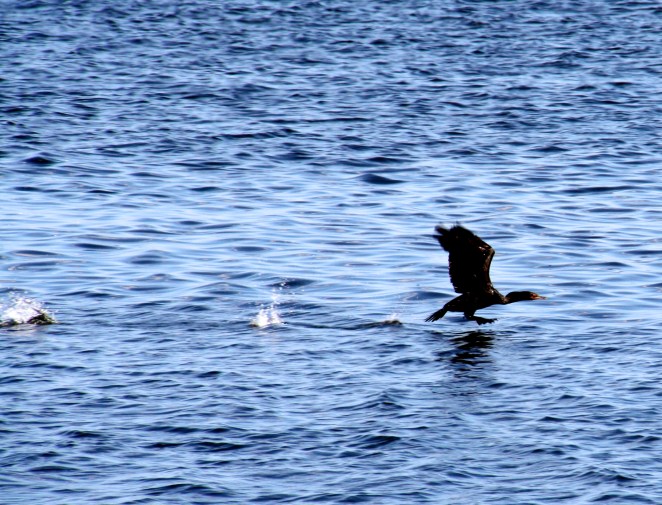
Luck, sometimes, just being in the right place at the right time. One step, two steps, and up he went and look at those footsteps. His flight, a step of faith, two steps of faith, and away he goes, fait accompli.Another golden oldie. I do love rediscovering them. The photos, too.
Flight of Fancy
Just by chance, I caught this cormorant. “Behind you, quick,” said Clare. I turned and ‘Click!’
Such a miracle: the first steps of flight taken over water. That first step heavy, the second one lighter, and the third one scarcely a paint brush pocking the waves.
The need to take flight lies deep within me. Fleeing from what? Running towards what? Who knows?
All I know is that the future lies to the right of this photo and the past lies to the left, and I don’t know the meaning of either.
But I do remember the words of Antonio Machado: ‘Caminante, no hay camino, sólo hay estela sobre la mar.’ “traveler, there is no road, just a wake across life’s sea.”
Comment: I revised this poem a few minutes ago and cut it down to its essentials. If you want to read the original and check the revisions, click on this link to the earlier poem. Any comments on the rewrite and the revision process would be welcome.
Not Oaxaca, but Avila, with una tromba, a meseta rainstorm, about to descend upon us. And when it descends, there is water, water, everywhere, as you can imagine from the clouds. In Oaxaca, water is precious. Tap water is to be avoided. Bottled water is to be preferred. We used to wash our vegetables in water that was specially chlorinated, also the pots and pans!
Water Peragua Water seeks its final solution as it slips from cupped hands. Does it remember when the earth was without form and darkness was upon the face of the deep? The waters under heaven were gathered into one place and the firmament appeared.
Light was divided from darkness and with the beginning of light came The Word, and words, and the world … … the world of water in which I was carried until the waters broke and the life sustaining substance drained away throwing me from dark to light.
The valley’s parched throat longs for water, born free, yet everywhere imprisoned: in chains, in bottles, in tins, in jars, in frozen cubes, its captive essence staring out with grief filled eyes.
A young boy on a tricycle bears a dozen prison cells, each with forty captives: forty fresh clean litres of water. “¡Agua!¡Peragua!” he calls. “¡Super Agua!”
He holds out his hand for money and invites me to pay a ransom, to set these prisoners free.
Real water yearns to be released, to be set free from its captivity, to trickle out of the corner of your mouth, to drip from your chin, to seek sanctuary in the ground.
Real water slips through your hair and leaves you squeaky clean. It is a mirage of palm trees upon burning sand.
It is the hot sun dragging its blood red tongue across the sky and panting for water like a great big thirsty dog.
Comment: More and more competitions, publishers, and magazines are asking for ‘original material, not previously published, or self-published, even on your own blog.’ So what is a poet to do? Put up fresh material, and it is illegible for entry elsewhere. Recycle and revise old material? Now that might work. Click on the link above for the original version of this post! And yes, it has been previously published on these ages!
A lighthouse to light your way, shining to make the night as clear as day and to highlight any obstacles that might stand in your way.
Lighthouse
Once upon a time that lighthouse on the quay was a young boy who sat within the shadow of his father’s tale. He sensed he would never feel the power of his own words because he didn’t seem to have any on account of the black hole inside him that swallowed everything up. He thought he would never know the joys of creating his own myths, telling his own story. He thought he would never come to grips with storm music, wind and rain, a lost path sought and found. He longed for someone to gift him a rainbow, with or without its pot of gold. He also thought that the fatal shadow, cast upon a child by a father, would always be there. One day, the early morning sun knocked on his bedroom window. He drew back the curtains and let in the light. That day, he emerged from the shadow and saw that the world was bright and filled with sunshine. Each morning, he breathed in the sunlight, felt it flow through his body. His heart pumped new blood and he was refreshed by the joy of living, of being himself, of being nobody but himself, unique and wonderful, subject to nobody’s wishes and whims. Gradually he grew into the person he was always destined to be. The sun’s rays lit up his face and eyes. Sunshine flourished within him and renewed not only him but all that he touched. Light flooded out like the beam from that other lighthouse, over there, on those rocks, that was put there to help and guide wayfarers and seafarers lest they become lost at sea. Lost, he found himself. Found, he centred himself. Joy and hope, belief and knowledge took root under the sun that each day nourished his body, soul, and spirit. Renewed, light flooded from him. He burned like a bonfire or a beacon and became one of those special lights that enlighten the world. He became that lighthouse.
Comment: One of the prose poems from Tales from Tara that slipped in here by accident. I have included it for, and dedicate it to, my good friend and fellow writer, Judy Wearing, to wish her well with health and strength in this new year that is now turning into something special.
Photo by my good friend, Geoff Slater. Books by yours truly, who stayed on the bus and believed.
To be a writer ….
He who would true valor see, let him come hither. One here will constant be, come bad or fair weather. No line length can him fright, he’ll with a paragraph fight, and he will have a right, to be a writer.
Those who beset him round with dismal stories, do but themselves confound: his strength the more is. There’s no discouragement will make him once relent his first avowed intent, to be a writer.
Rejections nor bad critics can daunt his spirit. He knows he at the end will a book inherit. So critics fly away, he’ll fear not what they say, he’ll labor night and day to be a writer.
Comment: John Bunyan tempted me and I fell into temptation. In fact, as my good friend Oscar Wilde once said: “I can resist anything except temptation.” So, ladies and gentlemen, change the he to a she or the pronoun of your choice, turn the writer to a sculptor, stoneist, poet, playwright, painter, novelist, dramatist, comedian, song-writer, singer. Breathe deep. Believe in your own artistic talent and remember: “Genius is 99% perspiration and 1% inspiration.” Remember this too: “You’ll never get to Vancouver by bus, if you get off the bus at Montreal or Toronto.”
As I walked home, it started to snow. Not the pure white fluffy snow of a pretty Merry Christmas card, but the dodgy, slippery mixture of rain, snow, and ice pellets that turned the steep streets of Swansea into ice slides and traps for the elderly. I turned up the collar of my coat, bowed my head, and stuffed my hands into my pockets. Two houses before my own, I stopped in front of our neighbor’s house. The window shone, a beacon in the gathering dark. I drew closer, pressed my nose against that window and looked in. A Christmas tree, decorated with lights, candles, more decorations, a fire burning on the hearth, two cats curled up warm before the fire, presents beneath the tree, stockings hanging from the mantelpiece. For a moment, my heart unfroze and I felt the spirit of Christmas. Then I thought of my own house. Cold and drafty. No lights, no decorations. No fire. The snowball snuggled back into my chest and refused to melt. When I got home, our house stood chill and empty. My parents were out at work and the fire had died. Nothing was ready for Christmas. I sat at the kitchen table, took out my sketch book and began to draw, then color. When my mother came home, I showed her my picture. “Very nice,” she said without looking up. “But mum, you haven’t really seen it.” She stared at the picture again. This time, she saw the Christmas tree and the lights, the cats before the fire, the candles burning on the mantelpiece, the decorations and the presents wrapped and waiting beneath the tree. But she never noticed the little boy standing outside the house in the falling sleet, cold and shivering, peering in through the window.
Comment: Everyone remembers Dylan Thomas’s story A Child’s Christmas in Wales, but not all Welsh Christmases are like that. This is the story of a forgotten child’s Christmas in Wales. It is a story about a latch-key kid, left alone at Christmas to fend for himself. I enclose the drawing he did and I dedicate the story to anyone who is alone this Covid-19 Christmas. Christmas spent on your own is not much fun. Looking through another’s window, from the cold street outside, is not much fun either. So, at this time of year, let us remember those who are lost and lonely, those who need a kindly smile and a helping hand, those who do not have the comfort of family and friends, a warm wood fire, or a cat or a dog to snuggle up to them, to lick them, and to wish them ‘all the best’ in the languages that all animals speak on Christmas Eve, and sometimes into Christmas Day. Phone a friend, nod to a neighbor, and may your Christmas season be filled with joy.
Married 54 years ago today. What a way to celebrate with 3 poems to Clare on QBF. My thanks to Brian Henry and Quick Brown Fox.
Yours
Yours are the hands that raise me up, that rescue me from dark depression, that haul me from life’s whirlpool, that clench around the jaws that bite, that save me from the claws that snatch.
Yours are the hands that move the pieces on the chess board of my days and nights, that break my breakfast eggs and bread, that bake my birthday cake and count the candles that you place and light.
You are the icing on that cake, and yours is the beauty that strips the scales from my eyes, then blinds me with light.
Comment: what excellent timing: thank you for publishing three of my poems to Clare and on our 54th wedding anniversary too (24 December 2020). An incredible gift and Clare and I both thank you for it, Brian. How to make a memorable day even more memorable. Tonight, when we open the champagne, we will have a glass for you on the table. Much as we would appreciate your presence, the two week quarantine on entering New Brunswick places a blanket over so many invitations and celebrations. That’s why every little helps, and this is so much more than a ‘little’, it is a lot, a very thoughtful lot. So, for Brian, his family, and all my family and friends: tonight we will be alone in our home. But we will raise a glass to absent friends, and we will be together in our hearts. “To absent friends”!!! Here’s the link to Brian’s page.
I met Milton Acorn in the photocopying room of the university in which I taught. I didn’t know who he was, but I soon found out. “Oy! You,” he waved his strong, carpenter’s hands, and stabbed me with a gnarled index finger. “Are you Milton Acorn,” I asked. “The poet?” “Yup. Make this machine work.” “I’m meant to be taking you to lunch.” “Got this job to do first,” he pointed at the machine. “Turn it on.” I typed in my code and the copier leapt into life. “Now go away. I need to be alone.”
A few minutes later, I returned to find him lying on the photocopier, eyes shut, face pressed against the glass. Lights flashed, the copier whirred, and a copy of his face emerged. He descended from the machine and added his face to the pile of photocopies that lay at his feet. “Tape,” he said. “I need tape,” he again stabbed me with his finger and held out his hand. “I’ll go and get some.” I went to my secretary’s office. “What the heck is he doing in there?” she asked. “I haven’t got a clue. But now he wants some Scotch tape,” I held out my hand and she handed me a roll of tape “Thanks,” I said.
I gave Milton the tape and watched as he taped the copies together. He had photocopied his whole body, arms, legs, back sides, feet. “Me,” he said happily. “That’s me,” Triumphant, he showed me his work: a self-portrait, shadowy and cloudy, still warm, with him all whiskered and worn, smelling still of photocopying ink, unique, unmistakable, uncouth, unseemly, but the real Milton Acorn, a jack pine sonnet self-grown in his own poetic image.
I have been a member of the Writers’ Foundation of New Brunswick for a long, long time. I am not a ‘founding member’, but I think I have been a member since around 1985, and I am sure I was a member in 1986, when Goose Lane Editions, Fredericton, published my second poetry collection, Broken Ghosts. I was most certainly a member in 1989 when my still-unpublished poetry manuscript Still Lives placed first in the Alfred G. Bailey poetry competition.
In the years between 1985-1986-1989 and 2020, I have never received a hand-written communication from any member of the WFNB Board, other than an official communication of one kind or another. Imagine, then, my surprise, when the above postcard, inserted in a hand-addressed envelope, arrived in my mail box yesterday. I was truly amazed and very grateful to the president who wrote these kind words to me. Amidst the panic and the pandemic, it is so nice to be remembered and in such a thoughtful way. Madam President: thank you so much for reaching out to me with this verbal gesture. And yes, you can count on my support for yourself and our Writers’ Federation, I hope for a long, long time to come.
I was in two minds whether to post this or not. However, I wish to emphasize several things: the importance of reaching out, the importance of continuing to believe in ourselves and our creative talents during these difficult times, the necessity of creating alternate communities and of supporting each other as much as possible, the need to avoid total isolation and to maintain human contact in different ways when the physical things — meeting, touching, holding, direct dialog — and the normal activities and relationships of healthy human beings are denied to us, and last, but by no means least, the need to encourage each other and to offer comfort and recognition whenever and wherever possible.
Red leaves multiply on maple trees. Bright berries staining a mountain ash.
One flower survives on the hollyhock, its blaze of glorious blooms lost, faded in a silence of dried seeds, absent bees.
Hummingbirds are now long gone. Geese gather in great gaggles feasting on grass before taking flight and soaring south.
I want to ask questions about their journey but they mouth denial and waddle away to paddle on grey waves when I approach.
Comment: With a temperature yesterday of 21 C (that’s plus 21 C) rafts of geese are still around. These photos are from earlier in the fall. I love the way several stand erect, looking at and for possible intruders, while others feed. Shared responsibilities. I guess we humans could learn a great deal from the geese, if only ‘we were not full of care / and had some time to stop, and stare’ (W. H. Davies, one of my favorite Welsh poets, the verses changed slightly and adapted to Mactaquac). Roedd hi’n y tywydd heulog a cynnes yfory / the weather was sunny and warm yesterday. What a joy to be able to write that in Welsh after so many years without the language.