Carved in Stone 59 & 60

Carved in Stone
59

St. David of Wales once said,
“Do ye the little things in life.” 

I do, and I wander
along the banks of the River Taff,
admiring how wild daffodils
flourish each spring, in Wales.

Young, I run on the beaches,
Brandy Cove, Pwll Ddu, Langland,
Caswell, Swansea Bay,
and, as I write these words,
I hear my footsteps
echoing back through time.

Baudelaire’s words ring in my mind,
“Creativity is nothing more nor less
than childhood recovered at will.”

Or, as Pablo Picasso said,
“I have spent my life
learning to see, paint,
and write again, like a child.”

And on and on I go –
child-hood, youth, maturity, age,
then back to my second childhood,
when I can recreate
that youthful world
in all its joyous beauty.

60

Does life flows through me,
like water in a clepsydra?

Does it flicker like a candle
guttering on a church altar?

Is it circular, like a sundial,
or the Roman numerals
on the face of the clock?

Am I just flesh and blood,
doomed to blossom and flourish,
then wither and perish?

Or will some small part of me
linger on, an unchained melody,
with all my memories slowly erased.

Commentary:

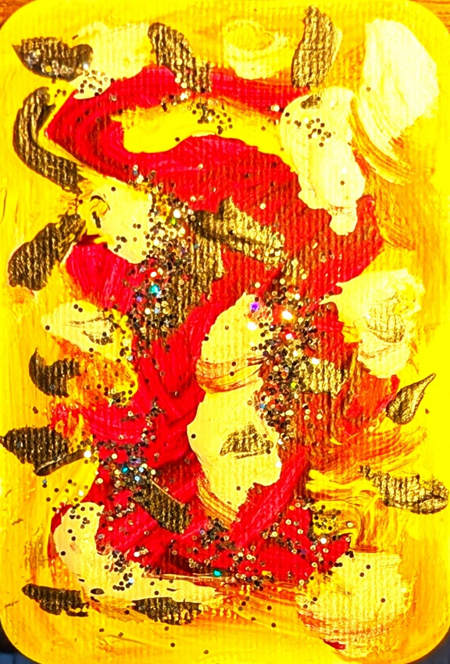
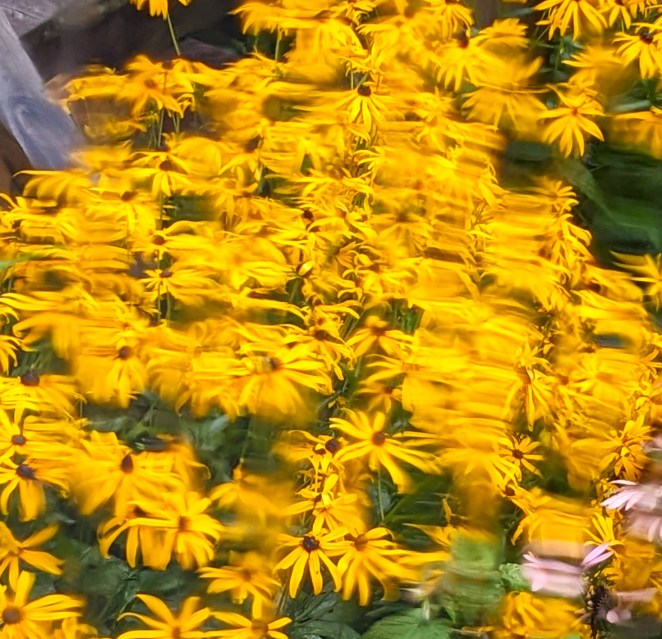
Moo’s daffodils are painted and potted, not growing wild at all. They are still the national flower of Wales and they still grow wild, in the spring, in Blackweir Gardens and beside Roath Park Lake. At least, I hope they do. I haven’t been back to check for 37 years now. Maybe things have changed, and the daffodils have gone the way of the sky lark, the cuckoo, the cowslips, and the bluebells. I wonder if the foxes still wear gloves? Let me know if you know the answer to that one. Just write “I do” on the back of the usual postcard. And you know what to do with it.

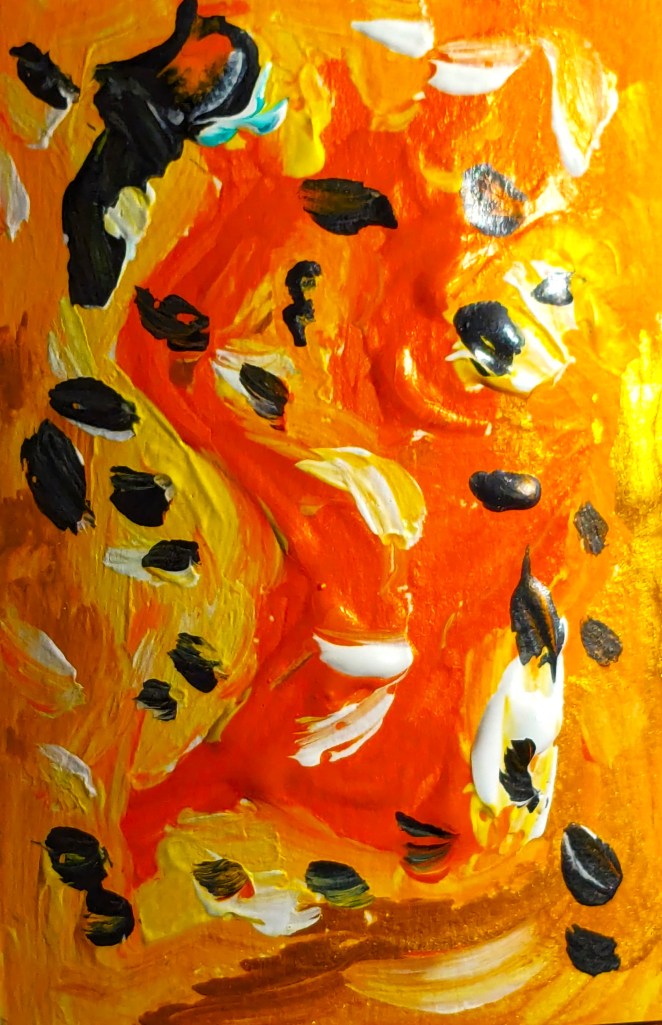
As for me, I am moving into my second childhood and, in may ways it is so much better than my first one. Here, I am free to look back on my life, to harvest my memories, to paint what I want – well, what Moo wants, anyway – and to think my own thoughts. Thank heavens Moo doesn’t think for me, though he does get his fingers covered in paint when he reads my mind and puts paintbrush to postcard, and designs his designs.

I feel very sorry for Moo. I guess he never had a childhood, so therefore, ipso facto, he can never have a second one. How much he is missing even he doesn’t know. How could he? Mysterious Moo – I like that idea. Sólo el misterio nos hace vivir, sólo el misterio. Only the mystery keeps us alive, only the mystery. And if you guessed that the author was Federico García Lorca, then you can award yourself a glow of satisfaction, for I have no prizes to hand around.

But hold on a moment, that was the title of one of Lorca’s drawings, so he was the artist, yes, but maybe not the author. Picky, picky nit-picky! Another of the joys of second childhood – annoyingly spotting the minor slips of other second-childhood thinkers – and never, never ever admit the mistakes you might, or might not make, are your own. Blame someone else. There’s always somebody out there whether to own up to your errors, especially if the price is right.
Carved in Stone 51 & 52

Carved in Stone
51

Time, shape, and location –
the Templars’ Castle
in Ponferrada,
considered impregnable,
but it had no water works,
no moat.

Napoleon placed his cannon
on the hills above
and fired down into the bailey,
shattering walls, gates, and doors.

Again, only the ruins remain
inhabited by choughs
that nest in the walls,
and rise up in stormy clouds
when visitors disturb them.
 
I go there on a sunny day
and wonder when the castle drowses
if it dreams of its former glories,
ground down into the dust.

52

I climb a ruined wall
and watch white clouds
as they gather over the hills,
then roll down into the valley –
a cavalry charge of plunging horses.

So easy to see
Santiago Matamoros,
St. James the Moor Slayer,
descending from the clouds
to rescue the Christian army.

I study the skies
and see something secret,
almost mythical,
carved from the mists of time.

But this not my land
and these are not my people
nor my legends.

I sense I am not welcome here,
that I can never belong,
and I decide to move on.

Commentary:
“I sense that I am not welcome here, that I can never belong, time to move on.” Sad words – but we live in a world that, all too often, has turned its back on people. More, it has turned them into numbers and statistics, and number sand statistics are not flesh and blood. Tragic really. And doubly tragic the labels that are stuck on people. So hard to get off, those sticky labels, for they are designed not to come off easily, but to linger, like sticky plastic wrappers in the grocery store.

James Bond – 007 – interesting – but I am not a number, though I have had numbers attached to me all my life, as have you and all the people you know. Number plates on cars, telephone numbers, Medicare numbers, dental care numbers, bank account numbers, driving license numbers, student numbers, graduate student numbers, library card numbers – and now passwords, a mixture of numbers, letters (small and capital), and signs, all jumbled in such a way as to make things inaccessible for those who do not know the numbers. An alien world, my friends, for the numbers, those numbers, are much more important than we are, and each of us, like it or not, is reduced to a number, or a label, or a recognizable feature or nick-name.

So, how do we belong? How do we fit in? How do we survive? If we are lucky, we have small communities that thrive around us and look after us. But sometimes we are left alone. All alone. And then we have nothing to belong to, no sense of being, of belonging, no sense of a valued place in life, of being worthy. And when our worthlessness sinks in, then we sink lower, and lower, and we wake up one day and realize that it is all over and that the end is near, for we have nothing, not even the desire to live on.

Carved in Stone 27

The philosopher in search of his stone.

Carved in Stone

27

Miguel de Cervantes –
I read and re-read his words,
envious of his ability to reach out
with language that thrills me still.

I see him as a total entity,
while I see myself in pieces,
broken, unable to express
the simplest thoughts.

As I age, I sense the water
slipping from the water-clock,
the candles burning lower.

I still cannot make the mark
I want to make, for they are beyond me,
those marvelous word-worlds.

My words are mortal, his are immortal.
Mine just ink stains on a humble page,
his cast in print, but crafted to last forever.

As I bear witness to those powers,
so much greater than mine,
my eyes fill with tears.

Commentary:

They are beyond me, those marvelous word-worlds. Indeed they are. But I do not seek to create ‘a marvelous word-world’. I am happy with ‘ink stains on a humble page’. I seek to reach out and find those one or two people who accept me for what I am and find their own selves in a small corner of the tiny gardens I discover or create. Not a world, then, but a tiny corner of my own world, described, and offered to those who have eyes to see and ears to hear and hearts and minds to feel and understand.

And what is this infatuation with the poem itself? I no longer write individual poems, I write sequences of linked poems, a set of poetic narratives, if you need to find a label for what I am trying to do. Cervantes once wrote “La épica también puede escribirse en prosa.” / Epic poetry can also be written in prose. What happens if we reverse that statement and say – “A narrative sequence can also be written in poetry.” Interesting, eh?

And what is this desire to leave something, some trace of us, behind? I cannot answer that question. The answer will vary for each one of us, and for each fall wall flower perishing against the garden wall. I look at the homeless, pushing their grocery carts, head down. Their existence is as important as mine. Their desire to survive, for another day, another week, another season – and winter is coming one – is more powerful than any poet’s desire to leave a work – a magnum opus – to celebrate their lives.

And yes, my words are mortal, as I am mortal, as Miguel de Cervantes and all the great writers were mortal. Patrick Lane once told me that if poets leave one poem behind them that is remembered, they have done well. Even the greatest poets, and you can check this in the anthologies over the ages, rarely leave more than ten or a dozen memorable poems. As for me, I am happy to say that I have never had a poem included in an anthology. Not to my knowledge anyway.

And what does Magnum Opus actually mean? I leave you with the quote from Wikipedia set out above. Click on it, and find yet another way to distract, deflect, and change the direction of our lives! Given that road, who would ever want to walk it to its end?

OAS

OAS

I take up my pen to scribble
my name and a riddle in the sands,
neither seen nor understood
by folk in far off lands.

Yet here I stand on foreign strand
my body twice marooned
by friends and fate and oft of late
my achievements all lampooned.

I bid you spare a thought for me
and also for my fate:
I came, I saw, I got a job,
but retirement ain’t great.

A pittance for a pension,
a life on OAS,
a walking stick and SOS,
that’s all that’s left, I guess.

Commentary:

A Golden Oldie from way back (2013 or so). Things get worse, in many ways, but yma o hyd – we’re still here. And that’s the main thing. We need rain, more rain, and yet more rain. Yet the damp really gets to those of us who suffer from osteo-arthritis. Maybe we should put a tariff on it (250%) and then it would be priced out of existence. Then it can rain as much as it wants and the aches and pains will stay in Aix-les-Bains and not come running after me.

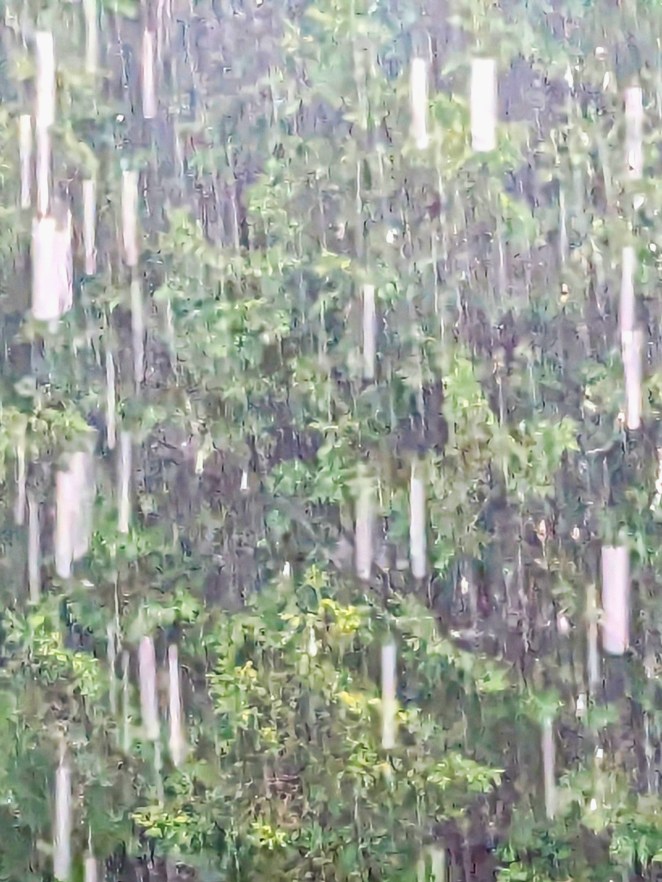
I asked Moo for a painting of rain drops falling on my head, but he didn’t have one. So I found a photograph of a real rain storm falling on the back porch, a year or so ago. We need one of those right now. Moo is nodding his head as I type. Oh dear, he just snored. He must have fallen asleep. He does much more noddy now than he used to. And so do I. Maybe I’ll do a photo of a big yawn next. Or he can paint one.

Exploring the Divine in Nature

Divinity

outside us or in us
the divine is always with us

green god
of the mountain ash
garlanded now
with autumn berries

lady hollyhock
and her flock
of butterflies and bees

colibri
martyred soul
reborn
as a hummingbird

our garden
a paradise
where the creator
still strolls

some of her
many faces
glimpsed
among the leaves

in this half-light
as the sun
goes down

What could you do less of?

Daily writing prompt
What could you do less of?

What could you do less of?
I shall deliberately misinterpret that prompt / question and answer it my way. I could do less of listening to stupid adverts, repeated ad nauseam, sometimes with gimmicky tunes – one to two lines maximum – again and again, all day, every day. Surf the channels to escape an ad, and what do you get? A synchronized set up where almost every channel is blasting out the same, or similar, ads at the same time. Have you noticed that when you leave the TV room, and retreat to the kitchen to get some limited peace, the ads follow you because the volume is turned up at ad time so you just can’t escape.

I remember my grandfather, back in the sixties, with the advent of ITV in Wales – the Independent TV channel that used ads – sitting before the TV set, his foot up before the screen and his fingers in his ears so he would not be able to see or hear those ads. Alas, once heard, seldom forgotten, and I can still sing most of those meaningless jingles heard back in my childhood. How it I hate when I go shopping in the supermarket and shoppers tunelessly whistle a TV ad as they shuffle along behind their carts. Alas, ad free programming, all too often, is either expensive or non-existent.

And what about those telephone calls when they put you on hold until the next agent is free to attend to you? I won’t mention names, because I don’t want to get sued, but I guess we have all had the same experience. I had a ninety minute online wait one day, with horrible music, an exhortation to stay on the line so I wouldn’t lose my place in the queue aka line-up, and a 90 second ad that glorified the joys of the company’s product, repeated once every five minutes. I suffered through that ad 18 times on that one call alone. Another local firm gave me the similar treatment, except that it was a one minute ad, repeated once every ninety seconds. I suffered through 10 repetitions in a wait of 15 minutes, got fed up, and hung up the phone.

Look at the peaceful scene above. That’s the view from my bedroom window in Island View. Even the crows are absent, and the early morning silence, like the sun, is golden. Two birds with one stone – a morning person or an evening person? A morning person with dawns like this, but an evening person when a sunset like this one miraculously occurs.

Magnolia

Magnolia

She stands there, at the garden gate, waiting for me.
I can see the scene, the flower beds, the magnolia
bleeding, in Wales, its soft, spring snow of ivory pearls.

Some fall on her head, crowning her with a beauty
more precious than frankincense or myrrh. Petals
also perch their pure, ermine cape on her shoulders.

She walks towards me, eyes shining, arms open.
Then, the vision fades and she drifts away, leaving me
alone, my face bathed in the tears of her passing.

For pass each other by, we did. Ships in the night,
trains rushing through a tunnel of darkness, bathed,
for an instant, in the constellation of a station’s light.

Now, when I try to go back and to recreate that scene,
I find an empty garden, fallen leaves, and winter’s cold.

Comment:
I have been struck recently by the number of published articles that speak of post-Covid loneliness and the difficulties of re-establishing old friendships that fell by the wayside, let alone establishing new ones. It seems to get harder and harder, as we age, to leave our post-Covid isolation, to get out of our new comfort zones – sometimes so limited and limiting – and to make new friends. As we age, our minds go backwards and we return to earlier days and happier memories. Yet all too often those memories are tinged with the sepia sadness of old photos, from a non-digital age, faded and stained.

What does your ideal home look like?

Daily writing prompt
What does your ideal home look like?

What does your ideal home look like?

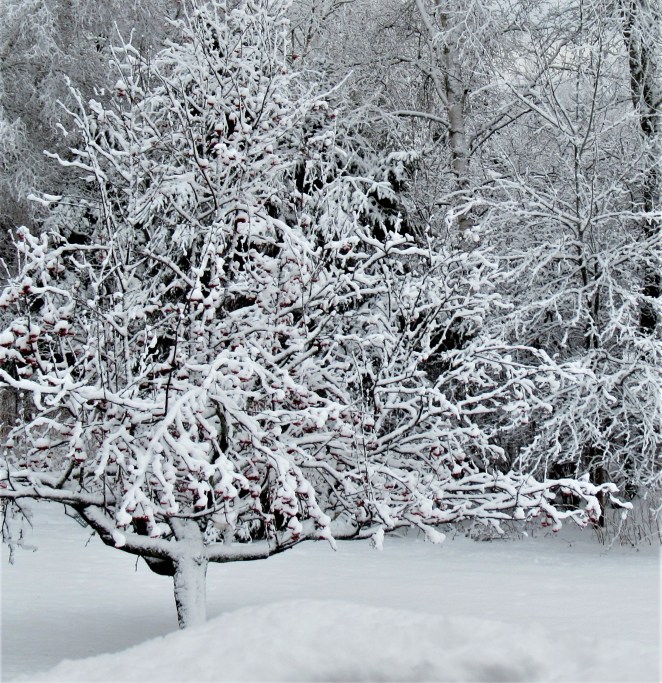
My ideal home looks exactly like the one I am living in right now. In the country, surrounded by trees, with blossoming crab apples in the front garden and a mountain ash in full view from the kitchen window, what more could I ask for? Blossoms in the spring, a gradual flowering throughout the summer, and now, as fall approaches, the fruit ripening.

Verde, que te quiero verde. – Green, for I love you green. But what exactly is green? I sit on the front porch in the cool of summer, and look out on a sea of greens – green grass, green leaves, light green, medium green, dark green, and all kinds of shades and hues as the sunlight filters a subtle dance of colors through the leaves. The eye distinguishes so many different shades of green. Alas, I do not have the vocabulary to distinguish verbally what I see visually. Ah, poor poet, linguistically damaged, and writing with one hand tied behind my back, I suffer from an ability to feel and an inability to express. Terminological inexactitudes, Winston Churchill called them. But in my case, they are the lies I must create when the truth overwhelms me with its beauty.

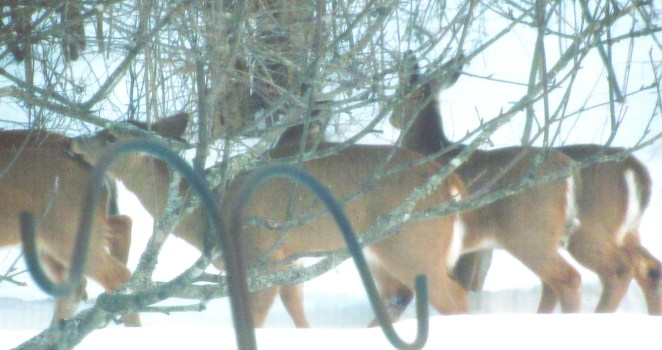
And in winter, when the cold winds blow, and the leaves lose the safety of their trees to be blown hither and thither at the wind’s will, what then? A blanket of whiteness, shadows shifting beneath the moon by night, and a million brilliant sparkles beneath the sun by day. And the visitors, every night the deer come, stay awhile, then vanish, only to reappear the next day. At midnight, in the moonlight, I watch them from my window as they dance on their hind legs and nibble the hanging fruit that the mountain ash reserves, just for them, so that they will survive, as they have done for millennia, in this paradise that surrounds my ideal home.

Was today typical?

Daily writing prompt
Was today typical?

Was today typical?

So, I Googled the meaning of typical and here are some of the synonyms that appeared. Standard, normal, stock, representative, usual, conventional, characteristic, regular, orthodox. Following the meanings offered, yes, today was typical. Dark at midnight, dawn breaking about 5:30 AM, full sun by 7:30 AM, noon – dead on 12 o’clock, as usual. And so it goes on. The weather may change, but the basic structure of the days, although also cyclical, growing longer then shorter, in terms of daylight hours, does not change much. Therefore, yes, by this definition, it was a typical day. But was it?

For creative people, each day is different and each moment, minute, hour of each day is different. Creatives listen, observe, feel, touch, delve beneath the surfaces of things, and see things in a lateral multiplicity that means everything is evolving, changing, growing, decaying. Creative people look and listen (with or without mother). They imitate, and from that imitation they create and re-create. And creativity moves way beyond the standard, normal, stock, representative, usual, conventional, characteristic, regular, and orthodox. If it doesn’t, it’s not creative, it’s just standard, normal, stock, representative, usual, conventional, characteristic, regular, orthodox.

Was today typical? Well, it’s not over yet. But up until now, it has only been typical in terms of its intimate creative typicality. The light has changed with the changing sky and clouds. Rain fell, and changed the tones of the colors around. The light changed, but so did the scents that arose from the warm earth with its carpet of grass and the tarmac and concrete, its heat suddenly cooled. The ground glistened, spider-webs sparkled, birds sang when the sun returned, flowers tossed their heads, in slightly different ways from yesterday, when the wind was warm. Now, damp and shining, their dance-steps and rhythms also changed. Now the world is wet. The trees are waving their fans and have caused a slight wind to arise and rustle their leaves. This day is full of creative magic – but only for those who have ears to hear and eyes to see. For too many people, alas, yes, this is, after all, just another typical, humdrum, boring old day. As W. H. Davies wrote: “What is this life if, full of care, we have no time to stand and stare?” Creatives make that time – and they live among the blessed.

Heartbreaking

Heartbreaking

How many have broken their hearts,
reading what I have written, as I have
broken mine, reading what others wrote?

My words reach out, naked, stripped
of false trappings, fake images,
my flesh and blood damp on the page.

Who knows where my words will land,
on fertile ground, on desert sand, or will
they lie on dry, stony paths, infertile?

So many people now scorn living words,
preferring those dull dry three-word chants,
fists clenched, or raised, that hypnotize.

Their love of words, thoughts, ideas, life
have been coffined in confining boxes,
cardboard castles, corrugated cans,
that they lock, then throw away the key.

Comment: Thank you Moo for your painting – Words fall like leaves and drift away. It make a fine companion to the poem.