Still Life with Hollyhock

IMG_0206

Still Life with Hollyhock
Geoff Slater

How do you frame this beaver pond,
those paths, those woods? How do you
know what to leave, what to choose?
Where does light begin and darkness end?

Up and down: two dimensions. Easy.
But where does depth come from?
Or the tactility, the energy, water’s
flow, that rush of breathless movement
that transcends the painting’s stillness?

So many questions, so few answers.
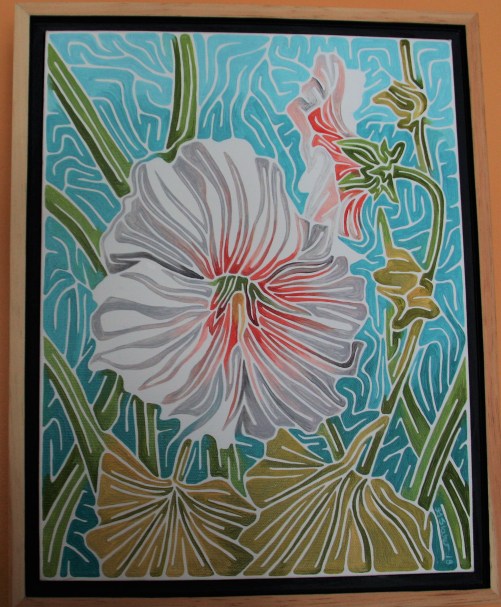
The hollyhock that blooms in my kitchen
is not a real hollyhock. It is the painting
of a photo of a genuine flower that once
upon a time flourished in my garden.

A still life, then, a nature morte, a dead
nature, portrayed in paint and hung alive,
on display in this coffin’s wooden frame.

Comment: I love the way language changes the way we look at life.  A still life painting becomes nature morte in French and naturaleza muerta in Spanish. Still life becomes dead nature. Fascinating. I also love the way in which the camera captures nature and the natural world. We think it is an accurate depiction, but really it isn’t necessarily that accurate. Filters, light and shadow, mood: they all fluctuate and sometimes we capture that which we never saw and sometimes that which we saw is never captured. Oh the subtle enigmas of creative art.
IMG_1005 (3)

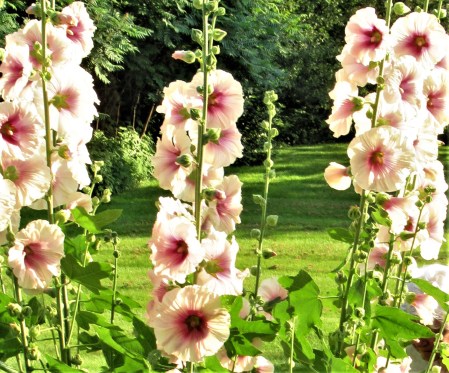
And it is the same with the hollyhock, my hollyhock, Geoff’s hollyhock. At the top of the page is Geoff’s painting of my hollyhock. The above is a photo of my hollyhock. Which bloom did Geoff capture and reproduce in paint? Language: and what do I mean when I say ‘my hollyhock’? My indicates possession, ownership. How and in what way does one own a hollyhock? How does one possess a garden, a flower bed, a tree? Are they not free, living, beings with a life and maybe even a mind of their own? Does one hollyhock talk to another hollyhock as the trees are said to converse with the trees? Do the trees in the garden possess a soul and if they do, in what sense do they possess one? And what is a soul anyway? I guess it depends upon the church and creed to which you belong. Certainly the garden has a life of its own and we discover that every spring when the grass and flowers grow back and the dandelions return.

image5

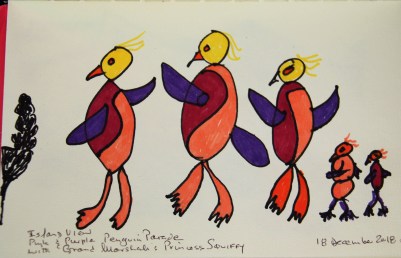
Questions: dangerous things, questions. Several of the questions posed above could have landed me in an Inquisitional institute in Spain in the 1500’s and 1600’s. That is a frightening thought. Alas, the philosophy of all that is way too deep for this poor poet and apology for a philosopher. One thing I do know, though: I love the garden going on outside my window and it is a privilege to be allowed to watch it, admire it, and follow its progress as the sun returns and the draws the birds back with it.
IMG_0198

¡Vale! Hail and fare thee well.
Last Dance

IMG_0177

Last Dance

The shy lady in the corner,
body withered by cancer,
stands up to dance.

She bows to the band
then floats into movement.

Dancing alone she clings
to the empty air as she
once clung to her man.

Nymphs and shepherds play
sweet music at midnight in this
room turned sacred grove.

Her dance-steps are a draught
of joyous water from the fount
of eternal youth and lasting love.

Comment: Another Golden Oldie pulled out of the magic hat of a forgotten manuscript. Such a joy to rediscover these things. Draught is the English form of American draft, incidentally, as in draught cider. I hate how my spell-checker corrects my spelling, even when it is correct. Wednesday was dance night in the hospice. At seven o’clock a band would arrive and set up at one end of the dining room. Tables were cleared away and chairs placed in rows so that patients could sit and listen or move onto the dance space that awaited them. This one old lady, shy and very much worn down by her treatment, stood up when the last dance was called and floated in an ethereal space that was hers and hers alone. The other patients stood around in a circle and applauded as she danced  and the band played on and on until everyone was dancing and the room was filled with joy and forgetfulness. Such is human strength, even in the face of apparent and imminent disaster. Dance on, my friends, dance on.

IMG_1256 (2)


Bleeding Heart

IMG_1338 (2)

Bleeding Heart

White moths
wing their snowstorm,
pale stars through the night.

A candle flickers in the darkness.
Hands reach out to grasp me.
A feathered shadow flies
frail fingers across my face.

Butterflies
stutter their eye-lash kisses
against closed cheeks.

Awake,
I lie anchored by what pale visions
fluttering on the horizon?

Eye of the peacock,
can you touch what I see
when my eyelids close?

Black rock of the midnight sun,
blocking this day’s dark cave,
when will I be released
from my daily bondage?

Last night, the planet
quivered beneath my body
as I felt each footfall of a transient god
who mapped in runes
the ruins of my bleeding heart.


IMG_0811 (2)

Comment: Another Golden Oldie, also dug out from the rejection / dejection of striations. I tinkered with it this morning. Funny what a shift in structure and a twitching of the metaphors will do. New lamps for old: indeed, and why not? We are not just writers, we are re-writers and some thoughts can be reworked to rise again in the shadows of the adopted children that are our poems. This bleeding heart plant vanished a couple of years ago. We dug up the flowerbed, inserted a rockery, and watched and waited. After two years, the bleeding heart plant resurrected itself from within the stones. Survival, renewal, faith, hope: key words nowadays. Who locked that plant down? Who let it rise up again? When we have gone, how will our gardens get on without us? Very well, in all probability, but they may be more of a tangled garden than a cultivated one. And what’s wrong with a tangled garden? Why, nothing at all, my friends, absolutely nothing at all.

image5

Lost

IMG_1058 (2)

Lost

My body’s house has many rooms and you, my love,
rule over them all. Your shadow dances on walls.
in mirrors, and your breath brushes my cheek

every time I open doors or windows. That silly cat
looks for you and hisses when I bring her kibble.
I walk from room to room, but when I seek you,

you are no longer here. I knock, nothing opens.
Afraid, sometimes, to enter a room, I know
you are in there. I hear your footsteps on the stair.

Sometimes your voice’s echo breaks the silence.
You whisper my name in the same old way.
How can it be true, my love, that you have gone,

that you have left me here alone? I count the hours,
the days, embracing dust motes to find no solace
in salacious sunbeams and my occasional dreams.

IMG_1774

Comment: A Golden Oldie. I wrote this some time ago while my beloved was in Ottawa visiting our daughter. Separation is such a strange thing: an absence, yes, but also a presence in the tiniest details and the most unsuspected moments. And then there is the dream world where things join together, and then fall apart. This poem has so much more meaning in a time like this when so many people are separated and can no longer be together. Time … I have written about it before … passes. Hopefully, families and friends will be reunited once more, the sooner the better. In the meantime, we’ll meet again, don’t know where, don’t know when. Chadwch eich fydd / Keep your faith, as St. David, the patron saint of Wales is said to have said circa 500, byddwch lawen / be joyful, and gwnewch y pethau bychain mewn bwywd / do the little things in life.

Lamplighter


img_0218

Lamplighter

When I was very young, many of our streets still had gas lamps.  The lamp-lighter would appear in winter around three or three-thirty to light those lamps. I remember him walking up the street with his long pole over his shoulder, moving from lamp to lamp. We had one outside our front door. He would turn on the gas, then light the lamp from the lighted wick at the end of his pole.  Sometimes he carried a ladder with him. Then, every so often, when the lamp needed tending, he would climb the ladder and adjust the wick. These gas lights were not very bright but they stood out like light houses between stretches of darkness and we would walk from pool to glowing pool, as if they were stepping stones leading us up the hill to home. We all knew the lamplighter and he would often wave to us as we sat in the front room window to watch him walk by. We rarely saw him in the mornings when he came back to turn off the lamps. We were all tucked safely into our beds. I remember that I wanted to be lamplighter. Later I realized that there are many ways to light a lamp and spread brightness through the world. When I qualified as an academic and a teacher, I became a lighter of a very different set of lamps.

IMG_0262

Comment: I discovered this prose poem in an old and dusty manuscript. I can’t even remember when I wrote it. Prose poems: I discovered Charles Baudelaire’s Petits Poèmes en Prose in a small bouquiniste along the banks of the Seine when I studied French in Paris during the school year I spent in France, 1962-63. I have always loved his prose poems and I have always wanted to write some of my own. That I did, and then promptly forgot about them, is one of the wonders of my creative life. How could I forget these creations? Funny: reading what I wrote back then takes me straight into the front room in my grandmother’s house in Brynmill. She would sit in the bay window playing eternal games of patience and together we would eat grapes, peep at the cards, wait, we didn’t know for what, and watch the light slowly fade. Nobody ever told me my grandmother had cancer. She died from it one day when I was away at school and when I came home for the holidays, she just wasn’t there. Her chair and her table were still there, but her warm presence, her loving kindness, had all gone. I never had a chance to properly say good-bye to her. Maybe these belated words will serve that purpose.


Butterflies


IMG_1053 (2)

Butterflies

“Poetry gives permanence to the temporal forms of the self.”
Miguel de Unamuno.

… butterflies … temporal forms … fluttering …
existing for one sweet day … they perch … spread
their wings … fan us with their beauty … flourish …
catch our attention … then caught by a gust
tear their wings on a thorn … and perish … blink
your eye and they are gone … yet reborn … they
cluster and gather in dusty ditches …
congregate on bees’ balm … smother Black-Eyed
Susan and Cape Daisy … shimmer in shade …
butterflies by day … fireflies by night …
terrestrial stars floating in their forest
firmament … dark tamarack … black oak … bird’s
eye maple … silver birch … impermanence
surrounds us … dances beneath stars … sings with
robins … echoes the owl’s haunting cry …
eternity held briefly in our hands …
then escaping like water or sand … black
words on white paper capturing nothing …
… my dialog … my time … my place … butterflies …

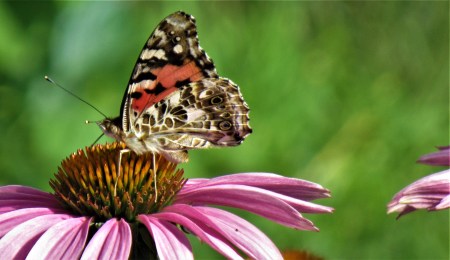
Comment: This is another golden oldie that gains in meaning day by day as the lock down continues. Miguel de Unamuno (1864-1936) was a respected academic, philosopher novelist, essay writer, story-teller and powerful poet. He is probably most famous internationally for the philosophy he espoused in The Tragic Sense of Life. Other works of his include Our Lord Don Quixote and Niebla / Mist. The photo shows one of the butterflies that adorn the garden by my kitchen window each summer.

Easter Sunday

IMG_1776 (2)

Easter Sunday

Easter Sunday: such a joyful day.
Last night the deer came out to play.
Good Friday’s snow is going away.

The Queen’s ‘Happy Easter’ was said at home.
The Pope held mass all alone in Rome.
I’m writing this poem and I’m home alone.

We’re locked down at home and so is the cat.
This morning she threw up her food on the mat,
three hoicks and a yuck and then a wet splat!

The snow is melting. The sun’s in the sky.
Rain is forecast and the river is high.
Let’s hope I stay well: I don’t want to die.

I know that I’ll die, sooner or later,
but if at all possible, let it be later,
‘cos I’m not quite ready to meet my creator.

Maybe he’s like me, with a tear of sorrow
for all things undone and left till tomorrow.

I do hope he’s a procrastinator
not a ‘do-it-right-now’ style of dictator.


IMG_1336 (2)


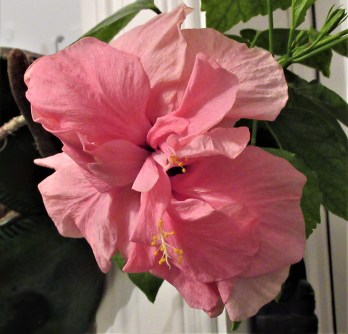
Hibiscus

IMG_1777 (2).JPG

Hibiscus
Day 26 CV-19

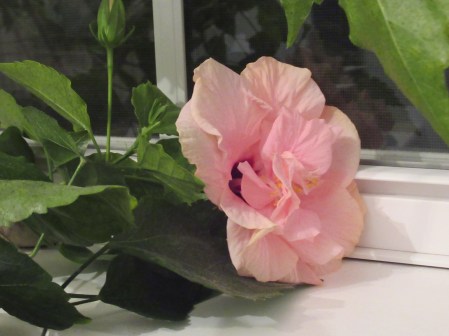
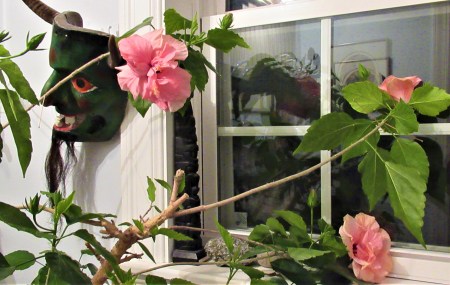
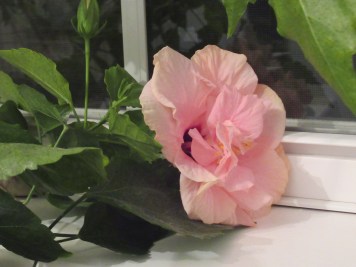
The hibiscus lives downstairs. We bought it years and years ago. A tiny plant in the florist’s shop, we brought it home. When we placed it here, by the window, we were horrified to see it was covered with tiny spider mites. Gradually, in spite of all our efforts, it lost its flowers and then, one by one, its leaves. After Clare had magicked the spider mites away, she nourished that one last leaf. “If that goes, the plant goes,” she told me. “It cannot survive without leaves.” It took time and daily care and attention, true TLC, but a second leaf appeared, and then a third. Now, each winter, it puts out flowers and fills the room with joy and light.

IMG_1776 (2).JPG

More important, in these dark times it fills us with hope and the knowledge that however bad things may appear to be, we can hang on, we can survive. We can be present in every second that we are given and that we can, and must, enjoy every moment to the full. Condemned to a certain death, our hibiscus survived to remind us of the miracle of life, for life is stronger than death, and hope is stronger than despair, and spring and summer are stronger than winter, even if it seems to be ‘our winter of discontent’.

IMG_1774


Creativity

IMG_1526 (2)

Creativity

When creative artists get together they talk and walk and hug and hold and discuss so many things, like how the creative spirit can inflate the body and send it soaring like a trial balloon, how listeners can be swept away by a magic vortex of voice, and how time and space can be suspended in the glories of creation that spin a web of forgetfulness around us and makes us disregard who and what we are as we forge new worlds.
Dark earth-spirits of love, want, and creation, hold us captive and drive us onward and inward until we give birth to that which was waiting patiently to be born, even though we never knew that the seed had been planted. “What is this?” we ask as we survey the new-born entity fresh on the page, held in the hands, suddenly full of life and breathing on its own, a thing of beauty, an essential being. It makes complete sense as we struggle to hold it as it grows and transforms from internally ours to eternally theirs, a product of our mind and body now belonging no longer to us but to the world beyond us.
We long to know its fate, to watch it as it walks along its path, its destiny now in its own hands. “What is it?” people ask as we stand still and know not what to tell them. Some sigh, some mutter ‘nice’, others just turn and walk away, lost in a self-created labyrinth of cul-de-sacs, dead end streets, and black, blind walls. Many go back to their two-thumbed clicking and surf the networks, bereft of the imagination to see and explore that which has been thrust fresh before them, this new-born babe beautiful in its swaddling clothes, a new creation.

Comment: The photograph … a geranium against the snow. Truth and beauty can survive even the hardest winters. As true creative artists we must be prepared to fight for our creative ideals. When the skies seem to be at their darkest (see my recent posts Poem from the Cree, Co-[vidi]-s and Outrageous Fortune) that is when we must strive to re-create the light, not just for ourselves, but for others as well.  

New Projects

IMG_0026

New Projects

 … how do you choose them, these new projects? Simple answer: I really don’t know. So much depends on you and your work habits. In my own case I have a back log of projects. I have been writing and creating for years. As a result I have a whole set of files that I can turn to and select from. Two novels, about fifty short stories organized into two or three as yet unpublished manuscripts, a couple of hundred poems, organized into three separate thematically organized manuscripts, a set of writings on facilitating creative writing …

Projects … do the work and then choose the order in which you will publish it. I look at the hollyhock that suddenly appeared last year in my garden. Do the work: the birds (in all probability) seeded it. The hard work: the hollyhock grew itself. I should add that my beloved nearly tore it out on the grounds that she didn’t recognize it and it looked like a weed. But she left it, and it grew into what it was meant to be: a hollyhock. One stalk. So many buds. We didn’t know which would blossom first. And it didn’t matter. One after anther they all blossomed. The hollyhock knew what it was doing [we didn’t]. It had belief and faith [we didn’t]. But we had hope.

The Hollyhock Project: This year the hollyhock has eight [yes, eight] different shoots. It’s no longer a single flower, it’s become a bush! It has also shed seeds further afield [I should really write abed, since they’re all in the same flower bed.] I wonder in what order they will blossom. It doesn’t matter really: I am just confident they will bloom. And the sunflowers have rooted below the bird feeders. They have their own projects and I know they will grow as and how they will. And the yucca has four shoots that will flower, how and why I just don’t know. But each flower has its project(s) and I am confident they will all flower and flourish.

My own projects: When June came in, I didn’t know what to do, nor did I know in what order to do it. Then Time-spirits came together. Geoff gave me some drawings and I chose one for the cover. I took the manuscript to the printers, got an estimate, and received a mock-up. The text had shifted in the transfer from computer to computer. My 70 page text had grown to 132 pages. I spent the next 72 hours rewriting everything, eliminating words, lines, poems, dropping the text back down to 70 pages. It is now published. I wondered what to do with the McAdam Railway Station poems. Geoff came to see me on Sunday, 23 June, and told me that he would be celebrating his birthday the following Friday. He also told me that the McAdam Railway Station would be unveiling his mural the following Sunday (June 30). The McAdam railway poems were published on Saturday, 29 June, and I took them to McAdam in time for the ceremony.

Trust: Trust yourself, trust your projects, trust the universal spirit [Northrup Frye’s Spiritus Mundi], under whichever name you acknowledge it). And remember, genius is 99% perspiration and 1% inspiration. Put in the mileage, put in he hard work, believe, and trust. ¡Qué será, será! Whatever will be, will be.

IMG_0206

Comment: another golden oldie. I am trying to choose what new projects to start and which old projects to finish. A pleasant problem. Meanwhile, I am enjoying the prospect of a nice, snowy Canadian winter day. Best wishes and happy writing to all.