Carved in Stone 43

Carved in Stone
43

Back home, in that little cul-de-sac,
the husbands are away,
working their night shifts,
while the wives are at home,
entertaining the truckers,
those long-distance drivers,
who park in that street and lodge there,
overnight, in the houses.

The children, boys and girls,
go out into the street,
climb into the trucks,
duck under the tarpaulins,
and, with all of us sworn to silence,
practice what their elders
are doing back home.

Commentary:
Monkey see, monkey do. And who knows what Monkey sees or does when the lights are turned out, darkness descends, and the honor of the blood cult takes control. Ask the animals, they will teach you. That was the motto of Bristol Zoo, where the Monkey Temple ruled, and Alfred the Gorilla and Rosie, the Elephant, were King and Queen of the beasts.

Knowledge – where does it come from? How do we attaint it? Is there a difference between knowledge, what is known, felt, and worked out for yourself, and education, when you obey orders and do what you are told to do (and how to do it). “We don’t need no education, we don’t need no thought control.” I have always loved Pink Floyd and The Wall. So many walls, so many barriers, so many things to break down in order to build them up again. Songs – Frank Sinatra – “I did it my way!” And who teaches what and to whom, underneath the tarpaulin when the lights are out? “Hey, teacher, leave those kids alone.”

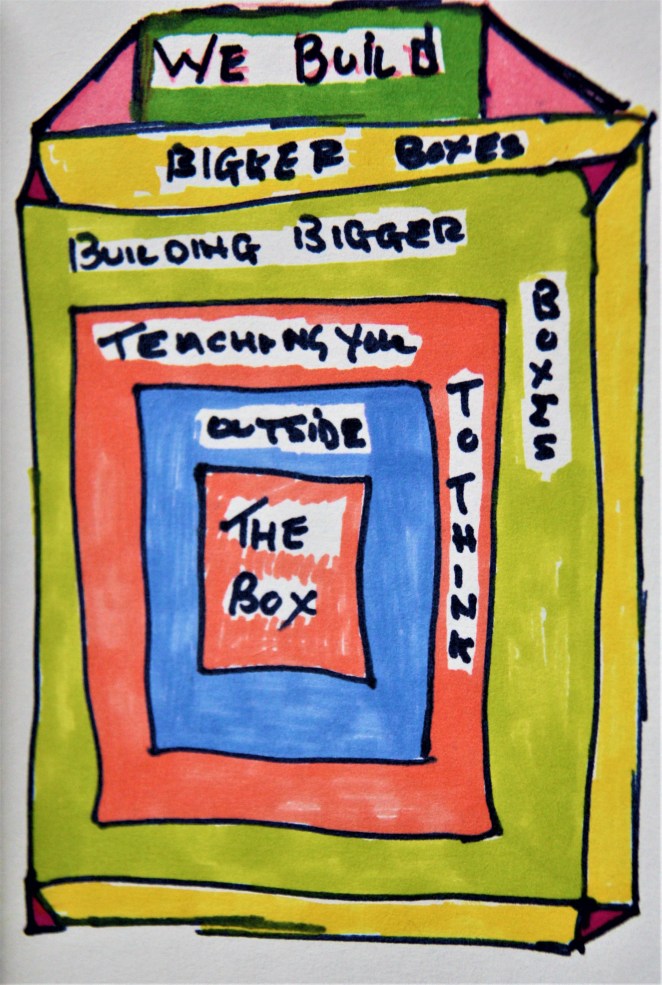
And beware of anyone who tells you that “we teach you to think outside the box.” That person will only give you a slightly bigger box, of his or her own making, inside of which you will be forced to think.

Of course, there are other ways in which we can think about education. How about this one? Filling empty heads with knowledge. How many ways are there to do this? And what is the exact content of the jug from which the knowledge will flow? And how many sows’ ears does it take to make a silk purse? “Hey, teacher, leave those kids alone.” Giddy up, Neddy I’m on my hobby horse now.

Clepsydra 30

30

… but before all that
     did I emerge slowly
          from the grain
               of a granite heart
                    as a sculpture
                         emerges from stone

I broke out of a silent world
     left the flesh-and-blood house
          where my mother lodged me
               abandoned that amniotic silence
                    broken only
                         by my mother’s heartbeat

my own heart
     responded to that rhythm
          until I materialized
               and slipped into
                    this waiting world

only to be held at the hips
     trapped
          a climber in a cave
               half out
                    yet not able to break
                         completely free

and me
     visited all my life
          by the nightmare
               of that pincer grip
                    until the doctor
                         forceps in hand
                              pincered me
                                   and drew me forth
white meat
     from a reluctant lobster’s claw
          silent
               dangling upside down
                    a special lobster
                         blue at the bottom
                              red at the top
                                   breathless
                                        motionless

until that first slap
     broke the silence
          and wailing
                I came into
                     that waiting world …

Commentary:

Nice painting, Moo. I like that. Its original title is Walking on Air, and I guess that’s what it might have felt like, dangling up side down, held by my feet, trying to walk on my hands, and look at all those suggestive colours. Colors / colours – English or Canadian? Does it matter? Red is still red and a rose by any other name would smell as sweet.

“Vanity of vanities, all is vanity.” Ecclesiastes, if I am not mistaken. “Great knowledge brings great grief; for in much wisdom is much grief, and he who increases knowledge increases sorrow.” So, we live and we learn, but what do we learn? Only the wisdom of all the wise people who walked this way before us. “In my beginning is my end …” – T. S. Eliot – “and in my end is my beginning.” In blood we begin our days, and in blood will we end them, just as the day begins with the spilling of the sun’s blood and ends in an evening of glory. Except when it’s cloudy, and then, of course, we have to guess what’s happening.

Guess-work – we guess how it began and we guess how it will end. And there’s the Clepsydra for you – drop after drop of water and people gathering knowledge, only to know how little they know, for, as Erich von Richthofen said, in the Medieval Course at the University of Toronto, a long time ago, in the 60’sixties of the last century which was also in the last millennium – “The more I know, the more I realize how much I don’t know.”

Clepsydra 27

Clepsydra 27

… the museum closes its doors
     inside the clepsydra murmurs
          on and on

evening falls from the sky
     in great cataracts of light
          stars flare like candles

who will see
     that last drop of water
          trembling at
               the clepsydra’s edge,

who will snuff out
     that last flickering
          flame of my life
               as the final verses
                    of the children’s song
                         loom closer

Here comes a candle
     to light you to bed.
          And here comes a chopper
               to chop of your head…

Commentary:

Moo got it right this time – “evening falls from the sky in great cataracts of light, stars flare like candles …” Lovely painting of a star ‘flaring like a candle’ against the evening sky. I think he called the painting Affirmation. Yup, he’s nodding his head, and he has his eyes wide open. He’s not dropping off into one of those drowsy moments of old age. Too early in the morning to do ‘noddy’ I say. Oh-oh, there he goes. It’s Billy Cotton Band Show Time … “Wakey-wakey!” Now how many of you remember the Billy Cotton Band Show on BBC Radio on Sunday afternoons, just as people are dropping off to sleep after the enormous Sunday dinner and dessert? Hands up if you’re over eighty and remember that. Oh dear. Not a good idea. Moo’s hand’s gone up and he’s still got his eyes shut. Ah well, appearances aren’t everything.

And look at that comma after – the clepsydra’s edge, (line 10) -. The one that got away. There’s always one that gets away, no matter how hard we try – and try we do. Clepsydra is meant to be a single sentence, with no punctuation other than an ellipsis at the beginning and end of each sequence. And what have we here? A common or garden comma, growing like a large, spring dent-de-lion / dandelion in the middle of a patch of flowery images and metaphors. Out, out fowl spot! What bird was that? A Flying MacBeth just dropped something on my windshield. ‘What a foul fowl was that fellow,’ said the soccer referee pointing to the penalty spot. A round spot with a whale of a tail.

“Any questions?” I asked my students at the end of class one day. A brave young lad raised his hand. “I have a question, sir?” [I liked it when they called me, sir. It happened about once or twice a year. I always knew something drastic was about to happen when I received a knighthood.] “Ask away,” I replied. “What the heck are you on? I’d love to have some of that. Can you give me some, sir!” Two knighthoods in one day. I’ll be a KG next, instead of an RG. I bet you don’t get that joke! Answers by snail mail and dog sled, please!

Monkey Meets Pontius Parrot

Monkey Meets Pontius Parrot
(With glorious  memories of Macarronic Latin)

Pontius Parrot is very clever
and very pontifical.
“Pretty Polly!”
He pontificates from his pulpit.

His name isn’t Polly
and he doesn’t have a pulpit
but he parrots words
in Macaronic Latin:
“Caesar adsum jam forte.”

Pontius Parrot is perky at the podium
and bounces up and down,
preening himself self-consciously,
rattling his chains,
shaking his bars,  and speaking Latin:
“Brutus aderat.”

He is marked with shame and scandal.
A dysfunctional family of feathered friends
 has henpecked him until he is black and blue
and he has thrown up copiously:
 “Caesar sic in omnibus.”

He dips his wings in holy water,
calls for some soft soap, 
and washes his feathers and claws.

Poor Pontius Parrot,
he can only say “Repent!”
“Brutus sic in at.”

Commentary:

I asked Moo if he had ever painted a parrot, but he told me that he hadn’t. However, one of his favorite viewers, had once called this painting a pile of spaghetti wriggling in tomato sauce and he thought that spaghetti was close enough to macaroni for it to serve as a painting for Bony Macaroni Latin.

I had to explain to him what we mean when we say Macaronic Latin. Back to that boarding school and we used to invent all sorts of Macaronic Latin phrases. They used to cane us with bamboo canes. So here’s the verb paradigm in Latin for ‘to cane a student’. Bendo – whackere- ouchi – sorebum. Of course, it helps if you know what Latin verb paradigms look like. They are easy to remember and are aide memoires for the four main parts of the verb. Bendo – I bend over – first person singular, present tense – whackere – to whack or cane – infinitive – ouchi – I said ‘ouch’ – past tense – sorbum – the inevitable result – past participle.

Now, if we look at the italics in the poem we see a poem within a poem, and that smaller poem is written in Macaronic Latin.

“Caesar adsum jam forte.
Brutus aderat.
 Caesar sic in omnibus.
Brutus sic in at.

Translation

Caesar had some jam for tea.
Brutus had a rat.
Caesar sick in omnibus.
Brutus sick in hat.

Oh never underestimate the ingenuity – linguistic and / or otherwise (and we won’t go into that one right now) – of the bored-to-tears Public Schoolboy. Especially if he is not destined to be a Perfect Prefect like Perfect Prefect Plod – who was never any good at Latin, if I remember well. Neither was I come to think of it. Horrible language, dead and reeks like the dead rat that Brutus ate.

As for the ‘repent’, well, usually, just before he beat you, the master doing the beating would enquire as to your health and ask you if you repented of your sins, crimes, bad language, being cheeky to Perfect Prefect Plod, or whatever else you had done (like smoking or holding a girl’s hand in public instead of a boy’s). You always said ‘yes, of course I do, sir,’ in the vain hope of avoiding a beating. But, bad luck, the cane descended anyway, ouchi was heard, and the victim retired to the bath room to examine his past participle, also known as his sorbum.

I bet you never imagined any of that. Wow! What a great lesson I have taught you today. Think about it all and think about it carefully. Now you know why Pink Floyd sang “We don’t need no education.” But what an education it was. And remember, the Duke of Wellington, Old Nosey, once said ‘my battles were won on the playing fields of the pubic schools of England.’ Oh dear – I hope I got that right. I fear there’s a letter missing somewhere.


Monkey Visitsthe Chimpanzees’ Tea Party

Monkey Visits
the Chimpanzees’ Tea Party

Dressed to the nines in their gala outfits,
they have come here for the tea party.
Hairy penguins, they waddle back
and forth across the temple,
then lunge for a table with its jumbo shrimp,
smoked salmon, scallops, baked oysters.

Faces slashed from ear to ear
by enormous grins,
“Food’s free!” they say
and stuff themselves
regardless of the consequences.

Serviettes tucked into collars,
they scoff lobster and crab.
Birds of Paradise, subtle delicacies
flown in from half a world away,
decorate the tables.

There is something about them, though,
these chimpanzees,
gripping cup handles
between finger and thumb,
enormously pleased to be the centre of attention,
however clumsily they walk,
in their hired-for-the-occasion,
ill-fitting, black and white penguin suits.

Commentary:

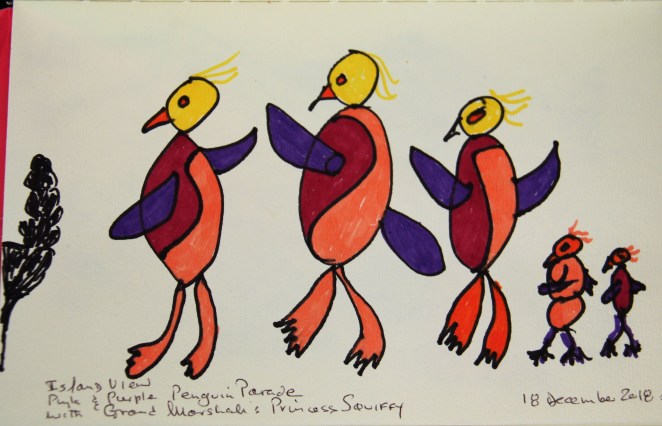
Moo apologizes. He hasn’t painted any chimpanzees, but a long time ago (2018) he drew and colored this cartoon. Pink and Purple Penguin Parade with Grand Marshall, Princess Squiffy. You can just see the end of Princess Squiffy’s tail as she vanishes out of the cartoon, encouraging the Pink and Purple Penguins to follow behind her behind. Oh the joys of leading the parade. Not everybody wants to do it though, many are content not to lead, but just to follow. Perhaps we should have called our cat MacNamara. After all, he was the leader of the band. But I don’t think Princess Squiffy would rather be anything other than what she is – a princess.

This poem, from Monkey Temple (of course / wrth gwrs) reminds me of Parents’ Day at my Boarding School. After several weeks of scarcely edible food, the tide would suddenly turn. Thursday, prime rib roast beef for supper. Friday, roast chicken with all the trimmings. When our parents arrived on the Saturday, all we could talk about was the wonderful food we had been eating for the last two days. Cunning, eh? We all had to dress up for Parents’ Day. Sunday starched collars, collar studs and all, and nice clean Sunday School ties.

Tea on the lawns in summer – unforgettable. A marquee, in case it rained, but otherwise tables laden down with a variety of skillfully cut sandwiches, little triangles, with no crusts, followed by endless helpings of strawberries and cream. The boys served their parents, fleeting back and forth to full the rapidly emptying plates. One boys father, I won’t say whose, devoured 12 bowls of strawberries and cream before the headmaster call the son over and begged him to beg his father not to eat all the strawberries and cream as some other parents’ would like some also.

Griffin Hunting – not a typical public school sport but one in which my school most certainly indulged. Our school symbol – a griffin – woven with gold thread on a dark blue background symbolized for the younger boys the perfection of the Prefects. To Hunt a Griffin was to behave in such a way as to attract the attention of older boys (already Perfect Prefects) and the school masters so that one became a candidate to climb the ladder and become a candidate for Griffin-hood. Some of us, myself included, preferred the anonymity of Robin Hood and were happy in our chosen roles of outlaws in Sherwood Forest and agents provocateurs and anarchists. Not for us the gentle counting of innumerable sheep. We chose rather the perils of after-dark transistor radios and the joys of Radio Luxemburg.

I remember being caught out of bed one night, on my knees, in a corner of the dormitory. All the dorm occupants were squealing and making a terrible noise. This attracted the attention of Perfect Prefect Plod – and in he came, threw the door open, and switched on the light. “You!” he pointed at me. “What do you think you are doing, out of bed?” “I am catching a mouse, Prefect Plod,” I replied. “You are a nasty little liar,” said Prefect Plod. “There are no mice in our nice clean house.” “Oh yes there are,” I replied, and I showed him the little mouse that I had cradled in my hands. “Give that to me,” ordered Prefect Plod. So I did. And the mouse took an instant dislike to him and immediately sunk its sharp little teeth into his thumb. I remember Prefect Plod running out of the dorm screaming “Matron! Matron!” and the little rodent swinging back and forth and hanging grimly on.

Those boarding school days ended 63 years ago. Hard to believe, really, but I still have such vivid memories of them. And of the Perfect Prefects, gripping cup handles between finger and thumb, enormously pleased to be the centre of attention on Parents’ Day, however clumsily they walked, in their spruced up for the occasion, Sunday Suits and Shirts, with their Golden Griffin ties. I always think of the Chimpanzees’ Tea Party when I think of the special performances of that little lot ‘for a Prefect’s lot is not a nappy one, nappy one.’

Poisoned Pawn

Poisoned Paw

Openings are so important.
They should be magnets
drawing the opposition in,
but sometimes they’re whirl-pools
dragging you down.

You try to hold your breath,
but you must breathe deep, let go,
go with the flow and prepare for
whatever awaits you in the deep.
Down there, it’s a different world.

Light breaks its black and white bishops,
and the knights walk a forked path
when not pinned down. When you lose
do you mourn for the simplicity of draughts,
or Fox and Hounds or do you strive
to establish, once more, your light in the dark,
down there, where no sun shines.

You are the glow-worm,
glowing where no light glows.
You are the line, the sinker, the hook,
the bait, the temptation that encourages
your opponents to sacrifice their own peace,
 to join you, and together, to swim, or drown.

Commentary:

My family didn’t play much chess. I bought my first chess set when I was ten years old, at Boot’s the Chemist, down by the market, in Swansea. I also bought Harry Golembek’s book The Game of Chess. I still have both the set and the book, seventy years later. Descriptive notation. Absolutely bewildering. I stared at the chart that gave the code names of every square and remained totally confused. I had to look up each square, from its notation, locate it on the chart, then move the piece on my board into the appropriate position. And remember, each side had exactly the same format – QR1, QKt1, QB1, Q1, K1, KB1, KKt1, KR1. Not quite a mirror image as the squares reversed themselves on the other side of the board.

I remember clearly the day that ‘Light broke where no light shone.’ I looked at the maze of numbers, and suddenly the pattern clicked into shape in my mind and I understood the whole idea of descriptive notation. Boundary Knowledge – you cross a boundary after days of bewilderment, and enter a new phase of enlightenment ‘light breaks where no light shines’. When I watched the film, The Poisoned Pawn, I remembered my own learning days in chess. Great fun, that particular opening. Do we take the poisoned pawn, or do we leave it? I will leave you to decide. But remember, it’s not called the poisoned pawn for nothing, damned if you do and damned if you don’t!

I used descriptive notation throughout my school days. I had one particular friend in boarding school who also played chess. We slept in the same dormitory, two beds apart. After lights out, no talking, no reading. Prefects prowled at night to enforce the rules. After lights out, one of us would call out ‘P-K4’ and thus the game started. We weren’t exactly talking, so it wasn’t easy to catch us. Every night, we played the game in our heads. A great memory trainer. Occasionally we managed to finish a game – not often – we were both too wary of Fool’s Mate and the simple early traps! Each day, during one of the school breaks, we would restart the game of the night before, from memory, and then play it to its end. We very rarely forgot the moves we had made and we virtually never disagreed on the board position.

This was totally unlike chess with my family. The grown-ups would all gather round the board. Their object was to distract me, to move pieces when I wasn’t looking, to remove (MY) pieces and leave me in a desperate situation. “‘Knock, knock!’ ‘Who’s that at the door? Go and look.” And off I would go to return to a battlefield that had totally changed its shape and mood. I would carefully reconstruct it, piece by piece, square by square. But I have never forgotten the black looks, the accusations of cheating, the fury of the old ones being beaten by the younger generation. In the end, nobody within the family would play me, unless I gave them a handicap by removing a rook or one of the bishops.

I didn’t discover algebraic notation until I lived first in France, and then in Spain. Algebraic notation. Each of the 64 squares had its own letter and number and, as a result, there was no way to confuse the position of the pieces. Staunton chess sets in England became a variety of different piece shapes on the continent and I often lost games when I forgot that the pawn had one circle, the bishop two, and the queen three, but they all looked like. Many a time I gave up a bishop thinking it was a pawn – oh that poisoned pawn again.

Now, in my dotage, I play chess against the computer. I haven’t played a live opponent for years. But I do have a chess book collection and I have played Fisher’s best games, and Fisher vs Spassky, and I have studied the Russians and how they play and think – very differently from me. And so, in my old age, I sit at the chessboard of my life, and I move the pieces here and there, and remember old friends, and how we shifted across the shifting boards of our days. So many pieces have dropped from life’s chessboard, but a few of us are left, and we move more slowly, but we wander on and on.

PS Moo, sometimes slow in understanding, offered me several paintings that suggested the aftermath of the Poisoned Prawn. When I explained the basics of chess to him, he said he didn’t have a chess painting he could recommend, so he suggested this painting – the correct way to teach. ‘You can’t teach chess,’ I said, ‘it is so instinctive.’ I took one look at the right way to teach and loved it. Here we go The Right Way to Teach! X – WRONG!

The Book of Everything

Discourse Analysis
and
The Meaning of Meaning

Words have dictionary definitions that allow us to agree on what they mean. In this fashion, when I say ‘my grandmother’, you automatically know that I am referring either to the mother of my mother (maternal grandmother) or the mother of my father (paternal grandmother). This is the dictionary meaning of the word ‘grandmother’.

But words have lives of their own, and their meaning changes when used by individuals. You, the reader, never knew my grandmothers. You never will. They both passed away a long time ago. I loved them both, but for very different reasons, and to me they were as different as different can be.

This means that when you, the reader of these words, reach the word ‘grandmother’, the faces you see, the emotions you feel, the memories conjured up by that word are totally different from mine. Same word, same dictionary definition, different personal memories, experiences, relationships. In addition, the role that our grandmother(s) played in our lives will be very different too. That role may vary from culture to culture, from language to language, and from the social structure of the changing society in which we live.

For example, when I first went to Santander, Spain, I visited a family who lived in a large, detached house that contained three generations of the family – grandmother and siblings, father and mother, grandchildren, and an assortment of aunts and uncles. No need for babysitters in that household. Everybody had a vested interest in the development of the young ones and the older ones received tender, loving care, twenty-four hours a day, every day of the week.

I lived from time to time in the same town as my own grandparents. I saw them regularly, but rarely on a daily basis. When my parents sent me to my first boarding school, age six (if I remember correctly), I lost contact with my family. My paternal grandfather died when I was away at school. My maternal grandmother died while I was away at school. My paternal grandmother died when I was living in Spain. My maternal grandfather died when I was living in Canada. Alas, after those early years, I scarcely knew them. My experience, then, was so different from that of other people.

When I moved to Canada, the Atlantic Ocean separated me from my parents. My daughter, born in Canada, grew up with no close knowledge of her grandparents. The word ‘grandmother’ did not mean the same to her as it did to the grandchildren in Santander, or to me. How could it? All those miles between the families, and visits limited to a couple of weeks every other year at best. Although the dictionary meaning is always the same, what a difference in the emotional meanings for each person using that word.

Discourse Analysis, the way I use it, builds not on the dictionary meanings of words, but on their emotional and personal resonance. I take the standard, dictionary meaning of words, twist it, look for meanings at different levels, and then build an alternative narrative on that changed meaning. I have great fun doing so.

Part of that verbal fun comes from my childhood. I listened to Radio Shows like The Goon Show and Beyond Our Ken. Giles’ Cartoons gave my names like Chalky White, the skeletal school teacher, or Mr. Dimwitty, a rather dense teacher in another school. These shows also twisted the meaning of words and drew their humor from such multiple meanings. The Goon Show – “Min, did you put the cat out?” “No, Henry, was it on fire?” Or on an escaped convict – “He fell into a wheelbarrow of cement and showed every sign of becoming a hardened criminal.” Or from Beyond Our Ken – “My ear was ringing. I picked it up and answered it. ‘Ken here, who am I speaking to?’ ‘Larry Choo.’ ‘Ah, Choo.’ ‘Bless you, Ken.’ Verbal scenes like these – it’s hard to get visual pictures from listening to the radio – remain engraved in my memory banks. More than engrained, they become part of the verbal system from within which I write.

This system includes Direct Discourse, Indirect Discourse, and the Twisted Discourse of an Inventive Mind that still wishes to create. It also comes from Francico de Quevedo’s Conceptismo, from Ramón del Valle-Inclán’s esperpento, and from certain aspects of Albert Camus’s Theory of the Absurd, all blended with the poetry of Jacques Prévert and the songs of Georges Brassens. This from the latter – “Tout le monde viendra me voir pendu, sauf les aveugles, bien entendu.” Everyone will come to see me hanged, except the blind of course.

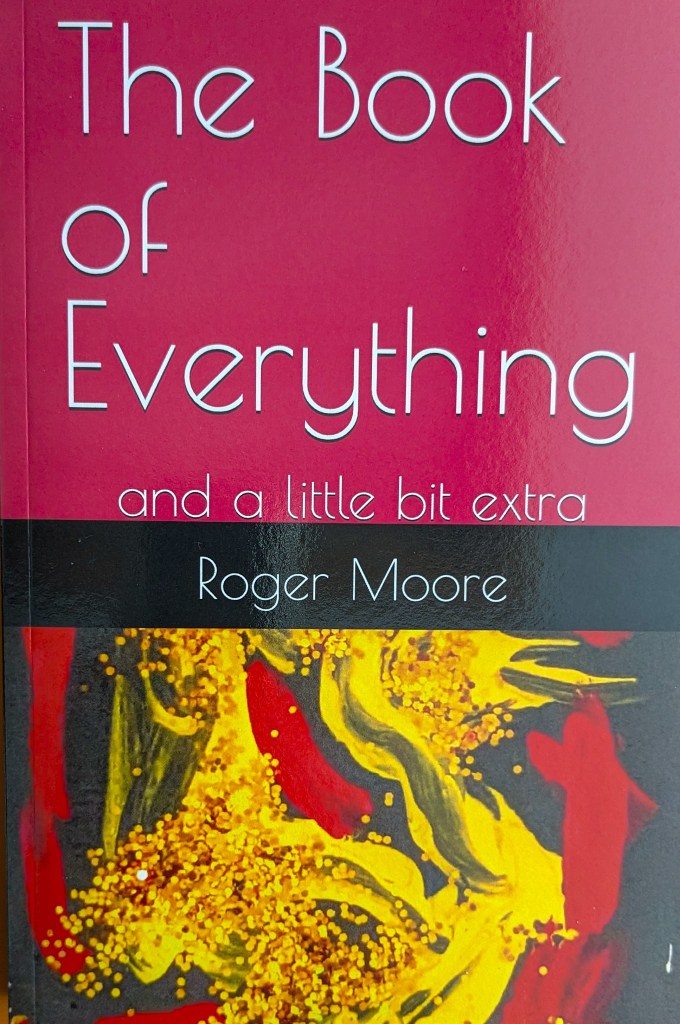
This is not always easy humor, nor is it a comfortable way to see the world. But it is a traditional one with a long literary history. The title of my book goes back to Francisco de Quevedo, of course, who, in 1631, in Madrid, published El libro de todas las cosas y otras muchas más / The book of everything and a lot more things as well. Don Roger turns to his good friend Don Francisco whenever he needs a helping hand.

The pieces themselves were first published on my blog rogermoorepoet.com. They have been revised, and I have added some more pieces in a similar vein. Tolle, lege – Take and read.  Above all, enjoy this world of mine, with its subtle and not so subtle humor, its sly digs at many of our follies, and its many forms of creativity.

The Book of Everything
and
a little bit extra

Click on the title to purchase this book.

Why do you blog?

Why do you blog?

Good question. And there’s no easy answer. I guess, in my case, that my computer and my teaching (I have been retired for 16 years) were closely linked. I used programs like Blackboard and WebCT to teach hybrid courses, online and in the classroom. The online factors – chat groups, info sharing, course analysis – backed up the in-class material and gave students a space in what was, back then, late 20th Century, a new, but rapidly developing teaching space and style.

I found the development of a web page allowed me to preserve course notes, to construct class material, to allow students to access material (in their own time and space) and many found this useful. I also encouraged students to build their own web pages (and this was in the twentieth century, remember!). I also told them that they would probably, long term, find the web page building more important than the material that I was teaching them, for my material, like that of many other teachers, had a limited shelf life, and was not carved in stone and everlasting. This was particularly true as rapidly changing times, methodologies, and students – often from different cultures and with different styles of learning and levels of knowledge – spelled the end of the single course outline imposed, top down, on all members of the class.

When I retired from teaching, I kept the web pages I had built. Then, some five or six years after retirement, I decided to start a blog, rather than just have a webpage. Now, blogging has become a habit. Not an incurable one – just this year I missed four months ‘blog time and space’ on this web page / blog of mine.

But is this web page of mine a blog? Not really. I don’t sell anything on it, rather I give my books away to friends who wish to read them. I don’t charge for accessing my ideas, my thoughts, my creativity, my poetry, my photos, my paintings, my philosophy. My oh my, look at all those ‘my -s’!

At this point in time I am wondering whether to continue blogging or not. I have been approached by many people who wish to enrich themselves by enriching my webpage so I can then enrich myself. But I neither want nor need that. Rather, I follow the philosophy of Miguel de Unamuno, the great Spanish philosopher. “If I can reach out and help just one person,” he said, “I will not have lived in vain. And I guess that’s why I blog – to reach out on the off-chance that one or two of my words will touch someone in a meaningful fashion and help them to understand the world a little bit better and even, maybe, to help reshape their lives.

What is your mission?

Daily writing prompt
What is your mission?

What is your mission?

Let us begin, as usual, by asking, what do we mean by ‘mission’? Here are some examples of the meaning of mission. (a) an important assignment carried out for political, religious, or commercial purposes, typically involving travel. (b) the vocation or calling of a religious organization, especially a Christian one, to go out into the world and spread its faith. (c) any important task or duty that is assigned, allotted, or self-imposed. (d) an important goal or purpose that is accompanied by strong conviction; a calling or vocation.

I can happily dismiss (a) and (b) from the start. I do not consider an assignment to be a mission, not in my case anyway. I am not one to wander the world, good book in hand, heart on sleeve, convincing people to believe what I believe. That said, I can work with (c) and (d) because, as a life-long teacher, who was offered, at various time, an array of other jobs, I am happy to say that I was a teacher by vocation, by calling. Teaching was my mission. My mission was accomplished.

I taught, in Canada, from 1966 to 2009. Then I reached retirement age. On June 30, 2009, I was a teacher. On July 1, 2009, I was nothing. The shock was enormous. It took me a long time to recover and discover that no, my life was not over, and yes, I had many other things to do. Thankfully they all involved teaching, in one way or another. I used my teaching / research experience to sit on the editorial boards of various learned journals. I even edited a couple of them. I also translated, usually from Spanish to English, and worked with the translations of other people. I also wrote articles on teaching and on creativity.

Creativity gradually took me over. I offered workshops on prose and poetry, wrote and edited books, penned introductions for other writers, and even published some books by other people, usually my family or close friends.

There was never much money in teaching or in creative writing. I always did it for love – love of the subject, love of learning, love of the students, love of watching them grow and develop. When I work one-on-one with another writer, or with a small group of writers, that love is still there. Alas, as I grow older (much older!), I feel the ability to motivate slipping away. The will, the vocation if you like, is still there, but body and mind are growing weak, and that, my friends, is the saddest thing of all.

Dark Angel

He will come to me, the dark angel,
and will meet me face to face.

He will take all that I own,
for my wealth is only temporary:
health, wealth, possessions are all on loan.

My house, my wife, my car,
my daughter, my grand-child,
 my garden, my trees, my flowers,
my poetry, my works of art.
I use the possessive adjective
knowing full well that these things
are only on loan. I will never be able
to preserve and possess them.

I even rent this aching heart,
these ageing, migrant bones,
this death that has walked beside me,
step by step, every day
since the day that I was born.

My death alone is mine.
It belongs to nobody else.
It will be my sole possession.
It will soon be the only thing
I have ever really owned.

Comment:

Dark Angel is from my poetry book – Septets for the End of Time / Poems for the end of Time. The lead painting in today’s blog is by my friend, Moo, and he calls it Storm-Me.

What’s your favorite word?

Daily writing prompt
What’s your favorite word?

What’s your favorite word?
Seems like a daft question to me. Just one word?

Llanfairpwllgwyngylldrawbwlchllantisilioggogogoch – how’s that for a single word? And what’s wrong with married ones anyway. Or should I go for something like – home, health, morning (good or bad), night, how? -as in How! And what about the vast quantity of expletives that are found in so many languages? Many of them are single words, although many others are found in fertile and creative compound structures.

Of course, wrth gwrs, we are thinking of how many single words in how many languages? Or are we? I personally think that phrases might be more important than single words. Thank you becomes gracias (in Spanish) or te / se lo agradezco (more formally). It changes to merci (in French) or merci bien, or merci beaucoup, or grand merci, or merci mille fois, or je vous remercie. Then, in Welsh it becomes diolch, though many prefer diolch yn fawr.

Mind you, when living in Mexico, especially in some of the more isolated villages where food and water are not always the cleanest, bathroom may be a key word. Quick is also an important one. Put them together and you get bathroom quick! Help is also very useful when travelling alone and lost. As is Please! Por favor, in Spanish – two words of course!

Single words, in isolation, can be very dangerous. Especially when using a second language that one doesn’t dominate. Examples of embarrassing mistakes are multiple in the language-learning text-books. Speaking of which, it is interesting how infrequently they offer phrases like “Where is the bathroom?” or “I need the toilet. Now.” Alas, they also avoid the inevitable consequences like – “Too late!” “Sorry!” “Where is the nearest dry cleaners?”

A funny thing, language. And other people’s languages are equally funny. By funny, I mean weird, strange, and unpredictable, especially without a sharp cultural knowledge to permit the speaker to actually understand what he or she wants to say and how to phrase it correctly. Simple example – embarazada, in Spanish, does not mean embarrassed, it means pregnant. You would be surprised at how many young ladies, learning Spanish in Spain, have amazed their hosts and teachers by the simple announcement, often in class, that ‘estoy embarazada’‘I am pregnant’ – and I have seen the looks of amazement adorning the sympathetic faces of the families gathered round the table or the looks on the faces of the classes being so addressed.

So, a little knowledge is a dangerous thing. I can think of very few words, single words, that I would use on their own. But I can think of many, many phrases, most short, that I would be happy to use, and many more that I would avoid at all costs. As the students in the lower grades of Spanish used to say – “Buenas Nachos” and “I only want to be able to ask for a beer.” “Can’t we watch the Smurfs?” Have you ever tried to understand humor in another language, another culture? It is one of the hardest things to master, especially when it depends on the double-meaning of words, words which, all too often, only have one meaning in the pocket dictionaries people carry around with them. Caveat emptor. Buyer beware. And tread carefully, for you may not know just whose toes you are treading on, nor why, nor how they will react – the people, not the toes. Dangerous things those pronouns.

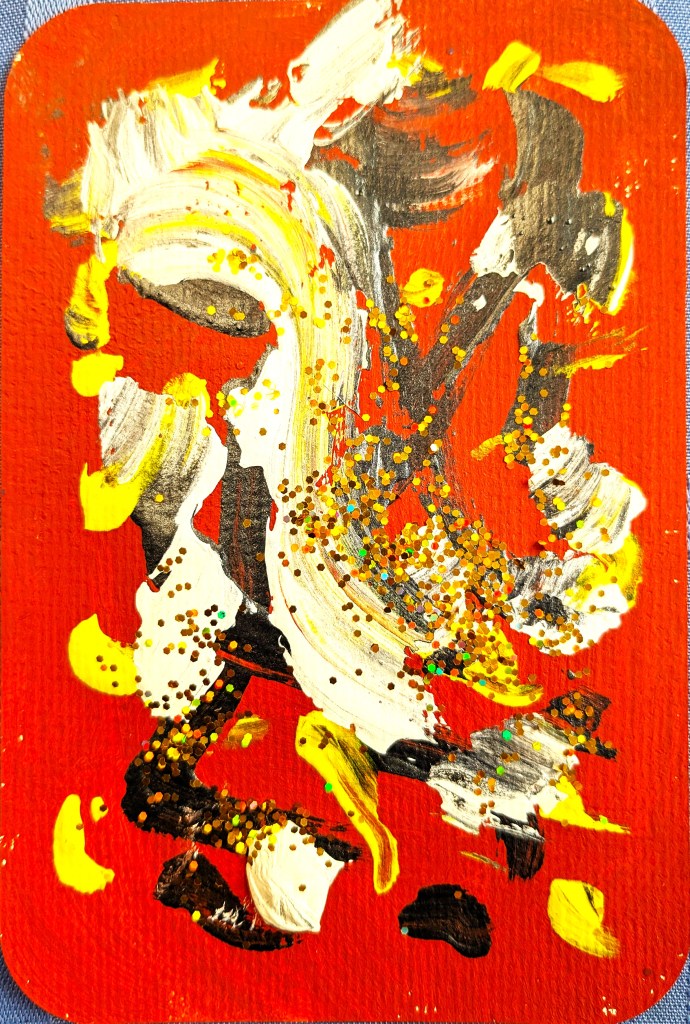
On the other hand, we can always go religious and turn to the Bible for advice. There we find “Faith, hope, and charity, and the greatest of these is charity.” So. Problem solved. I have found my one word – Charity. That said, I do like the painting Moo offered me for this prompt. He calls it Hope. And remember, you can’t go wrong with any of those three words – Faith, Hope, and Charity. Tolle lege. Amen.