Gower

Empress 070.jpg

Gower

To be Welsh in Gower is to spell it funny
and pronounce it worse: Gwyr.
It’s to know how to say Pwll Ddu.
It’s meeting the cows in the lane to Brandy Cove
and knowing them all by name and reputation,
which one kicks, which one gores,
when to walk in the middle of the lane,
and when to jump for the safety of the hedge.

It’s to know the difference between the twin farmers
Upper and Lower Jones.
It’s to recognize their sheepdogs, Floss and Jess,
and to call them with their different whistles.
It’s knowing the time of day by sun and shadow;
it’s knowing the tide is in or out
by the salt smell in the air
without ever needing to see the sea;

and now, in this far away land called Canada,
it’s hearing your stomach growl for crempog or teisen lap
whilst memory’s fish‑hook tugs at your heart
in the same way your father hauled in salmon bass
at Rhossili, Brandy Cove, Pennard, Oxwich, and Three Cliffs.

Commentary: I was checking Gwyr, the Welsh for Gower, where I was born, and found this interpretation of the name. <<G is for generous, your giving nature. W is for wise, more tomorrow than today. Y is for young, the years never show. R is for rapport, friends seek you.>> I don’t know if that’s me, but it certainly wouldn’t be a bad set of descriptors to live up to.

 

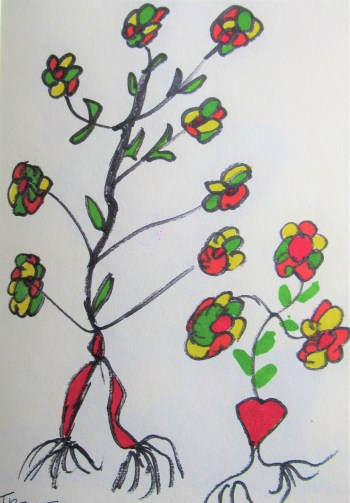
Flower-power


IMG_0902 (2).JPG

Flower-power
or
Why should the young kids have all the fun?

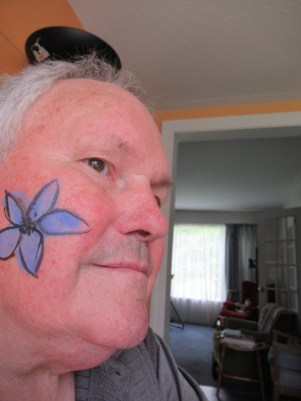
So it’s children’s day at the local supermarket. As I push my shopping cart through the door, I see the face-painter with a young girl sitting before her, getting her face painted. Behind the willing victim, several young children wait, shuffling their feet in expectation. I go out to the car park, unload my cart, and push it back to the supermarket.
As I park my cart, I see that the line-up has disappeared and the face-painter sits alone, cleaning her brushes. I walk up to her table and ask “How much?”
“It’s free,” she tells me. “It’s children’s day.”
“Will you paint my face?” I ask her.
“You’re not a child,” she looks at me in astonishment.
“No, I’m not,” I reply, “but I’m in my second childhood.”
I pull out the chair and sit down.
“I’ve got some photos on my phone, or I can try and paint whatever you would like. Would you like to see some pictures?”
“No, thanks. Just  look at me and paint what you think I would like.”
“What are your favorite colors?” she looks at me and smiles.
“I don’t have any favorite colors, but I always avoid green, yellow, and gold.”
“Oh, well, how about a nice flower?”
“Great!” I say.
One of the trolley boys who return the shopping carts in great convoys walked by.
“You need a mirror,” he says, “so people can see themselves.”
“Great idea, stay here, I’ll go and get one.”
“Don’t worry. I’ve got a mirror in the car. I’ll have a look when I get there. Meanwhile, it’s a surprise. I’ll put a photo up on my blog when I get home.”
“Promise?”
“I promise.”

IMG_0903.JPG

I gave her my blog address and I kept my promise. Unlike many people I know, I usually do.

IMG_0903 (2).JPG

Commentary: with many thanks to Emily, the face-painter, who treated my second-childhood with humor and dignity. As I said to her at the time, ‘why should the young kids have all the fun?”


Dewi Sant


IMG_0899 (2).JPG

Dewi Sant
Cathays

 To be Welsh in Cardiff on St. David’s Day
is to walk the dogs through Blackweir Gardens
and to nod with the daffodils as they step
their stately minuet under the trees.

Wet paths wander through rain‑speckled woods
and the fish are born blind in the gardens’ stream
on account of the coal that drifts its black silt
like fine, powdered night‑time down from Taffs Well.

Under their umbrellas, the fishermen dream
of sewin and perch; the bubbling waters
swirl faster today because of the rain that fell
last night in the Rhondda where a word‑storm

brought closure of pit after pit and each loss
cut colder than a volley of hail as King Coal
tumbled from his mining‑valley throne.

Yet still the daffodils sway, the fish are born blind,
and the Taff’s black waters swirl restlessly on
past unemployed fishermen to Severn and sea.

Dreamer

IMG_0826 (3)

Dreamer
Maindy Road
Cardiff

Dressed in clothes spun from the thinnest of air
I gave my dreams to any who would listen.
“A gift,” they called it, “for words.”

Yet, when the winds blew wrong
my words changed to smoke that stained
or flames that blistered and scarred.

My tongue twisted and forked until lies
lay heavy in my mouth and my words
were weighed down with hooks, and sinkers.

My life became a night-mare ridden full‑tilt
at a windmill with a great wooden sail.
On certain nights, when the sky was sprinkled

with seeds of living gold, I rose upwards
to the moon and my words become stars;
on lesser nights, I lay broken in the gutter.

Mannequins


IMG_0836

Mannequins
McAdam Railway Station #12

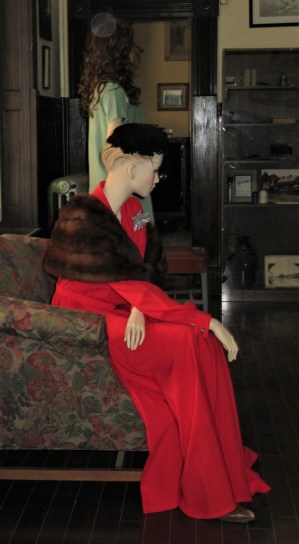
“He startles the unaware, that man by
the door, in uniform, with his youthful
looks and old-fashioned peaked cap,

fingers poised by his silver watch chain
ready to pull out his Waltham pocket watch
and check the time against the master-clock.

Two ladies wait in the waiting room.
One wears winter robes of red and black
while the other wears velvety green. Both

are motionless, one seated, one standing. Yet
if you watch them from a corner of one eye,
you will see shadowy gestures as their lips move.

Overnight they have changed into summer
clothes, gauzy, almost see-through, flowery
patterns, light-weight wedding boots, laced,

restful, cool, thin-soled. ‘Are you for real?’
I ask the standing one, for a joke. When she
nods and winks, a chill settles over the room.”

IMG_0676 (2).JPG


Shunting

IMG_0777.JPG

Shunting
McAdam Railway Station # 7

So many memories
cling like hobos
to freight trains.

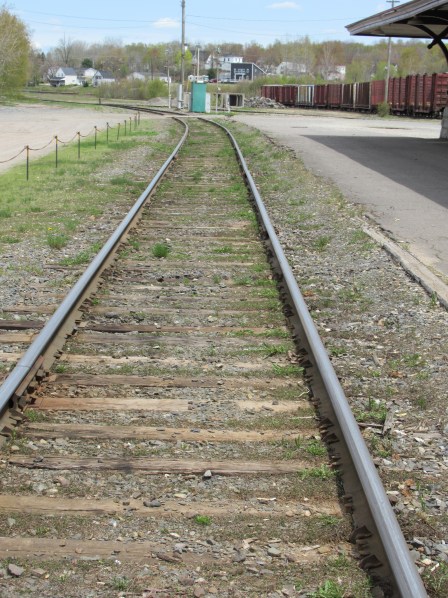
Tracks as always,
sleepers, steel rails
an optical illusion,

joining in the distance
where the miles
between now and then

knit themselves together
and we are young once more,
riding the rails,

dreaming of towns
beyond this town,
dreaming of the future,
not the past.

Comment: This is one of my own memories. We lived by the railway yards in Swansea and again in Cardiff. The trains were a regular part of my dreams. I lay awake one night waiting for the 3:20 to London, but it never came. I couldn’t sleep, waiting for that train. Next day I learned that there had been a railway accident. When I returned to boarding school after the holidays, I would lie awake at night waiting for trains that never arrived. We had a track close to the school, but we called it the Beetle Crusher because it was old and rusty and used so rarely that the beetles, who never knew when it was coming, would get crushed when it arrived. I have written a book about that train and that school, but I have yet to publish it. When I was very young and we travelled to London on the Great Western Railway (GWR) train from Swansea High Street, we had to go up to the engine driver and say ‘hello’. And then we had to thank the engine before we set off. Iron, steam, coal, inanimate to many perhaps, but live living animated beings young children who sat, like our ancestors in Gower caves, and watched the pictures the sea-coal flames painted in the fire.

A Three Year Old Girl

img_0181

A Three-Year Old Girl
McAdam Railway Station #3

“I often see her, walking around,
standing in a doorway,
looking into a room.

She’s very curious
but never says a word.
Doesn’t ask questions.

She’s not scary at all,
like some of the others.

There are rooms here
where people won’t go
if they’re alone.

But they mean no harm,
these broken ghosts.

They’re lost, nowhere
else to go, I guess.
Just missed the last train”

Comment: Another story from Elsie, who says she often sees this young child in one room or another. The station is indeed filled with many memories and you can feel warm and cold presences throughout the building. Some rooms are filled with foreboding, while others are warm and comforting. Many old buildings have these qualities as do the old iron age walled camps scattered around the south of England. Maiden Castle and Badbury Rings spring to mind, as do Westbury White Horse, Corfe Castle and parts of Brownsea Island in Poole Harbour. Do I believe in ghosts? I echo the words of my mentor and fellow-countryman, Dylan Thomas: “I’d be a fool if I didn’t.”

In the Cave

9_Bisonte_Magdaleniense_polícromo.jpg

In the Cave
(514-520 BC)

one goes on a journey
knows where one’s been

reality returning
one tells what one’s seen

shadows dancing
on night’s silver screen

verbal sketches
from where one’s been

speaking other languages
heard not seen

the more one speaks
the more others think
‘dream’

a dream for those
who’ve never been
where one’s been


Purple

IMG_0038

Purple

I pen poems
in emerald ink
but I prefer
the violence of evening’s
bruised violets

wind-beaten clouds
add dark depths
to a rainbow

a glow of satisfaction
flutters northern lights

the setting sun
hums low notes
to cello
and double bass

Comment: I like this, but I prefer the re-write. If you wish to express your preference, I would be glad to receive it. This is the third revision. Click here to read the first posted version of Purple. Any comments on the evolution of the poem would also be welcomed.

Purple

violent
evening’s
bruised violets

wind-beaten clouds
move through dark depths
a rainbow arcs
an iris curve

northern lights
flicker organ music
fugues of color
sound into light

low notes hum
bring tears to the eye
cello and double bass
serenade a setting sun


Butterflies

img_0189

Butterflies

butterflies
their ephemeral forms
flutter by
flickering
brief their sweet sway

they spread
paint-daubed
fanciful wings
fan flowers
flourish

eternity
perched briefly
on flowering bees’ balm

robin puffs out
his red breast
hauls down
tomorrow’s sun

white-throat sings
an evening elegy

Comment: 

“Poetry gives permanence to the temporal forms of the self.”
Miguel de Unamuno.