Absence

Absence …

… makes the heart grow
callouses scabs you can
pick at with your finger
nails bleeding fresh blood

they remind you that you have
a heart feelings something
buried so deep you need
a pick and a shovel to dig
a shaft with wooden slats
placed carefully at the sides
so your mine won’t collapse

you dig deeper and deeper
until in the gloom you see
the feathered fluttering —

a broken-winged canary
sacrificed in its cage
so part of you can escape
flee the mine
and come out alive

Commentary:

A golden oldie. Moo thought Poppy Day (11/11/2024) would be a suitable painting. Those who survive rarely forget those they were forced to leave behind. Kindred spirits, they travel though life together, the live one carrying the other on his shoulders as he would have done earlier, had he been able to.

Moo still has a teddy bear. He tells me he has always slept with one. His first teddy was an Australian Koala, a real stuffed koala given him by his Australian family, back when he was born. Moo was reading a book on the Battle of Britain (15 September 1940). It had a picture of the gunner from a Bolton Paul Defiant, sitting in the gun turret. Behind him, he had his little teddy bear. Moo couldn’t stop crying. He thinks he might have been an air gunner in another life, and when he saw that teddy, it brought back so many memories – flak, night fighters, search lights, tracer bullets, pain, flames, and then the unending darkness. So many did not come back, especially the tail-gunners. Their absence is still a presence to someone in their families. And so it should be.

Clepsydra 8

8

… those other faces fading
     drifting away
          their smiles their frowns
               melting away into the dark
                    where no star glows

they cannot return
     nothing walks the woods
          save a silence
               where once they strode

empty the hand
     once held out to help them

silent the prayer
     emerging from pale lips
          and unanswered

where are they now
     those who walked
          this way before us
               glum ghosts
                    hushed their chorus

I promised
     to remember them
          but I forgot them
               as one by one
                    they slipped away …

Carved In Stone

Carved in Stone

Brief Introduction

“Poetry explains itself. If it doesn’t, it’s inexplicable.” Pedro Salinas.

I entered this collection of poems for the Alfred G. Bailey Awad (poetry manuscript), WFNB, 2025. Alas, it did not win an award, but the judge, Kathy Mac, made some excellent suggestions as to how I might improve the manuscript. I have followed her advice to the best of my ability.

Carved in Stone is the second dialog (Chronotopos II) in my Bakhtinian Dialogs with my time and my place. Clepsydra, Chronotopos I, won third place in the Bailey Award (2025) and has already been published. I have one, possibly two, more Dialogs planned.

Reception Theory – I write, you read. Any meaning that you extract from my poetry will depend on your own culture and background. Tolle, Lege – Take and read. Read slowly, and with care.

I am a poet, a dreamer, if you will. These are my dreams. When you enter my world, you mingle your dreams with mine. The result, I hope, will be an interesting intellectual blend of new creativity. Pax amorque.

1

Behold me here,
filled with a sort of shallow,
hollowed-out wisdom
accumulated over decades
while listening with my eyes
to the words and thoughts
of writers, long-dead.

Imprisoned in book pages,
do they bang their heads
against walls that bind,
or hammer with their fists
at the barred lines
of their printed cages?

These spirits long to break free,
but they choke on library dust
and pollen from verbal flowers
that bloom unseen.

Those old ones avoided
the traps of temporal power,
or, once trapped,
gnawed off a precious limb
to limp into freedom.

Comment:
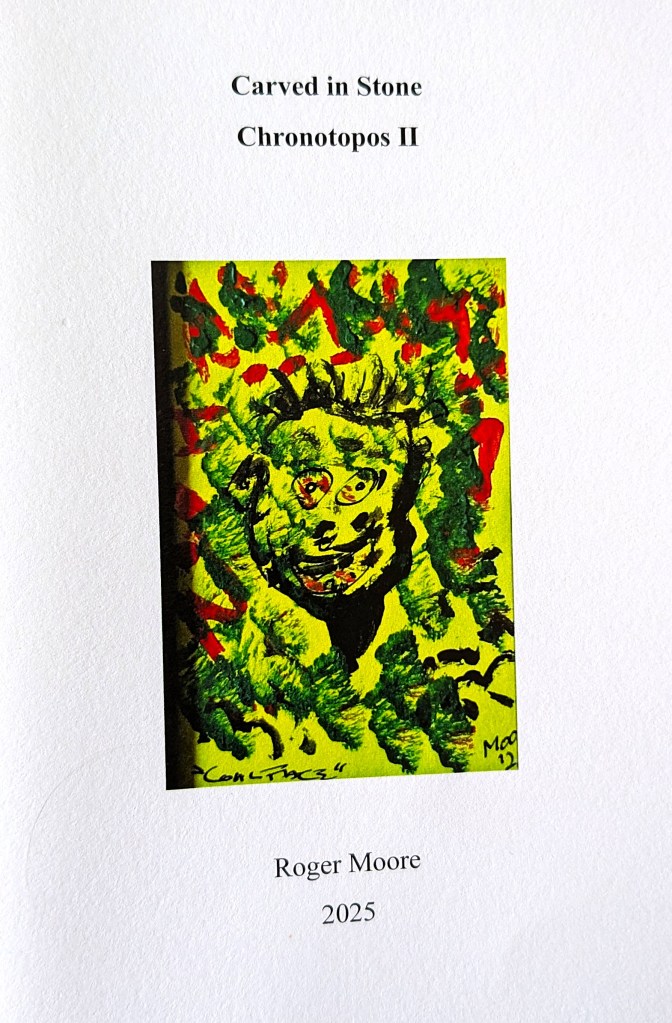
The cover painting, painted for me by my friend Moo when he read the manuscript of this book, is called Coal Face. It refers to the young Welsh boys in the Rhondda coal fields, aged 8-12 years old, who went down the mines to work at the coal face. This happened when the coal seams grew thin and only small children had the ability to work at the coal face and carve and mine the coal. Here are the relevant verses (44 – 45).

44

The old man, withered,
last house on the left,
leaning on his garden wall,
coughing, spitting up
coal dust and blood.

He’s not old, when you get close,
just grown old, underground,
where emphysema
and pneumoconiosis
devour men and boys.

He spits on the side walk.
Mining souvenirs,
Max Boyce calls them,
and they appear
every time the young man,
turned suddenly old,
starts to cough.

He can’t walk far,
wearing carpet slippers,
soft and furry,
just leans on the wall.

He fell, or was pushed,
into the trap at an early age,
when the coal seams
had grown so thin,
that only a small boy
could kneel at the coal face
before the black altar
of the underground god.

There, with a pick and shovel
he learned to carve and shape
those seams.

45

No candles burned at that altar.
A single match, let alone
a candle flame,
would spell the end,
if gas leaked from the seam.

Only the canaries,
confined in their cages,
sang songs.

Doomed,
like the blind pit ponies,
never to see the light of day,
they lived out their lives
down there.

So many died underground,
unable to get out,
buried alive,
before they were even dead.

Dark Angel

Dark Angel

He will come to me, the dark angel,
and will meet me face to face.

He will take all that I own,
for my wealth is only temporary:
health, wealth, possessions are all on loan.

My house, my wife, my car,
my daughter, my grand-child,
 my garden, my trees, my flowers,
my poetry, my works of art.
I use the possessive adjective
knowing full well that these things
are only on loan. I will never be able
to preserve and possess them.

I even rent this aching heart,
these ageing, migrant bones,
this death that has walked beside me,
step by step, every day
since the day that I was born.

My death alone is mine.
It belongs to nobody else.
It will be my sole possession.
It will soon be the only thing
I have ever really owned.

Comment:

Dark Angel is the third poem in the first sequence (Crystal Liturgy) of my poetry book Septets for the End of Time. The painting, by my friend Moo, expresses his impressions of how he reacts, in paint, to my poem, in words.

“Well,” I said to Moo, “you’ve gone and done it this time. Do you think that painting really represents my poem? I see no darkness in it and certainly no angel.”

Moo gave me a long, strange look. I felt like I was looking in the mirror and seeing parts of my own soul fragmenting and falling away, like scales from my eyes.

“It’s not what the poem says,” he replied. “It’s what I think you feel as you’re writing that poem. I see the tension, the cry from the heart, the struggle to accept, and the realization that, in the end, everything is inevitable and must turn out as it will. That said, more than anything, it is the cry, de profundis, from the depth of your self that I feel. My painting depicts that cry and your suffering.”

“What if it’s not my suffering? What if it’s the suffering of Messiaen and his musicians as they play the soul music that keeps them alive?”

“But surely,” Moo replied, “that’s the whole point. Orde Amoris, according to the recent Pope who has just passed away, is love felt for the person suffering, no matter who he or she is. Pope Francis spoke in praise of the parable of the Good Samaritan. When you see someone suffering at the wayside, you stop and help that person. You don’t just walk on by. Your suffering is my suffering. When I paint your suffering I also paint my own suffering and when you grieve, then I grieve with you.”

“And when that happens, when we all grieve together, we do not grieve alone and in vain.”

“Exactly.”

What are your thoughts on the concept of living a very long life?

Daily writing prompt
What are your thoughts on the concept of living a very long life?

What are your thoughts on the concept of living a very long life?

A simplistic question in so many ways as so many definitions are needed. How long is long? 100 years? 200 years? Back to 1066 to watch the Battle of Hastings? 1588 to see the Spanish Armada sailing up the channel? 1815 to see the Battle of Waterloo and talk with Wellington and Napoleon – why not? I am Anglo-Welsh and New Brunswick is bilingual, French and English, so why shouldn’t I – or anyone else who wants to live such a long life – have a talk with both of them?

And does living a very long life include the concept of being healthy, and happy, and wise, and not living in squalor or poverty or in a permanent war zone? How about being kept in an incubator, or an iron lung, or on permanent life support? How long is long under those (or similar) conditions. And what about friends and family? In the Celtic myths, men who visit the fairies in Ireland and live and eat with them, come back to reality [now define that word in this day and age] only to find their friends and families long dead and gone. So what would the conditions of the ‘return’ be like if a long life meant watching the passing of everyone and everything you know or returning to a world you no longer recognized?

And change is so rapid nowadays. AI is developing so quickly, how can anyone keep up? I know that as I slow down (mentally and physically) I understand less and less about the machines I use, including my Nexus Rollator. Does a ‘very long life’ include sipping from the Fountain of Youth? Or does it consist of an enlarged old age – post molestam senectutem, nos habebit humus after a troubled old age, the earth will have us. I am sure we all recognize Gaudeamus igitur, in Latin, and its theme of Ubi sunt qui ante nos in mundo fuerewhere now are those lived in this world before us, and if we don’t, then how swiftly we have forgotten the power of Latin is with its memorable phrases and omnipresent seeds of memento mori .

For me the question is a clear one – do you wish for quantity (a very long life) or quality (a very happy and successful one, even if it is a bit shorter)?

A close friend of mine, one of the most honest and courageous people that I have known, suffering in a horrific way from terminal cancer, asked for, and received, MAID (Medical Assistance In Dying). It was a long legal and medical process to get MAID, involving famiy members, lawyers, doctors, and many other things. As the Romans used to say mors omnia solvit death resolves everything. My friend and his family preferred to shorten life – on their own terms – rather than prolong it under such prolonged suffering and torment. My friend, I salute you and your family and commend you for your bravery.

So, define the terms within which that very long life would be lived – and then ask yourself the question once more. Because as it stands right now, with no further understanding, the answer should only be “depends”. And remember, lives are like swimming pools – they have shallow ends and deep ends. All too often when you talk about life and the end of life, so much depends.

Comment:

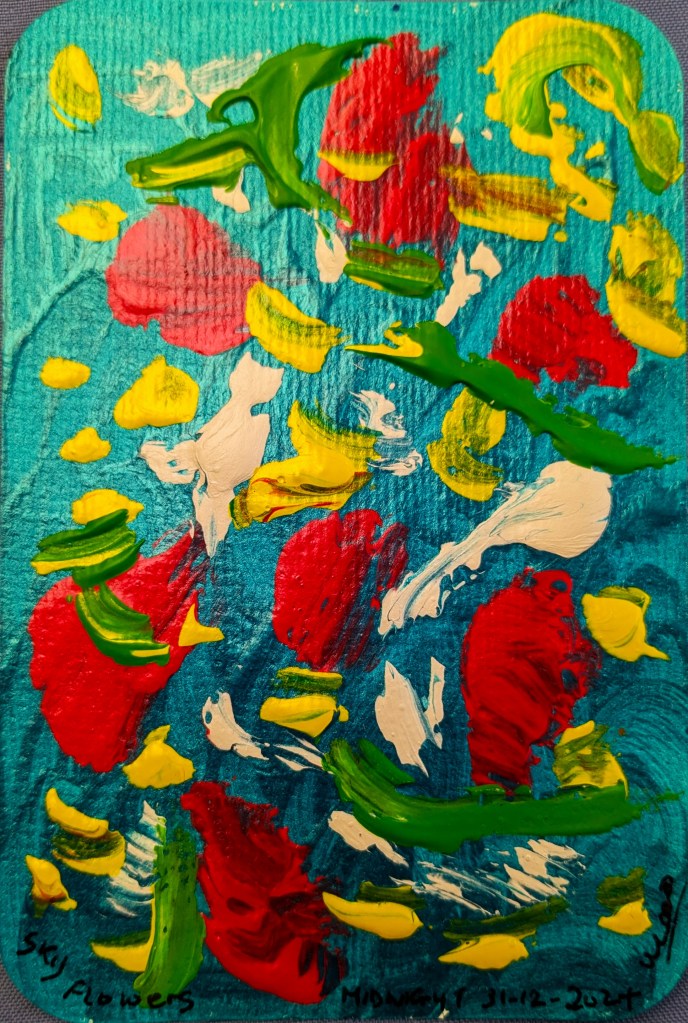
I must thank my friend, Moo, for his depiction of the fireworks from New Year’s Eve. Sky Flowers, he calls it. The fireworks have gone already – but – vis breve, ars longa – his painting still survives.

How would you design the city of the future?

Daily writing prompt
How would you design the city of the future?

How would you design the city of the future?

What future? Utopian or Dystopian?

Dystopian – how does one plan to design the city of the future in, for example, Syria, Gaza, Ukraine, a war-torn African country? There are wars and rumors of wars. What sort of future city does one design in the aftermath of a nuclear war? Bunkers for the elite? Underground tunnels? Radiation free zones? MAD – Mutually Assured Destruction – and who would be alive to inhabit one of those cities? The ultra-rich might escape on their super-yacht-space-crafts. But where would they go? And for how long would they survive? And what sort of cities would they build when they got to wherever they were going? From some of the rumors that I am hearing, the multi-billionaires are already building those -super-survival-Noah’s-Ark-Bunker Cities in various parts of our world as it is now. A water world? A dust storm world? A radio-active world? First, define the future, and then we can design for it.

And remember how many times, during and after the first Iraq war, we have heard generals and politicians boasting that ‘we bombed them back to the stone age.’ Just think about that. The stone age. Primitive in the extreme. No electricity, no running water, no regular food supply, no weapons other than sticks and stones, no bronze (that age came later), no iron (that age came later), no medicine, no doctors, no hospitals … think twice before you celebrate ‘bombing anyone back to the stone age’, because that might just happen to you, over the next few years. And remember, if everybody turns off all sources of light, we will be entering a very dark age indeed.

Utopian – Voltaire’s Candide – “everything is for the best in the best of all worlds.” Great. Now re-read the paragraph above. Even if our desired Utopian world avoids a nuclear holocaust and turns out to be the best of all worlds, we are still looking at climate change, rising seas – with the accompanying joy of developing new waterfront properties!??? as someone phrased it recently – over-population, mass population shifts, a dwindling set of natural resources, a scarcity of food and, more important, a scarcity of drinking water, and a tremendous division between the ultra-rich and the super poor. We are also dealing with forever plastics, polluted water, air pollution, the extinction of vital and diverse species, and so many more problems. A Utopia, perhaps, but a Dystopian Utopia, not a total disaster, but a Utopian world walking the plank towards a shark-infested sea.

So, tell me, how do we design the city of the future? A super-charged Noah’s Ark, space ship city, sailing to Planet B because we have flooded Planet A with so many devastating Dystopian indulgences? A deep-earth bunker, or linked set of bunkers, way below the earth, where a select community think they can ride out the coming storm? And what if our planet disintegrates and becomes just another dust cloud, its debris floating in the universe?

I would like to think that my own city of the future would be a small one-roomed, wooden cottage, buried six feet deep, in the peace and quiet of a rural cemetery. But who will bury me, if the world around me perishes and I survive only to fulfill my human fate, and die? I would also welcome a fiery end with my ashes scattered in the peace of the countryside, or in my own garden. Then I think of the wildfires currently consuming large parts of the world and I wonder if any of that will survive. Moreover, can a welcome grave in an enormous graveyard be considered a city of the future? If it can, get planning.

Mors omnia solvit / death solves everything. Indeed it does. And it will solve this question, this problem, and the future city, that I will never design or inhabit, unless, along with Blake, “we build Jerusalem, in England’s green and pleasant land.” If England’s Green and Pleasant Land still exists. And from what I am reading in the dystopian English press, there is little chance of that! And anyway, I live in Canada, so what has England’s polluted and dystopian land got to do with me?

What are your daily habits?


Daily writing prompt
What are your daily habits?

What are your daily habits?

“The habit (Greek: Σχήμα, romanized: Schēma) is essentially the same throughout the world. The normal monastic color is black, symbolic of repentance and simplicity. The habits of monks and nuns are identical. Additionally, nuns wear a scarf, called an apostolnik.”

So, my daily habits are a little bit monastic. “Monks were very religious, lived simple lives and followed certain rules to discipline themselves. The monks didn’t have any possessions, they didn’t even own their own clothes and they wore a simple garment known as a habit. Monks chose to live in the monastery as they wanted to help others and worship God.”

I can’t say I am very religious, in the church-going sense, but I do live a pretty simple life. My rules and disciplines consist of daily exercises, stretching and strength, a morning wash and shave, getting dressed in my non-monkish habits – jeans, shirt, sox, shoes or sandals. Coffee and fruit for breakfast. Writing – (a) in my journal (b) on the computer (c) in my poetry book. An early lunch, usually a sandwich. A post-prandial walk around the garden with my roller, examining the hollyhocks, the yucca, and the clematis, and checking on the progress of the other flowers.

The daily routine of a monk is somewhat similar. Monks typically wake up early in the morning, often before sunrise. I wake up early, text a couple of my best friends on the cell phone beside my bed, and then I go back to sleep again. I often begin the day with a prayer or a hymn – as do the monks – “Every morning, when I wake, / oh Lord, this little prayer I make, / that thou will keep a watchful eye, / on all poor creatures born to die.” Then I begin my daily routine of work and meditation. The specific activities and schedule can vary, but generally, I spend several hours each day in work (writing) or study (reading).

I try to think like a monk – to think like a monk means to remain calm and focused under all circumstances, especially when life gets challenging. Alas, at my age, I meet challengers all through the day. Things fall to the floor – challenge – can I pick them up with my magic claw? I can’t open bottles and cans – challenge – can I do so with one of my two magic appliances? I actually have three, but one of them doesn’t work. The other two, however, are wonderful. It is almost impossible for me to open plastic wrappings – challenge – can I do so with a pair of scissors, a pocket knife, or must I, in the worst case scenario, use a genuine can opener? Good tip, that, incidentally, especially for bubble packs. There are many other challenges, the worst of which is always what to do if I fall down. We won’t talk about that – I just do my best not to fall.

I also do my best to lead a relatively simple life – I try (1) to do one thing at a time – (2) to commit whole-heartedly to my family and few close friends – (3) to simplify my life and concentrate on what I am doing – (4) to develop my mind by not indulging excessively in social media – (5) to order my existence by making lists of essentials that must be accomplished – (6) to express myself and my love for the world around me in poetry, prose, and paint – and finally, (7) to remember that, the day I was born, I took my first step on the path to death. Beyond that, I do very little more.

What notable things happened today?

Daily writing prompt
What notable things happened today?

What notable things happened today?

One of my best friends passed away today at approximately 2:30 pm. She had been rushed into the Hospice and perished within days of being admitted. Such things are never easy, especially when the deceased person is younger than you.

My friend was a wonderful cook. To mark her passing, I made a traditional Welsh leek and onion dish for my beloved, who pronounced it good. Concentrating on the cooking enabled me to come to terms with a loss that is not only mine, but belongs to her family and the larger writing community as well.

My friend wrote prose, but was a poet at heart. Her creativity went beyond the written page and entered into her life, her relationships, and her cooking. A ray of sunshine in the kitchen, she brought the sunshine of her life to her guests when she presented the gifted poems of her food.

The title of the prompt includes the word “things”. A mutual friend contacted me with news of her passing. I contacted two more mutual friends and we shared happy memories – horas non numero nisi serenasI count only the happy hours.

Covid came between so many of us, especially the older generation. It drove a wedge between friends, shut out mutual meeting places, destroyed regular reunions and contact. This passing of a loved one, beloved to many of us, helped us reconstruct the spider webs of friendship, allowed us to share our grief, and enabled us to see the world in a slightly different light – one of joy and happiness – joy in the love we all shared, happiness in recalling the best of those moments.

Vis brevis, ars longa.
Requiescat in pacem.
Pax amorque.

And no, Latin is not a dead language.

What is your career plan?

Daily writing prompt
What is your career plan?

What is your career plan?

“Pull the other one, it’s got bells on,” as the comedian said on our old black and white TV back in the late fifties when the television shows first started. My grandfather bought that TV in 1953 in order for us to watch the Coronation of Elizabeth II. I was nine years old at the time. Now I am – hold on – “How old am I? Let me count the days” – as Shakespeare might have written, if he had actually written his own plays and poems. Or were all those glorious words written by a conspiracy of authors who then had their work claimed by some else aka Willy the Shake? Snake oil, all of it, or as they say in some parts of Wales – blydi hel.

I wonder how many of my readers know how to play Tute, a Spanish card game, slightly akin to whist? Well, in it you score by singing – Canto las veinteo canto las cuarenta – well, I am well on my way to winning my game of Tute because Canto las ochenta!

So, at eighty years of age, after fifteen years in retirement, what sort of career plan can anyone have? Plan – is it a detailed proposal for doing or achieving something? Or might it be – an intention or decision about what one is going to do? As for career – is it an occupation undertaken for a significant period of a person’s life and with opportunities for progress?

So, in my retirement, what opportunities are there for progress when I seem to be regressing most of the time? And what plans can I make when the unplanned knocks on my door at irregular, uncomfortable intervals?

And that’s the problem with prompts and life in general – one size designed to fit all and I do not fit in. Never have. I no longer have a career. I no longer have any plans. I drift with the winds and the waves “as idle as a painted ship upon a painted ocean.”

I guess my only plan is to stay afloat for as long as possible and to avoid, if I can, that deadly dive down, down, down, into Admiral Brown, and down to Davey’s Locker.

What makes you laugh?

Daily writing prompt
What makes you laugh?

What makes you laugh?

The current state that the world is in. Seems like a strange answer, doesn’t it? Wars, famine, plagues, diseases, fire, flood, earthquakes, drought, what is there to laugh at? All of it, of course. Because if I didn’t laugh at it, I would cry. And crying – well, there just aren’t enough tears, are there? Anyway, as the Reader’s Digest used to say “Laughter is the best medicine.” So, if we want to heal the world, we must first learn to laugh at it.

In fact, there are many things we should be laughing at – politics and politicians, for one. Or is that two? Chuckling away – it’s hard to tell them apart nowadays. In fact, if we laughed right out loud at the folies bergeres who masquerade as wise men, can-can dancers who actually can’t-can’t, and decision makers who really can’t decide, then that laughter would be the last straw that would break the camel’s back and dump them all on their backsides in the desert where they belong. There, they would be voices ‘crying in the wilderness’, crying indeed, for deprived of their privileges, none of them would be laughing. But we would. And we’d probably be a great deal better off.

New words also make me laugh. Homicide, femicide, domicide, ecocide, countrycide – tell me, who makes up these names? Who keeps popping them into the dictionary? And if they mean what I think they mean, we should all be on our knees, praying and weeping. It’s like fake suicide. That happens when push comes to shove, and the subsequent defenestration is deemed a suicide.

Look at Moo’s painting, Burning Birbi. Now that is something to really make you cry. Moo tells me he was going to call it Burning Bush, but then he remembered all the poor birbis who were burned to death in the Australian Bush Fires. They ascended the eucalyptus trees for safety, and there, of course, they met their sad and tragic fate, while trying to escape the conflagration. I can laugh many things off. But not the fate of those cuddly little Koalas, brought to the edge of destruction by our treatment of their natural habitat.

Welsh proverb – “Laugh and the world laughs with you. Cry, and you cry alone.” So, I am laughing at it all. I have to – or else I will suffer a break down. So, laugh with me, and let the real losers cry in the wilderness, hermits all, abandoned to their lonesome own-somes.