Silence

Silence

Pain stops at the edge of silence
and silence is the sound of sunlight
breaking against the walls of the room
in which I sit and listen, in silence,
waiting for the notes to begin again.

Silence, yes, yet my silence lies broken
by the renewed intrusion of the clock,
by the electric hum from lights and heating.

Ghostly noises break into my thoughts:
cheers from a distant tennis court,
those eternal advertisements
that invade my innermost being.

What triviality now shatters
the Messiaenic mood that wrapped me
for a moment in a many-colored cloak
woven from musical oblivion.

Time’s teeth start to gnaw again
and the grandfather clock
nibbles at my soul, extracting
its essence in a surge of sound,
tick-tock, tick-tock.

Westminster Chimes choke
life from the hour and ring
the tick-tock knell that files
my life away, second by second,
minute by minute, day by day.

Comment:

Silence is the fifth poem in the first sequence (Crystal Liturgy) of my poetry book Septets for the End of Time.

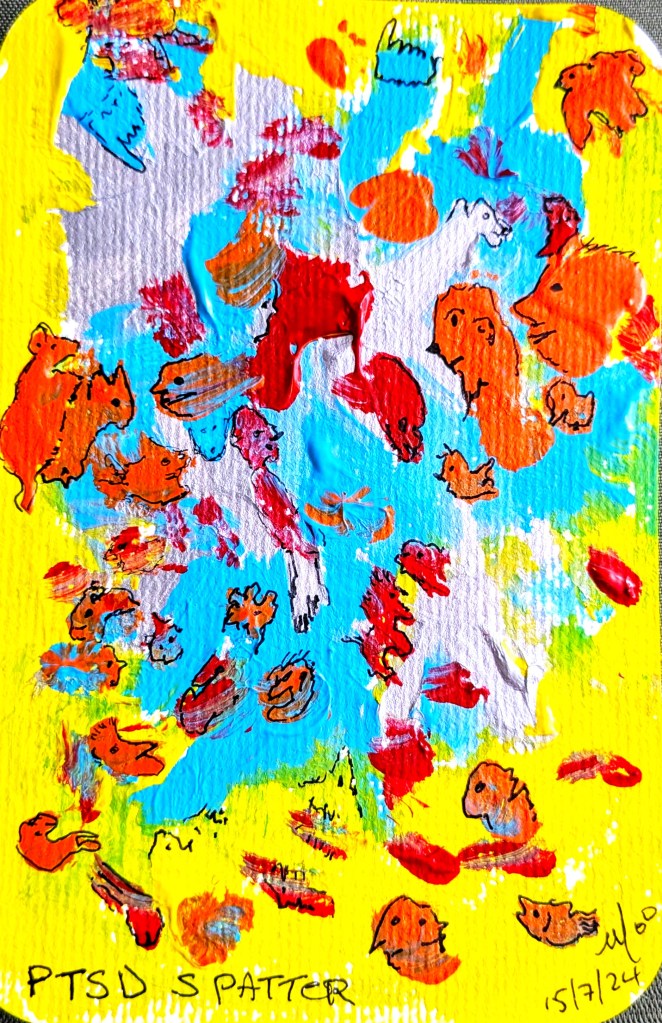
“So,” said Moo, “today I offer this painting where the title, Sound of Silence, fits well with the title of your poem. That said, I am not sure that the painting itself, qua painting, is as suitable as earlier pairings. De gustibus non est disputandum / there is no arguing about taste. I guess you either like something or you don’t.”

“It certainly isn’t in your usual style. In fact, it looks more like a colored pencil sketch than a painting. Where did you draw the title from?”

“Actually, it’s from one of your poems about Avila, in Spain, the city where, or so they say, you can hear the silence. You complained about all the noise that you found, especially the church bells, in that otherwise silent city.”

“Ah yes. I remember that poem. And I’ll never forget the sound of the bells echoing from wall to wall in those narrow, medieval streets. Bells from all the churches inside the walls of the city, tolling at exactly the same time, calling the faithful to prayer.”

“And that is one of the differences between us that I mentioned yesterday. My paintings, whatever they depict, are always silent. I have heard you read your poems out loud on Spotify and I have also heard other people reading them on your behalf, not always successfully. Poetry is designed not only to be read silently, but also to be read out loud, before an audience. Painting, on the other hand, is always silent. It does not speak, nor can it be heard. A painting is just there, in two dimensions, powerful, if you are lucky, weak and wobbly if the artist does not fulfill his task.”

“Interesting, dear Moo. And the images that I draw from Messiaen’s music are interesting too. For musical notes, without words, change into images within the listener’s mind, and then, when heard by the poet in me, become verbal images upon the page. Fascinating.”

“It is. Some time soo we must talk about intertextuality, the ways in which one artistic form or text can influence another. Hopefully, you’ll find a poem and I’ll find a painting that illustrate just that.”
Transitions

Transitions

Modes of limited transitions,
moods of time tapped in time
to time’s rhythmic piano.

Scales fall from my listening eyes
and all-seeing ears.
A transitory awakening,
this glimpse of the composer’s vision,
each note a new version
extracted from abstracts
perceived in color,
each note a hue, and chords
a rainbow spectrum of light
glimpsed darkly through
the raindrop’s distorting lens.

Birdsong and sunshine.
Notes perched
on the matinal branch,
each in tune with the other,
at times in seeming discord,
yet the morning chorus
diluting the day
with the liquidity
of light and sound.

Comment:

Transitions is the fourth poem in the first sequence (Crystal Liturgy) of my poetry book Septets for the End of Time.

“How on earth did you create that painting?” I asked my friend Moo. “And how do you relate it to this poem?”

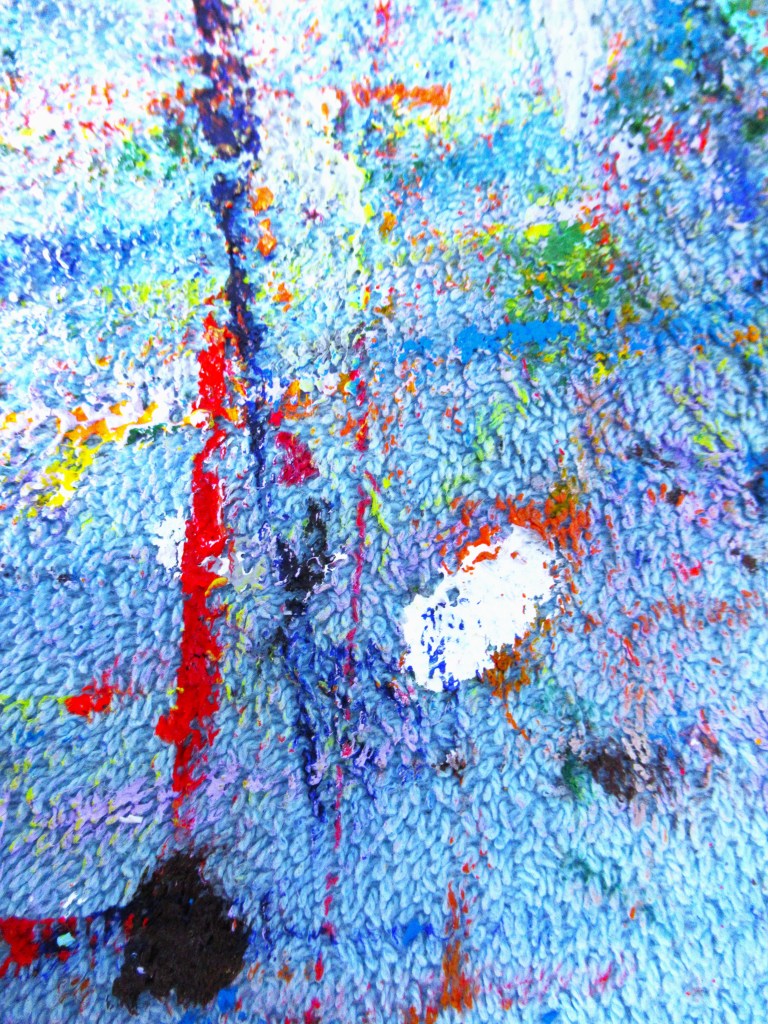
“Good questions,” Moo replied. “Difficult to answer, though.” First of all, this is not a painting. It is the background cloth, always changing, always in transition, upon which I create my post card paintings. The idea of transition summarizes the movement from paint, to brush, to painting, and the haziness of the creative moment. It relates directly to your lines ‘Scales fall from my listening eyes / and all-seeing ears.’ This is the point in time, the magic moment, when the painting declares itself. I assume you have the same moment when you write poetry.”

“The two processes are very different, I think. In my poetry, a thought leads to a verbal image, and then each of the words turn themselves into little worlds in which verbal gemstones appear. I try to catch those verbal gemstones and to transform them into poetry. If I listen carefully, then my ears see and my eyes hear the words forming themselves into the right order.”

“Interesting. And yes, that’s what happens in my painting too. The initial mood captured in that first color, and then the minor moods that emerge from the first one gradually woven into the painting.”

“That is somewhat similar to how I write – by listening to the words and doing what they tell me to do. Then I do what they want me to do, not what I want them to do.”

“Fascinating. But there is one huge difference between us.”

“What’s that?”

“I’ll tell you next time.”

The End of Time

The End of Time

A thin violin crying
its cat-gut heart out
in tears of sound, falling,
rhythmic raindrops,
down a grey-streaked face
tight with stress and taut with pain.

Such concentration,
such soulfulness packed
into each mindful note.

An audience of one,
I sit, head bowed, meditating
on the meaning of meaning
and the nothingness
of a being condemned
to oblivion, yet oblivious
of the how and when.

Each note a hammer-blow,
then, the piano pounding nail
after nail into this living coffin,
this body I drag through the motions
of extracting meaning
from this meaningless life.

Comment:

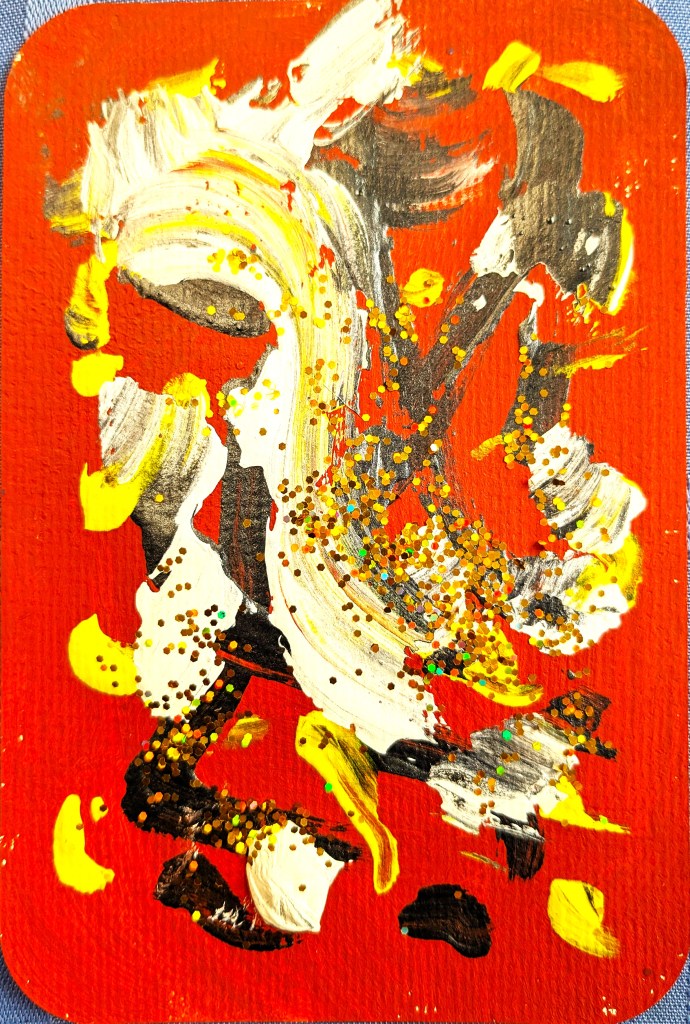
The End of Time is the second poem in the first sequence (Crystal Liturgy) of Septets for the End of Time. The painting, by my friend Moo, expresses his impressions of the nature of the end – but he doesn’t tell me the end of what. Certainly not of our friendship, I hope.

I am always worried by those last two lines: extracting meaning from this meaningless life as I don’t think that life is meaningless. However, there are times when it certainly feels that way. Those are the times when we need our beliefs in truth and the purity of art to survive. But how do you define them, you ask me. In all honesty, I don’t. I can’t. Art changes. What we consider to be true changes. Relativism? Yes, to a certain extent. I know what I believe. I don’t know what you believe. But I would never try to inflict or enforce my beliefs on to you. That is not how I work.

As for Moo, I don’t know how his mind works. I think he just sees things in color and shape and in the creation of movement within the stillness of a two dimensional illusion. I also think he thinks like a child. Maybe, like me, he has entered his second childhood, though I don’t really remember ever having had a first one. Oh dear – the meaning of meaning – one of the great enigmas of this wonderful world in which we live.

Crystal Liturgy

Crystal Liturgy

Here, in the abyss,
where song-birds pluck their notes
and send them, feather-light,
floating through the air,
here, you’ll find no vale of tears,
no fears of shadow-hawks,
for all blackness is abandoned
in the interests of sunlight and song.

Here, the crystal liturgy surges,
upwards from the rejoicing heart,
ever upwards, into the realms of light,
where color and sound alike
brim over with the joy that, yes,
brings release to head and heart.

Here, seven-stringed rainbows reign,
the everlasting harp is tuned and plucked,
and an eternity of music cements
the foundations of earth and sky.

Here, the master musician conducts
his celestial choir, their voices rising,
higher and higher, until they reach
the highest sphere, and song and voice
inspire, then expire, passing from our eyes
and ears into unbounded realms of light.

Here, the seven trumpets will sound
their furious dance, a dance that will announce
the end of this singer, the end of his song,
but never the end of song itself.

Comment:

Crystal Liturgy is the first poem in the first sequence of my poetry book Septets for the End of Time. My friend Moo, the painter, supplies the paintings for the book covers. He and I have decided to hold a dialog on our views of how the painting and the poem relate to each other. Hopefully, we will continue this dialog throughout Septets for the End of Time.

“I have tried to join the ideas of sound, light, song, and voice to the idea of the Platonic Universe, where the planets dance to the music of the spheres. I wrote these poems listening to Messiaen’s Quartet for the End of Time. I allowed the music to flow through me and I responded, in words, to the images that came from the sounds, and the silences, of the music.”

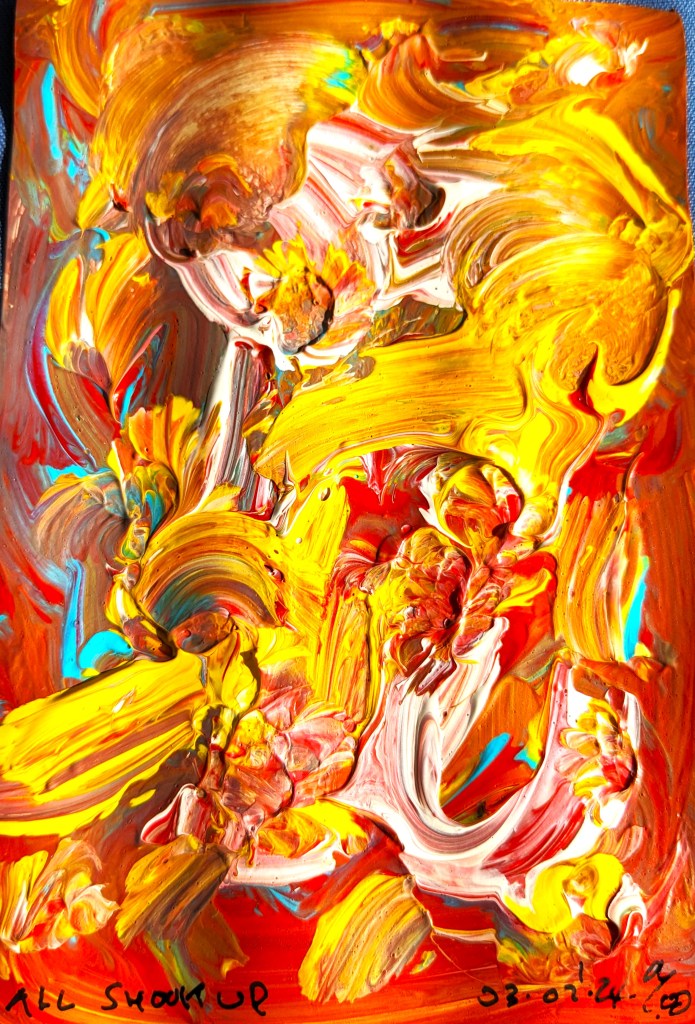
“I see no sorrows here, no woes,” Moo told me. “I only see the the joy of light and existence. The shadows have been dispersed, and my painting contains a generous helping of sunshine and light. I find it very suitable for this particular poem. My painting’s starburst of energy enhances the poem’s sense of movement, strength, and light. It also contains the message that all will be well.”

Empty Nest

Empty Nest

Who are they, these ghosts who flit into my life
and leave me foundering in treacherous waters
as I search for enlightenment and meaning?
Why do they return, revenants, to disturb
my peace and quiet, and to trouble my sleep?

I watch them wandering through the coal mines
of my mind, while yellow canaries twitter rage
from their cages. Oh, praise the blind pit ponies
whose blinkered eyes will never see the light.

They are so lonely, so distant, so lost in deep-down
galleries that I no longer know them.
Memory’s fish-hook cannot snag them,
cannot haul them back into daylight reality
far from night’s net of silvery dreams.

A place… a time…the sudden scent not of presence,
but of absence. The absence of movement,
noise, of that other body that once walked the rooms,
floors, opening and shutting doors, windows, a robin’s
whistle, a thrush’s trilled song… gone now, gone, all gone.

We drift through silent sadness, avoid each other’s eyes,
sit with our heads in our hands or knit our fingers together
in desperate gestures that express our emptiness,
the emptiness of an empty nest…

Comment:
So many people, leaving, drifting on, out, and away, so many empty nests left behind. Why do I grieve, when I know that this is the natural path of life? And for whom do I grieve, for myself, or for them? I do not know. I only know that when that last visitor leaves the party and the door finally closes, the walls close in and I am left alone in this emptiest of nests.

To sleep, perchance to dream. And that is when they return, those broken ghosts who visit me at night and fill my empty head with memories, some happy, some beautiful, some ugly, and some of them sad. They fly, tiny silent birds, when the first rays of the sun, hit my window and awaken me. But they endow my day with memories – each morning marked by the rawness of a nightmare, or the sweetness of a midsummer night’s dream.

What is your mission?

Daily writing prompt
What is your mission?

What is your mission?

Let us begin, as usual, by asking, what do we mean by ‘mission’? Here are some examples of the meaning of mission. (a) an important assignment carried out for political, religious, or commercial purposes, typically involving travel. (b) the vocation or calling of a religious organization, especially a Christian one, to go out into the world and spread its faith. (c) any important task or duty that is assigned, allotted, or self-imposed. (d) an important goal or purpose that is accompanied by strong conviction; a calling or vocation.

I can happily dismiss (a) and (b) from the start. I do not consider an assignment to be a mission, not in my case anyway. I am not one to wander the world, good book in hand, heart on sleeve, convincing people to believe what I believe. That said, I can work with (c) and (d) because, as a life-long teacher, who was offered, at various time, an array of other jobs, I am happy to say that I was a teacher by vocation, by calling. Teaching was my mission. My mission was accomplished.

I taught, in Canada, from 1966 to 2009. Then I reached retirement age. On June 30, 2009, I was a teacher. On July 1, 2009, I was nothing. The shock was enormous. It took me a long time to recover and discover that no, my life was not over, and yes, I had many other things to do. Thankfully they all involved teaching, in one way or another. I used my teaching / research experience to sit on the editorial boards of various learned journals. I even edited a couple of them. I also translated, usually from Spanish to English, and worked with the translations of other people. I also wrote articles on teaching and on creativity.

Creativity gradually took me over. I offered workshops on prose and poetry, wrote and edited books, penned introductions for other writers, and even published some books by other people, usually my family or close friends.

There was never much money in teaching or in creative writing. I always did it for love – love of the subject, love of learning, love of the students, love of watching them grow and develop. When I work one-on-one with another writer, or with a small group of writers, that love is still there. Alas, as I grow older (much older!), I feel the ability to motivate slipping away. The will, the vocation if you like, is still there, but body and mind are growing weak, and that, my friends, is the saddest thing of all.

Dark Angel

He will come to me, the dark angel,
and will meet me face to face.

He will take all that I own,
for my wealth is only temporary:
health, wealth, possessions are all on loan.

My house, my wife, my car,
my daughter, my grand-child,
 my garden, my trees, my flowers,
my poetry, my works of art.
I use the possessive adjective
knowing full well that these things
are only on loan. I will never be able
to preserve and possess them.

I even rent this aching heart,
these ageing, migrant bones,
this death that has walked beside me,
step by step, every day
since the day that I was born.

My death alone is mine.
It belongs to nobody else.
It will be my sole possession.
It will soon be the only thing
I have ever really owned.

Comment:

Dark Angel is from my poetry book – Septets for the End of Time / Poems for the end of Time. The lead painting in today’s blog is by my friend, Moo, and he calls it Storm-Me.

Do you play in your daily life? What does ‘playtime say to you?

Daily writing prompt
Do you play in your daily life? What says “playtime” to you?

Do you play in your daily life? What does ‘playtime say to you?

Poesía de juego y poesía que expresa la autenticidad del ser / poetry as play and poetry that expresses the authenticity of being. For me, poetry is play. However, it is far more than just ‘play‘ – because it is a play that expresses the authenticity of my being.

I write in my journal on a daily basis. As I write, I sometimes spot little gems, thoughts or word clusters that can be turned into poems. For me, playtime is when I start to elaborate the words (signifiers) and turn them into thoughts (signified). The meaning may be the message, but the words that carry the message are the building bricks of the poetry of play which sometimes, with a happy Midas touch, turns into the poetry of gold that expresses the authenticity of who and what I am.

But play is also what I do when I paint. And sometimes I sit beside my mirror image friend, Moo, and paint with him. While Moo is great with colours, he is sometimes at a loss for words. Then I help him by playing with words, shuffling them around, until he finds the title that he wishes for his poems. Sometimes I consult, on Moo’s behalf, with other friends, and they are the ones who join in the game, and settle the dispute by agreeing upon the name that Moo will finally choose for his painting.

But, speaking of painting, there is no play better than the game of making meaning out of color [does it really matter how you spell it? ] and shape while taking a line for a walk and turning it into something playful yet meaningful. Mix and match, and stitch and patch, and then add the lines and title that ease the metamorphosis of color into shape and meaning.

There are other games I play to help fill in the daily gaps that have entered my post-retirement life. Online games of patience, crosswords, chess games with their intricate patterns of red and white or light and dark. Then their [now it does matter how you spell there!!!] are mining games when I dig deep into other people’s poetry and search among the gems of Octavio Paz, Antonio Machado, Dylan Thomas, John O’Donohue, Milton Acorn, Valverde, Quevedo, St. Teresa of Avila, Gongora, Sor Juana, Cervantes, or many other friends, their voices now silences, with whom I speak with my eyes, in order to find something that inspires me to play yet another game – hunt the symbol.

Re-reading Rudyard Kipling is a game too. “Do you like Kipling?” “No, I never Kipple.”And in books like Kim, the great game of life goes on and on, and Kipling’s signifiers (words) turn into a signified (meaning) that is warped by my creative mind and changed into my ideas of a new game in which hunt the symbol turns into the game of Brillig where the slithey troves of new words, fresh words, are reborn into my game-world and emerge from their game-whirled into my own word-play conversation with my own thyme and plaice [or should that be time and place?] And long may Moo and I play that game!

When are you most happy?

Daily writing prompt
When are you most happy?

When are you most happy?

What on earth does that mean? When? Are we talking time of day, or time of night? Are we talking a season of the year? Are we talking mood swings – happy now, oh dear, mood swing, not happy now? Are we talking Hen Wen, the magic white pig at the feeding trough? “I am at my happiest, oink-oink, when I am eating a big burger from …” – and here you name your favorite burger outlet. None of that Hen Wen nonsense applies, of course, if you are vegetarian, vegan, or have an allergy to burgers or buns!

I can tell you when I am least happy – 7:30 am, on a wet, damp, cold, icy, snowy winter morning, when I have to get up, get dressed, and go out in the mush and the slush to have an early morning blood test – no food or drink for 12 hours – at the local hospital. Last time I did that, I couldn’t find a parking spot, and drove round and around until eventually one opened up, as far away as possible from the hospital of course. No, I was not a happy camper on that occasion. Especially when I slipped on the ice, returning to my car, and then found someone had driven into my side while I was parked there. Oh, that made me so happy and so jolly, I laughed until I cried. [I do hope you can recognize sarcasm when you see it.]

So, let us reverse the question and reframe it by saying that I am perfectly happy when the things that make me miserable do not happen. No fender-bender in the ice and snow – I am a happy man. Caught speeding or jumping a red light – totally by accident, of course, – and the man in blue asks me for my license, sees that it’s my birthday, and lets me drive away with a verbal warning and a jovial ‘happy birthday”! Ah yes, reverse psychology, that sort of thing does make me happy.

So, above all, it’s the little things in life that go right, and not wrong, that make me happy. This morning’s boiled egg, boiled to perfection – not too hard, not too soft. My coffee a perfect blend designed to bring joy and happiness. Marmalade on blue cheese, the Welsh equivalent of Chinese sweet and sour – oh yes, and actually making someone laugh or smile when they read this nonsense I write. Even Hen Wen grunts with joy – oink! oink! – at that one. So if you have enjoyed this post, please take the time to send me an oink or two, and I will be happy. Thanking you in advance is, yours sincerely, Hen ‘oink!’ Wen ‘oink!’ Wink, ‘oink!’

Lost

Lost

I took a wrong turn along the way
and got where I didn’t want to go.
Oh no! But there I was, stuck
in a land I didn’t understand.

Snow fell all around. No sound.
The forest silent. Trees asleep.
Snow rising higher. Ankle deep.
Obstacles. No path around.

I tried to speak. No sound came.
I couldn’t sing. I couldn’t hum.
Silently, I cried, but no help came.

I saw so many things I couldn’t name.
When I tired of playing this lost soul game,
I knew I was the one to blame.

Comment:
And yes, I have been lost. Absent without leave for a whole month – 11 November – 11 December. Where did I go? I still don’t know. I owe the above photo to my friend and Beta reader, KTJ.