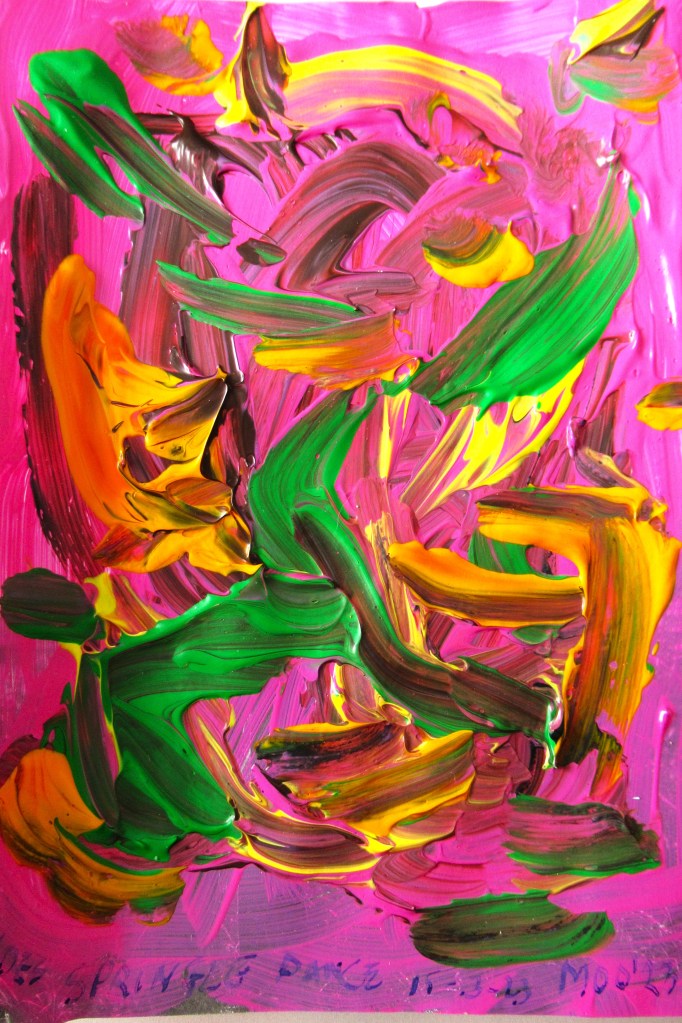
Hanwell

Hanwell

Here, in Hanwell Woods,
a seemingly abandoned chapel,
paint peeling, and two stark crosses
marked on barred doors.

The new copper spire gleams
as sunlight casts leaf shadows,
sending them dancing under trees.

Neither sight nor sound of bells
this sunny afternoon,
just the mosquitoes’ whine,
the black flies’ zip and buzz.

Across intervals of silence,
a far-off chain saw rips wood.
Trees and branches topple then fall.
Trails set free from winter’s debris.

The wind herds clouds instead of sheep.
Giant footprints drift shallow
across the shadowed land.

Patience

Patience


“Patience achieves everything.”
St. Theresa wrote this in Spanish,
back in the old days, when patience
was a virtue that few possessed.
Patience has vanished nowadays.

It is as dead as a doornail,
as dead as the proverbial dodo,
as dead as whatever cliché
springs to mind in the laziness
of the instant possession of each
passing cloud, each new slogan
marketed madly on the TV.

Turn off the TV. Go out, barefoot,
and walk on rain-wet grass
or walk on sea-wrinkled sand
out into the sun-warmed waves,
there where the sandpipers
stitch their secret messages
and the crows walk barefoot too.

Learn the secrets sown there,
decipher the ancient wisdom
left on the beach by wandering gulls.

There, in the tide-mark you will find,
among the sand-papered bones
and skulls, the secrets that will solve
the mysteries that you seek.

“If you try to force the soul, you never succeed.” John O’Donohue, Anam Cara, p. 147.

“La paziencia, todo lo alcanza.” St. Theresa of Avila.

A Place Eternal

A Place Eternal

When sunshine floods my body
it leads me down into a secret,
sacred space that I know exists
even though, all too often,
I am unable to locate it,
search as I may, but then,
when I no longer seek it,
it is with me, and I know
that I am no longer alone,
but wrapped in the comfort
of an angel’s protective wings.

That haunting presence lingers,
plays melodies within my mind,
invites me to return, keeps me warm
when chill winds blow.

I depart from that place,
a fingernail torn from the flesh.

“There is a place in the soul that neither space, nor time, nor flesh can touch. This is the eternal place within us.”

“You represent an unknown world that begs you to bring it to voice.”
John O’Donohue, Anam Cara, p. 105.

Painting: Sky Wound by Moo.

Sacred Moment

Sacred Moment


Evening falls, leads into night.
I search darkening skies
for the moon’s bright circle,
so meaningful, that light.

The moon, a thin wedding ring,
encircling a gilded cradle,
wherein five planets float.

Aligned, their circular lights
create such longing
in the observer’s heart.

The magic moment has come,
a moment forever sacred.
Whatever happens now
will be correct and right.

The Secret Fountain

The Secret Fountain

Go deep into yourself.
Search for the secret fountain,
the well with the sacred waters that renew,
replenish, and flow like sunlight.
Rest by its verdant banks. Here you can
find the self you thought you had lost.

Here, angels take wing and songbirds sing.
Telephone calls, e-mails, social media,
all such worldly things, lack meaning.

Rest awhile. The universe knows you.
Permit it to once again make friends
with who and what you are, what you were,
what you will always be, your eternal spirit
known, cossetted, comforted, and loved.

Your curriculum vitae no longer matters.
What matters is the heart of you,
that gold mine hidden deep within.
Here lies the mold of shining gold that will
enrich your soul, renew your life,
and gift you ever-lasting treasures.

Poems for the End of Time

Poems for the End of Time

Here it is, and it is up and waiting for you! I already have my first copy. More on the way. The same artist who did the cover for People of the Mist did this one as well. He’s such a nice person – doesn’t charge me a penny.

Introduction

         Poems for the End of Time is composed of two linked collections, Meditations on Messiaen and Lamentations for Holy Week. They both have separate introductions in the body of the text.

         My graduate work at the University of Toronto (MA, 1967, and PhD, 1975) included studies on Golden Age / Early Modern Spanish Poetry (16th -17th Centuries). It enabled me to read and enjoy both the Renaissance and the Baroque poetry of Spain. My own interests lay within nature poetry, as expressed by the Spanish Mystics (St. John of the Cross and St. Teresa of Avila), the Neo-Platonic Poets (in particular, Fray Luis de León), and the Metaphysical poets (Luis de Góngora and Francisco de Quevedo). Echoes of their writings and thoughts are frequent within these two poetic sequences.

         I will write further on both sequences later in the book. Briefly, both sets of poems were written while listening to the music of Olivier Messiaen. Three of his compositions, Quatuor pour la fin du temps / Quartet for the End of Time, Éclairs sur l’au-delà / Lightning over the Beyond, and Petites esquisses d’oiseaux / Little Sketches of Birds, influenced me enormously. I listened to them every day while I was writing and revising these poems.

         These poems are not for the simple-minded. They form a contrasting tapestry of point and counter-point, filled with allusions, word-plays, internal rhymes, repetitions, and alliterations. They have a music all of their own.

Do not expect simplistic escapism. If you are serious in your efforts to read, listen to the magic of Messiaen as you turn the pages, much as I did while I was writing.

Redemption

I had no paper with me in the car
so I wrote this poem on a bottle redemption slip.

Redemption

Redemption:
that’s what I seek
and some days it seeks me.
A double need this need to redeem
and be redeemed. A double need too
this god I need, the god who needs me.

Lonely he will be without me,
and I without him.
Knock and the door will open.
Seek and ye shall find.

I look and, yes, he’s there,
him within me and me within him.

This redemption slip is all I need:
empty bottles on the one hand,
my empty heart on the other,
both now redeemed.

All of this while I sit in the car
outside a fast-food chain
wondering if a bullet will come,
to break the car’s window pane,
or someone brutal who will rejoice
in his heaven-sent task of delivering
my personal order of take-out pain.

Black Paintings

Black Paintings
pinturas negras
Goya

Wrapped in his blanket of silence, the painter paints.
He pays no attention to the shrieks, screams, prayers,
curses, doesn’t even hear them. He sees their staring eyes
as the bull’s eyes at which anonymous soldiers, heads down,
backs to his easel, fire. He sees their mouths as black holes,
slashed across their faces. He sees the priest with his rosary,
but never hears the rattle of the beads or the firing squad’s guns
going off, filling the canvas with smoke, the square with blood.

Back home, in the Quinta del Sordo, his deaf man’s house,
he sits at the supper table, dwarfed by his painting of Saturn,
devouring one of his children. Beside him, old women,
hags themselves, suck soup silently from wooden spoons,
or fly soundless, black bats in the starless sky,
 on the back of goats or on their witches’ brooms.

The great, open wounds of his paintings speak to us
of his hushed suffering, of the calamitous world that spawned
such violence, plague, famine, and fear. Plundering armies,
guerrilla warfare in back street and alley, torture, pillage,
rape, and suffering, pits filled with the dead and dying,
famine walking the streets, and all of it inaudible,
the nightmares of a little child, seen, but never heard.
His paintings speak to us, and they allow us to reconstruct
in our imagination, the many things that the painter, deaf,
but never dumb, could never hear, yet reproduced
using his paintbrush and his taciturn palette as a tongue.

Click here for Roger’s reading.

“It is said that deafness is worse than blindness because you are isolated in an inner world of terrible silence.” John O’Donohue, Anam Cara, p. 71.
Swings

Swings

They told me that one day
my feet would be up in the air,
and the next they would be stuck
on the ground.

A roundabout, they said,
a merry-go-round,
with all the fun of whatever fair
happens to be around that day.

Someone, not me, flicks a switch,
music plays, the carousel horses
move up and down, slowly at first,
then faster and faster as day, music,
and horses all gather pace.

There are no reins. If there were,
I would heave those horses
back to whatever reality I left.

But what is reality now?
These hot flashes that warm my flesh?
Those cold flushes that make me shiver,
then turn up the heat
until I am sweating again?

Shadows grow. I pull less strongly
on the swing boat’s ropes.
My journey slows. The showman
raises the bar beneath the wooden hull.
 
Wish it or not, my journey grinds
to its inevitable end.

Click here for Roger’s reading.