Wednesday Workshop: New Projects

IMG_0026

Wednesday Workshops
New Projects
03 July 2019

New Projects … how do you choose them, these new projects? Simple answer: I really don’t know. So much depends on you and your work habits. In my own case I have a back log of projects. I have been writing and creating for years. As a result I have a whole set of files that I can turn to and select from. Two novels, about fifty short stories organized into two or three as yet unpublished manuscripts, a couple of hundred poems, organized into three separate thematically organized manuscripts, a set of writings on facilitating creative writing …

Projects … do the work and then choose the order in which you will publish it. I look at the hollyhock that suddenly appeared last year in my garden. Do the work: the birds (in all probability) seeded it. The hard work: the hollyhock grew itself. I should add that my beloved nearly tore it out on the grounds that she didn’t recognize it and it looked like a weed. But she left it, and it grew into what it was meant to be: a hollyhock. One stalk. So many buds. We didn’t know which would blossom first. And it didn’t matter. One after anther they all blossomed. The hollyhock knew what it was doing [we didn’t]. It had belief and faith [we didn’t]. But we had hope.

The Hollyhock Project: This year the hollyhock has eight [yes, eight] different shoots. It’s no longer a single flower, it’s become a bush! It has also shed seeds further afield [I should really write abed, since they’re all in the same flower bed.] I wonder in what order they will blossom. It doesn’t matter really: I am just confident they will bloom. And the sunflowers have rooted below the bird feeders. They have their own projects and I know they will grow as and how they will. And the yucca has four shoots that will flower, how and why I just don’t know. But each flower has its project(s) and I am confident they will all flower and flourish.

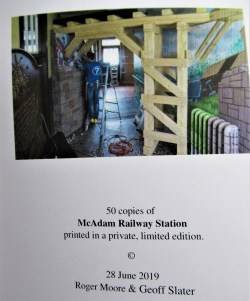
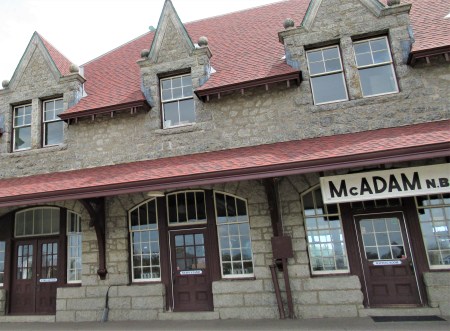
My own projects: When June came in, I didn’t know what to do, nor did I know in what order to do it. Then Time-spirits came together. Geoff gave me some drawings and I chose one for the cover. I took the manuscript to the printers, got an estimate, and received a mock-up. The text had shifted in the transfer from computer to computer. My 70 page text had grown to 132 pages. I spent the next 72 hours rewriting everything, eliminating words, lines, poems, dropping the text back down to 70 pages. It is now published. I wondered what to do with the McAdam Railway Station poems. Geoff came to see me on Sunday, 23 June, and told me that he would be celebrating his birthday the following Friday. He also told me that the McAdam Railway Station would be unveiling his mural the following Sunday (June 30). The McAdam railway poems were published on Saturday, 29 June, and I took them to McAdam in time for the ceremony.

Trust: Trust yourself, trust your projects, trust the universal spirit [Northrup Frye’s Spiritus Mundi], under whichever name you acknowledge it). And remember, genius is 99% perspiration and 1% inspiration. Put in the mileage, put in he hard work, believe, and trust. ¡Qué será, será! Whatever will be, will be.

IMG_0206


The Joy of A New Book

IMG_0915 (2).JPG

The Joy of a New Book

Very little to beat it actually, the joy of receiving and opening a new book, especially when it is one you have written yourself, in cooperation with a group of friends. In this book are the twenty-four (24) poems that I wrote for McAdam Railway Station.

IMG_0921 (2).JPG

I went to McAdam to watch Geoff working on his mural and installation (diorama). While there, I heard stories about the railway and started to write them down in stanza form. While I did write them, most of them were based on stories and anecdotes heard or overheard while the guides were guiding the tourists round the site. This is indeed a limited edition. We originally intended to print only 50 copies, but when we heard that there might be up to 300 people at the unveiling of Geoff’s mural, in McAdam, at 1:00 pm, Sunday, 30 June, 2019, we doubled the number of books we printed. I will be donating the majority of the 100 to McAdam Railway Station Historical Association. They can either give them away or sell them to help fund and support the impressive restoration work they are doing.

IMG_0923 (2).JPG

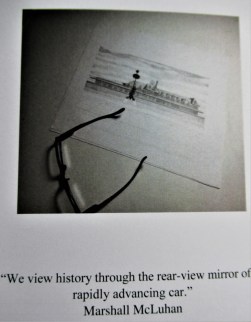
“We view history through the rear-view mirror of a rapidly advancing car” … and writing these poems was a veritable journey back into the past. Geoff left his glasses by his half-finished drawing, and that’s when the idea of linking McLuhan to Moore to McAdam occurred. Several of the poems focus on my own experiences of railway stations. Travel by train was a frequent choice in my childhood and  I went almost everywhere by train. A local in-town train ran from the station at the end of our road and I often took it when visiting friends, shopping in town, or following the local soccer team, Cardiff City, aka the Bluebirds. As a result, much of the imagery within the poems involves my own knowledge and love of trains, while the narrative structures themselves are often based on those overheard words.

IMG_0919 (3).JPG


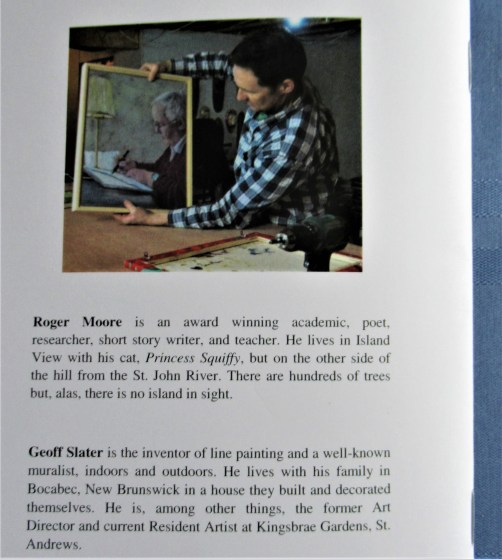
We wanted a photo of Geoff and me on the back cover and I discovered this one in my files. The portrait was done by Ruby Allan, my fellow artist in KIRA (June, 2107). She painted Roger Writing in the Red Room from a photo taken by another KIRA resident artist, Carlos Carty, the Peruvian pipe, as I was working at the desk in my room. Geoff framed the portrait and Mrs. Lucinda Flemer gracefully allowed it to be hung over the desk in the Red Room at KIRA, an honor for which I am exceedingly grateful. What a nice way to put our pictures on the cover of our book! If you are down McAdam way this Sunday, 30 June, drop in and see us. We’ll be there. Books and all.


Gower

Empress 070.jpg

Gower

To be Welsh in Gower is to spell it funny
and pronounce it worse: Gwyr.
It’s to know how to say Pwll Ddu.
It’s meeting the cows in the lane to Brandy Cove
and knowing them all by name and reputation,
which one kicks, which one gores,
when to walk in the middle of the lane,
and when to jump for the safety of the hedge.

It’s to know the difference between the twin farmers
Upper and Lower Jones.
It’s to recognize their sheepdogs, Floss and Jess,
and to call them with their different whistles.
It’s knowing the time of day by sun and shadow;
it’s knowing the tide is in or out
by the salt smell in the air
without ever needing to see the sea;

and now, in this far away land called Canada,
it’s hearing your stomach growl for crempog or teisen lap
whilst memory’s fish‑hook tugs at your heart
in the same way your father hauled in salmon bass
at Rhossili, Brandy Cove, Pennard, Oxwich, and Three Cliffs.

Commentary: I was checking Gwyr, the Welsh for Gower, where I was born, and found this interpretation of the name. <<G is for generous, your giving nature. W is for wise, more tomorrow than today. Y is for young, the years never show. R is for rapport, friends seek you.>> I don’t know if that’s me, but it certainly wouldn’t be a bad set of descriptors to live up to.


International Day

14633208_10207317214799871_1242532105939959170_o

International Day
St. Mary’s Street

To be Welsh in Cardiff on International Day
is to be decked entirely in red from deep
between your ribs where the Red Dragon
throbs pumping its blood through the Arms
Park along with your heart and bright blood
surges as you wear your scarlet jersey like
a flag as you step onto the grass ready to play.

You shed your grey hairs like a sheep
sheds its coat on the Wenallt or Caerphilly
Mountain or the Brecon Beacons and Boyo,
you know you’re unbeatable. So come
the four corners of the world to Cardiff
with a rugby ball and they shall be defeated,
ground into the Arms Park mud, humiliated.

Flower-power


IMG_0902 (2).JPG

Flower-power
or
Why should the young kids have all the fun?

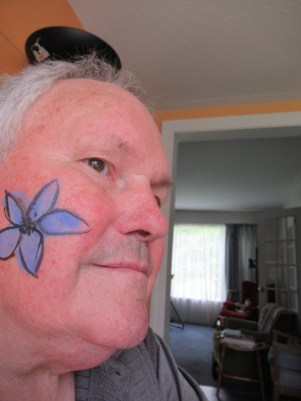
So it’s children’s day at the local supermarket. As I push my shopping cart through the door, I see the face-painter with a young girl sitting before her, getting her face painted. Behind the willing victim, several young children wait, shuffling their feet in expectation. I go out to the car park, unload my cart, and push it back to the supermarket.
As I park my cart, I see that the line-up has disappeared and the face-painter sits alone, cleaning her brushes. I walk up to her table and ask “How much?”
“It’s free,” she tells me. “It’s children’s day.”
“Will you paint my face?” I ask her.
“You’re not a child,” she looks at me in astonishment.
“No, I’m not,” I reply, “but I’m in my second childhood.”
I pull out the chair and sit down.
“I’ve got some photos on my phone, or I can try and paint whatever you would like. Would you like to see some pictures?”
“No, thanks. Just  look at me and paint what you think I would like.”
“What are your favorite colors?” she looks at me and smiles.
“I don’t have any favorite colors, but I always avoid green, yellow, and gold.”
“Oh, well, how about a nice flower?”
“Great!” I say.
One of the trolley boys who return the shopping carts in great convoys walked by.
“You need a mirror,” he says, “so people can see themselves.”
“Great idea, stay here, I’ll go and get one.”
“Don’t worry. I’ve got a mirror in the car. I’ll have a look when I get there. Meanwhile, it’s a surprise. I’ll put a photo up on my blog when I get home.”
“Promise?”
“I promise.”

IMG_0903.JPG

I gave her my blog address and I kept my promise. Unlike many people I know, I usually do.

IMG_0903 (2).JPG

Commentary: with many thanks to Emily, the face-painter, who treated my second-childhood with humor and dignity. As I said to her at the time, ‘why should the young kids have all the fun?”


Time-Spirits

IMG_0868.JPG

Time-Spirits

Zeitgeist

Zeitgeist is a concept from 18th- to 19th-century German philosophy, translated as “spirit of the age” or “spirit of the times”. It refers to an invisible agent or force dominating the characteristics of a given epoch.
Wikipedia

Those who cannot learn from history are doomed to repeat it.

“Plus ça change, plus c’est la même chose.”

Poems for troubled times.

Introduction

Our world finds itself in an incredible mess right now. Somehow, we have to sort it out. Images and metaphors tie past, present, and future together. We must pick our ways through the difficulties of these troubled times, as you must pick your way through the intricacies of these poems. Many of you will give up. Some of you, the chosen few, will make your way to the heart of each poem.

These poems are deliberately cryptic. Each one is a mind game I am playing with you. I do not underestimate you. I have placed clues throughout each poem and if you follow the clues you will arrive at many of the poem’s hidden meanings. Some poems are more difficult than others, their meaning more recondite. Others seem very straightforward, yet still contain secrets.

            This style of poetry has a long history going back to Anglo-Saxon riddles and way beyond, back into the mists of time. Luis de Góngora (1561-1627) and Francisco de Quevedo (1580-1645) specialized in similar forms of recondite poetry, often based on metaphor and the juego alusivo-elusivo, the game of alluding to something while eluding the act of saying what it is. Jorge Guillén (1893-1984) and Federico García Lorca (1898-1936) also played this game, as did Octavio Paz (1914-1998). In the works of all of these poets, the clues may rest in the poem or they may be found in a generic knowledge of the mythology of the poem’s exterior world.

             Always remember that “those who cannot learn from history are doomed to repeat it” (George Santayana). Otherwise expressed, in the words of T. S. Eliot: “Time present and time past / are both perhaps present in time future / and time future contained in time past” (Burnt Norton). The seeming anachronisms in these poems suggest that all time is ever-present and that each new day presents us with events that have already occurred on many occasions.

Commentary: The idea for Time-Spirits aka Zeitgeist was born around the kitchen table in Island View on Saturday, 22 December 2018, during a literary conversation between Gwen, Victor, and Roger. A poem at a time, one after another, grew from that table top chat. The result: 70 poems, not easy to read, deliberately difficult, that reflect our troubled times. My thanks to Geoff Slater, line-painter, who drew the cover picture: Robin Red in Claw and Breast, a symbol of nature ‘red in tooth and claw’. So are we in the words of Albert Camus who writes ‘nous sommes ou les meurtriers ou les victimes’ . Is it the early bird that catches the worm? Or is it the late worm that gets caught by the bird? Whichever: it’s the worm that gets eaten, until the robin bites the dust, when he is eaten in his turn. Just think of it as nature doing its regular recycling …


IMG_0865 (2).JPG


Duende

img_0826-3.jpg

Duende
Federico García Lorca

It starts in the soles of your feet, moves up
to your stomach, sends butterflies stamping
through your guts. Heart trapped by chattering teeth,
you stand there, silent, wondering … can you? …
will you? … what if you can’t? … then a voice breaks
the silence, but it’s no longer your voice.

The Duende holds you in its grip as you
hold the room, eyes wide, mouths open, possessed,
taken over like you by earth’s dark power,
volcanic within you, spewing forth its
lava of live words. The room is alive
with soul magic, with this dark, glorious
spark that devours the audience, heart
by heart. The magic ends. The maelstrom calms.

Abandoned, you stand empty, a hollow
shell. The Duende has left you. God is dead,
deepening your soul’s black night. Exhausted,
you sink through deepest depths searching for that
one last drop at the wine bottle’s bottom
that will save your soul and permit you peace.

IMG_0810 (2).JPG

Faces

IMG_0258.JPG

Faces
McAdam Railway Station #10

“White at windows
when trains pass through
in June on their way
to summer and sand.

Wind-tousled, tanned
at summer’s end
returning home to
Boston and Montreal.

I remember them
waving their hands,
flickering white hankies
as they went by.

This station is a ghost train
that travels through time
instead of space. Stand
still as silent stone. Wait.

Look: there’s someone,
waving at us now
from that window
on the second floor.”


IMG_0782 (2).JPG


S.O.S

IMG_0678 (2).JPG


S. O .S.
McAdam Railway Station #8

“Dozing in the cab, I was.
Smelt a different smoke.
It wasn’t my engine’s.

Looked around.
Saw flames. One, two,
three houses on fire.

Steam was up. Yessir.
Three short hoots I gave.
Three long. Three short.

S.O.S. Mayday. Mayday.
S.O.S. S.O.S. Kept going
till house lights came on.

People running. Leaving homes.
Jumped out of the cab.
Ran out to help them.

They thanked me.
Said I had saved their lives.
What else could I have done?”

Comment: This is a third hand poem. It came to me from Geoff who heard the story from the hardware store owner who witnessed the fire. The narrator is the anonymous engine driver who raised the alarm. Of course I don’t know exactly what he did, said, or thought. Our knowledge of history can be divided into two great moments: the momentous events, recorded by expert historians via diligent research, and intra-historia, as Miguel de Unamuno, that great Spanish philosopher and rector of Salamanca University called it, referring to those small, individual moments when history is made by anonymous human beings who did what they had to do and then faded into the anonymity of a distant past, now wrapped in silence, as is the store-keeper and the driver of the train.

IMG_0678 (2).JPG

Volunteers


IMG_0765 (2).JPG

Volunteers
McAdam Railway Station 6

Only the old in body
and young at heart know
how to cook like this.

The soda fountain stools,
the horseshoe bar
from the old Royal York,

they merit only the best.
Simplicity rules. Stews
like grandma made them,

lining the ribs,
defying damp and cold.
Railway Pie, recipes

a hundred years old, or more.
bread rolls that melt
into the butter knife,

coffee to kill for. No wonder
the old ghosts walk around
feeding off cooking smells,

sad, gentle eyes, watching us
as we eat, refusing to leave.

Comment: That’s the end of the Railway Pie, I’m afraid. The soup has already vanished. Three lucky people, arriving on cooking day, and receiving a free lunch. What joy, what delight. The volunteers were cooking for another event, outside the station, which was not yet open. Old ghosts watched from quiet corners as we ate. I am sure those spirits survive on the wonderful cooking smells that emerge. I should add how impressed I am at the knowledge displayed by the volunteers at McAdam Railway Station. They now only have their facts at their fingertips, but hey are able to express those facts in a way that draws the audience in and makes every visit a genuine pleasure. Volunteers: thank you for being there. You do a great job.

IMG_0765 (2).JPG