Sound of Silence

Sound of Silence
Cara Anam, p. xv

Where do the deer go
when they leave their tracks
behind them and pass out of our sight?

We lose them when, like school children,
they scale the snow bank,
stop at the roadside, and look left,
right, and left again, then walk sedately,
one by one, across the road, and blend
into the dark woods opposite our house.

Too many friends have walked a similar way,
crossed the great divide, and lost themselves
in the unknown that lies there, out of sight.

All too soon, we will be faced by that same
decision, whether or not to cross.
Our paths already tell us where we’ll go,
but the hands of our body clocks don’t yet
point to how, or when.

Click here to listen to Roger’s reading.

Heart and Hearth

Heart and Hearth

I remember the old coal fires in Swansea.
My grandmother’s house in the Hafod,
with a hearth separate from the kitchen.
The hearth held a huge cast iron fire-place
where cookpots and kettles hung
 or nestled into smouldering coals.

My grandfather’s house in Brynmill,
had a magic fireplace. Banked in before bed,
it gave warmth and light all through the night.
Warmth, comfort, the family gathered,
the wisdom of the old shared with the young,
traditional tales and songs passed down.

Everybody was welcome and each one
had a special spot reserved around the fire.

Comment:

I have been revising this poem, shortening it, and changing it very gently. Funny how the old days come back and dance before us, like the flames dance on the coals, as the old ghosts walk now upon the logs.

Click here for Roger’s reading.

True Names

True Names
Iron John, p. 236

No one will know our true names
until after we have left this place.

Like that elusive moon in tonight’s sky,
our paths will be visible, seen, but not heard.

Orion herds the stars, steering them westwards,
away from the sunrise, to moon’s golden circlet.

So much has been lost, so many of us have gone,
leaving us to mourn unspoken thoughts, silent words.

In spring, sometimes, we can hear voices whispering
to us among burgeoning blossoms and leaves.

Who will bear witness to lovers’ wishes and desires
when the great separation springs upon them?

Who will sing songs, give speech to the little children
taken before their time and lost in the silent night?

Click here for Roger’s reading.

Light Breaks

Bandits

Two shadows,
at three in the morning,
their faces masked,
shifty in the moonlight,
slip soundless over snow,
as they move towards
the bird feeders.

They huddle together,
forming a darker patch.
I watch the feeders move,
but cannot see the seed
nor hear it as it falls.

The feeders empty,
they move again
towards the back porch,
climb the steps,
and settle once more.

I know that by morning,
all traces of seed will be gone,
devoured by Dyson and Hoover,
scavengers and professional
seed removers.

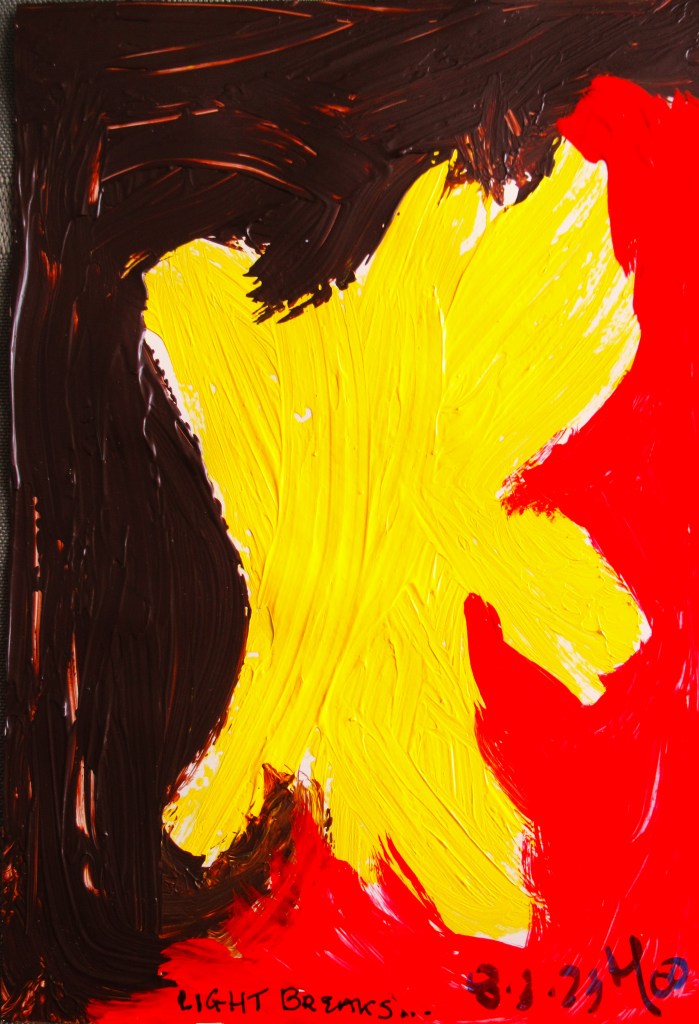
Comment: Light Breaks

“Light breaks where no sun shines…” but sometimes it takes a long time to happen. The name of my blog is rogermoorepoet and it’s main function is to showcase my poetry, above all, to my friends and followers. In my efforts to publish in print form, I have neglected to pay attention to the main function of this blog – poetry. Why? Because when I submit poems I always find the phrase – ‘must be unpublished – including on social media’! So I stopped publishing poetry on my poetry blog and on other social media. Okay, okay. I know. I am an idiot. BUT – light has now broken where no sun shone – Dylan Thomas, of course, another Swansea Boy, and as of today poetry is back. A big thank you to any and all who have been waiting for its return. Give me some encouragement – let me know if you like what I am doing – paintings and poetry!

Click here for Roger’s reading.

Deer, oh dear!

Deer, oh dear!


Deer

sitting here watching the deer
wandering through the garden
five six seven ten
never seen so many
twelve fifteen
a caravan
a convoy
one behind the other
walking in their footsteps
following on
so silent
then
ears pricked
turning watching listening
existential
here long before us
forever following old trails
knowing each change
each new direction
a connection
between us
and how it had been
for thousands of years
before we came here
to disturb them

Click to hear Roger’s reading on Anchor.

Hearth and Soul

Hearth and Soul

The kitchen – hearth and soul of the house. Here we gather, sit around the table and talk our hearts out. But here, in Island View, we have a kitchen, a gathering, but no hearth, and hence no real heart around which the household revolves.

In spite of that, old habits die hard. I remember the old coal fires in Swansea. My grandmother’s house in the Hafod, with a kitchen in a separate room from the stove, with a huge cast iron fire-place where cookpots and kettles could be hung or nestled into the coals. My grandfather’s house in Brynmill, where kitchen and hearth were separated, but the fire-place still held its magic. Banked in at night, those fires gave warmth and light ar hyd a nos and then they we resurrected the next morning.

We have a woodstove here in Island View, but we rarely light it as the fine particles make breathing difficult after a while. We keep it for emergencies. This winter we lit it when the temperatures dropped to -40C, with the wind chill factor, and heat pump and electric furnace needed assistance.

Warmth, comfort, the family gathered, the wisdom of the old folks shared with the young, and the passing on of traditional melodies. All the old memories and thoughts, the wishes and desires, the hiraeth too, handed down, from old to young. Everybody was welcome and everyone had his or her special place.

Such memories tug at the heart strings – hearth strings. Anyone who shares them with me will know what I mean.

Swansea

Swansea

To be Welsh in Swansea is to know each stop on the Mumbles Railway: the Slip, Singleton, Blackpill, the Mayals, West Cross, Oystermouth, the Mumbles Pier. It’s to remember that the single lines turn double by Green’s ice-cream stall, down by the Recreation Ground, where the trams fall silent, like dinosaurs, and wait, without grunting, for one to pass the other. It’s to read the family names on the War Memorial on the Prom. It’s to visit Frank Brangwyn in the Patti Pavilion and the Brangwyn Hall. It’s to talk to the old men playing bowls in Victoria Park. It’s to know that starfish stretch like a mysterious constellation, at low tide, when the fishnets  glow with gold and silver, and the banana boats bob in the bay, waiting to enter harbour, and the young boys dive from the concrete pipes without worrying about pollution.  But when the tide turns, the Mumbles Railway has been sold to a Texan, the brown and yellow busses no longer run to Pyle Corner, Bishopston, Pennard, Rhossili, sweet names of sand and tide, where my father’s ghost still fishes for salmon bass, casting its lines at the waves as they walk wet footprints up the beach to break down the sand-castle walls I built to last forever at Brandy Cove and by the Slip on Swansea sands.

Click here to listen to Roger’s reading on Anchor.

Writing in the Red Room

Writing in the Red Room

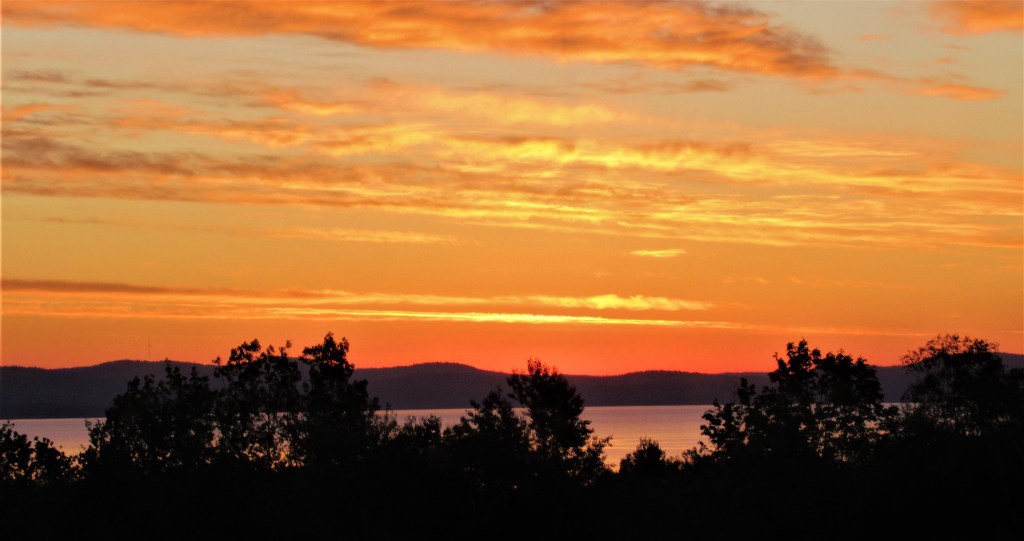
Dawn over Kingsbrae, as seen from the writer’s desk in the Red Room in KIRA. “A poet could not but be gay, in such a jocund company.” Wordsworth, thankfully, for how words change their value as language transforms itself and old values and meanings grow wings and flit away.

Gai saber – from Old Provençal: “gay knowledge” or “gay science”, the art of composing love poetry, especially the art of Provençal troubadours as set forth in a 14th-century work called the Leys d’amors. But one doesn’t have to be gay, in any sense of the word, old or new, to write poetry, and it is difficult not to write poetry when the sun creeps over those hills and lights up the room and the bay below.

Warmth and light flood into your heart. The pen fills with words and they splash out over the page, moving the writer as the sun moves, as light moves, as light breaks where no sun shines as yet, but will, soon, so very soon, and here it comes, filling the heart once more with wonderment, the bay with light, and the page overflowing with the joy of light.

To be here is to be honored and privileged beyond words. To be able to share that joy with others is a blessing that many seek and few find, and none possess, for, like fairy gifts, such powers fade away all too swiftly. And, when all is said and done, one can only be humble, rejoice in each moment, and give thanks.

My Teenage Self

My Teenage Self

What advice would you give to your teenage self? In one word – grow up. Useless advice really, because it happens, whether we want it to or not. That said, I have lost so many young rugby players that I coached or played with, to driving accidents and other misfortunes, sometimes self-inflicted via alcohol or drugs, that to say grow up – please! – is so important.

Each morning I read the obituaries in the local newspaper. Afterwards, I look back over the path I have journeyed. If I had perished at the age of the current ‘missing person’ – say, 45 – 50 – 55 – 60 – I think of all that I would have missed in those intervening years. Then I grieve for all that they will have missed in the life that should have lain ahead of them.

“Don’t cry over spilt milk” – Old Welsh Proverb. And no, we mustn’t cry over what is lost. We must celebrate what has been achieved, Dylan Thomas (1914-1953), one of Wales’s greatest Anglo-Welsh poets, dead at 39 – what other glory may have lain ahead of him? Garcilaso de la Vega (1501-1536), one of Spain’s purest and most innovative poets, dead at 35. What more might he have written in an extended lifetime? Federico Garcia Lorca (1898-1936), executed, many say tortured and murdered, at the age of 38. Think of the theatre, the poetry, the Gypsy Ballads, the songs of a dark love – what more did he have, hidden inside him, that was never allowed to spread its wings and fly out into the light of day?

So, I would give to my teenage self, the same advice that I would give to any teenager – grow up – please, grow up, don’t go too soon, – and please grow into that unique and wonderful being that you have the potential to be.