The Red Room

I looked for a picture of music, but could find nothing. No Carlos, no flute, no nothing. So, I invite you to use your imagination: just pretend these are the notes of an Andean flute, floating in the early morning air. Now close your eyes and listen carefully. Can you hear the music?

The Red Room

Carlos makes music on his flute.
He lives in the Green Room,
with its door just opposite mine

He creates the highest note of all
and it floats before me in the air,
a trapeze artist caught in a sunbeam
and suspended between the hands
that fling and those that catch.

His musical rhythms are different.
I try to follow his fingering.

In the space between notes,
tropical birds flash jungle colors
as they flit between flowers.

With a whirring of wings,
all music stops,
save for the robin’s trill
refreshing the early summer
with his eternal song.

Comment:

I finally found a photo of Carlos.
Here he is, in Kingsbrae Gardens,
playing Beethoven’s Ode to Joy
on ‘half-filled’ water bottles
tuned to play a perfect scale.
Like an Andean bird, the man
could pluck notes from the air
and fill the world with music.

Why?

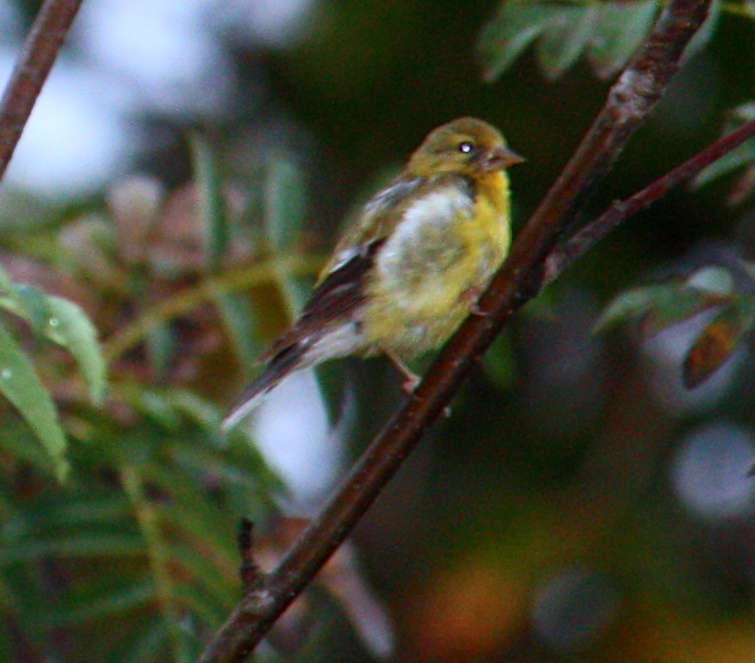
Different bird, same question: why? This one is from one of the beaches on the road to North Cape, PEI. Why, indeed?

Why?

In the mud nest jammed tight against the garage roof,
tiny yellow beaks flap ceaselessly open.

The parents sit on a vantage point of electric cable,
mouths moving in silent encouragement.

A sudden rush, a clamour of wing and claw,
a small body thudding down a ladder of air
to crash beak first on the concrete.
  “Why?”

 “Wye is a river.
      It flows through Ross-on-Wye
      and marks the boundary
      between England and Wales.”

And the swallows perch on the rafters
watching their fledgling
as it struggles on the floor:
the weakening wings,
the last slow kicks of the twitching legs.
“Why?”

“Y is a crooked letter
     invented by the Green Man of Wye.”

Comment: This is the original poem, written back in the eighties, wow, that’s forty years ago. I included it in my first poetry chapbook, Idlewood (published, 1991). It was a slim volume, dark green color, typed and photocopied, very humble, but MINE! A couple of years ago I wrote a prose poem, sort of flash fiction, in one of my Welsh sequences and included the story as part of the text. It came to me as a memory yesterday morning, and I posted it on Facebook. Here now is the story. Hopefully, you have just read the poem: I hope you liked it but, as I know all too well, de gustibus non est disputandum. I would like to know if you prefer the poetry to the prose. Please let me know, pretty please?

Why?

“Where are you going?” I ask. “To see a man about a dog,” my father replies. “Why?” I ask. “Hair of the dog,” his voice ghosts through the rapidly closing crack as the front door shuts behind him. “Why?” I cry out. I recall the mud nest jammed tight against our garage roof. Tiny yellow beaks flap ceaselessly open. Parent birds sit on a vantage point of electric cable, their beaks moving in silent encouragement. A sudden rush, a clamour of wing and claw, a small body thudding down a ladder of air to crash beak first on the concrete. “Why?” I ask. The age-old answer comes back to me. “Wye is a river. It flows through Ross-on-Wye and marks the boundary between England and Wales.” The swallows perch on the rafters watching their fledgling as it struggles on the floor, the weakening wing flaps, the last slow kicks of the twitching legs. “Y is a crooked letter invented by the Green Man of Wye,” my grandfather says. “Why?” I repeat. “I want to know why.” Silence hangs a question mark over the unsatisfied spaces of my questioning mind.

Fall

Mactaquac and geese at the head pond

Fall

Red leaves multiply on maple trees.
Bright berries staining a mountain ash.

One flower survives on the hollyhock,
its blaze of glorious blooms lost, faded
in a silence of dried seeds, absent bees.

Hummingbirds are now long gone. Geese
gather in great gaggles feasting on grass
before taking flight and soaring south.

I want to ask questions about their journey
but they mouth denial and waddle away
to paddle on grey waves when I approach.

Comment: With a temperature yesterday of 21 C (that’s plus 21 C) rafts of geese are still around. These photos are from earlier in the fall. I love the way several stand erect, looking at and for possible intruders, while others feed. Shared responsibilities. I guess we humans could learn a great deal from the geese, if only ‘we were not full of care / and had some time to stop, and stare’ (W. H. Davies, one of my favorite Welsh poets, the verses changed slightly and adapted to Mactaquac). Roedd hi’n y tywydd heulog a cynnes yfory / the weather was sunny and warm yesterday. What a joy to be able to write that in Welsh after so many years without the language.

Merry Sunshine

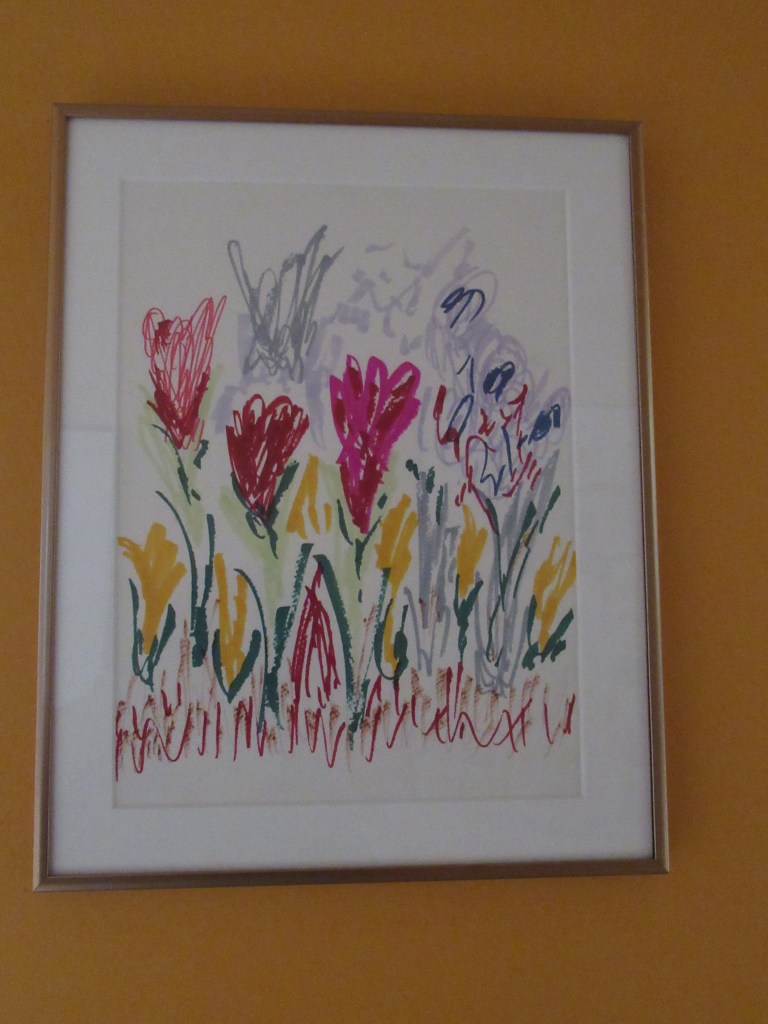
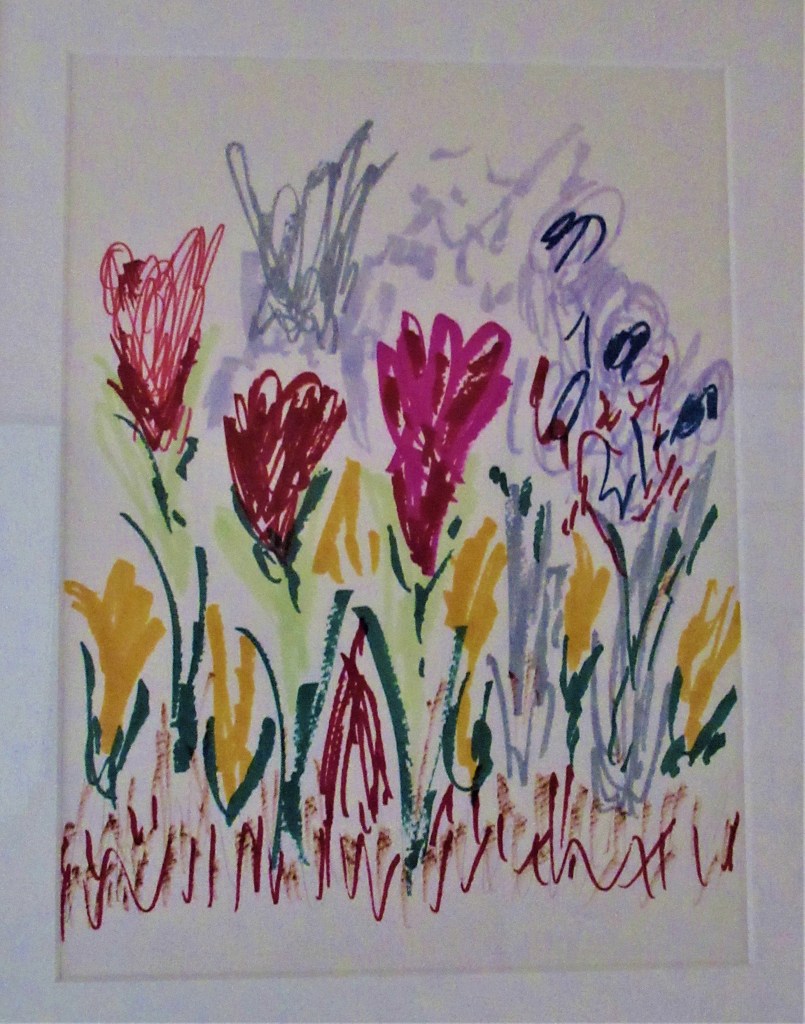
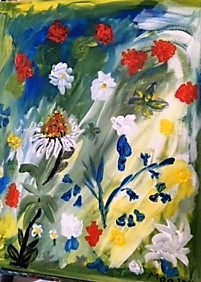
“The flowers that bloom in the spring, tra-la, bring promise of merry sunshine …” Gilbert and Sullivan, from The Mikado, if I remember correctly, and not at all anonymous like the Anonymous Bosch artist who painted this painting. Still, I like it, and it certainly lends a little bit of color to the pale cheeks of these walls.

“And we merrily dance and we sing, tr-la, as we welcome the promise they bring, tra-la, of a summer with roses and wine …” I can remember my grandfather singing that in the kitchen in Swansea. He would conduct with one hand, and encourage me to join in with the other. And I did. Merry days, they were, before the fire in winter and out in the greenhouse in early spring.

So, where have all the flowers gone? Gone with the grosbeaks, everyone. Which reminds me, I saw an Evening Grosbeak at the feeder this morning. The first one in years. There used to be several nesting nearby and they were regular visitors, as were the Gray Jays, aka Whisky Jacks, aka Gorbies, aka Ghosts of the Woods and all of them long, long gone.

Will they naw come back again? Who knows? The world is changing even as I sit at my window and watch it go by. February, March, April, May, June, and now July. The lock down has been lifted, but the fear of going unmasked in the great outdoors is still with us, as are the anonymous givers of the virus, a donation I do not want, and nor does anyone else, in their right minds, compus mentis, and not yet willing to on the anonymous ranks of the Gorbies, the Grosbeaks, the Swallows, and the other birds that have fled elsewhere, leaving our yard to the crows, the blue jays, the squirrels, the chipmunks, and the occasional more colorful visitors.

Spring Flowers
by
Anonymous Bosch

Kite

Kite Flying

So light, the kite,
a butterfly in flight.

Breeze battered,
sky-blue shattered.

Children stare
seeing the wing-shape
fluttering there
rising on flimsy air.

Diving, dipping,
nylon cord slipping,
finger-flesh ripping.

Here come others,
children and mothers.

Butterflies, bright,
ready for flight,
fighting wind-might:
a child’s delight.

I didn’t have photos of a kite.
I offer some humming birds instead.
Listen closely:
you can hear them hum.

Hot Water Duck

Canada Geese at Mactaquac

Hot Water Duck

The worst punishment of all was to be sent to bed early.  You climbed upstairs by candlelight, if you were lucky, or groped your way upwards in the dark, if you had been really bad. You entered the cold, dark, damp of the bedroom and punishment was not to have supper, and not to have a warm hot water bottle or a warm baked brick to keep you warm in bed. I loved that hot brick, baked in the oven or by the fireside, then wrapped up in a towel. Bricks and bottles: they banished damp from the bed and kept you warm for a while, or burned if the wrapping fell off. The hot water bottles: they were made of tin not rubber, and once, I remember a cast iron duck, that my grandmother baked in the oven, then wrapped in swaddling clothes, like a little baby. But if the grown-ups said you had been naughty, or nasty, or cheeky, or just plain wicked, then you were given nothing to keep you warm, and you lay in bed and shivered until you cried yourself to sleep.

Canada Geese and Fall Foliage at Mactaquac

Empty Nest

fundy 05 mist+wolfepipers 153

Emptiness
is an
Empty Nest

The wind at the window
scratches tiny notes.
I can no longer hear the tune
nor read the words.

Who walks beside me
as I pace my lonely path,
abandoned
in this empty house.

My self-portrait
stares back at me:
a splintered selfie,
framed in a sliver
of silvery glass.

Above me,
the monkey-faced moon,
that itinerant tinker,
walks a fractured way
over broken glass.

The knapsack on his back
is cobbled together
from a finery of cobwebs
and clumsy clouds.

IMG_0039

Her Shadow

IMG_0063

Her Shadow

“Birds, birds,” she shrieked with delight.
“The drab one is a girl like you,” I told her,
“but the bright one is a little boy.”

“Yellow,” she cried again with joy, “Yellow.”
Tiny hands plucked at air, catching nothing.

I can still see her standing there, her nose,
all wet and runny.  She left damp, snot-stained
marks, a sort of signature, on the cold wet glass.

She’s long gone now, way back home, but still
the window stays unwashed and her shadow
often comes between me and the morning sun.

Triumphs

Avila 2007a 105 (2)

Triumphs
Luis de Góngora

Waking to birdsong in the morning,
making it safely to the bathroom
without tripping on the rug in the hall,
shaving without cutting my face,

getting in and out of the shower
with neither a slip nor a fall,
drying those parts of the body
that are now so difficult to reach,

especially between my far-off toes,
pulling my shirt over wet and sticky
patches still damp from the shower,
negotiating each leg of my pants,

tugging the strings of the plastic sleeve
that helps my socks to glide onto my feet,
forcing swollen toes into under-size shoes,
hobbling to the top of the stairs,

lurching down them, cautiously,
one step at a time, on guard for the cat,
the edge of the steps, the worn patches
where my stick might catch or slip …
one more step, triumph, I’ve made it.

Comment: “Cada pie mal puesto es una caída, cada caída es un precipicio / Each ill- place footstep means a fall, every fall is a precipice.” Luis de Góngora (1561-1627). I have reached the age of fragility and futility: every day that passes without an accident or a fall is a triumph. I re-read Luis de Góngora with increasing pleasure, the Polifemo (1613), above all, but also the later poems about the difficulties of ageing. When I read them I realize that I am not alone, that others have aged before me, and then I think of Jorge Manrique dead at the age of 39. And what poems he wrote, as did Góngora with a whole poetry movement named after him.

As for the photo: young storks in Avila, Spain, ready to fly. The one at the top is bouncing up and down, waiting for the breeze to get under his wings and lift him to sun and stars. High in the sky above him, almost unseen, his parents wait, ready to swoop down and assist him when he gets lift off. Uncertain he may be in those first few triumphant wing strokes, but down they come, place their wings below his wings and show him how it’s done. For him, it is the world that awaits him.

For me, and people my age, the world shrinks, walls close in, the daily process of living becomes more difficult. My joy: not in the lift off, but in the painstaking processes, getting up, getting washed and shaved, getting dressed, going downstairs, the early morning taste of fresh-brewed coffee, each sip a pleasure … and out in the garden, spring robins calling, a phoebe whistling, rose-breasted nuthatches, American Goldfinches, and the wondrous joy of just being here, sitting in the sunshine, lapping up the warmth, and every moment of every day a triumph renewed.

IMG_1060 (2)

Still Life with Hollyhock

IMG_0206

Still Life with Hollyhock
Geoff Slater

How do you frame this beaver pond,
those paths, those woods? How do you
know what to leave, what to choose?
Where does light begin and darkness end?

Up and down: two dimensions. Easy.
But where does depth come from?
Or the tactility, the energy, water’s
flow, that rush of breathless movement
that transcends the painting’s stillness?

So many questions, so few answers.
The hollyhock that blooms in my kitchen
is not a real hollyhock. It is the painting
of a photo of a genuine flower that once
upon a time flourished in my garden.

A still life, then, a nature morte, a dead
nature, portrayed in paint and hung alive,
on display in this coffin’s wooden frame.

Comment: I love the way language changes the way we look at life.  A still life painting becomes nature morte in French and naturaleza muerta in Spanish. Still life becomes dead nature. Fascinating. I also love the way in which the camera captures nature and the natural world. We think it is an accurate depiction, but really it isn’t necessarily that accurate. Filters, light and shadow, mood: they all fluctuate and sometimes we capture that which we never saw and sometimes that which we saw is never captured. Oh the subtle enigmas of creative art.

IMG_1005 (3)

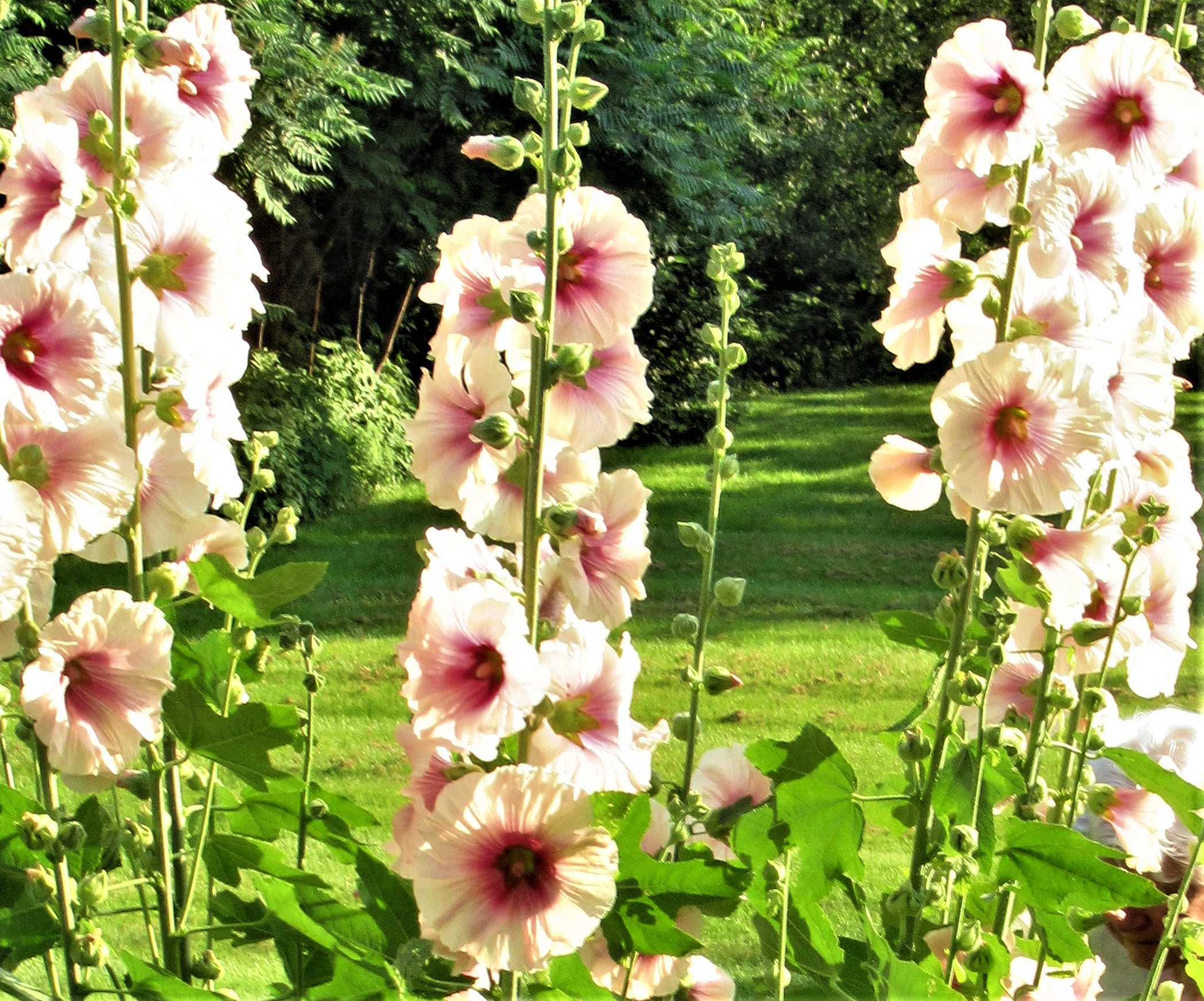
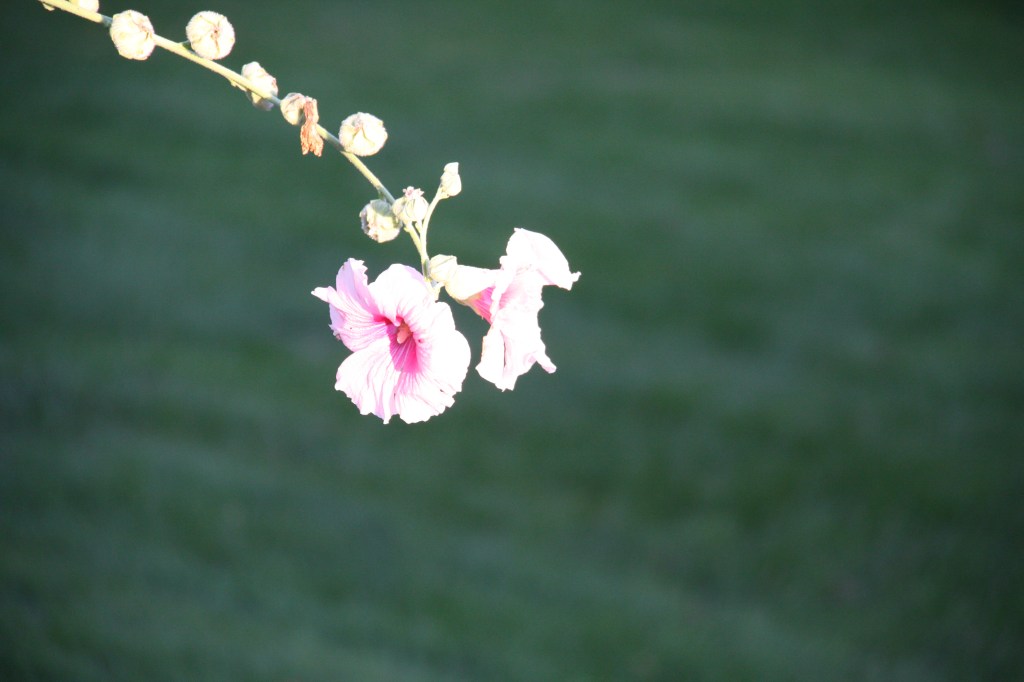
And it is the same with the hollyhock, my hollyhock, Geoff’s hollyhock. At the top of the page is Geoff’s painting of my hollyhock. The above is a photo of my hollyhock. Which bloom did Geoff capture and reproduce in paint? Language: and what do I mean when I say ‘my hollyhock’? My indicates possession, ownership. How and in what way does one own a hollyhock? How does one possess a garden, a flower bed, a tree? Are they not free, living, beings with a life and maybe even a mind of their own? Does one hollyhock talk to another hollyhock as the trees are said to converse with the trees? Do the trees in the garden possess a soul and if they do, in what sense do they possess one? And what is a soul anyway? I guess it depends upon the church and creed to which you belong. Certainly the garden has a life of its own and we discover that every spring when the grass and flowers grow back and the dandelions return.

image5

Questions: dangerous things, questions. Several of the questions posed above could have landed me in an Inquisitional institute in Spain in the 1500’s and 1600’s. That is a frightening thought. Alas, the philosophy of all that is way too deep for this poor poet and apology for a philosopher. One thing I do know, though: I love the garden going on outside my window and it is a privilege to be allowed to watch it, admire it, and follow its progress as the sun returns and the draws the birds back with it.

IMG_0198

¡Vale! Hail and fare thee well.