Jackson Pollock it ain’t. But just look at those fledgling storks launching themselves into the air. And yes, those are their nests!
Spotify Scroll down to appropriate episode.
Bird’s Nest Jackson PollockNo5 (1948)
This bird’s nest starts with a startling tweet that wins a trilled, thrilled response. A flutter of heart-string wings, creator, viewer, join
with the creation. Thin threads of life mix and match their tangled weave, existential tapestry, fathered in a feathered nest.
World without end, this labyrinth without an entry point, without a beginning, with a spaghetti-thread middle that meets
not in a breath-catch of the mind, but in a brush-flick of coloured rain, a cycle recycled of circled paint, circular
in its circumnavigation, its square eight by four-foot globe of a new world whirled in stringy whorls, reinvented beauty
drawn haphazardly from the bicycle tour de force of this artist’s inner mind.
Comment: This is a tongue-twister of a poem, much as Jackson Pollock’s painting is a twisted vision twisting the viewer’s eye. And, no, it is not easy to read. Nor is the painting easy to view. Click here for a link > Jackson Pollock < to the painting. Click here for a link to Alejandro Botelho’s reading of < My Grandfather >. Note that Alejandro’s reading of My Grandfather begins at 17.58. And note too that the other poets are also well worth listening to. Once again, thank you for this, Alejandro: your work is very much appreciated.
This is another academic word that has a simple meaning. In essence, it means texts talking to texts. Quevedo (1580-1645) writes ‘escucho con mis ojos a los muertos’ / ‘I listen with my eyes to dead men.’ He is suggesting that, each time we read a text written by another person we enter into a dialog with that text and that author. His metaphoric conversations with the writings of the long-dead Seneca become intertextual the moment he put pen to paper and wrote about them.
This intertextuality is a key component of my writing. You may not recognize all the phrases that I have used previously by other writers. I do. Some other readers will. Just take, as an example, the titles of some of my earlier books. The title of Broken Ghosts(Goose Lane, 1986) comes from these lines penned by the Swansea poet, Dylan Thomas (1914-1953). ‘Light breaks where no sun shines; / where no sea runs, the waters of the heart / push in their tides; and, broken ghosts with glow-worms in their heads, the things of light / file through the flesh where no flesh decks the bones.” Stars at Elbow and Foot, the title of my Selected Poems (Cyberwit.net, 2021) was also inspired by one of Dylan Thomas’s poems. “And death shall have no dominion. Dead men naked they shall be one with the man in the wind and the west moon; when their bones are picked clean and the clean bones gone, they shall have stars at elbow and foot.” The title of Though Lovers Be Lost (Kindle, 2016) also comes from this same poem, one of my favorites, obviously.
Sometimes readers are aware of these intertextual clues that I sow throughout my poems. Sometimes not. It doesn’t matter. There is a resonance in such chosen words and that resonance is there, irrespective of whether you are aware of the word-source or not. That said, the recognition and acknowledgement of intertextual relationships expands the poetic meanings of the creative world even further. It also establishes verbal links between author and author, epoch and epoch, genre and genre, thus establishing a wider intertextual network and a stronger chain of linked literary thoughts and meanings. In our creative journeys, we rarely walk alone, whether we are aware of it, or not.
The art of writing poetry about paintings is known as ekphrasis – which basically just means a verbal description of a visual work of art, whether it’s real or imaginary. The conversion of the visible (painting) to the printed page (verbal) is another link in the great chain of intertextuality, for paintings, too, are narratives with a different form of text. Other component parts are audible to verbal (alliteration, onomatopoeia), touch and feel (tactile) to verbal (as in synesthesia or the mixing of the senses) and the transfer of taste to verbal forms. Many of these transitions and transformations are present, not only in my own poetry, but in surrealism (verbal and visual) as well.
“When the snow flies…” they keep saying. I have seen blackfly, felt them nesting in my hair, picking painlessly at my scalp, until, next day, the itching begins and the bites get scratched, one after another, until they turn into scabs.
But I had never seen a snow fly, hard as I tried. When the geese fly… yes, I have seen and wondered at their spring invasion and their autumn retreat. I have marveled too at the goslings’ rapid growth, those golden fluff balls taking first to the water, and then one day, suddenly, they rise in the air.
Last year, in a moment of madness, I stood beneath Aurora Borealis and marveled at the sky’s flickering colors. The light became sound and it was then, astounded, I saw them dancing, those snow flies, dancing me senseless, in their rainbows of light.
Comment: “La Poesía se explica sóla, si no, no se explica” — famous words by Pedro Salinas the great Spanish poet of the Generation of 1927, who taught at Johns Hopkins University. So, I will not attempt to explain my words. They stand for themselves, or not, as the case may be.
However, I will venture into the area of the cliché and the commonplace. People use so many phrases without thinking about what they mean. To examine the cliché and explore its meaning is a delight. What are snow flies? And what will they do when that moment of their release comes about? When the snow flies dance beneath the Northern Lights on a late fall night in New Brunswick, they become visible to the watchful human eye. And now you know what happens “when the snow flies… dance!”
A whole lot of pens. But will they write one word of poetry?
Sense and Nonsense Wednesday Workshop 18 August 2021
Iterative Thematic Unity
Iterative thematic imagery is complicated term, used by academics, for a literary device that is really very simple. When the same or similar images are used again and again in a text this is repetition or reiteration, hence iterative. When they are bound thematically or within the associative fields already present in the poetry, then the repetition is said to be thematic. A work’s unity may be found within the three classical unities of time, space, and action, or it may be found within the imagery that links and unites. It seems complex, but it isn’t really.
“Now you are a river flowing silver beneath the moon. High tide in the salt marsh: your body fills with shadow and light. I dip my hands in dappled water.” The key images fall into two categories, (1) water: river / high tide / salt marsh / water and (2) light: silver / moon / shadow and light / dappled. Now the sense of the words becomes clear. You / your body is likened to a river seen in the moonlight. It can be touched: I dip my hands. This adds an extra sensory dimension and the depth of the images is apparent. And no, it is not a simple message, but it can be decoded and enjoyed because now you can make it yours.
Sense and Nonsense
When we talk poetry, what do we mean by sense and nonsense? Let us begin with automatic writing. Automatic writing is nonsense. Put your pen on the paper, do not let it off, write for five minutes, whatever comes into your head. The Surrealists published these thoughts, however distraught and distracted as meaningful poetry. Major poets (Lorca, Paz) have used these techniques to engender metaphors and images. However, they have searched among their subconscious thoughts and have rejected the dross to choose the genuine images that enlighten the inner world.
Sense or nonsense? “Eye of the peacock, / can you touch what I see / when my eyelids close for the night?” Key images: eye > see > eyelids > and these are linked to the eyes of the peacock, as displayed on his feathers, and this links to the ancient tale of the Argos and the Argonauts, and to the person who closes his eyes to sleep for the night, and the sense that we can touch (tactile) when we dream (visual), a mixing of the senses. The straightforward logic of the nightly news? Definitely not. But the logic of the subconscious world, of the dream world as defined by Carl Jung? Definitely. These words contain internal meanings that are different for each one of us. Logical meaning? Definitely not. Internal sensation that may generate ease or unease? Definitely. Sense or nonsense? That will depend upon the readers and how they react not in their logical minds but in that deep-seated region of subconsciousness where all imagery is related to what Carl Jung calls the racial subconscious.
Are there words or ideas here that you do not understand? Names and theories that you do not know? Literature in general and poetry in particular take you to places where you have never been and to places that you might never have thought of visiting. However, these are lands that will open their delights before you, if you deign to open up heart, mind, and eyes, and venture out to explore them. Use your dictionary, your thesaurus, your google search tool, and expand your verbal and linguistic horizons. Poetry is not an advert. It doesn’t sell you anything. But it can and does open new worlds and it encourages you to explore old worlds set within you. It will not persuade, cajole, and limit your mind and your choice, rather it will embolden you and help to open new horizons.
Last night’s rainstorm shrank the house. We closed down rooms and now the walls are closing in. There’s so much we no longer use, nor visit, so many rooms we no longer enter.
Almost all our friends downsized long ago. We are the holdouts. We love it here in this big house with its lawns and trees and flowerbeds with bees’ balm, butterflies, birds, and the yard abuzz with sunshine and bees.
But now we are starting to throw things out. Maybe we’ll move, next summer perhaps, or maybe not. For now is the time of indecision.
Like friends of the same age, we travel the lesser road of memory loss, a name and a face here, a date or phone number there.
Perhaps, when the time comes, we will have forgotten how to move. Meanwhile, the mandatory old man’s question: ‘where did I put my glasses?’
“I left her by the gate to the Beaver Pond at 2:38. It takes her twenty minutes to walk around the circuit. I always check my watch. Then I know when I can expect her back. In exactly eight minutes, she comes out of the woods and I can see her at the end of the boardwalk. I park the car in a spot from which I can watch her and wave to her. Today, I didn’t see her come out of the woods. It’s the radiation for prostate cancer … it’s left my bowels weak. I had to go to the bathroom … so I turned the car engine on … it was 2:44 … about two minutes before she was due to appear on the boardwalk … yesterday, a Great Blue Heron stood fishing in the pond … he flew when he saw her … a great crack of the wings … but today, the heron wasn’t there … just ducks … they flapped their wings, stood on the water, you know, the way they do, and scattered from the spot where she should have appeared … she walks very quietly, tip-toe, you know … she likes watching the heron and the ducks … she doesn’t like to frighten them … I don’t know what to think … I had to go … it was urgent … so I turned the car around and drove to the nearest bathroom … about one hundred yards away … I was in there … I don’t know … about five minutes … I didn’t check my watch … it’s dark in there … no electricity …besides, between hobbling on my sticks, praying to God to help me to hold on, opening and closing the door, struggling to get my pants down without soiling them …and then I drove back to the picnic tables … and waited … and waited …and she never appeared. I haven’t seen her since … she’s gone missing … I fear the worst … “
On the other end of the phone, a long silence, some heavy breathing, then:
“We’ll file a missing person’s report.”
“You will find her, won’t you? I love her, you know. I must find her. I want to know what’s happened … ” the old man wiped the corner of his right eye with the knuckle of the index finger of his left hand. He coughed and cleared his throat.
“Twenty years younger than you, you said?”
“Yes,” the old man nodded.
“Well, sir: we’ve already started our investigation. We’ll do our best to find her. We’ll contact you as soon as anything turns up.”
The police officer put down the phone and the circuit clicked out.
“What the hell you gonna do?”
“Not me … us.”
“Okay … us then … well … what the hell we gonna do?”
“You tell me. We got her on video. She walked out the other exit, by the park HQ, straight into the arms of the Deputy Police Commissioner. She’s twenty years younger than her husband and her husband’s got the sort of cancer that’s killed his sex life. Cancer? And the Deputy Commissioner’s the one who’s waiting for her? What the hell do you think we’re gonna do?”
Fall: Beaver Pond
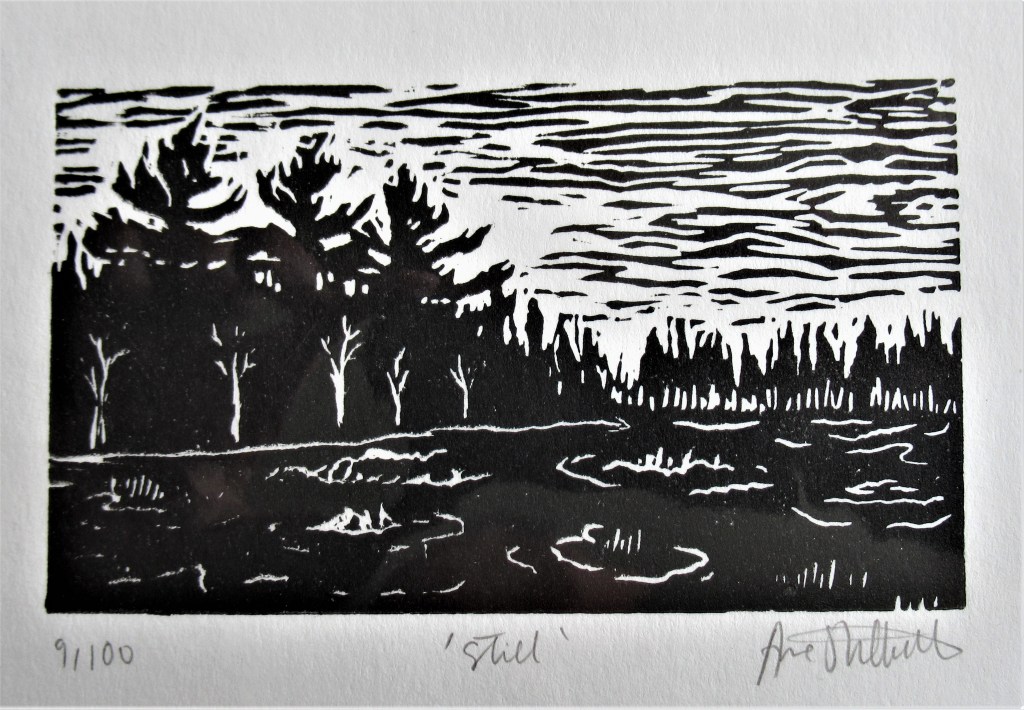
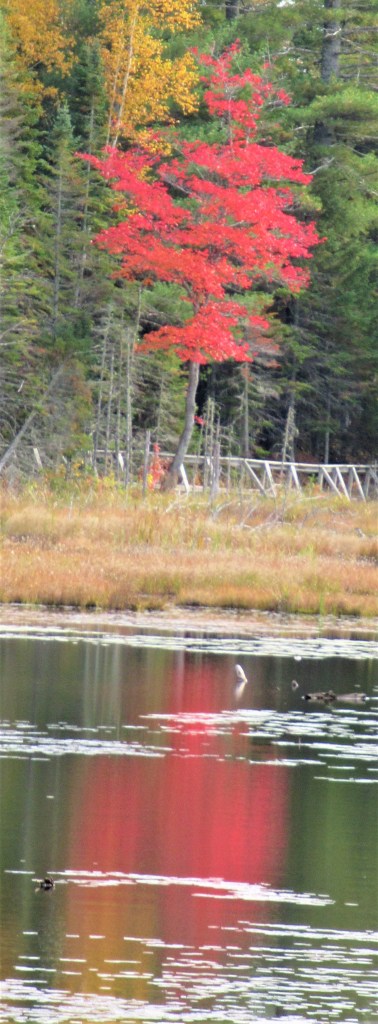
Comment The Beaver Pond at Mactaquac is a beautiful place to be, all year round. We love it in summer and fall and Anne Stillwell-Leblanc (< click on link for website) has captured the stillness and silence of the place in the above engraving. As I have become less mobile, so I have sent Clare cantering around the pond to enjoy the beauty we used to enjoy together. Meanwhile, I sit in the car and watch for Clare’s regular appearances through the trees and on the footbridge. As I sit, I write. Sometimes it is journal style, sometimes poetry, and occasionally a short story, like this one.
Roman Armies, men and words, were structured, highly structured. Poetic structure can take many forms: external structure, the sonnet, for example, with its 14 lines and its 4+4+3+3 verse form which can also be 4+4+4+2 or 5+5+4, or 5+4+5 or 2 x 7 or 3+3+3+3+2. I have experimented with all of these sonnet forms, and many more, at one stage or another in The Nature of Art. Milton Acorn, the Governor-General’s Poetry Award Winner for poetry, wrote a book called Jackpine Sonnets. His Jackpine Sonnets are wild and beautiful, growing this way and that, totally individual and out of shape, just like wind-swept jackpines of Tara Manor in St. Andrews on the East Coast of New Brunswick, Canada, where I penned some of these poems.
Internal Structures
In the same way that poems can be given a formal structure, so can lines. Structure can be external, flowing from line to line in an unbroken sequence, or it can be internal, limited to each line. Some of my poems include stanzas where the individual line flows into the stanza and the result is an amalgamation of both the individual and the whole. Individual lines can be structured by syllable count, 10, 11, 12 or more per line. They can also be structured by stress, the stress of normal speech or the stress of forced rhythm. Structures can have Greek or Latin names, English ones too. Or it can be the structure of simple, everyday speech. Fray Luis de León, (1527-1591) wrote that he counted his syllables when he spoke and he wrote prose and poetry the same way he spoke. Syllables, a strange term nowadays, not understood by all. Try the ‘beat’ of music: “You can’t always get what you want” (Rolling Stones) or “All you need is love,” (Beatles). Simple really, but it is all too easy to complicate these concepts.
Comment: Clearly this is a simplification of what can be an intensely scientific and academic subject. We have only to think of the books of rhetoric, with their long lists of Greek names for the different syllables, long and short, and the different line lengths that run from Iambic Pentameter to Hymns Ancient and Modern. However, the purpose of these thoughts is to simplify and not to complicate. More important, perhaps, rhythm, in one form or another is akin to structure and many of us have an innate sense of verbal rhythm, whether we count our syllables on our fingers, as I do, or count them not, as is the modern trend in some poets. Think daisy petals: she loves me, she loves me not, I count them, I count them not. Yet still the rhythm is there and that, in many ways, is one of the key secrets of our unique poetic voices: we all speak and write in different fashions and that is one of the things that makes us unique.
The Musicality of Words Wednesday Workshop Bastille Day 14 July 2021
The Roman armies marched all over Europe and, as they marched, they sang marching songs, traces of which lingered, along with the Latin language, everywhere they went. Think of the poems in his book as songs, each with its own special rhythm. You can find music in a single word, in a group of words, in a single line. You can hear and feel it too when you follow the punctuation and move with the words across adjoining lines. Unfortunately, far too many of us have become used to slogans and advertisements: three words repeated incessantly, two verses of a song that loop continuously. Many of us have forgotten how to read anything other than newspaper headlines and simple sentences. We have also forgotten how to listen to words, how to gain multiple meanings beyond the simplistic message of slogan, sound byte, scandal, and news. Diversity of meaning is what you learn when you read poetry, for poetry is more, much more, than the delivering of a simple message. To read a poem is to set out on a personal journey of exploration, into your own memories and mind, as mediated by the poet’s words. It is also to explore the vast treasure trove of our personal relationship with our language. Remember: a poetry book is a dream you hold in your hands.
Comment: Words have meaning, but they also have music and the musicality of meaning must never be forgotten for when music an meaning combine, a new set of meanings is formed that depend as much upon the ear as they do upon the decoding mind. This is all a part of what we refer to as the poet’s voice and remember this style of poetry is not to be found in newspaper headlines nor on the radio and television news, scaled down as they are to the lowest common denominators of language.
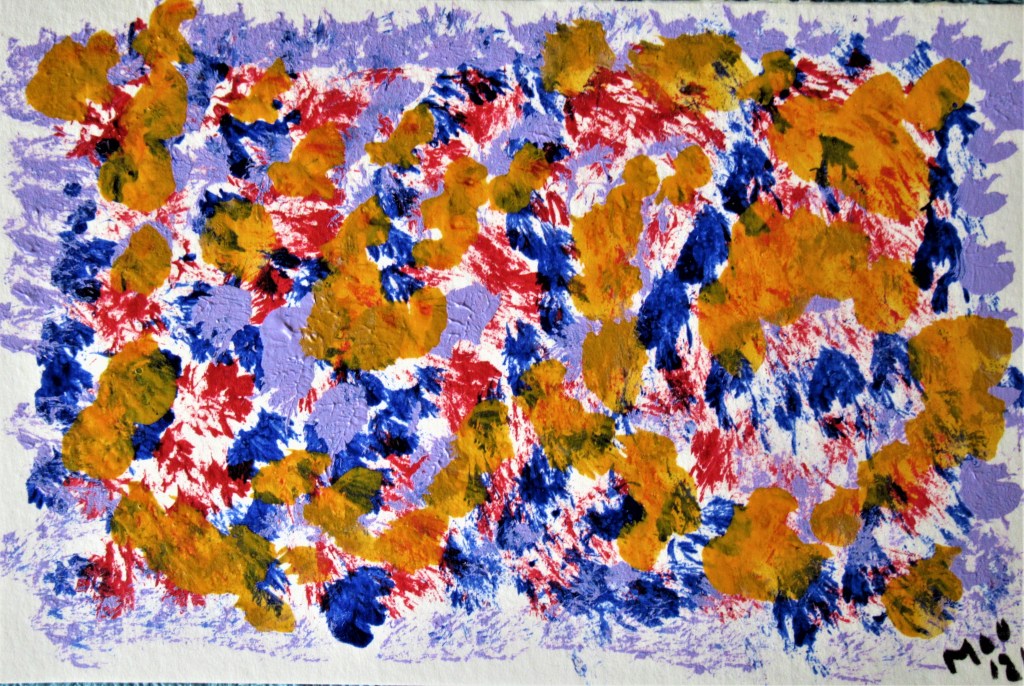
Look carefully at the painting that heads this Wednesday Workshop. Look at the movement and the musicality of linked forms and colors in a still, silent, two-dimensional space. Meaning takes on different meanings and becomes something different when we look at these words of color, these soundless sounds, these rhythmical movements of color. Beauty is in the eye of the beholder. Indeed it is, and in poetry, it is also in the musicality of the words and the flow of the ideas that bind the words and change their meanings.
The Nature of Art and the Art of Nature is a book of poems each one of which celebrates humanity’s relationship both with the natural world and the way that world is recreated by artists in so many different forms. In order to read these poems and receive full value from them, it would help to know how to approach them.
Preparing to Read
First, de-clutter the mind. Poetry cannot be hurried or rushed. Remember, it is better to read one poem a hundred times than to read one hundred poems once. Prepare yourself mentally and physically for your reading. Sit down. Make yourself comfortable. Close your eyes. Concentrate your mind on something you find peaceful: a sail on Passamaquoddy Bay, a rose in Kingsbrae’s Rose Gardens, a butterfly in the Butterfly Garden, or a fine white cotton cloud in a cerulean sky. Breathe in and then breathe out. Now slow your breathing down. Breathe in, count up to four, slowly, breathe out, counting up to six. Breathe in, count up to six, slowly, now breathe out, counting up to eight. Breathe in, counting up to eight, and breathe out, also counting up to eight. How long will you sit there? When your breathing has slowed and your mind is clear, you will be ready to start. You will know when that is.
Open your eyes. Take your book and begin to read. Don’t start on page one and rush through. Dip in, here and there, find a title or a first line that you like, and read that poem. Read it two or three times. Then move on, randomly to another poem. Select individual lines, phrases, sentences. Savour the words. Roll them around in your mind. Read them to yourself, quietly. Then read them out loud. Try to capture their essence, their rhythms. Taste them, as you would a fine Spanish Manzanilla wine. Select another word, another line, another poem. Seek and you will find some sequence that you like. Return to it often.
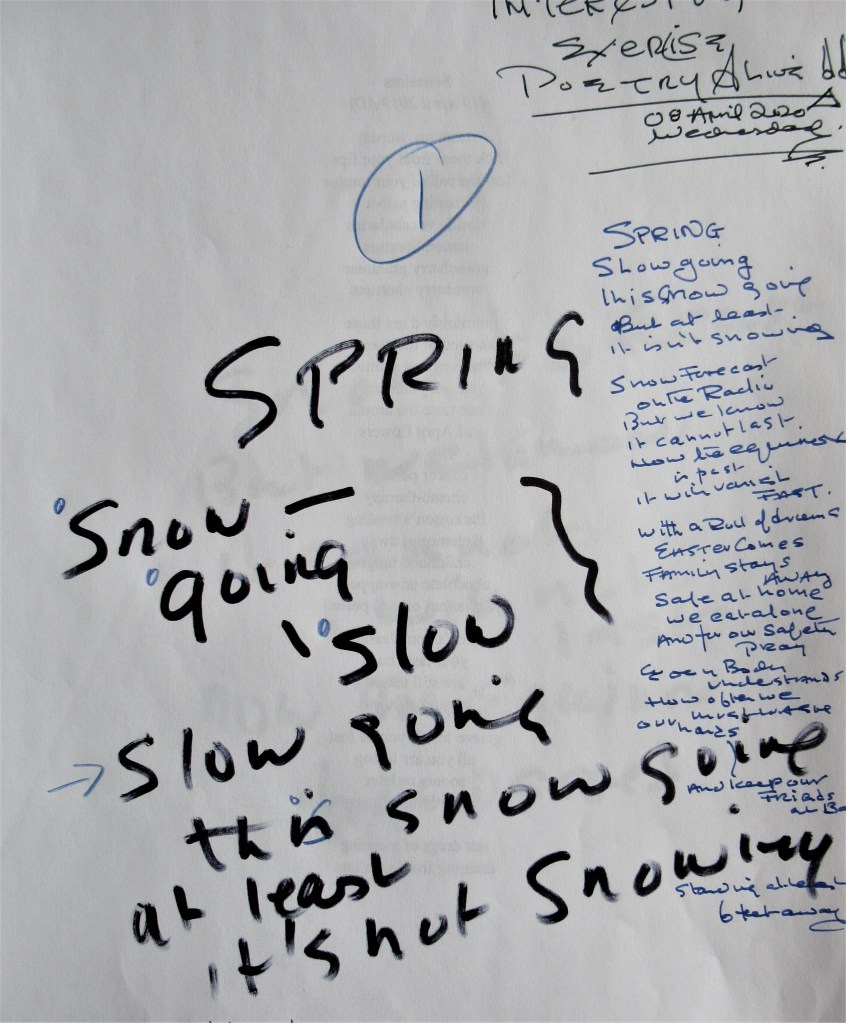
Comment: I will restart my Wednesday Workshops. The Nature of Art, the manuscript on which I am currently working, has an Introduction on The Nature of Poetry. I will put this up in installments. The handwritten opening page comes from an online video on Creativity and Writing Poetry during the Pandemic. This poetry video is the first one in the series. Click here for link. Other workshops on writing can be found by searching Writing Workshops on the Blog search (top right hand corner) or by going to this link Poetic Creativity and Thoughts on Writing
She is an oyster, silent at low tide, yet with a host of pearls waiting inside her, ready to be released. When set, she will release those pearls herself, stringing them together, like Chantal’s beads, into a skein of meaningful, enigmatic moments.
Enigmatic, yes, but, like Elgar’s Enigma Variations, a Russian Doll puzzle of secrets and intrigue. Comic book artist, she evolved to graphic designer, then multi-tasked first to Kinetics, and then to a painter who reaches out in empathy to the world around her.
For her, all art is linked and communications are key, on many levels. Visualization. Achievable goals. A step-by-step process with each step foreseen, planned beforehand, and each step always taken with an open mind that accepts the true response, leaving falsehoods behind.
Kinetics, yes, but she is above all a loner. Kayaking. Hiking. Weight-lifting. Yoga. Meditation. Mindfulness. Caring. Sharing. She sends me her web page and I am blown away by her empathy with birds and the natural world, that world her oyster and her, an oyster in that world.
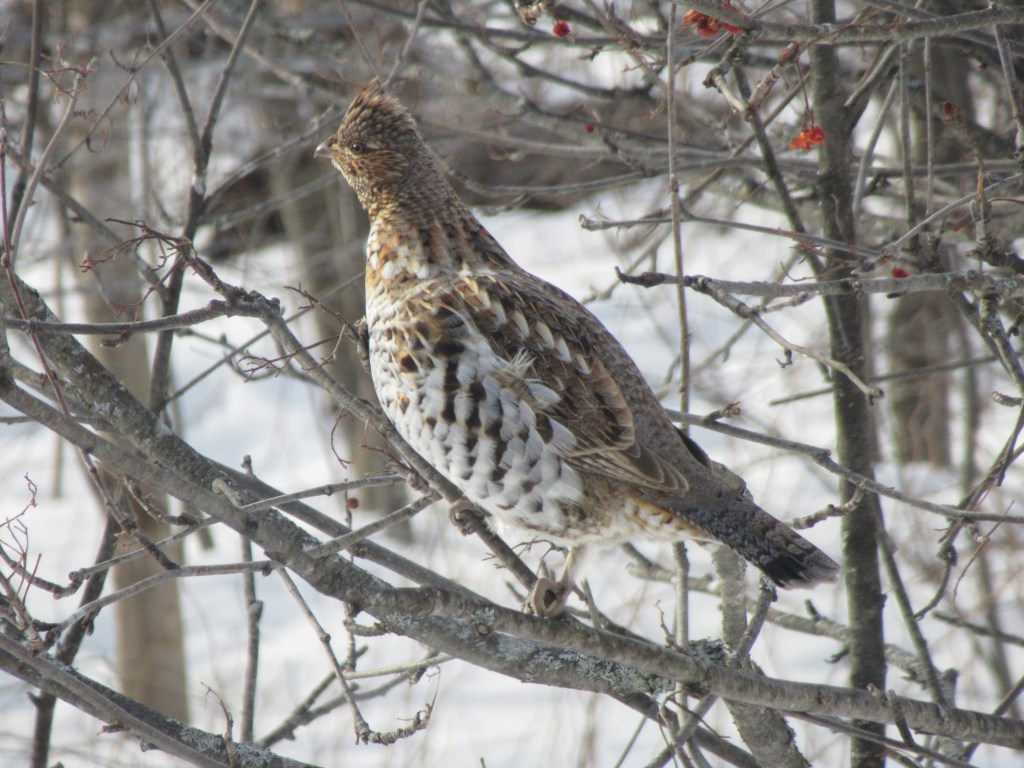
Comment: This particular bird visited our Mountain Ash in the garden at Island View. Kaitlin saw my photo and asked if she could paint it. I sent it to her, and this is the result. Wild life to Still Life to art and never Nature Morte! Together, Kaitlin and I have preserved forever the surprise visit of this beautiful bird.









 rogermoorepoet