Lac Megantic – 10 years on

Lac Megantic
ten years on

Fire on the water, the waves ablaze,
and the sound, a monster, indestructible,
a dragon descending, breathing fire,
so swift, so powerful, come sudden
from nowhere, yet another disaster,
one of the many that torment us
now and then with its ravage and roar.

It refused to move on until sated – but
who could satisfy the monster’s hunger,
destroy its will, defeat its power?
Not us with our pitiful sacrifices,
homes, friends, family, devoured.

In spite of our efforts to rebuild,
nothing can ever be the same.
Ten years later, memories, grief,
and our tears are all that remain.
Yes, it has left, but what can we do
to stop it, if, and when, it comes again?


Comment: I wrote this poem on July 6, 2023, while listening to the CBC radio commentary on the tenth anniversary of the Lac Megantic disaster. A terrible event, it still haunts so many people, and yes, the fears, tears, grief, and memories linger on. How could they not?

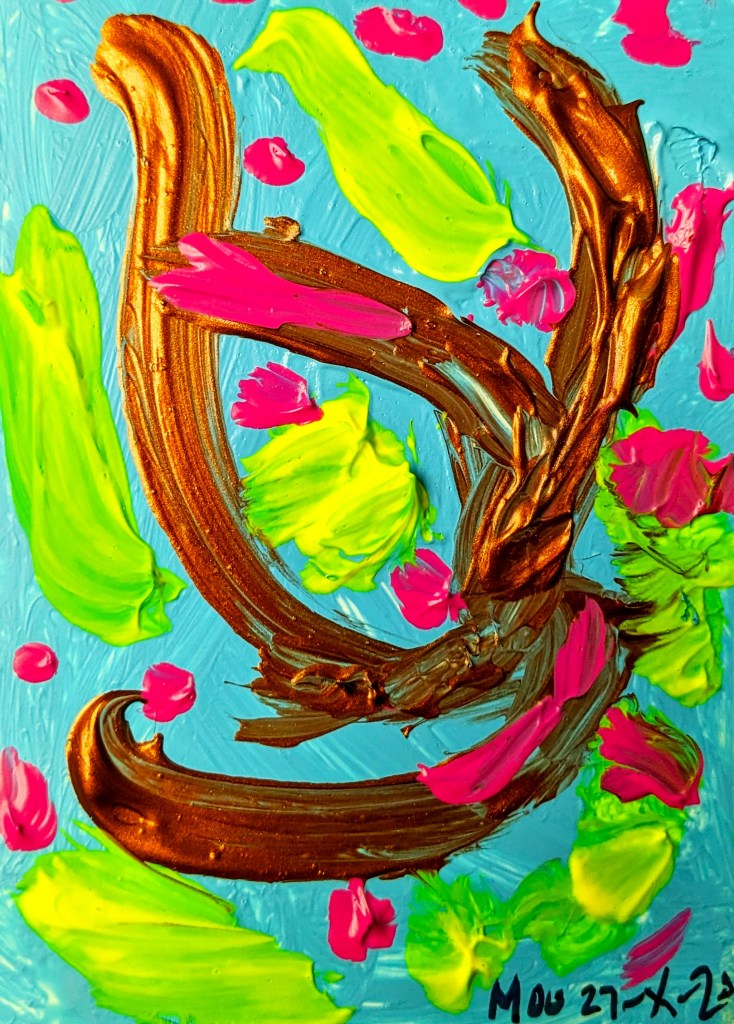
PaintingPoppies – by Clare Moore.

Magician

Magician

I stand on a tiny platform, high above
the upturned faces of the clamouring crowd.
Before me, the high-wire stretches across
the diameter of the circus tent.

Clad in the enormous shoes of a clumsy clown,
I grip the wire with the toes of one foot.
Now I must choose – umbrella or pole?

The spotlight outlines my face’s whiteness,
the bulbous nose, the fixed, painted smile.
My jaws clamp tight in concentration.

Clutching the brolly, a good old gamp, I walk
the thin wire plank of my current destiny.
One step, two steps, tickle you under the chin,
and I pretend to fall, grasp the wire, and raised
by the crowd’s gasp of despair, swing back up.

Then, a yard from the finish line, I swallow dive,
turn a somersault in the air, and land on my back
in the middle of the safety net as the crowd goes wild.

“The magician works on the threshold that runs between light and dark, visible and invisible.” John O’Donohue, Anam Cara, p. 145.

“The most difficult role in the play is that of the fool – for he who would play the fool must never be one.” Don Quixote.

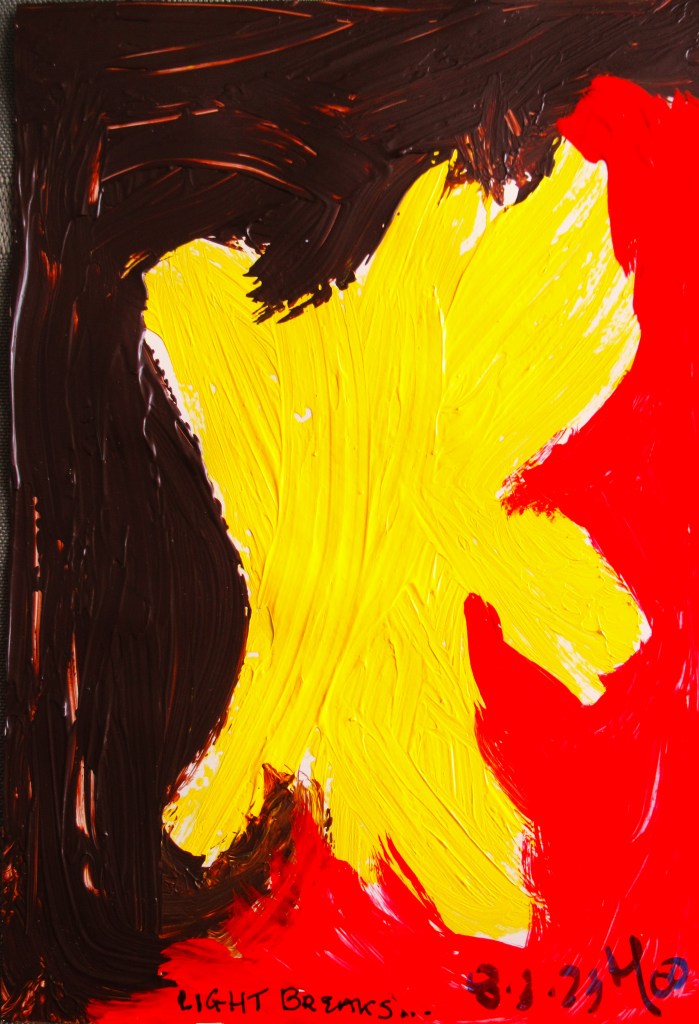
Painting: Fire Sky by Moo.

A Place Eternal

A Place Eternal

When sunshine floods my body
it leads me down into a secret,
sacred space that I know exists
even though, all too often,
I am unable to locate it,
search as I may, but then,
when I no longer seek it,
it is with me, and I know
that I am no longer alone,
but wrapped in the comfort
of an angel’s protective wings.

That haunting presence lingers,
plays melodies within my mind,
invites me to return, keeps me warm
when chill winds blow.

I depart from that place,
a fingernail torn from the flesh.

“There is a place in the soul that neither space, nor time, nor flesh can touch. This is the eternal place within us.”

“You represent an unknown world that begs you to bring it to voice.”
John O’Donohue, Anam Cara, p. 105.

Painting: Sky Wound by Moo.

A World of Silence

A World of Silence

My dreams are black-and-white movies,
no voices, with the cinema pianist tapping
silent notes on the hammer dulcimer.

Shadowy images, cast by a candle, flicker
along the walls, and I am back in school,
walking, half-asleep to midnight mass.

I stumble forward, from that distant past
towards a series of unknown futures
none of which may ever come to pass.

In the Big Top of my head, the gymnasts
hold hands and in silence float their clouds
above the heads of the wondering crowds.

To fall or not to fall, to fall to rise no more.
Soundless sighs erupt from silent, open
mouths as the tight-rope walker sets out.

The umbrella in his hand is a Roman candle
that throws shadows on the circus sand
as clowns with bulbous noses cavort below.

The ring-master flexes an inaudible whip.
The carnival ponies trot up and down.
The motor-bike rider accelerates. In the hush
the bike ascends the Wall of Death and falls,
diving down, down, down, into silence.

“All words come out of silence. The language of poetry rises from, and returns to, silence.” John O’Donohue, Anam Cara, p. 110.

Old Man Sin Drome

Old Man Sin Drome

Damn! He’s done it again.
He must pretend it hasn’t happened.
He struggles out of his jeans,
runs the hot tap in the powder room,
removes his underoos,
and places them in the basin.

He adds soap and watches the water
bubble and change color.
He rolls up his sleeves,
places his hands in the hot suds,
grabs the nail brush,
and starts to scrub.

Cancer. He is washing it away,
removing its stain, the smell,
the pain of its presence.
He drains the water and wrings
his underoos, twisting them this way
and that in an effort to purge.

More water now, no soap.
He waits for the water to discolor.
When it doesn’t, he knows that all
is well and the evidence destroyed.


He wrings out his underoos again,
then hangs them over the air vent to dry.
He keeps a spare pair in the cabinet drawer.
He puts them on, struggles back into his jeans,
and hopes that nobody will ever find out.

Wash Day Blues

Wash-Day Blues

“Out, out, foul spot.” Yet,
however much I scrub them,
those blood spots on my clothes
will not disappear. No seas
incarnadine for me. Picking
at scabs, my fingernails draw blood.
with so many ragged edges.

The old, stale liquid flows
fresh again from once-healed wounds.
Why made me open them up?
Was it just boredom? Or that itch
ever nibbling at the mind’s edge?

Tell me, how do we walk away?
How do we heal ourselves?
How do we forgive and forget?
Does the fresh blood wash away
the dirt I feel crusted round me?
Will I ever be clean again?

Wednesday is wash-day.
I scrub again and again
at all my dirty linen. Then I watch
as my wrinkled skin grows damp, scabs
soften, and I open them once more.

Two Spiders

Two Spiders

A spider dangles from its web by a fine, thin thread
that glistens in the sunlight. She hangs there, refusing
to think about the father she never knew, the aunties,
uncles, grand-parents, sisters and step-sisters, and all
those unknown relatives that abandoned her and fled.

What can she do? What can we do? Nothing.
We think ‘ancestry’ but we know, more or less,
who we are and what we are. We are just a son
and a daughter of troubled marriages where one set
got divorced and the other stayed together through
hell and high water, and all that those things mean.

But we are a son and a daughter, brought together
by chance, circumstance, happenstance, or some
thing beyond our control, and happy together,
the outside world shut out, and us in our little web,
as we have been for more than sixty years.

We have learned that, when the strong winds blow,
we must weave our web beneath fine grasses, that
do not stand strong like the oak tree, then stubbornly
break and fall, but bend like reeds or willows, before
the life’s storms, then straightening up, to raise
their heads, and surviving, after the winds pass.

Poems for the End of Time

Poems for the End of Time

Here it is, and it is up and waiting for you! I already have my first copy. More on the way. The same artist who did the cover for People of the Mist did this one as well. He’s such a nice person – doesn’t charge me a penny.

Introduction

         Poems for the End of Time is composed of two linked collections, Meditations on Messiaen and Lamentations for Holy Week. They both have separate introductions in the body of the text.

         My graduate work at the University of Toronto (MA, 1967, and PhD, 1975) included studies on Golden Age / Early Modern Spanish Poetry (16th -17th Centuries). It enabled me to read and enjoy both the Renaissance and the Baroque poetry of Spain. My own interests lay within nature poetry, as expressed by the Spanish Mystics (St. John of the Cross and St. Teresa of Avila), the Neo-Platonic Poets (in particular, Fray Luis de León), and the Metaphysical poets (Luis de Góngora and Francisco de Quevedo). Echoes of their writings and thoughts are frequent within these two poetic sequences.

         I will write further on both sequences later in the book. Briefly, both sets of poems were written while listening to the music of Olivier Messiaen. Three of his compositions, Quatuor pour la fin du temps / Quartet for the End of Time, Éclairs sur l’au-delà / Lightning over the Beyond, and Petites esquisses d’oiseaux / Little Sketches of Birds, influenced me enormously. I listened to them every day while I was writing and revising these poems.

         These poems are not for the simple-minded. They form a contrasting tapestry of point and counter-point, filled with allusions, word-plays, internal rhymes, repetitions, and alliterations. They have a music all of their own.

Do not expect simplistic escapism. If you are serious in your efforts to read, listen to the magic of Messiaen as you turn the pages, much as I did while I was writing.

Black Paintings

Black Paintings
pinturas negras
Goya

Wrapped in his blanket of silence, the painter paints.
He pays no attention to the shrieks, screams, prayers,
curses, doesn’t even hear them. He sees their staring eyes
as the bull’s eyes at which anonymous soldiers, heads down,
backs to his easel, fire. He sees their mouths as black holes,
slashed across their faces. He sees the priest with his rosary,
but never hears the rattle of the beads or the firing squad’s guns
going off, filling the canvas with smoke, the square with blood.

Back home, in the Quinta del Sordo, his deaf man’s house,
he sits at the supper table, dwarfed by his painting of Saturn,
devouring one of his children. Beside him, old women,
hags themselves, suck soup silently from wooden spoons,
or fly soundless, black bats in the starless sky,
 on the back of goats or on their witches’ brooms.

The great, open wounds of his paintings speak to us
of his hushed suffering, of the calamitous world that spawned
such violence, plague, famine, and fear. Plundering armies,
guerrilla warfare in back street and alley, torture, pillage,
rape, and suffering, pits filled with the dead and dying,
famine walking the streets, and all of it inaudible,
the nightmares of a little child, seen, but never heard.
His paintings speak to us, and they allow us to reconstruct
in our imagination, the many things that the painter, deaf,
but never dumb, could never hear, yet reproduced
using his paintbrush and his taciturn palette as a tongue.

Click here for Roger’s reading.

“It is said that deafness is worse than blindness because you are isolated in an inner world of terrible silence.” John O’Donohue, Anam Cara, p. 71.