Gorilla Drives the Zoo Bus

Gorilla Drives the Zoo Bus

Gorilla drives the same zoo bus
all day, every day;
same starting time, same finishing time,
same route, same stops,
different passengers,
but every passenger the same:
faceless.
Gorilla doesn’t want to know their names.

“Please tender the exact fare!”
Not a penny less, not a penny more,
and he polices every penny.
Bus conductor and master
of every passenger’s destiny,
he opens and shuts the door,
letting passengers on and off the bus,
but only at official stops.

Every passenger has a ticket,
and he punches every ticket
with a neat, round hole.

He never makes mistakes.
He grinds, like God’s own mills,
exceedingly small.

He has spent all his life in uniform.
He has a belt and braces to hold his trousers up.
He’s always prepared for the worst.  

Ten, fifteen, twenty years:
an anonymous wife;
anonymous little babies;
at shift’s end, a pension,
and another bus.

St. Peter’s at the wheel.
He doesn’t want to know
where gorilla wants to go:
he wants to know where he’s been.

Commentary:

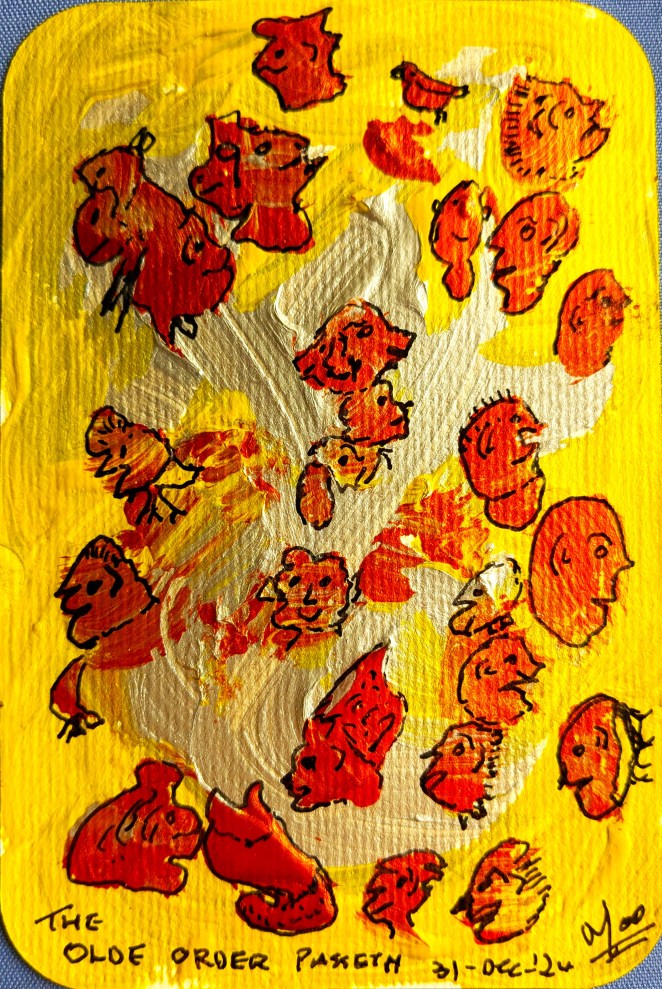
Moo didn’t have a painting of a gorilla driving a bus, so he offered me a painting of the passengers instead. Look carefully – you might even find a portrait of me or you in there. Who knows where Moo goes and who he sees? I certainly don’t. Remember Picasso – he used to run downstairs, out into the street, see a face he liked, and run back upstairs and paint it from memory. I wonder if Moo does the same thing. I’d ask him, but if he doesn’t want to answer the question, he just grunts. And I can imagine him grunting at that one.

Anyway, we all know and recognize the gorillas when we meet them. They are totally unimportant, have a miniscule job to do, but do it with absolute authority and the utmost perfection. Like Gorilla – “Not a penny less, not a penny more, and he polices every penny.” – “he opens and shuts the door, letting passengers on and off the bus, but only at official stops.” – “he punches every ticket with a neat, round hole.” – and probably in the exact same spot of every ticket! – “He never makes mistakes.” – and if he does, it’s the passenger who suffers, because ‘Get on, get off, who ever you may be, I am the lord of the bus,’ says he.

What will happen to us at the end of our shift? I really don’t know. And I don’t think anyone else does, either. Will St. Peter be there to greet us? (I don’t know.) Has the Zoo bus replaced the ferry over the River Styx? (I don’t know.) What will we be asked when we get there? (I don’t know.) How will we answer? (I don’t know.) Is there a little book in which all our deeds, good and bad, are written down? (I don’t know.) Are we to be divided into sheep and goats? (I don’t know.) What will poor monkey do when he is turned into a sheep or a goat? (I don’t know.)

So many questions, deep questions, packed into one small poem. Most of those questions unanswerable. But that’s one of the joys of poetry – to open a poem is to open a tin of calamares – there’s always another something or other left in the corner. Look, over there, bottom left, right at the bottom of the can, I spy with my little eye another question. ‘What is that question?’ you ask. Sorry, mate, I’m afraid I don’t know.

Monkey Turns Down Promotion

Monkey Turns Down Promotion

“I hereby appoint you head of the asylum.”

The young office monkey with the plastic stethoscope
was dressed neatly in a white sheet.

“Dr. Freud, I presume?”
Monkey held out his hand
but his witticism was lost in a flood of water
flowing from the flush and over the floor.

Monkey stood there, paddling in piddle.
Inmates with crowded heads and vacant faces,
fools grinning at a universe of folly,
paddled beside him. He wiped
a sick one’s drool from his sleeve.

The office boy spat on his hands,
slicked down his hair, and placed
his stethoscope on monkey’s heaving chest.

“You have no pulse.”
“How do you know I have no pulse?
Surely, you cannot hear my heart
for you have a banana stuck in your ear.”

“Speak up!” said the doctor,
“I cannot hear you:
I have a banana stuck in my ear.”

Then monkey felt fear.

Daylight diminished
and waters closed over his head.
He spurned the proffered paw,
the life belt thrown
by the offer of a new position.

Exit monkey left,
pursued by a chorus:
“Run, monkey, run!”

Commentary:

A Golden Oldie from Monkey Temple (2010). I came across it by accident as I thumbed through some older books – wow, fifteen years ago that came out. A Golden Oldie indeed. I had forgotten all about Monkey Temple. However, the last couple of days I have watched New Zealand vs Canada and England vs France (Women’s Rugby World Cup). Both semi-finals took place at Ashton gate, Bristol. That’s when I started thinking about Bristol and Bristol Zoo.

We had family in Bristol (Westbury-on-Trym) and from an early age we visited Bristol Zoo. One of my favorite places was the old ruined Monkey Temple, full of monkeys that impressed me with their antics. A small, walled zoo, it was full of innovations and I remember well Alfred the Gorilla and Rosie the Elephant. I loved the rides on Rosie’s back. The camels too offered lifts to young children and the elephants took apples from my hand with their long trunks. I also remember the bear pit, and loved watching the brown bear climb to the top of his pole and catch food thrown to him by the visitors.

I think everybody’s greatest thrill came with feeding time for the seals. What a racket when the attendant appeared with his / her pail of fish and he/she threw them to the waiting seals. Almost as thrilling was the penguin house with its aquarium and glass windows. Animals that seemed so clumsy, waddling on land, turn into sea-angels when they dived and we could meet them, face to face, so to speak, almost in their own environment.

My love of zoos reached out and I recall the zoo in Madrid, established when Columbus returned from his voyages with species of animals hitherto unknown. And who could forget Copo de Nieve, the albino gorilla in Barcelona zoo.

Alas, my zoo day’s are over. But the world is wonderful. Today, two deer entered our front yard, lunched on the fallen crab apples, and went to sleep underneath the trees outside our window. Joy to the world and the world brings me joy -sunrise and sunset, colored clouds, the deer in my yard, a fox passing through. However, I must admit I am not impressed by the little red squirrel that nests under the hood of my car and gnaws my cables. Nor by the porcupine who loves the salt in my garage doors and nibbles at the door frame every chance it gets. The love of nature – red in tooth and claw – I guess we have to enjoy the good and put up with the bad. Life’s like that. “Ask the animals, they will teach you.” Bristol Zoo motto.

Water

Water

Here, in Island View, my lawn’s parched grass
longs for water, long-promised but never drawing near.
Do my flowers remember when the earth slept without form
and darkness lay upon the face of the deep?

The waters under heaven gathered into one place.
When they separated, the firmament appeared.
Light sprang apart from darkness
and with the beginning of light came the word,
more words, and then the world …

… my own world of water in which my mother
carried me until her waters broke
and the life sustaining substance drained away
throwing me from dark to light.

In Oaxaca, water was born free, yet everywhere
lies imprisoned in bottles, in jars, in frozen cubes,
its captive essence staring out with grief-filled eyes.

A young boy on a tricycle pedals the streets
with a dozen prison cells, each with forty captives:
forty fresh clean litres of drinkable water. He holds
out his hand for money and invites the villagers
to pay a ransom, to set these prisoners free.

Real water yearns to be released, to be spontaneous,
to trickle out of the corner of your mouth,
to drip from your chin, and fall to the ground.

It is a mirage of palm trees upon burning sand.
It is the hot sun dragging its blood red tongue across the sky
and panting for water like a great big thirsty dog.

Commentary:

This year, spring came with lots of rain. At one stage it looked like the waterlogged plants in our flower beds would all drown. Then, just before summer came, the rain went away and we suffered day after day of unbearable heat followed by nights during which the temperatures scarcely dropped.

As a result, the woods dried up and dry lightning strikes started fires. At one stage close to forty wild fires burned, many out of control. Entry to the woods was forbidden by law. Gradually, the fire-fighters fought back, extinguished the fires, one by one, and reclaimed control. I hope everyone realizes the enormous debt we owe to those brave men and women who risk their lives to save not only our lives, but our houses and our properties.

The fires have gone now. We had a day’s rain, 11 mms fell, but it’s not enough. We need more, a great deal more. We need to soak the trees, the grass, and to feed the streams and rivers. We also need to refill the aquifers on which life on earth, as we know it, depends. We need deep ends in our pools, not the shallow ends of depends, when it depends on whether or not the skies open and the heavenly waters fall.

CBC radio last night – farmers say they have lost their winter hay. How will the animals survive our winters with the hay fields burned and dry? One farmer said that, having no hay himself, it would cost him a minimum of $55,000 to bring in hay – if he could find anyone to sell it to him. Unfortunately, the same is true across the Maritimes – drought, forest fires, and a lack of winter hay. Spare a thought (and a prayer or two) for all those poor creatures, born to die, who will suffer this winter on account of this summer’s heat.

Clepsydra 9 & 10

9

… what lies behind this attic door
     ready to spring out
           at the slow push of my hands

cobwebbed
     this world revealed
          a universe of memories
               waiting to be called
                    back into life

what life
     the flickering half-life
          of shadows on a wall     

or the alternate reality
     of planets that lost their way
          and forgot how to dance
               around their sun

do they still move
     in rhythm to an unsung song
          an unstrung guitar
               music no one else can hear
                    played by a wandering star

lost the glimmer
     of life’s candle
          adrift on distant waters,
               but never forgotten …

10

… nor seen
     nor heard
          I am amazed by the maze
               wandering
                    among cluttered objects,

my world takes shape
     in a mad hatter’s workshop
          where things grow legs
               walk this way that way
                    constantly getting lost

I can hear them
     chittering chattering
          but I can neither
               see nor hold them

like so many bats
     they roost upside-down
          little children lost
               in memory’s attic
                    where everything ages
                         slowly gathering dust …

What’s the most delicious thing you’ve ever eaten?

Daily writing prompt
What’s the most delicious thing you’ve ever eaten?

What’s the most delicious thing you’ve ever eaten?

No single item of food stands out. That said, eating is a cultural thing – does one eat on one’s own, or does one eat with family and friends? What role does food play in one’s life? For me, for example, food is cultural, an occasion, not a meal. For example, a fresh, Spanish croissant, for breakfast, a late breakfast, at the bar in the Rincon, Avila. Before me, the daily newspaper, open at the page with the daily chess problem. The coffee, freshly brewed, a cafe con leche, and the croissant, waiting to be dipped in the coffee, and the resulting delight transported to my mouth. Sometimes, there are no croissants left. Then, one of the world’s best kept secrets, un sobao pasiego, a small sponge cake, from the Vega de Pas in Cantabria. It holds together when dunked and can be eaten moist or dry.

By extension, when younger, after an afternoon’s soccer on the beach – la Segunda Playa del Sardinero, in Santander – cool red wine from a porron, and selected seafood in the form of tapas, nibbled with the other players, as thirst is quenched, and the appetite that comes from running on warm sand under a hot, summer sun, is slowly sated. Seafood – this includes octopus – pulpo a la gallega – or squid – calamares rellenos en su tinta – or caracoles de mar – sea-snails – or oysters, fresh, with a squeeze of lemon – or mejillones en salsa de tomate – mussels in tomato sauce – gambas a la plancha, roasted shrimp – or gambas al ajillo, pan fried shrimp in garlic – or almejas a la marinera, clams, Spanish style – the point is to ganarse el puchero / to earn your food, by dint of hard work, and to share it with your friends.

When I think of Welsh food, once again, it is the family gatherings and the love around the table that dominates. Under these circumstances, a simple boiled egg – not everyone can boil an egg properly – with hot toast and fresh salt butter, can be an overwhelmingly delicious meal. Eggs – so supple, so creative – scrambled eggs, creamy and lightly curded – an omelette aux fines herbes, with a lightly tossed green salad – a tortilla espanola, easy to prepare, but incredibly difficult to prepare to perfection. Free range eggs, fresh from the hen house, sea salt prepared locally, olive oil from a local terroir, potatoes, also local, onions from the garden. Each of these contains within it the taste of the same earth, the same air, the same rain.

Speaking of which, to travel to the high hills in the Province of Avila, and to smell the herbs that grow in the sheep pastures, thyme, rosemary, and to know that the flesh of the spring lamb will be flavoured by the herbs it has been eating – even the lechazo, a lamb still on its mother ‘s milk, tender, so tender, and so small that it broke my heart to see it. A lamb so small that I couldn’t eat it. I watched it appear on the family table and vanish in a couple of mouthfuls, washed down by a specially selected wine. I enjoyed the company and the rest of the meal. But I’ll never forget that tiny lamb.

However, it’s never just about food – it is about the cultural content of the room, the family, the table, the friends, the joy of sharing and caring. Oh dear, and I never got around to telling you about the paella I made, the ones that appears in the lead photo!

What’s in a name?

What’s in a name?

“A rose by any other name would smell as sweet.” What’s in a name? And how do we name things? Perhaps, more important, why do we name them? Perhaps when we name something, we feel that we control, if not the thing itself, then perhaps our relationship to it.

The Naming of Cats – that seems to be a strange place to start. To begin with, do we think we can control our cats when we name them? Now that is a very good question. And what name should we give to a cat when, in the words of T. S. Eliot and Old Possum, only a cat knows its one and only inscrutable name.

So, is a cat inscrutable? Does a cat have the inscrutable smile of the Sphinx? I wonder what the cat, pictured above, is thinking. One, two, three, where’s my breakfast? Oh yes, that’s Rudyard Kipling, my dearly beloveds, as you well know. Or do you? So much knowledge is being lost, swallowed up by the black hole of AI that is gnawing away at our brains the same way the moon gnaws at the sun disc in a solar eclipse.

“Sitting on my back porch watching the moon
devouring the sun with a big, black spoon.”

So what would we like to call the inscrutable cat who lounges so luxuriously on the bed in the above picture? Old Deuteronomy? No. Princess Squiffy? No. Willow, as in Pussy Willow? No. That’s somebody else’s cat. Blackjack? No. Blackjack is a black dog and this cat is white. Seamus? Sorry – wrong house, wrong family, wrong set of memories. Spot? No. Sorry, that’s what my grandfather called his zebra. Smudge? No. No smudges on that beauty. Sphinx? Or Sphincter? No. Mustn’t be rude.

Control. It’s all about control. Do you really think we can control that cat merely by naming it? Or , as is all too often the truth, do you thank that a cat like that actually controls us. In that case we must move from Thy Servant a Dog to Thy Master (or Mistress) a Cat.

“Do you like Kipling?”
“Not really. I never Kipple.”

So how about Master? Mistress? Colonel Bogey? Sergeant Major? Boss? Top Cat? Prince or Princess? Queen or Queenie? Please send your answers on a postcard to the North Pole via dog sled, preferably before Christmas, and maybe Santa will send you a nice present – if you give Saucy Sue her correct name.

PS. It’s not Saucy Sue. Roll the dice and try again.

What makes you laugh?

Daily writing prompt
What makes you laugh?

What makes you laugh?

The current state that the world is in. Seems like a strange answer, doesn’t it? Wars, famine, plagues, diseases, fire, flood, earthquakes, drought, what is there to laugh at? All of it, of course. Because if I didn’t laugh at it, I would cry. And crying – well, there just aren’t enough tears, are there? Anyway, as the Reader’s Digest used to say “Laughter is the best medicine.” So, if we want to heal the world, we must first learn to laugh at it.

In fact, there are many things we should be laughing at – politics and politicians, for one. Or is that two? Chuckling away – it’s hard to tell them apart nowadays. In fact, if we laughed right out loud at the folies bergeres who masquerade as wise men, can-can dancers who actually can’t-can’t, and decision makers who really can’t decide, then that laughter would be the last straw that would break the camel’s back and dump them all on their backsides in the desert where they belong. There, they would be voices ‘crying in the wilderness’, crying indeed, for deprived of their privileges, none of them would be laughing. But we would. And we’d probably be a great deal better off.

New words also make me laugh. Homicide, femicide, domicide, ecocide, countrycide – tell me, who makes up these names? Who keeps popping them into the dictionary? And if they mean what I think they mean, we should all be on our knees, praying and weeping. It’s like fake suicide. That happens when push comes to shove, and the subsequent defenestration is deemed a suicide.

Look at Moo’s painting, Burning Birbi. Now that is something to really make you cry. Moo tells me he was going to call it Burning Bush, but then he remembered all the poor birbis who were burned to death in the Australian Bush Fires. They ascended the eucalyptus trees for safety, and there, of course, they met their sad and tragic fate, while trying to escape the conflagration. I can laugh many things off. But not the fate of those cuddly little Koalas, brought to the edge of destruction by our treatment of their natural habitat.

Welsh proverb – “Laugh and the world laughs with you. Cry, and you cry alone.” So, I am laughing at it all. I have to – or else I will suffer a break down. So, laugh with me, and let the real losers cry in the wilderness, hermits all, abandoned to their lonesome own-somes.

Wed Th Fri

WTF

Wednesday, 31 January.
Thursday, 01 February.
Friday, 02 February.

Where has the first month of 2024 gone?
WTF – I always knew it meant Wednesday, Thursday, Friday.

Comment:

I never know what I am painting until I have painted it. I thought of calling this one Doggy in the Window. But there are so many other creatures swimming around in this little aquarium of mine. How many can you spot? What fun. A fishing expedition in search of the meaning of meaning and who knows how many little doggies you may pull out. There may even be an Axolotl in there. Who knows?

This painting is on sale for the remarkably small sum of $1,000,000. And if you beleive that, you will believe anything. You may even believe you can find the little doggy in there!

PS – I may start posting poetry again soon. I have nearly finished my next collection and all the unwanted extras can be placed here, on my blog.

Choices

Choices

Winter-low sun in my eyes,
I sit at the breakfast table
blinking back rainbows.

Light quivers into fragments.
Too much light and my world
turns dark. I can no longer see
the computer screen, nor am I
able to write in the old-fashioned
way with pen, ink, and paper.

To continue working, I must lower
the blinds or move to the other room
away from the sunlight.

Another option:
to forget deadlines and schedules
to lay down my pen, to close my eyes,
to bask in early morning pleasures,
purring like an ageing cat
enjoying the sun.

Comment:
A Golden Oldie that suddenly surfaced from “among my souvenirs”, as Connie Francis once sang. Or was it twice? Sunshine is certainly a magic balm for old bones. Only now am I starting to understand the wisdom of animals, that old dog, lying in the sun, the ageing cat curled up in a sunny window, the ancient donkey, seeking warmth, away from the shade. Such joy in the small things that make life so much better.

Do you ever see wild animals?

Daily writing prompt
Do you ever see wild animals?

Do you ever see wild animals?

Indeed I do. And sometimes, just like this Wapiti, or White-Tailed deer, they see me as well. Some are camera shy. But this one, caught one morning walking past my garage door, heard the click of the first camera shot, stopped, turned towards the sound, then kindly waited until I had shot him, in the only way I would ever shoot a wild animal, with my camera. Isn’t he a handsome fellow – very photogenic.

Some of the animals that pass through our yard do not seem that wild. This one lay down for a little rest about forty feet from the house. Early morning light, not easy to shoot, but he sat there and waited for me. Alas, I was using a camera with a laser focus and the red flash of the light disturbed him. I didn’t mean to do so. Whoops – there he goes, tail-up and now you know what they mean when they say ‘high-tailing it’ out of the woods and up the road.

And what about the chipmunks, and the squirrels, and the skunks, and the raccoons, and the jack-rabbits, and the porcupines? They all drop in from time to time. Look at this happy couple. Aw! Aren’t they sweet?

And don’t forget the birds – but give us another prompt – all about our feathered friends -and we’ll talk about them next time