Clepsydra 25 & 26

25

… how will it all end
     does it not need closure
          something to bring
               the water-wheel full circle
                    a golden key to open
                         what

the museum’s door
     memory’s door
          the archives where
               so many memories lie
                    gathering dust

though some may tell the truth
     whatever that is

or does the story go on and on
     never pausing
          never ending
               wrinkle after wrinkle
                    threaded through time
                         after time
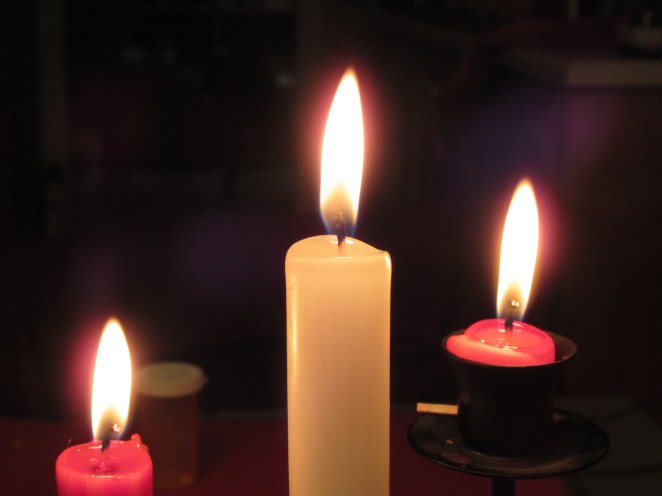
                              the candle
                                    burning

the clepsydra
     dripping all life away
          the pendulum
               swaying
                    back and forth …

26

… Westminster Chimes
     chiming the quarters
          church bells
               ringing out a warning

the hills alive
     alight
          with burning beacons

what new armadas
     sailing now off our coast
          what fireflies flicker
               their thunderous roar
                    frightening birds in trees
                         driving deer
                              into the woods

how many people
     cast forth like bread
          upon the waters
               to return ten-fold

hark to the bells
     ringing out again
          St. Clement’s
               St. Martin’s
                    the Old Bailey
hark to the children singing
     dancing in a circle
          never-ending
               until the music ends

and the last child
     is caught by
          the lowering arms
               trapped
                    a fish flapping
                         in the osprey’s grasp …

Commentary:

I wonder how many people still sing the children’s song about the bells of London? Images from it – intertextuality – occur throughout Clepsydra.

“Oranges and lemons,”
ring the bells of St. Clement’s.

“You owe me five farthings,”
say the bells of St. Martin’s.

“When will you pay me,”
ask the bells of Old Bailey.

“When I grow rich,”
sing the bells of Shoreditch.

“And when will that be,”
sing the silver bells of Battersea.

“I do not know,”
booms the great bell at Bow.

“Here comes a candle
to light you to bed.
And here comes a chopper
to chop off your head.”

The song appeared at children’s parties. Two of them joined hands, held their hands high, like London’s Tower Bridge, and the children, in a long chain passed beneath the ‘bridge’ as the song was sung. At the end, the children speeded up and they tried to avoid the last verse when the bridge’s arms descended and two children were caught. These then had to replace the original two gate-keepers and the game started again. At least, that was how I remember it being played.

It is worth remembering how violent in their imagery children’s songs can be. The games seem sweet, but they often have dark undertones, some going back to the Black Death – “Ring a ring a rosies, a pocket full of posies, atishoo, atishoo, we all fall down.” If you don’t know what that all signifies, go down the rabbit hole with Alice and the white rabbit and look it all up! And find out what a farthing is, and a penny farthing – go on – I double-dog dare you!

And remember – poetry carries its own meaning – or multiple meanings – and they are not always easy to find. Dig, my friends, dig. There’s gold in them there hills.

Empty Nest

Empty Nest

X marks the spot
where the energy ran out,
the moment when the tide turned
and water ebbed, and refused to flow.

A place… a time…the sudden scent
not of presence, but of absence.
The absence of movement,
noise, of that other body
that once walked the rooms,
opening and shutting doors,
windows, like a robin’s whistle,
a thrush’s trilled song…
gone now, gone, all gone.

We drift through silent sadness,
avoid each other’s eyes,
sit with our heads in our hands
or knit our fingers together
in desperate gestures
that express our emptiness,
the emptiness of an empty nest…

Commentary:

The poem speaks for itself, as a good poem ought to. Even bad poems speak for themselves sometimes. Amazing how empty the house seems when we sit in separate rooms, work at different computers, read in silence, or do the crossword or sudoku, miles away in time and space. And those little feet have gone now – not that they were that little this past visit. But holidays end, child and grandchild depart, the house returns to its former silence, and we are left to contemplate the emptiness of an empty nest.

Raven

Raven

When Raven flies through his trap door in the sky, a light bulb clicks off in my head and I fall into darkness. Is there some safety net before oblivion? Raven’s claws scar crow’s feet on a fingernail moon. His bleak black beak widens the hole in my head and the Easter egg of my skull shows thin blue cracks. Outside my window, the river moves backwards and forwards with the tide. Raven shrugs at cancerous creatures, promising nothing. He soars into clear skies in search of his private exit and extinguishes sun, moon, and stars, plunging our world into blackness. The light on the point picks out a heron, mobbed by a clacking ring of gulls. The sea mist wraps the real world tight in its cloak. Now sea and lighthouse, heron and gulls, are distant things of memory. Raven, shoulders hunched, stands like a stone, an anthracite block hacked out from the coal seam in my mind, hand carved from feathers and my forefathers’ blood.

Commentary:

I had forgotten all about this poem in prose. It comes from Fundy Lines, if I remember correctly. Photo credit (below) to one of my former students, an excellent poet herself, who took the trouble to locate the correct rock and then take a photo of book and rock together.


Moo thought his painting of a dark shape that looks a little bit like a bird of ill-omen would be just what this prose poem needed. Maybe he’s right. I trust him with his choice of paintings. Well, most of the time anyway. He can be a bit ‘off’ from time to time, but mostly we form a good team, especially where Surrealism is concerned.

I guess Raven formed part of my Surreal sequences. I really do enjoy Surrealism. The mixing of metaphors, for example, the unexpected meeting of a sewing machine with a carving knife and an umbrella on an operating table. And look what Raven’s up to. He discovers a trap door in the sky. Well, that would be very useful, if we had wings and could fly. Then he turns off the light bulb in my head. I didn’t even know I had one in there. I guess Raven, like coyote and zopilote is a bit of a Trickster. Next he changes into a woodpecker and widens the hole in my skull. Poor old me – avian trepanning – no wonder I have problems! My head becomes an Easter Egg and has cracks in it giving birth to what? Some mad ideas, I guess, pecking their way out into the wonderful world in which Moo and I live in perfect harmony with my beloved and our cat. And look at all those Welsh mining memories – lignite, house coal, steam coal, anthracite, jet – and remember, when the coal comes from the Rhondda down the Merthyr – Taff Vale line, I’ll be there.

It will be a long way from Canada to Taff’s Well. Maybe Raven will be kind and fly me there, through his Island View trap door that has direct access to the trap door just above Castell Coch, the Fairy Castle of my childhood. That would be faster, and easier, than my old two-wheeler Raleigh bicycle with it’s Sturmey-Archer three gear click on the handlebars. I bet Raven can fly faster than I can pedal. And if I could have pedaled as fast as Raven flies, downhill and uphill, I would have been King of the Mountains and an all time winner of the Tour de France. Now that would have been surrealistically surreal, seeing me as a cereal winner, with my snap, crackle, and pop! Not that my dad would have been happy. He never was happy with anything I did!

Cage of Flame

Cage of Flame

Now you are a river
flowing silver beneath the moon.
High tide in the salt marsh:
 your body fills with shadow and light.
 I dip my hands in dappled water.

Twin gulls, they float down stream,
then perch on an ice-floe
of half-remembered dreams.

Eagle with a broken wing,
why am I trapped in this cage of flame?
When I turn my feathers to the sun,
my back is striped
with the black and white
of a convict’s bars.

Awake, I lie anchored
by what pale visions
fluttering on the horizon?

White moths wing their snow
storm through the night.
A feathered shadow ghosts
fingers towards my face.
Butterflies stutter
against a shuttered window.

A candle flickers in the darkness
and maps in runes
the ruins of my heart. Eye of the peacock,
can you touch what I see
when my eyelids close for the night?

The black rock of the midnight sun
rolled up the sky.
Last night, the planet quivered
beneath my body
and I felt each footfall
a transient god.

When will I be released
from my daily bondage?

Commentary:

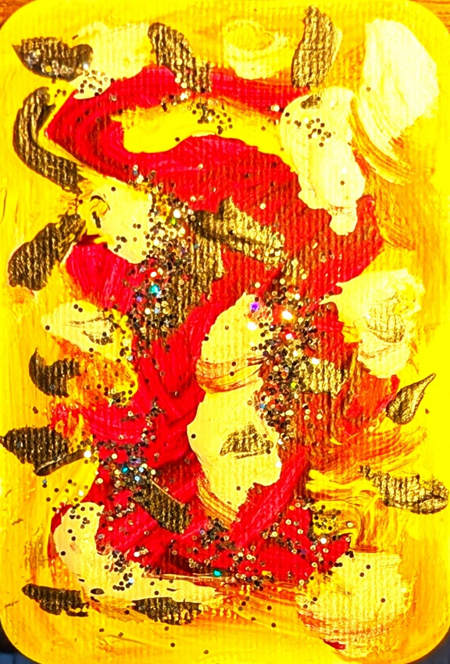
Moo reminded me that this poem also existed as a prose poem. here it is in prose layout. Think about it and let me know which version you prefer. Is one easier to read than the other? Do the rhythms come through more strongly in one version? Meanwhile, since he hasn’t painted a cage of flame, nor a river flowing silver, he suggested that if I really felt like the poem suggested I might feel like, then All Shook Up – with its warm, colorful flame images, might be just the poem to fit the crime. Better, he said than playing billiards on a cloth untrue, with a twisted cue, and elliptical billiard balls.

I wonder how many people recognize that little tip of the hat to the past glories of English Comic Opera? Since Canada post is on rotating strike – talk about twisted cues and elliptical billiard balls – then send your answers by highly trained snails (snail mail) or dog sled via whatever route still has enough snow for the huskies to haul on. Meanwhile, Ottawa has declared that the Maritime provinces are continuing with their suffering a buffering from lack of rain and severe drought. I do long for that river flowing silver, not to mention high tide in the salt marsh. We need water badly. And the sooner the better. Aquifers, rivers, wells, they all need filling.

Ah, the majestic game of cricket – and how I long for that summer test match curse – Rain Stopped Play. Or as the BBC commentator said on the radio one day – I heard him – “play has been stopped because of piddles on the putch – oh, sorry, I mean puddles on the pitch.” I wonder what Mr. Hugh Jarce would have thought of that. I know he always loved that old cricketing Chestnut – ‘The bowler’s Holding, the batsman’s Willey.” Unlike much wanted rain, it didn’t stop the match, but the commentators who perpetrated that jest laughed so much, the commentary stopped for nearly five minutes. Oh, the things one remembers as one gets old. Now, where did I put my glasses? I wonder if my beloved knows.

Cage of Flame

Now you are a river flowing silver beneath the moon. High tide in the salt marsh: your body fills with shadow and light. I dip my hands in dappled water. Twin gulls, they float down stream, then perch on an ice-floe of half-remembered dreams. Eagle with a broken wing, why am I trapped in this cage of flame? When I turn my feathers to the sun, my back is striped with the black and white of a convict’s bars. Awake, I lie anchored by what pale visions fluttering on the horizon? White moths wing their snow storm through the night. A feathered shadow ghosts fingers towards my face. Butterflies stutter against a shuttered window. A candle flickers in the darkness and map in runes the ruins of my heart. Eye of the peacock, can you touch what I see when my eyelids close for the night? The black rock of the midnight sun rolled up the sky. Last night, the planet quivered beneath my body and I felt each footfall of a transient god. When will I be released from my daily bondage?

Loss

Loss of …

By the time I remembered your name
I had forgotten your face,
and then I couldn’t recall
why I wanted to talk to you
in the first place.

Words and phrases bounce,
water off a duck’s back.

They sparkle like a high tide
rejected by the retriever
as he shakes his coat dry
on emerging from the sea.

This book I read is a word parcel,
a clepsydra of droplets
a rainbow strung with colored beads
each scoring a bull’s eye
on the world’s taut literary hide.

Mapa mundi of forgotten lands,
I trace dark landmarks
on the back of scarred hands
and wonder why I have never visited
faraway places with names
I cannot even pronounce.

Tourist guide to a failing memory,
I track the trails of drifting ships
as their white sails vanish,
blank butterflies from a distant summer,
floating over a darkening horizon.

Commentary:

I notice how my memory fails a little bit, day by day. I mis-spell a word. Forget a telephone number. Have to check a recipe three or four times – was it twenty minutes at 400F or 30 at 350F? Then I wonder how many spoons of sugar I put in my coffee. Worse, I forget whether I have taken all my tablets or not. I line them up in order, take them one by one, and still forget whether I took the last one or not. Oh dear.

I make shopping lists and check each item off as I put it in the cart. Then I check the cart to see if I did put the items in. Impulse buying. I haven’t seen Marmite on the shelves for some time now. So, every time I see it I buy it. Now I have four pots of Marmite in the cupboard. Animal Farm – Marmite good, Vegemite bad. And I can even say that in an Australian accent.

I forget words in English, but suddenly remember them in Welsh, French or Spanish. Then I forget them in the other languages as well. Last night I remembered callos in Spanish but forgot what they were in English. I had to ask my beloved and she reminded me that callos meant tripe. Great. I now knew what they were but I couldn’t remember why I wanted to know what they were in the first place.

This afternoon I looked everywhere for my glasses and then I remembered that I was wearing them. I have a little name tag that I wear when I go out. That way I will at least remember who I am. Now, I have just changed my coat – so where’s my name tag? As for my cell phone, I never call myself on it, so why should I remember the number anyway? I guess that’s it for now. I am sure I had something else I wanted to say, but I can’t remember what it was. Oh dear!

Alone

Alone

the longing
to belong
appears from
nowhere

I want
to lose myself
in something bigger
than myself

religion
can bite like that
church and altar
feast days
incense and candles
confession
repentance
forgiveness
then sin again

I am not religious
not in that sense

nor am I militant
right arm raised
goose-stepping
in a parade
each step in time
with every one else

if that’s the meaning
of belonging
I guess I’ll continue
to dream alone

Commentary:

Moo thinks that Princess Squiffy, out at the front of the parade, a solitary cat, all alone and on her own, would be perfect for this poem. I am not so sure. Everybody is so happy, so engaged, except for Princess Squiffy aka Vomit, who is vanishing into the woodwork – about to plan and execute her next act of sabotage, I guess. Yes, Vomit! She’s the one who throws up in my chair.

The meaning of meaning – such a simple phrase, such a complicated philosophical history. How does one ‘belong’? In what ways can one ‘belong’? Does one yearn to belong or long to belong? And what does it mean – to belong? Does my cat belong to me? Does my dog belong to me? Cat and dog are long dead now – so how can they belong to me? And when I am gone, all my belongings will belong to someone else. A strange world, eh? And yet I long to belong in it for as long as possible.

The two most dangerous words in the world – thine and mine. Cervantes wrote that somewhere. For thine and mine are possessives. They teach us to possess things, to claim them as ours. My house, my garden, my trees, my flowers, my lawn. With the drought that has occurred this summer and into the fall, I can no longer say my lawn, my flowers, my garden, for they have all dried up and marched along, privatim et seriatim, – a touch of Kipling there, Storky and Co. if I remember correctly, and I don’t, because I just checked and it’s Stalky not Storky! – into whatever happy gardens dead flowers and gardens inhabit in their after life.

I think one of the most dangerous games ever invented is Monopoly. Make no mistake, I love my Monopoly set – especially the top hat and the flat iron – but what do we learn from Monopoly and from all similar types of game playing and role modelling? Why, to gather everything into our hands hands and possess everything on the Monopoly Board. At least when we play chess, we defeat an opponent by check-mating his / her king. We don’t have to accrue all 31 pieces on our side of the board leaving the poor king alone on the other. Even Fox and Hounds – and that’s an impossible game to win when you’re the fox- doesn’t humiliate anyone in quite that fashion. Ah well, the meaning of the meaning of Monopoly – Happy Canadian Thanksgiving – we can all have a good rant about that one.

My First Thanksgiving

My First Thanksgiving

For the first twenty-two years of my life,
Thanksgiving had no meaning, no substance,
no shape, nor form, nothing to hold me.

When I emigrated to Canada,
my Canadian cousins changed all that.
when they invited me to come to
Kincardine for Thanksgiving.

They served a traditional Thanksgiving Dinner
with vegetables in colored jellies
and all sorts of things I had never seen.

We were all surprised
at how alike we looked.
Like Cousin George in Vancouver,
or Cousin Elsie in Revelstoke.

They told me how WWII
had brought the family back together
on these special holidays –
Christmas in Wales for the Canadian troops
or Thanksgiving in Winnipeg
for the Welsh boys learning to fly.

That thanksgiving, the old family names
turned into photographs before me.
Snaps of my mother’s wedding,
my grandmother holding me on her knee.

And finally, as a special Thanksgiving gift
a long-distance phone call to Britain
and Clare on the phone saying
yes she would come to Canada
and yes she would marry me.

And I remember crying
all the way back from Kincardine
to Toronto and that was my first
Thanksgiving in Canada.

The Screws

The Screws

There is no science to sciatica,
just a series of sensations
most of them involving pain.

I don’t know how or when it comes,
but one day, it knocks on your door
and makes you clutch back and buttock.

It’s like a hawk at the bird feeder,
flown in from nowhere to shriek
and shred, unawares, one small bird.

Was it the flannel I dropped yesterday
when showering?  I stooped to pick it up,
lunged forward and, was that it?

The pain came later. It kept me awake
all night, my worst nightmare.
No comfort anywhere. An endless

wriggling and every movement a knife
blade stabbing at my buttock and groping
its slow, painful way down my leg.

The screws, my grandfather called it,
a metal screw screwed into his leg,
leaving him limp and limping.

I googled it today, sciatica, and they
suggested an ice pad for twenty minutes,
repeated twenty minutes later.

“Yes,” I muttered, “yes” and found
in the fridge the ice pack we used
to use in our Coleman’s cooler.

My beloved helped me undo my pants.
“This,” she said, “will be icing on the cake.”
“No,” I said, “it will be icing on the ache.”

Tomorrow, I will call the pyro-quack-tor.
She will bend me to her will, straighten
my back, cure the pain, set me right again,
provided she doesn’t read this post
and will permit me to enter her domain.

Commentary:

Moo doesn’t paint pain, even though it occasionally emerges in his paintings. This painting of his is called Grey Day and I guess a Grey Day is rather like a Blue, Blue Day, something to be avoided, because you feel like running away. And that’s the problem with “The Screws” – it’s hard to face the pain when it’s behind you, unless you are a contortionist and can twist and twirl and see yourself in the mirror. I suppose another solution is to have eyes in the back of your head, but not everyone is that gifted.

As for the pyro-quack-tor, my apologies, Chiropractor, mine is excellent. I limp into her office, crawl onto the medical bed, and then, thirty minutes later, I hop off it like a man reborn, and skip down the corridor, waving my sticks and grinning as if I were a Gorilla in heat. Oh dear, not the sort of condition in which one should drive the zoo bus!

As for my joke – “This,” she said, “will be icing on the cake.” “No,” I said, “it will be icing on the ache!” This takes me back to my old school days – Aix-les-Bains / Aches and Pains. I remember one of my school friends going to Baden-Baden for his summer holiday. A double-barreled name, wow, very foreign. He asked me where I had been and I replied “Cardiff-Cardiff – this is Cardiff.” They used the English version back in those days, not the Welsh one – “Caer Dydd – Caer Dydd.” Doesn’t sound quite the same in Welsh. And how about Cas Newydd – Cas Newydd [Newport] or Pen y Bont – Pen y Bont [Bridgend]. And let’s not get into Llanfair.p.g – Lanfair.p.g – [Llanfairpwllgwyngyllgogerychwyrndrobwllllantysiliogogogoch – Llanfairpwllgwyngyllgogerychwyrndrobwllllantysiliogogogoch].

Try saying that one twice in quick succession. You’ll be sitting in the railway station a long time, just waiting to find out where you are. That, of course, is if trains still run to Llanfair p. g. “Gentlemen will please refrain from …. ” and if you can finish that little ditty off, in public, you have more courage than I do! Besides which, my voice broke long ago, and I haven’t mended it yet!

St. Mary Redcliffe

St. Mary Redcliffe

Time and Temple Meads
have begrimed your wand-thin spire,
the tallest in England.

You waved goodbye
to the Cabot boys,
Nova Scotia bound,
as they set sail.

Starling lime your belfry,
gift and inspiration
of Merchant Adventurers,
that gentlemen’s company.

Worms wriggle and gnaw
at your ship’s figure-head,
harbored now, bare-breasted,
sturdy in your oak-beam nave.

Rust rustles and creaks
at the Edney Gates,
wrought to last centuries
by Bristol ironmasters,
themselves apprenticed
to learn time’s laws.

Commentary:

Yesterday, via Zoom, I met with the Canadian Alumni of Bristol University. Sarah Price (Bristol Alumni Association) and Heather Proctor (Alumna) set the meeting up for us. Golden Oldies, all of us, we sat there and reminisced about our days, so long ago for most of us, at Bristol. I graduated in 1966, the same year I came to Canada. Most of the other alumni graduated long before I did. My last visit was in 1986 when I met with the Spanish Department, much changed, and talked abut my most recent research. One alumnus had visited just last year and talked of his returning to his old hall, his old room, his olde department, and all the changes that he had seen.

Most of those gathered had been in halls of one sort or another. Their experiences and friendships seemed very different to mine. Digs out in Knowle, Bristol, my first year. Then rooms in a rooming house, up by the Clifton Suspension Bridge, with other members of the Cross-Country team, for my next two years. Summers in Spain and France distanced me enormously from both England and the university. I remember coming back from Spain one summer and standing at the bus stop in Clifton, waiting for a bus to take me to Temple Meads Railway Station, a Number 18, if I remember correctly. Well, the bus arrived and drove towards me at enormous speed. It didn’t look as if the driver had any attention of stopping. So, I ran out into the road, waving my arms. He braked, gave me a very strange look, and asked me what I wanted. I said I wanted to go to Temple Meads. He said well get on the ****ing bus then. I looked at a great expanse of green metal, with windows, but no door, and asked him “Where’s the door?” Of course, after three months in Spain, like an idiot, I was standing on the wrong side of the road, and the wrong side of the bus. Such bitter-sweet memories.

I suppose I wasn’t a very good student. My only talent was speaking Spanish fluently. I worked hard at that, completely immersed in Santander, playing soccer on the sand, wandering through bars at night, learning to drink from a porrón and a bota without disgracing myself, and fishing on the weekends for panchos and julias in the Bay of Santander. I also learned how to row an old battered row boat, un bote. And it was all marvelous fun.

I also wrote a great deal of poetry and even managed to publish regularly in the Nonesuch Magazine. St. Mary Redcliffe, the poem above, dates from those days. I loved that church and visited it regularly. I wonder how many other Bristol students went in there and walked around inside. I also wonder how many stood with Jorge Luis Borges by the polished, black slate of the city hall, with its coal mine on the green, and gazed at their reflections in those shiny azabache mirrors. As I wrote yesterday on my blog – “How much can we know, your life of mine, my life of yours? At what point do those twin railway lines meet at the edge of time? Or are they doomed to a parallel universe where mind and mind, rail and rail, neither meet nor understand?” Sometimes, we can take a great joy in working out the answers to such questions. 

Clepsydra 22

22

… winds kiss words from lips
      sand creaks
           squeaks underfoot
                    creeps between dry toes

the sand cleanses
     purges
          brings closure
               each magnificent moment
                    lighting a candle

is this beach an altar
     under the rocks’
         shadow church
              it doesn’t matter

mindfulness
     holding each memory
          each piece of colored glass

wave after wave
     climbing ashore
          washing footprints
               memories away
                    closing
                         door after door …

Commentary:

“Wave after wave climbing ashore, washing footprints, memories away, closing door after door.” Everything turns out in black-and-white – here a crow, there a seagull. What does each say to each, when they meet upon the beach? Silence and stillness. No sound of wind or wave, no sign of the tide rising or falling, and what do the birds say to each other, when they meet like this? Two solitudes, mine and thine, and somehow the silence must be broken, or in our separate solitudes we will remain. What if I open my solitude and show it to you? Will you then open yours and spread it willingly before me? Or will you turn away, crow spurning seagull and there’s no going back.

And did my feet, in ancient time, walk upon the beach in Santander? Did they wander over the cliffs at Cabo Mayor? What did I say to the sands in Swansea Bay when, sitting on the steps by the railway station, I dusted the sand from between my toes, placed socks upon my feet, and did up my sandals? Private places, private memories, private conversations live on in the privacy of my head.

A dozen heads, all crowded onto the computer screen, zoomed in so they can be together for an hour or two, repeating their memories to each other – how much did they really share? How much can we know, your life of mine, my life of yours? At what point do those twin railway lines meet at the edge of time? Or are they doomed to a parallel universe where mind and mind, rail and rail, neither meet nor understand? Tell me, if you can, what the crow thought of the gull when they met, that morning on the sand.