Do lazy days make you feel rested or unproductive?

Daily writing prompt
Do lazy days make you feel rested or unproductive?

Do lazy days make you feel rested or unproductive?

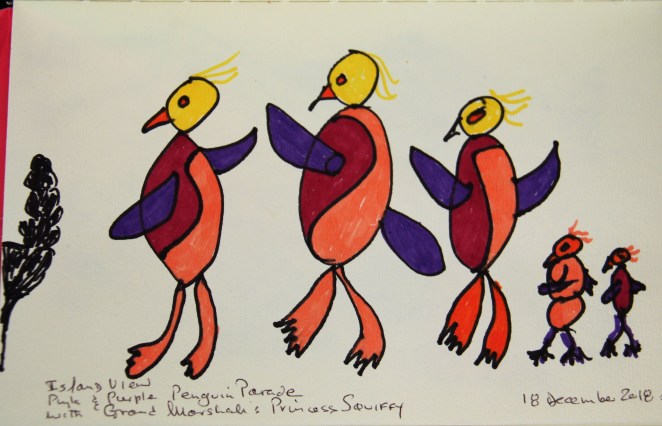
How on earth do you define a lazy day? If a Lazy Boy is a chair, what is a Lazy Day? Is it something like a Lazy Rocker? Or a Lazy Twister? ‘Come on, let’s twist again’! Is it no more than a lazy, hazy, crazy day of summer, as the song would have it? In which case, is it possible to have a lazy day when summer has gone, the days grow cold, and autumn is on the way? And who is having the lazy day, anyway? And is that a lazy painting I see before my eyes?

Enjoying retirement, as I am, busy or not, I feel quite rested, most of the time. As for being productive or unproductive, well! I feel productive when I post an answer to a blog prompt. So today, I am being productive. Ipso facto, I suppose I am not being lazy, though the sun is shining outside, the leaves are actually staying on the trees, after the overnight frost, and are not hurrying and scurrying and busying themselves in falling to to the ground. It’s a lazy leaf day – they are definitely not being productive. If they were, they would be littering the yard for me to tidy them up and then they would be productive by making me labour, and I would not be having a lazy day, because I would be busy picking up the leaves, putting them into piles, then waiting for the busybody wind to stop being lazy and to interfere with my work and scatter leaves around the garden again.

So, back to the original prompt – Do lazy days make you feel rested or unproductive? Let us give a totally non-committal, political answer – after all, it is the election season – and say – “It depends”. It depends on the multiple meanings of a lazy day, rested, productive, or unproductive. If the hen doesn’t lay an egg, is she being lazy and unproductive? Or does she feel fulfilled and rested? I could ask any one of the dozen or so eggs I keep resting in the fridge. Oh boy, do they have a restful time, lying there, eggs-in-waiting. And what are they waiting for? That joyous moment when they appear in public, are cracked open and whisked into omelets or scrambled like the brain – rested, rusted, busy, productive or unproductive – of anyone so twisted that they would write anything like this in response to a simple prompt. A simple prompt, you say? Now that’s a great departure point – what do you mean by a simple prompt? Answers on an egg-shell fragment please!

Ah yes, it’s another busy, productive day and my scrambled brains, like the scrambled eggs I devoured for breakfast, are all as busy as little bees can be, even though the bees are now out of season and there are none left in the garden. And with that I bid you farewell, au revoir, or is it adieu? I’m too lazy to care? Please choose whichever buzz word suits you best!

Solitary

Solitary

They drove me there,
passed through the gates,
unpacked my trunk,
chatted with the head,
shook my hand,
then drove away.

The metallic clang
of the closing gates
still lives with me.

How old was I?
Six? Seven?
I no longer know
and there’s nobody
left alive to tell me.

I remember so well
the woodgrain on the desk,
the carved initials,
the loneliness that bit,
the barred windows
of that empty classroom.

Comment:
Looking back, I wonder just how and why I ended up in a series of boarding schools, starting when I was only six years old. What does that abandonment do to an only child, taken away, and left among strangers? I still have nightmares and wake up screaming, from time to time.

Why, why, why? The pinball of doubt bounces round the interior of my head as I struggle to plot different paths, different ways, how life could have, might have, been so different.

I guess that schooling, force fed, made me what I am. But then the pin ball starts again – what am I? Who am I? Why am I? And how did I become whatever it is that I became? Mea culpa, mea culpa, mea maxima culpa – was I then the one to blame?

A Touch of Frost

A Touch of Frost

1

Cooler nights
have brought
a touch of frost
to higher ground.

At night,
temperatures fall.
By day,
they build.

I watch as Autumn,
finger on lips,
tiptoes
through the garden.

2

With a wave of its wand,
winter threatens.

A gust of wind
swirls the leaves,
bears tufts of snow
dancing round the tree.

I watch
as my grandchild grows,
my child grows older.

She has a gentle
touch of frost,
a grey fringe
at the curl’s roots.

When I glance
in the mirror,
I see the full effects –
drifts of snow
gathered on my head.

I look
at my beloved.
Her hair –
a crab apple tree
in full spring bloom.

Comment:
Nice to add a new poem of my own to this poetry page. Today’s poem came as a result of discovering Moo’s painting – A Touch of Frost. Painting and poem, painter and poet – a great collaboration.

What are you doing this evening?

Daily writing prompt
What are you doing this evening?

What are you doing this evening?

This evening, I am thinking about how September is the month in which academics, thinkers, and philosophers, as well as everyday people, can be reborn. I wrote this article 25 years ago. Re-reading it now, I am amazed by its clairvoyance. Here are my thoughts from way back then.

“September Renaissance: The Annual Adventure of (Re)Creating the Individual.”

This address was delivered to faculty at MOUNT ALLISON UNIVERSITY on 07 September 1999. It is a revision (and an extension) of the adress I delivered to students at St. Thomas University during the inaugural speech delivered to the incoming class of students by the winner of the St. Thomas University Excellence in Teaching Award.

Tomorrow, 08 September, 1999, is a very special day for me, and I would like to share my Special Day with all of you.

“A Special Day?” you think. “It must be his birthday.”

But no, it’s not my birthday. Could it be my Saint’s Day then? If we were in class, and you were all students, I would see some puzzled faces. A hand would be raised: “Please Dr. Moore, what’s a Saint’s Day?”

I would smile at the student brave enough to ask that question. “Good question!” I would say. “When one person asks a question, class, there are twenty people in the room, perhaps more, who wanted to ask that question, but did not raise their hands because they were afraid to do so. Never be afraid to ask questions. Question everything. Question everyone. Ask questions all the time. That, in part, is what you are here for: to ask questions and to learn to ask the right questions.”

So: what is a Saint’s Day? Well, in Spain, people often have two celebrations a year: their birth day and their Saint’s Day. Their birthday is, of course, the day they are born; their Saint’s Day is the Feast Day of the Saint after whom they are named. That was a good question, class, and you have gained a little knowledge! But No! It is not my Saint’s Day.

Why is today such a special occasion for me? Again, if this were a classroom I might, at this stage, do one of several things:

  • I might divide you into groups and ask you to discuss the question;
  • I might turn on a video;
  • I might access the classroom computer and show you a multi-media presentation;
  • I might give you a lecture or a talk or a question and answer session, much as I am now doing;
  • I might send you to the library to find out the answer for yourselves;
  • I might send you to the computer room to surf the net in search of an answer;
  • I might ask you to work together on an interactive listserve and let others help you access the information;
  • I might send you home early with reading material for the next class;
  • I might send you home to watch a specific television program;
  • I might set you the question as a Problem Based Learning Group Research Project (written answers on my desk, tomorrow, by 3:15 pm!);
  • I might ask you to write your essay in a journal page or in a researched essay (due in six weeks time, with annotated bibliography!);
  • I might ask you to tap in to your subconscious and freewrite around the question for fifteen minutes;
  • I might tell you to do some thinking and asking around, because that specific question will be on the final examination;
  • I might ask you to design a poster or your own multi-media presentation demonstrating the meaning of the question and several possible answers …


… Clearly, there is no right or wrong approach and there are many ways of dealing with what is, on the surface, a relatively simple question. You are using many of these approaches in your own classes here at Mount Allison University and I do not presume to tell you that one way is right and another wrong. So much depends on the shifting relationships between teacher, learner, class size, class maturity, work capacity, research resources, and subject matter. At Mount Allison you have a national reputation for the excellence of your students and of your faculty. You have proved over a long period of time your ability to distinguish between the more important questions and the correct research and investigation procedures; above all, you know how to choose those that are most suitable to you and to your own students.

Since this is NOT a classroom, since you are not my students, and since I would have great difficulty in dividing you up into small groups so that you could discuss why tomorrow is such an important day for me, I will provide you with the required answer: TOMORROW, September 8, 1999, is my RE-BIRTH-Day! Tomorrow, I celebrate the day of my RE-BIRTH. Thirty-three years ago tomorrow, I was RE-BORN.

Permit me to share with you the matter of my RE-BIRTH!

It came about like this: On September 8, 1966, I got up at 4:00 am, ate a light breakfast, packed my suitcases into my father’s car, and headed for Heathrow Airport, London. There I boarded BOAC Flight 1040 and at 3:00 pm that afternoon I landed in Toronto, Ontario, Canada. By 3:15 pm, I was passing through Canadian Customs and Immigration and by 3:30 pm, I was RE-BORN as a Canadian.

This RE-BIRTH was not an easy process. It took me a long time to learn to act, think, and speak like a Canadian. It also took me a long time to realize that while the Canadian within me was growing stronger every day, other parts of me, even when they were rigorously maintained, were beginning to die. Thus, at the same time as I celebrate my RE-BIRTH as a Canadian, I mourn the gradual passing away of my Welshness, the slow disappearance of my Welsh family, the fading of my Welsh friends, some of whom I have not seen in more than thirty years.

Yes! I was RE-BORN 33 years ago tomorrow. But this is not the only RE-BIRTH that I have undertaken. There have been many other rebirths:

  • 28 years ago, I emigrated from Ontario and was RE-BORN as a New Brunswicker;
  • 27 years ago, I left the University of New Brunswick and was RE-BORN as a St. Thomas University professor;
  • 24 years ago, I was RE-BORN when I graduated with my PhD and was officially no longer a student;
  • 5 years ago, when I visited the Dominican Republic, I was RE-BORN as a conscious critic of certain neo-colonial policies and attitudes towards Developing Countries; in the DR, incidentally, I was also held up at gun-point — and surviving THAT little incident certainly guaranteed an instant RE-BIRTH which I celebrated in the closest bar!
  • 4 years ago, in December 1995, I was RE-BORN as a pseudo Professor of Education when I visited Oaxaca, Mexico, as part of what was later to be called the St. Thomas University – University of New Brunswick – Universidad Autónoma Benito Juárez de Oaxaca Faculty Exchange Program;
  • And tomorrow, on September 8, 1999, as I celebrate the 33rd anniversary of my being RE-BORN as a Canadian, I am in fact in the process of being RE-BORN yet again.


I will explain how in a moment. Meanwhile let me say that along with the pain and struggle for RE-BIRTH come various things:

  • PRIDE: in the fact that I, along with everyone else in this room, can achieve RE-BIRTH;
  • HUMILITY: in the knowledge of how fortunate I am, together with all of you gathered here in this room today, to be counted among those who are still capable of RECREATING their lives and of being RE-BORN;
  • RESPONSIBILITY: in the knowledge that when we are RE-BORN a new set of duties falls upon our shoulders;
  • ENERGY AND ENTHUSIASM: in the knowledge that I, like every one of you, am capable of sharing the secret of my RE-BIRTH with the students who come to my office and my class almost every day in search of the new selves which they wish to create for themselves.


This summer, to prepare myself for this Fall’s RE-BIRTH, I did the following:

• I revised all my courses;
• I attended the University of New Brunswick Multi-Media Institute for three weeks and completed my Certificate of Multi-Media Studies;
• I reconstructed, with the aid of Clare (without whom I would not be here today, but perhaps I’ll tell you more about that later), my web page;
• I (re)commenced my annual summer reading program to update my thinking.

I say all this to assure you that I know as well as you do that knowledge is not a solitary, self-contained unit which, once attained, stays with us forever. Knowledge is an ongoing process; learning is a lifetime commitment; you, as faculty, teach at Mount Allison University, as I teach at St. Thomas University, not just to earn a salary, but to continue a life-long commitment to teaching and learning. If you are like me, you love the sheer process of teaching and learning; you love the contact with young, developing minds.

I try always, as I am sure you do, to encourage my students to start their life studies with us at St. Thomas and to continue their life studies when they leave university. We do not say “Learn for four years and then you can stop learning for you will have all the knowledge you will need for the rest of your lives.” At least, I hope we don’t.

And it is the same thing for us, as faculty. For we, as faculty, are actively involved in our own ongoing research and scholarship, some of which we publish and some of which we use in our classes; research moreover, without which the knowledge we share with our students would be a dead package, taken from our notes, and handed over without thought or revision, or consideration, to the next generation, much as certain forms of knowledge were handed to me when I was an undergraduate by some of the teachers de cuyos nombres no quiero acordarme / by teachers whose names I do not wish to recall, to borrow the famous words with which Cervantes opened perhaps the world’s greatest novel: Don Quijote de la Mancha.


So what did I read this summer?

Amongst other things, I read about the RENAISSANCE — the RE-BIRTH of Western Civilization in the 15th and 16th Centuries; I also read about the REFORMATION that came about as a direct result of the challenges and questions posed by the RENAISSANCE; and I read about the COUNTER-REFORMATION that sprang up as a reaction to and dialogue with that first REFORMATION.

I also realized, not for the first time, the similarities between our own age and that of the RENAISSANCE. The RENAISSANCE, as Marshall MacLuhan pointed out in The Gutenberg Galaxy, was a time of new ideas and new technology; in addition, a radical change occurred in the paradigm of man’s learning and thinking. The known world was expanding with the voyages of discovery that set out to East and to West. Man’s view of the universe changed with the various discoveries in optics that allowed us to see objects in space larger and in more detail than ever before. This led, of course, to the concept of the heliocentric universe, where human beings were displaced, away from the centre of creation; a new concept for the Church, and one that they fought against bitterly at the time.

In the same period the printing press had an enormous influence on the dissemination of knowledge, and totally changed peoples’ ways of disseminating, creating, receiving and perceiving written information. It is very difficult for us to understand, even today — perhaps especially today — the impact of the printed word on a semi-literate society in which, again according to Cervantes, groups of people would gather in the evenings to have books read out loud to them by the one or two people in the village who could read. Walter Ong has described this process to us in Orality and Literacy, another book which I (re)read this summer. Suffice to say, that for us, as a television generation, it is difficult to understand the initial impact of radio upon our parents and grandparents. For the new generations of students emerging today, it is difficult to imagine life without the instant communication of television, telephone, email, and computer.

In many ways, the impact of print must have been similar to the impact of the electronic technological revolution which we are going through today. And one thing I know for certain, after completing my Certificate in MultiMedia Studies: none of us are aware, nor will we be fully aware for a long time yet, of the full impact of the electronic technological revolution upon the hearts, souls, intelligence, and minds (not to speak of the wrists and eyes) of those who use it and of those who are now growing up, many of whom know no other way of accessing information.

The paradigm of knowledge and technical skill is still changing and developing explosively; as a result, we are still unaware of exactly what can be achieved by the new media. Take computer chess, for example. Chessmaster 2000 had approximately 150 games programmed into its chess library; Chessmaster 4000 not only has 1500 games programmed in, but also presents us with games in which Karpov commentates in digital audio his own moves in his own matches!

Yet, in spite of this tremendous rate of progress, few of us who follow Chess would have dreamed that Deep Blue, programmed by a gentleman from Clare’s home town of Bournemouth, would thrash Karpov, the world chess champion from the Soviet Union, only a year or two down the road. Nor can we understand the extremely rapid progress that leads us in a matter of months, to see the memory banks in a pc clone expand from 1 gig of memory to 4 gigs of memory, to 6 gigs of memory, to the 10.6 gigs of memory that Dell is advertising in its latest computer sales. In some ways, it is like the 10, or 12, or 14 zeros that are now following the initial figures in the MEXICAN FOBAPROA SCANDAL: so many zeros that the concept of the magnitude of the debt is beyond the understanding of most of us.

In our day, then, as in the Renaissance, the paradigm of knowledge is expanding explosively. Knowledge in the Renaissance evolved so quickly that few individuals were capable of grasping the full meaning of the REVOLUTION, the RENAISSANCE, the REBIRTH which they were observing and in which they were involved. In fact, the RENAISSANCE BATTLE OF THE BOOKS or the continuing discussions between the ANCIENTS AND MODERNS were very similar in many regards to some of the discussions regarding the FUTURE OF EDUCATION that we are holding in all the Atlantic Provinces Universities right now. Authority or Innovation? The old ways or the new? Technology or Tradition? Whatever side we come down upon, these discussions are good for us all for they mean we are alive and thinking and that our knowledge is not a dead but a living thing.

This summer, I also (re)read Mikhail Bakhtin; I believe with him, that human beings can live in a DIALOGISTIC RELATIONSHIP WITH THEIR CHRONOTOPOS — that is to say, in less Bakhtinian language, that people can hold a dialogue with their time and their space, a dialogue which can bring about change, new directions, new commitments, in short, a RE-BIRTH.

And now, from Dialogue to Drama: Wayne C. Booth, in Freedom and the Individual (the Oxford University Amnesty International Lectures of 1992) wrote that we are all individuals, writing the drama of our own lives; each student’s entrance to Mount Allison University, in Wayne Boothian Theory, is a chance for that student to begin his or her play again; all students can rewrite their roles and their characters; as we can rewrite our lives and our roles. In short, each one of you can, like me, be RE-BORN. And believe me: September is the month in which this ANNUAL REBIRTH can and should take place.

I also read several books on the THEORY OF TIME: sidereal time, atomic time, linear time, instantaneous or contemporaneous time … many of the courses I teach at St. Thomas University are based on linear time: each term, they progress steadily from Day 1 to Day 36; however, our lives as teachers and learners are also based on seasonal or cyclical time. For teacher and student, the learning and teaching cycle begins anew every September; this is the time of the SEPTEMBER RENAISSANCE or RE-BIRTH. September then is the month for us ALL to be RE-BORN.

In some ways, the most important books I read this summer were all written on or about don Francisco de Quevedo. These books no longer have a single author. We are no longer dealing with one person’s ideas. Thus, although Pablo Jauraldo Pou’s name adorns the edition of the latest and best biography of don Francisco de Quevedo, Quevedo’s life has actually been researched by an extensive team of scholars, students, and friends, so large, that only the most important dozen or so can be acknowledged. The same is true of James O. Crosby’s edition of the Sueños, or of Ignacio Arellano and Lia Schwartz Lerner’s edition of the metaphysical poetry, or of Crosby and Jauralde’s edition of Quevedo y su familia en setecientos documentos notoriales, a compendium of legal documents concerning the Quevedo family which runs from 1572 to 1724.

In fact, when a single author, not a member of a team, writes on Quevedo nowadays, it is to offer a study of just a small portion of the author’s work. In this fashion, Josette Riandière de la Roche’s Nouveaux documents quévédiens: Une famille à Madrid au temps de Philippe II deals with a very short time period and only a selected aspect of the life of the poet. In similar fashion, Santiago Fernández Mosquera’s La poesía amorosa de Quevedo: disposición y estilo desde CANTA SOLA A LISI deals with only one aspect of Quevedo’s poetry, that of the love poems seen in the light of the sonnet sequence to Lisi.

TEAMWORK: it is becoming more and more necessary to work as a member of a team in order to keep up with the knowledge explosion with which we are confronted. I once said, tongue in cheek, that a TIER 2 CIDA GRANT APPLICATION demands the construction of a team. You need

  • a reader who specializes in how to read the AUCC / CIDA guidelines as they change from year to year;
  • an interpreter who specializes in what the current buzzwords are in government circles actually mean and how to use them in your documents;
  • an accountant who specializes in cash flow, international money transfer, and book balancing;
  • a manager who specializes in Results Based Management or whatever form of management system is the current government buzz word;
  • this manager must also have organizational skills to link the various parts of the application to the Results Based Management that is currently demanded by AUCC/CIDA.

Further, the manager must have people skills in order to hold the team together when things are going badly or well, for triumph and disaster, as we well know although both impostors are ever present when applying for Grants from Government Sources; you also need

  • a writer who specializes in writing up the final text so that it will convince the granting authorities that you, the applicant, another often forgotten member of the team, actually knows what you are doing;
  • finally you need what I call a people person or a wheeler – dealer who will get out there and make the appropriate contacts and find out who are the current movers and shakers and who will actually give you the internal promotion that your CIDA GRANT needs if the application is to be successful.

I would also suggest, perhaps not totally tongue in cheek, that a similar team approach to the writing of SSHRCC GRANTS FOR THE HUMANITIES would not be a bad idea.

TEAMWORK: As I said earlier, I completed my Certificate in MultiMedia Studies at the University of New Brunswick this summer. One of the things that I learned was the importance of teamwork in computing.

In our first SCENARIO FOR A CASE STUDY this summer, for example, we were required to design and build a commercial web site. Of course one person can build a website, and a pretty good one at that. But the studio team which we were given consisted of

  • a graphic artist,
  • a sound engineer,
  • a creative director,
  • a computer tech,
  • a multimedia specialist,
  • a photographer,
  • a specialist in digital photography,
  • a graphics designer, and
  • a colour specialist.

We did not have digital video capacity and were forced to contract digital video out. Costing was also a major part of the exercise: how many people, how many tasks, what order for the tasks, how many hours, how much time, how much money! I repeat: the new paradigms of knowledge that are developing around us will be demanding more and more teamwork from us.

I will end this brief presentation by reminding you that this fall, on Saturday October the Sixteenth, 1999, to be precise, the Atlantic Teaching Showcase will be coming to St. Thomas University, Fredericton. I hope to see some of you in St. Thomas, at that meeting. I am, as many of you know, the Chair of the Atlantic Association of Universities Teaching Showcase for this year.

However, I have not arranged the Showcase on my own. On the contrary: I have gathered a team of faculty and together we are working towards the Teaching Showcase. In fact, I have one person looking after finances, another looking after registration, another building a website, another looking after catering, another looking after audio visual equipment, another booking rooms, another organizing the program, another recruiting and organizing student help. We have planned and arranged the program between about eight of us.

An exercise in teamwork, no less.

I know that in all that I have said so far today, here at Mount Allison University, I am talking to people who know as much as I do, or more, about all these things: REBIRTH, RENAISSANCE, TEAM WORK, COLLABORATION. For a very long time, I have been impressed by the quality of Mount Allison’s teachers and by the quality of Mount Allison’s students.

In five weeks’ time, at the Atlantic Association of Universities Teaching Showcase, there will be a session entitled “WORKING TOGETHER: MODELS OF COLLABORATION INSIDE AND OUTSIDE THE CLASSROOM.” This particular session is a perfect example of the type of teamwork I have been talking about today. The session was presented to me in its entirety as a proposal for a single session incorporating 4 papers and some interactive discussion. The session will have a 90 minute slot and I very much hope to be present for what promises to be an exciting time. The session currently consists of a series of four papers, as follows:

  • “Mixing media: High Theory, Low Culture (or Inviting Popular Culture into the Classroom”;
  • “Collaborating with Students: Sharing Power over Syllabus Design”;
  • “Interdisciplinary Collaborative Project: A Model”;
  • “Beyond Discipline: Facilitating Collaborative Student Research”.

The session organizers are all associated with Mount Allison University and I would like to congratulate Professors Pat Saunders-Evans, Deborah Wills, Robert Lapp, Jeff and Ausra Burns on the hard work they have put in to an excellent integrated proposal.

Imitation, they say, is the best form of flattery. I have stood here today and spoken to you and you have kindly listened to my words. Tomorrow, I will spend part of my RE-BIRTH-DAY with you, here at Mount Allison. I have been invited to attend your Learning and Teaching Development Workshops, and I hope to take back to St. Thomas University some of the excellent ideas on which you are working here on campus. You are nationally and internationally recognized leaders in your field. Tomorrow, it will be my turn to listen to, and learn from, you!

Thank you for inviting me here.
And thank you for listening.

Scour the news for an entirely uninteresting story. Consider how it connects to your life. Write about that.

Daily writing prompt
Scour the news for an entirely uninteresting story. Consider how it connects to your life. Write about that.

Scour the news for an entirely uninteresting story. Consider how it connects to your life. Write about that.

Scour the news – what on earth does that mean? Let’s begin with scour – If you scour something such as a place or a book, you make a thorough search of it to try to find what you are looking for. Rescue crews had scoured an area of 30 square miles. Synonyms: search, hunt, comb, ransack. Search, hunt, scour, ransack – well? Which one are you after? And how long have I got? Question: what am I looking for? Answer: an entirely uninteresting story. What a tremendous waste of my time. And, when you get to my age, time is precious.

As for the news, well, what on earth do you mean by that? I speak several languages fluently. Am I looking for an entirely uninteresting piece of news in all of them? As one of the Two Ronnies used to say “You’re having me on, aren’t you? You’re having me on.” Let’s just stick to one language – English. Then let us ponder for a moment the meaning of the news. How many newspapers do you wish me to purchase and peruse? I am not a millionaire, you know. Or do you want me to listen to the news on the radio or the television? If so, how many channels? How about sending me online? I love the thought of that. There are thousands of websites out there filled with all kinds of news, good bad, indifferent, fake, artificial? And you want me to scour them all in search of, and I quote “an entirely uninteresting story”! Pull the other one, as the old comedians used to say, ‘”it’s got bells on”.

I’ll tell you what I’ll do. I’ll scour your prompt, that’s what I’ll do. Having given it a brief analysis, I declare it entirely uninteresting. Next I’ll consider how it links to my life. Well, sorry, it doesn’t. If I were to follow it through, I’d be sitting here for hours, wearing my fingers out on the keyboard. So, what’s the link between your prompt and my life? A total waste of time, that’s what. Sorry, I have better things to do with my life. Like reading Shakespeare – “Friends, Romans, Countrymen, and prompt readers, lend me your shovels. I come to bury this prompt, not to praise it.”

Here endeth the lesson and the prompt.

What are your future travel plans?

Daily writing prompt
What are your future travel plans?

What are your future travel plans?

When Covid struck in Avila, Spain, a small walled city, the abulenses (the Spanish name for people who live there) were confined to their houses and apartments. They got their exercise by walking on their balconies, or walking around their living quarters, however small, again and again.

When I was young, I traveled regularly to Bristol Zoo. The lions and tigers paced restlessly in their cages, or else just lay there, soporific. Maybe their food contained the drugs that curbed their violence. I never asked. But I do remember that relentless padding from one side to another. In the aquarium, the fish swam around and around going nowhere. The same with the seals and the penguins. Alas, they were only animated by feeding time, when the attendants appeared with their buckets of fish. Then the animals came alive and dived, jump, swam, and responded to the food thrown to them to entertain the watchers.

And it was somewhat similar in Avila – the restless pacing, the circuit of the room, the movement to the kitchen or the fridge. Some people lost weight, but many put it on. They got up from the chairs in which they were sitting, walked to the fridge, opened the door, took out a beer or two, and returned to their chairs in front of their tv sets. Language is always renewing itself and, in times of difference and stress, we invent new words. This routine became known as El Paseo de la Nevera – The Stroll to the Fridge.

Now, as my age increases and my energy grows less, a similar thing is happening to me. I count my steps as I limp around the house, hobbling from room to room. I aim for 2,000 steps a day, but sometime manage more than that. I go out, in good weather – not raining, not too hot, not too humid – and time my walks around the garden. I am unable to count my steps when I lean on my Rollator as my hands do not move and they must be in motion, if I am to keep a record on my watch. When walking, I stay as close as possible to the shade and try to keep cool. Each day, I try to walk two or three times in this fashion. Sometimes I even manage four outings at 15 minutes apiece. Occasionally, especially if I go shopping as well, leaning on my shopping cart, I may even manage an hour’s walk or more. When I achieve my targets, I feel fulfilled and satisfied.

While walking in the garden, I do one of two things. (a) I concentrate on the flowers, the ants beneath my feet, the weeds, the moss, the birds, the way nature grows and blesses me. Or (b), I pretend I am back in Avila, or Santander, or Brandy Cove, or Pwll Ddu, or Bishopston Valley, and as I walk, I visit my favorite bars and talk to the family and friends that I miss so much and haven’t seen for so long, most of whom I never hear from nor will ever see again.

And these are my travel plans – to continue doing this for as long as possible. To walk regularly. To continue to dream as I walk. To rejoice in the sunshine of my garden. To survive – and to enjoy each moment that I am permitted to do so.

AMDG Ad Majorem Gloriam Dei.

Do you still sleep in your childhood bedroom?

Do you still sleep in your childhood bedroom?

Good question. A better one might have been – “Did you have your own bedroom as a child?” The answer is “No, I didn’t. Not that I can remember.” As a war baby, I was moved around quite a bit in my childhood. I remember sleeping in three different bedrooms in our first house. Then we moved in with my maternal grandparents, and I slept in three more bedrooms, often in the same bed with one or other of the grandparents, sometimes on a makeshift bed on the floor. Later, or it may be around the same time, those early childhood memories are so hazy, I went to live with my parental grandparents – three more bedrooms there – same conditions. The family also had a bungalow close to the beach on the Gower peninsula. It had three bedrooms and I slept in all of them, under similar conditions, and seldom alone, until my later years.

I was bundled off to boarding school while I was still a child. Two dormitories at the first boarding school. I was between six and eight years old, and the memories of that school are not sharp, though I recall with total clarity the canings and the shaming of myself and the other young children. It was a religious school. And I need say no more on that subject.

My second boarding school , a preparatory school, saw me inhabiting four dormitories that I can remember. My clearest memory of that place is running away one night, only to be brought kicking and screaming back to the place. Both my parents worked. During the holidays, I was shipped around to various members of the family – aunts, uncles, and grandparents. When I left that school, for the last time, age eleven, my grandparents drove me to my new forever home in a city far from my birthday place. There, three bedrooms witnessed my sleeping habits.

My third boarding school, the Junior School of a larger college, provided me with two dormitories, one per year while I was there. This was the time at which I started to travel with my mother during the vacations. A coach tour on the continent once saw us visiting six countries in two weeks, and that wasn’t the only coach tur I did with her. A succession of hotel bedrooms, then, and no nocturnal stability at all.

I stayed in my fourth boarding school, the Senior School of that Junior School, for five years and received a new dormitory each year. From there I went to study in Paris – more bedrooms – then down to Spain for the summer courses at the International University in Santander, but by now, age eighteen, my childhood was over.

So, a quick count shows that I slept in at least twenty-five bedrooms during my child. And that’s without counting holiday hotels, flats, apartments, and other forms of lodgings, including Youth Hostels.

So, remind me – what was the question? Ah yes, I remember now. “Do You still sleep in your childhood bedroom?” Well, my friends and readers, the answer is a very loud “NO!” Think about it – how could I have? I am not sure that I even had a childhood bedroom!

What are your daily habits?


Daily writing prompt
What are your daily habits?

What are your daily habits?

“The habit (Greek: Σχήμα, romanized: Schēma) is essentially the same throughout the world. The normal monastic color is black, symbolic of repentance and simplicity. The habits of monks and nuns are identical. Additionally, nuns wear a scarf, called an apostolnik.”

So, my daily habits are a little bit monastic. “Monks were very religious, lived simple lives and followed certain rules to discipline themselves. The monks didn’t have any possessions, they didn’t even own their own clothes and they wore a simple garment known as a habit. Monks chose to live in the monastery as they wanted to help others and worship God.”

I can’t say I am very religious, in the church-going sense, but I do live a pretty simple life. My rules and disciplines consist of daily exercises, stretching and strength, a morning wash and shave, getting dressed in my non-monkish habits – jeans, shirt, sox, shoes or sandals. Coffee and fruit for breakfast. Writing – (a) in my journal (b) on the computer (c) in my poetry book. An early lunch, usually a sandwich. A post-prandial walk around the garden with my roller, examining the hollyhocks, the yucca, and the clematis, and checking on the progress of the other flowers.

The daily routine of a monk is somewhat similar. Monks typically wake up early in the morning, often before sunrise. I wake up early, text a couple of my best friends on the cell phone beside my bed, and then I go back to sleep again. I often begin the day with a prayer or a hymn – as do the monks – “Every morning, when I wake, / oh Lord, this little prayer I make, / that thou will keep a watchful eye, / on all poor creatures born to die.” Then I begin my daily routine of work and meditation. The specific activities and schedule can vary, but generally, I spend several hours each day in work (writing) or study (reading).

I try to think like a monk – to think like a monk means to remain calm and focused under all circumstances, especially when life gets challenging. Alas, at my age, I meet challengers all through the day. Things fall to the floor – challenge – can I pick them up with my magic claw? I can’t open bottles and cans – challenge – can I do so with one of my two magic appliances? I actually have three, but one of them doesn’t work. The other two, however, are wonderful. It is almost impossible for me to open plastic wrappings – challenge – can I do so with a pair of scissors, a pocket knife, or must I, in the worst case scenario, use a genuine can opener? Good tip, that, incidentally, especially for bubble packs. There are many other challenges, the worst of which is always what to do if I fall down. We won’t talk about that – I just do my best not to fall.

I also do my best to lead a relatively simple life – I try (1) to do one thing at a time – (2) to commit whole-heartedly to my family and few close friends – (3) to simplify my life and concentrate on what I am doing – (4) to develop my mind by not indulging excessively in social media – (5) to order my existence by making lists of essentials that must be accomplished – (6) to express myself and my love for the world around me in poetry, prose, and paint – and finally, (7) to remember that, the day I was born, I took my first step on the path to death. Beyond that, I do very little more.

Are there things you try to practice daily to live a more sustainable lifestyle?

Daily writing prompt
Are there things you try to practice daily to live a more sustainable lifestyle?

Are there things you try to practice daily to live a more sustainable lifestyle?

Let me begin by asking a straightforward question – what on earth does this question mean? Permit me to begin with the word lifestyle. I googled it and got the following – 1. a set of attitudes, habits, or possessions associated with a particular person or group. 2. such attitudes, etc, regarded as fashionable or desirable. Let me now google sustainable. Here’s what I found – 1. able to be maintained at a certain rate or level – “sustainable fusion reactions”. 2. able to be upheld or defended – “sustainable definitions of good educational practice”. 3. Sustainability is ability to maintain or support a process over time. Sustainability is often broken into three core concepts: economic, environmental, and social.

This is all very interesting indeed. So, what can I practice daily that will allow me to maintain “sustainable fusion reactions”? Answers via snail mail, trained snails please, via the North Pole, to arrive by Christmas, if the snails can maintain the pace. What can I practice daily to “uphold or defend sustainable definitions of good educational practice”? Good question as a retired former teacher, I have to admit that there is very little I can do about an academic world, already moribund, that I left fifteen years ago. As for the three core concepts of economic sustainability, environmental sustainability, and social sustainability, well, I really don’t know what to say.

Economic sustainability – I look at the growing number of homeless and the multitude of retirees who are forced out of their homes or apartments and onto the streets by rising rents, and I feel fear and dismay. I watch prices rise and my savings fall – you tell me, pretty please, what can I do about it? Hope? Pray? Petition? Buy less? I already do that. Eat less? I already do that. I can control a certain amount around my own house and home, but there’s little I can do about homelessness and the stock exchange and the cost of living.

Social sustainability. Covid brought shutdown (2020) and shutdown meant a great many friendships and connections were broken. It is hard, at my advancing age, to establish new friends, begin new relationships, or renew connections with friends who are happy to remain disconnected. Besides which, a year or more of masking, not meeting, not leaving home, changes one’s lifestyle. It is hard, as I say, to gear up and start again.

Environmental sustainability. “Drill, baby, drill.” What can I do, on a daily basis, to stop drillers drilling, miners mining, polluters polluting, forest fires burning? I certainly try to pollute as little as possible on a daily basis – but – I do not own an open cast mine, an oil refinery, nor do I have an oil field to exploit, nor a space ship to launch like a modern day Noah’s Ark, to escape the deliberate destruction I am doing to the earth. Clearly, I try not to play with matches, especially on a hot dry day. But that’s mainly a cross between courtesy and common sense. To phrase it another way, I certainly didn’t guzzle up all the cod on the Grand Banks, or allow the sewage from a major sewage works to overflow into rivers, lakes, and seas in order to save money and make larger profits for my friends and shareholders.

Given my limitations, yes there are things I do on a daily basis to live a more sustainable lifestyle. I eat less. Go out less. Exercise and stretch more. Try to recycle as much as possible. Try not to over indulge and to make my daily bread stretch as far as possible, sometimes into a second or third day. I would, if I could, buy seven loaves and five fishes, go out into a central square, and feed a multitude. But, alas, something like that is really way beyond both me and my pension level.

If you were forced to wear one outfit over and over again, what would it be?

Daily writing prompt
If you were forced to wear one outfit over and over again, what would it be?

If you were forced to wear one outfit over and over again, what would it be?

Oh dear – such a difficult question. I have seen so many people puzzling over which dress they would choose, which blouse matched the skirt, which tie best highlighted the shirt, what color hanky, suitably folded, best suited the little breast pocket of the suit. Why do we have to have outfits? Couldn’t we have infits.

Now that’s a great idea. The one infit that I wear, every day, regardless, is my birthday suit. I have worn it, day in, day out for 80 years and it still (in)-fits me and, quite honestly, I have never spent a day without out it. Of course, it has worn a bit over the years. And no, I will not show you any photos.

However, I can say that the six pack that I once sported has become a rubber tire. There are bruises and scars where once the skin was white and tight, or bronzed and shining bright. Muscles have shrunk. Back has bent. Arthritis kicks in, now and again, but my birthday suit adapts to everything. It really was a wonderful invention.

And, guess what! Every day is my birthday now and today I am 29,370 days old. Not everyone can say that. And yes, I can also tell you, in all confidence, that I wear my birthday suit every day now in celebration of each passing birthday.

In Spain everybody has two birthdays – the day they were born and their saint’s day. The saint’s day is the day on which the saint after whom they are named is celebrated. Two birthdays is lovely – but to have 365 birthdays a year, to wear my birthday suit for every one of them, is spectacular. And it’s even better to have 366 birthdays in a leap year.

I know you know that a leopard cannot change its spots, but did you know that a leopard had 365 spots on his coat – one for every day of the year? Now that’s a fact that not everybody is aware of. What about a leap year, you ask. Well, on the 29th of February, every four years, to find that extra spot, you just have to lift the leopard’s tail. And don’t ask me how I know, because I am not going to tell you.