Alebrijes

alebrije2

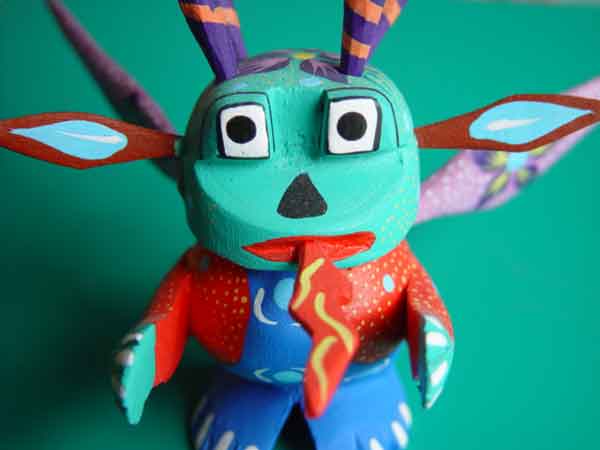
     Alebrijes step out from dried wood and stand in the shower of paint that falls from the brush’s tip. Yellow flash of lightning, pointillistic rain, garish colors that mirror those of the códices. The carvings take the form of fantasy figures, anthropomorphic animals,
 and mythological creatures.

Sometimes one individual selects the wood, carves it, then covers it in paint. Occasionally an entire family takes part in the work of making the alebrije. One person collects the wood and prepares it for carving. Another carves and sands it. A third works on the undercoat, and a fourth applies the final patterns of paint.

The great debate: does the form in the wood 
reveal itself to the carver
 or do the carvers impose their own visions on the wood? In the case of the team, do the family members debate and come to a joint conclusion?

These thoughts, exchanged with wood-carvers in Oaxaca, all with different opinions, have led to a series of interesting conversations. What exactly is creativity? Where does it come from? Do we, as artists, impose it upon our creations? Or do we merely observe and watch as new ideas float to the surface of our minds? How does the creative mind really function? And, by extension, how much of the sub-conscious creative sequence can be placed into words?

Alebrijes

 Are they half-grasped dreams
that wake, wide eyed, to a new day’s sun?

Or are they alive and thriving
when they fall from the tree?

Does the carver fish their color and shape
from his own interior sea,
or does he watch and wait for the spirit
to emerge from its wooden cocoon
to be reborn in a fiery block of color?

Daybreak:
in a secluded corner of my waking mind,
my neighbor’s dog greets the dawn with sparks
of bright colors born from his bark.

My waking dream: dark angels with butterfly bodies,
their inverted wings spread over my head to keep me warm.
In the town square, the local artist plucks dreams
from my head and paints them on carved wood.

Or is this the true source of inspiration?

Poema de Amor – Love Poem

Poema de Amor / Love Poem

Mitla, Oaxaca, Mexico.


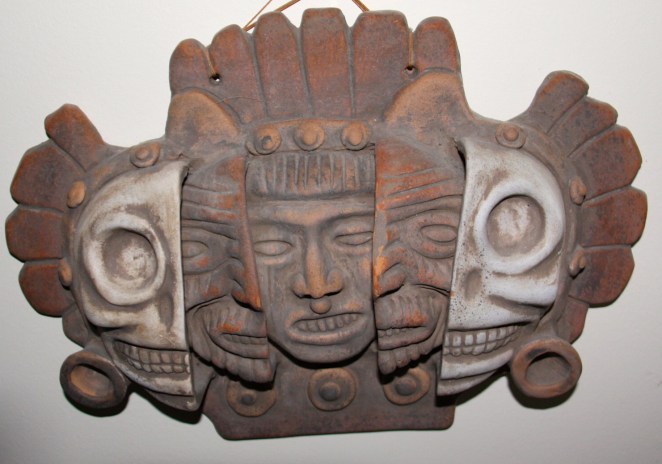
Mitla is a sacred burial place in the Oaxaca Valley.
 The caves in the hills above the town
 are said to lead directly to an underworld from which demons and devils emerge at night and by means of which humans can communicate with the souls of the dead. Mitla, in fact, is often called the city of the dead.
 Legend has it that if you embrace  a certain magic column in the Palace at Mitla, 
the time left for you to live can be measured by the distance 
between your fingers as they reach round the pillar and almost touch.
 The pillar, they say, grows and shrinks according to the length of the seeker’s life. Petrus,  a rock, in Latin, evolves into piedra, 
a rock or stone in Spanish: upon this rock will I build my church.

1
We walk on tiptoe round the garden
peeling free the sunlight cloud by cloud

sometimes the heart is a sacrifice of feathers
bound with blood to an ornate altar

petrus
this rock cold against my chest
piedra
centuries of glyphs alive in your face

if our arms meet round these all too human columns
what will become of us?

2
beneath your skin the woad lies as blue as this evening sky
yellow light bends low in the fields below us
each darkened pool a warrior fallen beneath the scythe

the moon paints a delicate circle
its great round open eye stands out
above the rooftops
tonight it bears an eye lid carved from  cloud

our teeth are diadems of whiteness
we tie shadows to our heels
and dance in triumph through street and square

3
daylight bends itself round rock and turns into shadow
we flourish in blocks of fire

dreaming new selves from roots and branches
we clasp each resurrection with greedy fingers
will the moon rise again tonight and will we watch?

dark angel bodies with butterfly wings
our shadows have eloped together

we can see them sitting side by side
bumping knees at a table in the zócalo

4
church bells gild the barrio‘s rooftops
our fingers reach to the skies and hold back light
we draw shadow blinds to shut out the day
night fills us with stars and silhouettes

we dream ourselves together in a silent movie
closed flesh woven from cobwebs
lies open to a tongue-slash of madness

the neighbor’s dog wakes up on the azotea
he barks bright colors as dawn declares day
and windows and balconies welcome the sun

can anyone see the dew-fresh flowers
growing from our tangled limbs?

your fingers sew a padlock on my lips
“Listen to the crackle of the rising sun!”

Tuseday’s Child

Tuesday’s Child

1

Thursday’s Child has far to go …
so too does Tuesday’s child,
especially this one, when he sets out
on a Tuesday on a long journey.

Just by chance, I caught this cormorant.
“Behind you, quick,” said Clare.
I turned and ‘Click!’

2

Such a miracle:
the first steps of flight
taken over water.
That first step heavy,
the second one lighter,
and the third one
scarcely a paint brush
pocking the waves.

3

The need for Tuesday’s Child
to take flight lies deep within me.
Fleeing from what?
Running towards what?
Who knows?

All I know is that the future
lies to the right of this photo
and the past lies to the left,
and I don’t know
what either might contain.

4

But I do remember the words
of Antonio Machado:

‘Caminante, no hay camino,
sólo hay estela sobre la mar.’
traveler, there is no road,
just a wake across life’s sea.

5

We may not know what lies ahead
but, like a ship at sea,
we leave white water behind us
and that wake tells us
where we have been
and what we have done.

Patience

   ‘Paciencia y barajar,” / Patience and shuffle the cards Miguel de Cervantes wrote, a long time ago, in the early seventeenth century. I think of it as watching and waiting. We must learn to observe, to stand still and watch the world around us. Who knows what lies there, just beneath the surface, waiting for us to find it?

We know our work is lonely and we thrive in the loneliness of the blank page, the blank screen. We stare at the water’s surface and wait and watch and then we shuffle the cards, the keys, the letters on the page, and something emerges. What will it be?

IMG_0233


Carpe diem / seize the day: with the moment seized, we have time now to think, to polish, to work at it until it is ready. And yes, there is pride in that amber eye, pride and a sense of satisfaction.
We know our work is never done. We worry at it, work around it, gnaw it as a dog gnaws at a bone. Little children gathered round our grandma’s stove as the cookies cook we ask impatiently “are they ready now?”

Impatience is our enemy. We must wait in silence: wait and watch. Sooner or later that silver flash of inspiration will light up whatever page we happen to be decorating.