Low Ebb

Low Ebb

We have been apart too long, my love,
night’s dark corridor lying between us
and neither of us approaching the other
when doors close and blinds are drawn.

The way to the heart of the matter is not
an easy path to walk, not any more.
Our secret ways and dreams lie cold
upon chill, empty sheets and pillows.

Each day the tide revives the beach,
flowing out, abandoning its wet debris
for the sun to perform its magic: fresh
seaweed drying above warm sand.

Sea-birds bury their beaks, writing claw
letters as crabs burrow, dig deep, waiting
for the tide to return and re-create
its alternate reality of dreamy waters.

Half of my bed performs its nightly duty.
The other half lies cold, empty, lonely.
No sea-life wanders there, not even in
my most creative dreams of sun and sand.

Comment: The loneliness of old age is compounded by many factors, including ill-health, sleeplessness, and the need to sleep in separate rooms. How many homeless people suffer that loneliness, and more, and at ages much less than ours? And then there’s the distress of trying to live in poverty, to survive from day to day, with safety net that will not protect us, if we chance to fall. A sad world then, as Polly Toynbee points out in today’s Guardian.


What TV shows did you watch as a kid?

Daily writing prompt
What TV shows did you watch as a kid?

What TV shows did you watch as a kid?

Well, first of all I want to define the age group that outlines the meaning of ‘kid’. Here’s one definition: What age range is a kid? Children (1 year through 12 years) Adolescents (13 years through 17 years. They may also be referred to as teenagers depending on the context.) If we start with the 1-12 year old age group, then I can safely say I had no favorite TV shows as a kid, quite simply because during those years, we didn’t have a TV. Ipso facto, not having a TV, I couldn’t watch one.

That said, our first family TV was bought by my maternal grandfather in June, 1953. It was very small, black and white, very grainy, and was the only one on the street where he lived. I remember all of us crowing into the sacred room where the TV stood and watching the Coronation of Queen Elizabeth II. I was 9 years old at the time. I don’t remember much about the Coronation, but it was my first TV show.

Early TV. In the beginning, there were black and white sets. The BBC had only one channel. It came on from 12 noon until 1:30 or 2:00 pm, then shut off until 5:00 pm when it opened for evening programming until 9:30 pm or 10. I was safely tucked into my bed by then. And since I visited my grandparents at odd times, I rarely saw any TV shows. I do remember Sooty, a hand puppet, hitting Harry Corbett, the puppet-master, with a hammer (!), and I have vague visions of Muffin the Mule, a string puppet, dancing on a piano.

By the age of nine, I had been removed from my first boarding school and was attending my second. There were no television sets in boarding schools in those days. So, guess what? There were no favorite programs. In the holidays, with both parents working, to make enough money to send me to boarding school, as they so frequently told me, I often spent time with aunts and uncles (no TV) or with my paternal grandmother (no TV). The bungalow was our favorite summer residence, and that didn’t even have running water or electricity, let alone a TV set. It had one radio, an item of religious importance, that ran off a battery, and was for the sole use of my uncle. It sat on a high shelf and was untouchable. One bungalow in the bungalow field actually had a telephone, and that was only used for emergencies.

So, in the age group I am writing about, age 1-12, I rarely, if ever, saw a TV set and I certainly had no favorite programs. Radio programs, yes. But that is a different story, one that tells of a single radio in the dormitory, to the sound of which, eight or ten or twelve boys, in rows of beds, fell asleep to the sound of music. It also tells of prowling masters who would enter the dorms and switch the radios off. I will not go into the horrors of boarding school life during those formative years. I have done that elsewhere. But the shows that I remember were all true life horror shows where real flesh and blood, in the 6-12 age group, suffered appallingly, at the hands of older boys and brutal masters. But those shows, and I remember them well, were never seen on TV and were denied vehemently by the perpetrators, boys who had been bullied in their turn, and masters who claimed they were only doing their duty and making men of us. Men, indeed, and an adulthood that I, among many others, never wanted to enter.

Words of Wisdom

Words of Wisdom

“You can’t write about life if you haven’t
lived it.” Words of wisdom from the poet
who wrote The Old Man and the Sea.

“But,” I hear you say, “what did he know
about writing? He never took any courses
that taught him how to write, nor held a certificate
from a prestigious school that guarantees quality.
Nor was he a poet, he only wrote prose.”

And yet, the prestige of that ivy-covered,
ivory tower leads poets… I pause for a moment…
– to where exactly? Into debt, of course, and also
down the paved path of their own destruction.

What kind of life do they live, those writers,
who only exist within their cerebral boxes,
and never step outside them unless they are
ordered to build an even bigger box?

Have they walked with street-walkers in Madrid?
Have they sat beside the poorest of the poor,
in Oaxaca, shivering in thin cotton clothing
beneath falling snow? Have they visited Madrid’s
Plaza de España, stepping high to avoid the blunt,
bloodied needles, shared, to take away the pain?
Have they pan-handled in Yorkville or slept
in sleeping bags, by the Royal York, in the snow,
at 40 below, on the gratings above the Subway?

“The unexamined life is not worth living,” some say
Socrates said. But what I think is ‘the unlived life is
not worth examining.” Tear down the walls that
inhibit and limit you. Go out into the world and see
what others see and feel. Only then, come back,
stab your pen into your veins, fill it with your blood,
and set before us what was done to you, what you
experienced, how you survived, and what you felt.

Comment: Once again I thank my friend Moo for his illustration – Building Bigger Boxes. It goes well with the theme of this rant, or is it a poem? A verbal rant to echo a visual rant, perhaps, or vice versa.

Modern Society

Daily writing prompt
What would you change about modern society?

What would you change about modern society?

Good question – what indeed? First, define society. It’s not as if a single society dominated the world. Do we then distinguish between the world, this geoidal planet on which we live, and the multiple societies that inhabit this world? If we do, then what right do you, or I, or any other individual have to change any or all of the world’s cultures and societies? And how do we change them?

Many ways have been tried in the past, very few successfully. The Spanish Inquisition burned many books and censored others. Other book burnings and spurnings have taken place, and in some places, they are still happening. But are they effective in the long term? Good question. Short term, maybe. Long term, I am not so sure.

Do we limit education, and by extension, knowledge, to a few , limited people, who believe what we believe, and do what we want them to do? That has been tried as well. Short-term successes, but long term disasters. As well as depriving people of education and books, we can also enslave them. This is still happening in many places.

So, another definition: what do we mean by change? Change for the better? Change for the worse? Change for change’s sake? Change for the betterment of our own selves and the devil take the hindmost? And what do we mean by modern? So many questions – so few answers.

Albert Camus once wrote that he was ‘optimiste, quant au monde, pessimiste quant a l’homme‘ – an optimist where the world is concerned, a pessimist where humankind is concerned. Personally, I am not sure that this particular thought stands up any longer. Is it still possible to be optimistic about a planet that we are capable of blowing to smithereens, a planet, moreover, that is currently suffering from wind and rain, fire and flood, famine and war, pandemic and a pollution like none we have ever seen before?

How can I change the world? I am just a single human being. Well, I am a married one, actually. But I only have one vote. I rather fear that single vote (votes don’t marry and produce offspring) will have little effect on my ability to make any change at all to modern society.

Pass the soap and a towel, please, as a certain person said a long time ago. I want to cleanse my hands and purge my soul. I am too old a dog to try and learn new tricks.

What foods would you like to make?

Daily writing prompt
What foods would you like to make?

What foods would you like to make?

Walking round the supermarket the other day, I was astonished by the high prices now written on labels. Meat is virtually unaffordable, especially the good cuts. Butter at $9.00 a lb is a shock to the system. Eggs are up to $6.00 or more for a dozen. Wow! So much of what I used to cook I can now no longer afford. So What foods would I like to make?

Good, wholesome, cheap, nourishing foods. Foods that could be distributed to the city’s poorest people, at very little cost. Foods that would support those who are struggling with high rentals or rapidly climbing mortgages. Foods that would give a genuine opportunity to do both, to those who are wondering whether they should heat or eat . Foods that would allow people to stay on their medication and not be forced to choose between eating, heating, or skipping their pills.

Now, with these enormous heatwaves, house-cooling is also a priority, as is clean air, and clean water. Our food preparation, sooner or later, will have to take so many different factors into account. ‘Brother, there’s a reckoning comin’ in the morning’ – the spiritual says it well and speaks true – ‘better get ready ‘cos I’m giving you the warning’.

And remember, the percentages of people who can no longer afford to live a decent, respectable life is rising, not falling. Food Banks are on the rise and more people are using them. Soup kitchens too. In the United Kingdom, now known as the Untied Kingdom, it is rumored that government is cutting sponsorship to food banks so that more people will return to their daily gigs and fulfill their duties of supporting themselves financially by seeking multiple employments at minimum wage or less. Alas, even then, with multiple jobs and moonlighting, they cannot necessarily sustain a decent life-style.

So, what foods would I like to make? Good, cheap wholesome foods that would support a maximum number of people for a maximum span of time. Pax amorque.

Which activities make you lose track of time?

Daily writing prompt
Which activities make you lose track of time?

Which activities make you lose track of time?

I guess it depends on how you define activities. Sleeping certainly makes me lose track of time. But sleeping is not an activity, you say. So I say, what about sleep walking? A track to walk on, and sometimes sleep walkers lose track of themselves, and hands of the clock lost in the dark ahead of them, on they go, tick-tock, little clockwork soldiers marching until someone or something wakes them up. Where am I? They ask. And what time is it?

Watching my fox terrier chasing his tail as he runs round and round in circles, never quite catching it, but never giving up his high hopes of catching that little rat-tail of a tail that dangles there behind. And round about and out and in all day that silly dog did spin, spinning in prose and spinning in rhyme, until I lost all track of time.

Same thing happens with that little electric railway that ran on a single loop around the kitchen table. Diddle-da-diddly-da, just like a real train, except no smoke, no puff the magic dragon, no sense of a schedule or arriving and departing on time, when circular time is meaningless, as are the numbers on the sundial when the sun isn’t shining, or the hands on the clock when the numbers are missing, and you don’t know whether you are looking in time’s mirror or are standing on your head in the Antipodes and all the while the clock hands are marching round and round, tick-tock, and there is no track by which time can be tracked. And the runaway hands went round the track and the ghost train hooted whoo-hooo, as it vanished into the timeless tunnel of darkest night, and then exited. like Rip Van Winkle, the engine driver with a huge beard, and the carriages all covered with cobwebs and skeletons peeping out of the compartments and sitting beside some of the travellers as they snore on their seats.

And wow, the activity, if it be an activity, of walking my fingers over the keys has just made me lose track of the last ten minutes. And now it is time for me to drive to hospital, have a needle stuck in my arm, and allow a nurse to draw my blood. And the moment from the first sight of the needle to the moment it is withdrawn from the end is e-n-d-l-e-s-s and takes an eternity.

Bone Fire Night

Bone Fire Night

Sometimes the sun’s too bright
and we are best, at night, by moonlight,
when shadows flicker and we seize,
in the shimmering half-light,
half-truths glowing in the dark.

In the full light of day, these ideas
take forms, flesh themselves out,
grow skin and bone, flesh and blood,
their skeletal beings standing,
fully-clothed, beside us.

They take on match-stick bodies,
twisted, pipe-cleaner shapes,
or stick their stakes into the ground,
hold out their arms, and turn into
scarecrows that scare away the truth

Do they bring us release from our
darkest yearnings, or are they those
self-same cravings, hankering after
their day of glory, that precious moment
when they stand upright in the sun?

With the advent of bone fire night,
we stack them into wheelbarrows,
place them on the gathering pile
of outmoded thoughts and ideas,
light a match, and watch them burn.

Lac Megantic – 10 years on

Lac Megantic
ten years on

Fire on the water, the waves ablaze,
and the sound, a monster, indestructible,
a dragon descending, breathing fire,
so swift, so powerful, come sudden
from nowhere, yet another disaster,
one of the many that torment us
now and then with its ravage and roar.

It refused to move on until sated – but
who could satisfy the monster’s hunger,
destroy its will, defeat its power?
Not us with our pitiful sacrifices,
homes, friends, family, devoured.

In spite of our efforts to rebuild,
nothing can ever be the same.
Ten years later, memories, grief,
and our tears are all that remain.
Yes, it has left, but what can we do
to stop it, if, and when, it comes again?


Comment: I wrote this poem on July 6, 2023, while listening to the CBC radio commentary on the tenth anniversary of the Lac Megantic disaster. A terrible event, it still haunts so many people, and yes, the fears, tears, grief, and memories linger on. How could they not?

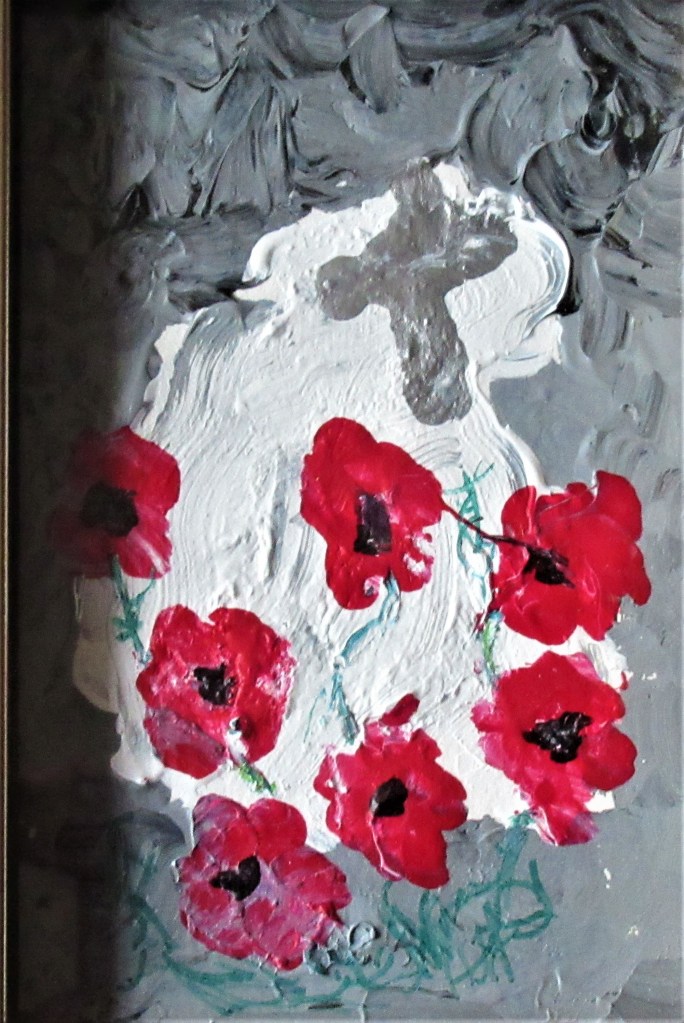
PaintingPoppies – by Clare Moore.

Magician

Magician

I stand on a tiny platform, high above
the upturned faces of the clamouring crowd.
Before me, the high-wire stretches across
the diameter of the circus tent.

Clad in the enormous shoes of a clumsy clown,
I grip the wire with the toes of one foot.
Now I must choose – umbrella or pole?

The spotlight outlines my face’s whiteness,
the bulbous nose, the fixed, painted smile.
My jaws clamp tight in concentration.

Clutching the brolly, a good old gamp, I walk
the thin wire plank of my current destiny.
One step, two steps, tickle you under the chin,
and I pretend to fall, grasp the wire, and raised
by the crowd’s gasp of despair, swing back up.

Then, a yard from the finish line, I swallow dive,
turn a somersault in the air, and land on my back
in the middle of the safety net as the crowd goes wild.

“The magician works on the threshold that runs between light and dark, visible and invisible.” John O’Donohue, Anam Cara, p. 145.

“The most difficult role in the play is that of the fool – for he who would play the fool must never be one.” Don Quixote.

Painting: Fire Sky by Moo.

Lost

Lost

Where can it be? I put it
somewhere safe, but I
can’t remember where.

So many things grow legs,
go absent without leave,
walk out of my world.

I am slowly losing control.
My life will soon be left
in somebody else’s hands.

They will control my wants
needs, and necessities.
Then I too will be lost.

Placed somewhere safe,
perhaps, there to lie forgotten,
abandoned, secure, perhaps,
but who knows at what cost.