Windmills

Windmills

Only the pendulum clock
disturbs the silence
as the slow stars circle
and the moon hides
its face beneath
seven excluding veils.

Tranquility finds me,
seated here, head in hands,
contemplating the complicated
dance steps of a terra-centric
universe where planets weave
an intricate back and forth
to justify the falsehoods
of misguided mistakes.

Men, confident in their wisdom,
know that all is well,
that their faith in the old gods,
the old books, the words
that were written, in stone,
before the modern world began,
need no rethinking.

Those whirling sails,
imprinted on the questing mind,
are a giant’s arms, those sheep
an enemy army cloaked
in dust, coats of arms visible
only to the far-sighted
whose eyes defy vision’s laws.

Right, they were then.
Right they are now.
Nothing changes. Nothing
can possibly change.
Sheep are the enemy
and windmills wait to invade
the unsuspecting mind.

Comment: The history of Don Quixote and its reception in Spain is quite interesting. I was very sorry to read that Cervantes’s language is now considered so antiquated that interpreters are needed. I actually have a cartoon version of his quests – a picture reader, so to speak, very brief, because each picture is worth a thousand words. I have not yet seen the simplified text, rewritten with today’s reader in mind.

Don Quixote still holds many lessons for this modern world of ours and is definitely worth re-reading for, as Soren Kierkegaard (1813-1555) wrote: “There are two ways to be fooled. One is to believe what isn’t true; the other is to refuse to believe what is true.” Don Quixote, the character, threads a narrow path between those two extremes, as do many of the other supporting characters, some of whom use metatheatre for their smoke and mirror Wizard of Oz trickery. And remember, or forget at your peril, nihil sub sōle novum – there is nothing new under the sun. And yes, history does repeat itself, as you will see if you read (or re-read) Cervantes’s master piece.

Coal Face

And Every Valley

And every valley shall be filled with coal.
And the miners will mine, growing old
before their time, with pneumoconiosis
a constant companion, and that dark spot
on the grey slide of the sidewalk a mining
souvenir coughed up from the depths
of lungs that so seldom saw the sun
and soaked themselves in the black dust
that cluttered, clogged, bent and twisted
those beautiful young bodies into ageing,
pipe-cleaner shapes, yellowed and inked
with nicotine and sorrows buried so deep,
a thousand, two thousand feet down,
and often so far out to sea that loved ones
knew their loved ones would never see
the white handkerchiefs waved, never
in surrender, but in a butterfly prayer,
an offering, and a blessing that their men
would survive the shift and come back
to the surface and live again amidst family
and friends, and always the fear, the pinched
-face, livid, living fear that such an ending
might never be the one on offer, but rather
the grimmer end of gas, or flame, or collapse,
with the pit wheels stopped, and the sirens
blaring, and the black crowds gathering, and
no canaries, no miners, singing in their cages.

Comment: A friend wrote to me about the closing of the pits in Nottinghamshire and how the mining communities had suffered, were still suffering, and might never recover. This poem is the first one in a sequence on the mine closures in South Wales and other mining communities. Poems For the End of Time – the book is available here.

Low Ebb

Low Ebb

We have been apart too long, my love,
night’s dark corridor lying between us
and neither of us approaching the other
when doors close and blinds are drawn.

The way to the heart of the matter is not
an easy path to walk, not any more.
Our secret ways and dreams lie cold
upon chill, empty sheets and pillows.

Each day the tide revives the beach,
flowing out, abandoning its wet debris
for the sun to perform its magic: fresh
seaweed drying above warm sand.

Sea-birds bury their beaks, writing claw
letters as crabs burrow, dig deep, waiting
for the tide to return and re-create
its alternate reality of dreamy waters.

Half of my bed performs its nightly duty.
The other half lies cold, empty, lonely.
No sea-life wanders there, not even in
my most creative dreams of sun and sand.

Comment: The loneliness of old age is compounded by many factors, including ill-health, sleeplessness, and the need to sleep in separate rooms. How many homeless people suffer that loneliness, and more, and at ages much less than ours? And then there’s the distress of trying to live in poverty, to survive from day to day, with safety net that will not protect us, if we chance to fall. A sad world then, as Polly Toynbee points out in today’s Guardian.


What TV shows did you watch as a kid?

Daily writing prompt
What TV shows did you watch as a kid?

What TV shows did you watch as a kid?

Well, first of all I want to define the age group that outlines the meaning of ‘kid’. Here’s one definition: What age range is a kid? Children (1 year through 12 years) Adolescents (13 years through 17 years. They may also be referred to as teenagers depending on the context.) If we start with the 1-12 year old age group, then I can safely say I had no favorite TV shows as a kid, quite simply because during those years, we didn’t have a TV. Ipso facto, not having a TV, I couldn’t watch one.

That said, our first family TV was bought by my maternal grandfather in June, 1953. It was very small, black and white, very grainy, and was the only one on the street where he lived. I remember all of us crowing into the sacred room where the TV stood and watching the Coronation of Queen Elizabeth II. I was 9 years old at the time. I don’t remember much about the Coronation, but it was my first TV show.

Early TV. In the beginning, there were black and white sets. The BBC had only one channel. It came on from 12 noon until 1:30 or 2:00 pm, then shut off until 5:00 pm when it opened for evening programming until 9:30 pm or 10. I was safely tucked into my bed by then. And since I visited my grandparents at odd times, I rarely saw any TV shows. I do remember Sooty, a hand puppet, hitting Harry Corbett, the puppet-master, with a hammer (!), and I have vague visions of Muffin the Mule, a string puppet, dancing on a piano.

By the age of nine, I had been removed from my first boarding school and was attending my second. There were no television sets in boarding schools in those days. So, guess what? There were no favorite programs. In the holidays, with both parents working, to make enough money to send me to boarding school, as they so frequently told me, I often spent time with aunts and uncles (no TV) or with my paternal grandmother (no TV). The bungalow was our favorite summer residence, and that didn’t even have running water or electricity, let alone a TV set. It had one radio, an item of religious importance, that ran off a battery, and was for the sole use of my uncle. It sat on a high shelf and was untouchable. One bungalow in the bungalow field actually had a telephone, and that was only used for emergencies.

So, in the age group I am writing about, age 1-12, I rarely, if ever, saw a TV set and I certainly had no favorite programs. Radio programs, yes. But that is a different story, one that tells of a single radio in the dormitory, to the sound of which, eight or ten or twelve boys, in rows of beds, fell asleep to the sound of music. It also tells of prowling masters who would enter the dorms and switch the radios off. I will not go into the horrors of boarding school life during those formative years. I have done that elsewhere. But the shows that I remember were all true life horror shows where real flesh and blood, in the 6-12 age group, suffered appallingly, at the hands of older boys and brutal masters. But those shows, and I remember them well, were never seen on TV and were denied vehemently by the perpetrators, boys who had been bullied in their turn, and masters who claimed they were only doing their duty and making men of us. Men, indeed, and an adulthood that I, among many others, never wanted to enter.

What change, big or small, would you like your blog to make in the world?

Daily writing prompt
What change, big or small, would you like your blog to make in the world?

What change, big or small, would you like your blog to make in the world?

Looking around me and seeing the way that the world I know is so totally divided, and knowing that words and ideas will bounce off people’s backs like rain off a duck’s back, I do not expect my blog to make any changes, big or small, to the world. Would I like it to? Yes, I would. But whether it will or not is a different question.

My blog consists of several elements. Let us start with the poetry. If I can reach out and touch somebody with one or more of my poems, then I will be very happy. This is, after all, a poetry blog. And part of that blog is a continuing discourse on creative writing and poetic creativity. If one of my articles / posts on creativity can help one person, just one, to improve their creativity, then I will feel justified with all the hard work and thought I have put into the posts.

I also write about Discourse Analysis, the meaning of words and texts. In our current, doubt-ridden world, it is often the loudest voice that carries the most weight, and he wildest ideas that get the most attention. I always remember that still, small voice that comes after the fire and the thunder: “What doest thou here, Elijah?” Alas, I am not an Elijah, nor am I a prophet, nor am I out to make a profit. But if someone, somewhere, recognizes my voice as a still, small, voice speaking a little bit of sense in this wilderness of wild words, then I will be satisfied. My creative prose comes next. It is mostly composed of flash fiction, memoirs, and short stories. If I can bring tears or laughter to the eyes and the heart of just one reader, then again I will feel that I have done my work.

Then there is my art work. I have always been told that I am useless at art. Mind you, I think those people came from the same school of thought that told me, as a teenager, that I would never go to university – except on a train. However, I discovered Matisse and his words ‘making meaning out of color and shape’. Then came Dali – ‘I don’t know what it means, but I know it means something.’ Out of those words have come cartoons and paintings, some funny, some sad, and all of them unique. Again, if one reader / viewer finds joy in them, then I will be happy. And if my own work persuades one battered, belittled artist that he or she can paint, create, make meaning out of color and shape, then I will have achieved the minor miracle of helping to change someone’s life for the better.

As for these prompts, I have only just started to be prompted into doing something. Why? I am not sure why. I just think that I have a different view of the world from most people. If I can offer that alternative view of reality, a joyous reality, I might add, to one, or maybe even two people, then once more, I can feel that yes, my blog has made one, small change to the world around me. And I cannot ask for more than that.

Meanwhile, I think of the studies I did on the Spanish Civil War (1936-1939). The right kept moving further right. The left kept moving further left. The middle ground where discourse, creative thinking, and debate can flourish, slowly vanished. Then, when positions and thoughts became so deeply entrenched that there was no room for mainoeuvre / manouver / maneuver, whichever way you wish to spell it, then shooting broke out and people went to war and found, all too often, their often-violent deaths. I would not wish that fate on any person, government or country. If just one person would read that powerful and bitter history, and learn from it, then the world might be a better place.

To talk to one person at a time, that’s what I want from my blog. Then I want that person to talk to another person, and the third one to a fourth, and so on and so forth, until we have established, one person at a time, a linked chain that may, just may, be long enough and strong enough to help lighten the darkness and head off the dangers into which we seem to be steering.

Apologia

Apologia
pro vita mea

The fairground’s distorting mirrors distort.
I change as I walk past one and then another.

Rage, rage against that hump-backed shape
that looks back at me from the bottle-glass.

Magic: eye of a newt, eye of a toad, cat’s
eyes at night lighting the road to bed.

Bedlam all around me. Absurd this world,
gone carnival mad in the blink of an eye.

I need a white stick to walk through
this fog that clings to my clay-bound soul.

This wine I drink, these thoughts I think,
life’s fountain pen soon runs out of ink.

Watch the tides as they ebb and they flow.
When your time runs out, pack up, and go.

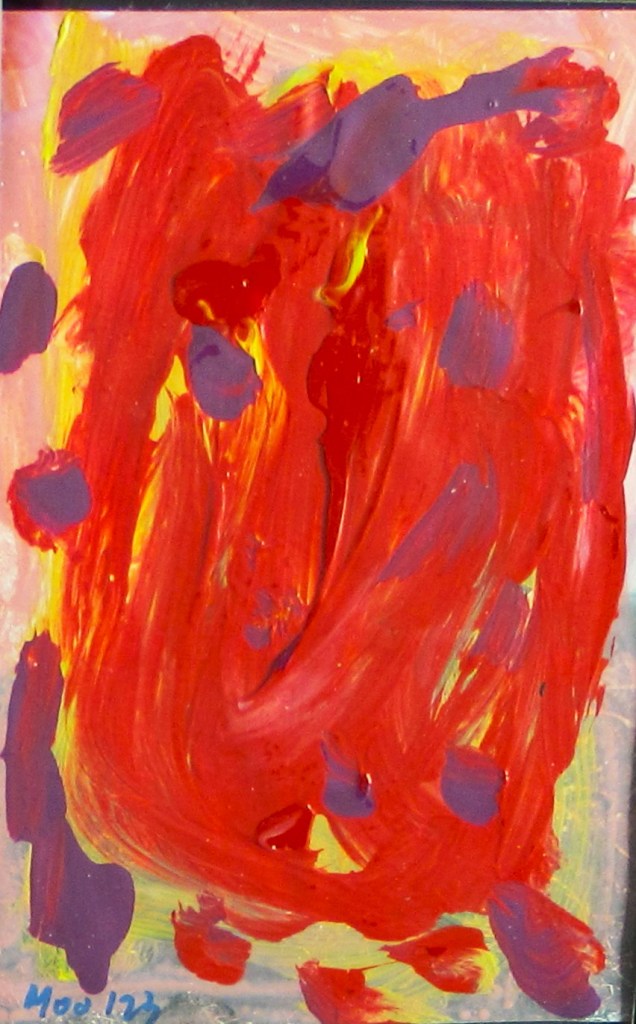
Comment: My friend Moo did himself proud with the above painting. What is it? I asked him. Dunno was his reply. I have shown it to several friends and speculation is rife: the dancer and the dance, dancer and diver, a blur of three figures, headless mermaid (I love that one). And yes, life is absurd (Albert Camus), a carnival (Bakhtin) in which knowledge is power and civilization is mad (Foucault).

Originality and imitation – how many genuinely original ideas are there? Very few. And the same goes for poetry – original poems are very rare. Most of our ideas come from elsewhere, even if we do not know it. The title of the above poem comes from Petrarch. It’s structure is traditional – a sonnet. Its ideas are borrowed from Camus, Bakhtin, Foucault. And yet, shuffle the cards (Cervantes) throw the dice (Mallarme’) and this poem and this post have both achieved a kind of originality and uniqueness by linking disparate ideas in a new unity.

Write about a random act of kindness you’ve done for someone.

Daily writing prompt
Write about a random act of kindness you’ve done for someone.

Write about a random act of kindness you’ve done for someone.

Sir Alex Ferguson, one of soccer’s greatest managers, once said that it wasn’t the victories he remembered, but the defeats. So it is with my own coaching career – it’s the losses I recall. Same thing with random acts of kindness. There have been many, too many to count. I will not paper my e-walls with glowing memories of past kindnesses. But what about those random acts of kindness I failed to do? Here’s one of them.

            Crave More: I hate those words. I always choose a cart with the shop’s name on the handle. I can handle that. I can’t handle a shopping cart that screams Crave More at me every time I stoop down and place another item in the wire grid. If stores were honest, they would inscribe their shopping carts with a sign that said Think More, Crave Less, and Save Your Money. I bet that would quickly cut into profits.

            Anyway, there I was, in La-La-Land, leaning on my cart, still half asleep, when this ghost drifted towards me. “Help me,” it said. “I’m hungry. I need food.” I woke up from my dream, looked at the ghost, tall, skeletal thin, cavernous eyes and cheekbones protruding, gaps in the teeth, grey face drawn and lined. The single word “Sorry” came automatically to my lips. Then I felt shame. I looked at him again. “I only carry plastic.” The excuse limped heavily across the air between us. I saw something in his eyes, I knew not what, and I turned away.

            Then, as I walked away, I added 100 lb of muscle to the scarecrow frame. Took forty years away. Filled his body with joy and pride, and remembered how he played when I used to coach him, hard and fast, but true. I ran my hand through the card index of former players that I had coached. I knew their moves, and attributes, the way they played the game, their stronger / weaker side, their playing strengths, their weaknesses. I remembered him holding up the Champion’s Cup. But I couldn’t remember his name.

            I pushed the cart all over the store in a frantic search for him. I went to the ATM and took out cash. I could hand it to him. I could tell him he had dropped it. I went through a thousand scenes. I could invite him to the snack bar. I could tell him to buy what he needed and follow me to the check out lane where I would add his purchases to my cart. I looked everywhere. He was nowhere to be seen.

            A single opportunity. One chance. That’s all we get. Miss it, and we blow the game. Take it, and we win the Championship and hold up the Cup.

How would you describe yourself to someone who can’t see you?

Daily writing prompt
How would you describe yourself to someone who can’t see you?

How would you describe yourself to someone who can’t see you?

Well, that would depend on why they couldn’t see me. “Those who have eyes, but cannot see.” Many have stood beside or before me, looked into my eyes, as I looked into theirs, and never saw me. “The most difficult role in the play is that of the fool,” said Don Quixote, “for he who would play the fool must never be one. So many people saw me deliberately playing the role of the fool and forgot the above quote. They also forgot what Antonio Machado wrote: “The eye you see is not an eye because you see it, it is an eye because it sees you.” And there you have it: why would I bother describing myself to people of that ilk, so stupid and blind with their own limited wisdom, that they couldn’t see me anyway.

Keenan’s Well, by Seamus Heaney, is a wonderful poem. It tells us about Rosie Keenan, his blind from birth neighbor, who played the piano and sang all day. She let them touch her books, like books of wallpaper, and feel the letters of braille by means of which she was able to read. They allowed her to touch their faces with her oh-so-sensitive fingers, and she said she saw them, as well as knowing them by their voices. When he read her a poem about Keenan’s well, she told him that she, blind from birth, ‘could see the sun shining at the bottom of it now.”

How would you describe yourself to someone who can’t see you? I wouldn’t waste my time and energy trying to do so.

What traditions have you not kept that your parents had?

Daily writing prompt
What traditions have you not kept that your parents had?

What traditions have you not kept that your parents had?

What traditions have you not kept that your parents had?

To the best of my knowledge, my parents only had three traditions. I have not kept any of them.

Tradition 1: They took two weeks holiday every year in August. Both were hard-working, and that holiday was always a precious break from work. Being employed in academia and a life-long inhabitant of the Ivory Tower, I have not had holidays forced upon me by a 9 to 5 work schedule. Research and creativity do not function according to a 9 to 5 clock. I realize how fortunate I am, and I give thanks every day for my intellectual and creative freedom.

Tradition 2: They fought like cats and dogs at every opportunity. It was so bad that, at one stage, in my innocence, I thought that cats were females and that dogs were males, and that was why they opened instant hostilities whenever they saw each other. Luckily, I have no siblings to challenge this view of events, and my parents are long gone, so they won’t be worried either.

Tradition 3: My maternal grandmother’s birthday was just before Christmas. On her birthday, every year when I was a child, my mother would come home early from work, but my father wouldn’t. He often didn’t come home at all. Office parties. My mother would hang around the house for a while, consoling herself. Then she would get angry, tell me to pack a bag, pack one herself, and call a taxi. This would take us to the railway station or the bus station, and off we would go to grandma’s house to celebrate her birthday. My father, looking sheepish and hang-dog, would arrive late Christmas Eve, or early Christmas morning. On Boxing Day, the gloves came off, and they were at it again. That’s why it’s called Boxing Day. Well, that’s what I thought anyway.

So there you have it. Three traditions that my parents had and that I have never kept.

Was today typical?

Daily writing prompt
Was today typical?

Was today typical?

So, I Googled the meaning of typical and here are some of the synonyms that appeared. Standard, normal, stock, representative, usual, conventional, characteristic, regular, orthodox. Following the meanings offered, yes, today was typical. Dark at midnight, dawn breaking about 5:30 AM, full sun by 7:30 AM, noon – dead on 12 o’clock, as usual. And so it goes on. The weather may change, but the basic structure of the days, although also cyclical, growing longer then shorter, in terms of daylight hours, does not change much. Therefore, yes, by this definition, it was a typical day. But was it?

For creative people, each day is different and each moment, minute, hour of each day is different. Creatives listen, observe, feel, touch, delve beneath the surfaces of things, and see things in a lateral multiplicity that means everything is evolving, changing, growing, decaying. Creative people look and listen (with or without mother). They imitate, and from that imitation they create and re-create. And creativity moves way beyond the standard, normal, stock, representative, usual, conventional, characteristic, regular, and orthodox. If it doesn’t, it’s not creative, it’s just standard, normal, stock, representative, usual, conventional, characteristic, regular, orthodox.

Was today typical? Well, it’s not over yet. But up until now, it has only been typical in terms of its intimate creative typicality. The light has changed with the changing sky and clouds. Rain fell, and changed the tones of the colors around. The light changed, but so did the scents that arose from the warm earth with its carpet of grass and the tarmac and concrete, its heat suddenly cooled. The ground glistened, spider-webs sparkled, birds sang when the sun returned, flowers tossed their heads, in slightly different ways from yesterday, when the wind was warm. Now, damp and shining, their dance-steps and rhythms also changed. Now the world is wet. The trees are waving their fans and have caused a slight wind to arise and rustle their leaves. This day is full of creative magic – but only for those who have ears to hear and eyes to see. For too many people, alas, yes, this is, after all, just another typical, humdrum, boring old day. As W. H. Davies wrote: “What is this life if, full of care, we have no time to stand and stare?” Creatives make that time – and they live among the blessed.