Carved in Stone 63

Carved in Stone
63

Words descend, soft and peaceful.
They brush my mind
with the hushed touch
of a grey jay’s soundless wings.

Yet the grey jays have gone,
vanished along with the grosbeaks,
evening, pine, and rose breasted.

Words can hardly express what I feel
in this diminishing world
when I inhale color and light.

Dawn bursts into bloom,
and the indoor hyacinth starts,
once more, to blossom.

Its immanent beauty
fills me with a warmth
that disperses night’s shadows,
taking away all sense of gloom.

Commentary:

The indoor hyacinth starts, once more, to blossom. Its immanent beauty fills me with a warmth that disperses night’s shadows, taking away all sense of gloom. Indeed it does. Once upon a time, it became infested with little bugs and was reduced to one leaf. Clare worked with it, spoke to it, cajoled it, and bit by bit it came back to life. Now it lives in the front porch in summer and returns to the house, southern aspect, in winter, to flourish when least we expect it.

Hyacinth, Jamaica in Spanish. And nothing more delicious than the miel de jamaica that one is offered in Oaxaca, fruit juice squeezed from the hyacinth flowers. “My wife has gone to the West Indies.” “Jamaica?” “No, she went of her own accord.” Humor flows and the hyacinth flowers, and I spend my winter hours sitting and watching my indoor flowers.

Yet the grey jays have gone, vanished along with the grosbeaks, evening, pine, and rose breasted. They used to flock on the picnic tables but as the weather warmed, they went further north. I remember when 64 mourning doves perched on the power lines. Now, we have two or three who look lonely in the garden and sound even lonelier. Words can hardly express what I feel in this diminishing world when I inhale color and light, but long for the passerines’ morning and evening flight.

But, in spite of all that, sad as it is, the hyacinth’s immanent beauty fills me with a warmth
that disperses night’s shadows, taking away all sense of gloom.

Carved in Stone 50

Carved in Stone
50

Here, in the castle of my own home,
I sit and write and patiently wait
for the enemy’s superior forces
to arrive and overwhelm me.

But death is not the enemy.
He is the friend
who has walked beside me
every day, since the day
that I was born.

I know him and I trust him,
though I am unaware
of when he will come to call
and I am ignorant of the shape
he will finally take.

Commentary:

Francisco de Quevedo, the 17th Century Spanish Neo-stoic and Metaphysical poet, wrote “the day I was born I took my first step on the path to death.” And so it is, with all of us. Sometimes we are able to choose our paths, sometimes they are forced upon us, sometimes they appear – with choices – and we make our selection and move on.

There are so many roads to travel. For Antonio Machado (Spain, Generation of 1898) there is no road. There is only a wake upon the sea – “Caminante, no hay camino, solo hay estela sobre el mar.” We must look back, to see where we have come from and where we have been. But there are many other possible paths, beside that of the sea – gravel paths, cobbled ways, log trucking roads in the Canadian Forest, cattle roads, transhumance roads, winding roads, straight Roman roads, roads that run up hill, down hill, or twist and bend following the paths of rivers.

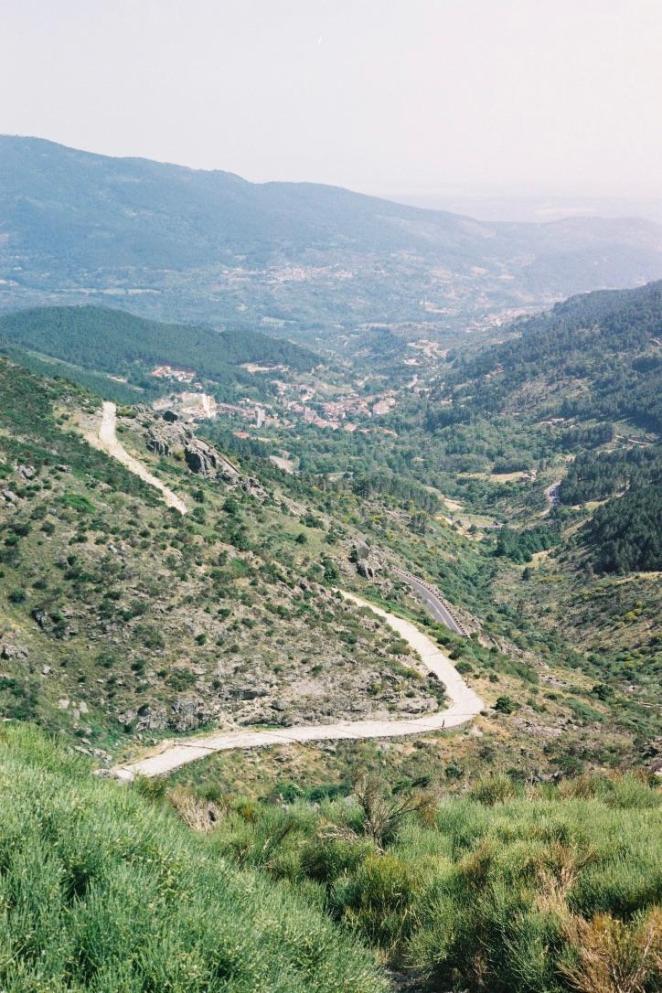
The picture above shows the old Roman Road that leads to the Puerto del Pico, in the province of Avila. It followed the contours of the hill and formed part of the Ruta de la Plata, the road that took Latin American silver from Seville to the Spanish capital in Madrid. Look carefully and you can see the modern highway that runs parallel to the old Roman road. Nowadays, that older road is used for transhumance, the movement of cattle from the valleys in the winter to the hills in the summer. The same road, the same pass, so many different uses, and the road a wake upon the path of so many lives.

Fire Storm

Fire Storm

Yesterday, it was difficult to breathe.
We inhaled dust and ashes as smoke
from forest fires scuttled towards us,
carried piggy-back on a strong west wind.

Today, the wind herds clouds into aerial castles,
pinnacles and pyramids piled upwards,
tall ships’ canvases painted dark, thundery,
raised by fierce wedges thrust beneath them,
lofting them into darkening skies.

Beyond a certain height, water becomes ice.
Particles group together. Hail stones form,
small at first, growing ever larger
until the very air can no longer bear
their weight. Golf ball big, they tumble down
the sky’s steep ladder and fall to earth.

The dry drum roll of distant thunder rumbles.
A scissor-slash of light shreds black skies.
An executioner’s hay wain rolls towards us,
a runaway train destined to tear our lives
apart. It leaves us helpless, clamoring for safety,
our world torn apart, our earth sore wounded.

Death scythes away, downing rich and poor alike.
Who now knows which way thrown dice will fall?
The dye’s sharp edge, once cast, cuts like a blade.
Hail stones clatter on the roof, battering us down.

Clepsydra 23 & 24

23

… gulls on the wharf-side roof
     fishing boats
          returning to port
               white wakes trailing,
                    pointing to where they’ve been

where have I been
     all my life         

where is the wake
     that tracked me to and from
          so many unimportant places

so often have I waited
     for that moment of reunion
          port station airport

birds leaving nest
     only to return
          then leave again
               are not more faithful

sweet brevity of life
     a stone memorial
          on the harbour wall
               raised to all
                    who went to sea
                         and never returned
                              dying in the waves’ embrace …

24

… a watery grave
     no church no candles
          just cold waters sliding shut
               as down to the depths they go
                    

sinking from level to level
     never to rise again
          not till seas run dry
               burnt up by the sun’s candle

even then they’ll walk no more
          with their beloveds
               hand in hand
                    on diminishing land
                         or sea-licked sand …

Commentary:

“Birds leaving nest, only to return, then leave again, are not more faithful.” A lovely photo, from Avila, of storks, bouncing on their nests, waiting for the wind to lift them up aloft. I thought of using sea side photo from PEI, but this image caught my eye, and my words. A verbal – visual link. Not easy to spot, but there, in the sky above them, a parent waits. As soon as one chick takes flight, the watching parent will drop, fly under the fledgling’s wings, and tutor the young bird in the art of soaring and flying. I have spent many a happy hour, just sitting there, watching them.

And here’s the photo from PEI. An osprey, returning to the nest, after a fishing expedition. One hopes for such moments. Then, suddenly, one day, the magic happens, and verbal and visual joining hands in a single moment of magic. And listen to that baby bird, beak open, shrieking, waiting for the parent to arrive. I can still hear the screeching, although we are in the age of silent, but colorful, pictures.

In the picture below, the Grande Réunion – you can see the White Geese gathered at Bic. They return every year, so beautiful. The first time I saw them, I thought they were a drift of late snow. Then they rose from the field, and flew up, into the air. I have often seen snow falling but that was the first time I saw snow actually rising, after it had settled. A memorable moment.

Moments of magic, as I said, and each of them linked – verbal to visual. Silent dialogs with my time and my place, now shared with whoever has ears to hear and eyes to see and an imagination to reconstruct the alternate realities.

Autumn Leaves

Autumn Leaves

I used to run,
jump, and catch them
in mid-air,
one, two, three
in each hand.

Now
I stand and wait
for them to fall
and land, perhaps,
on my clothes
or catch in my hair

the Leprechaun luck
of my Irish heritage,
so long-denied,
with its pot of golden leaves
waiting for me
at summer’s cast-off
rainbow’s end.

Commentary:

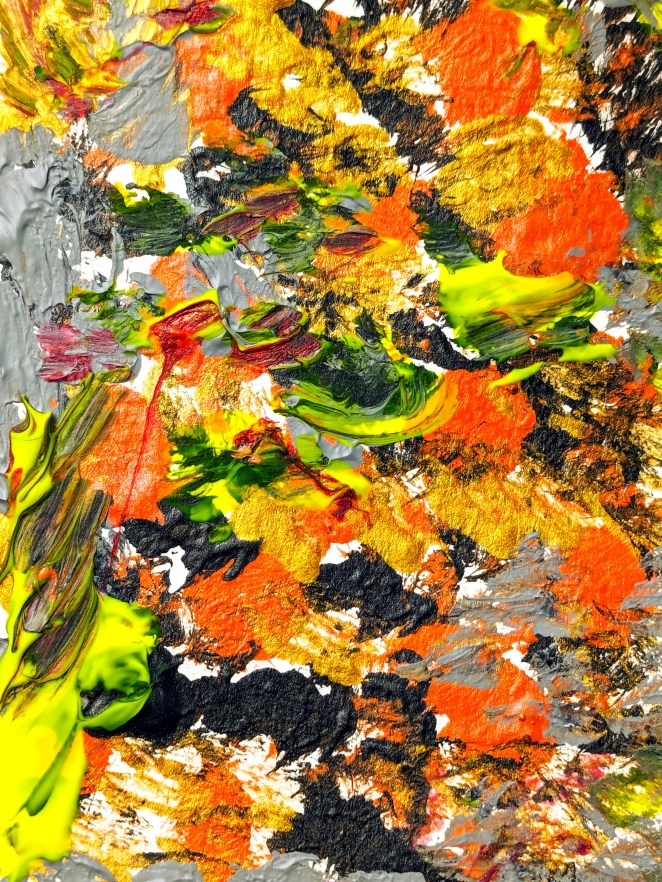
Autumn Leaves, but where does it go to. Good question. Moo asked me that the other day. I just had to tell him that I didn’t know. However, he did offer me the perfect painting for the fall and the changing leaves. Fall Folly Age. I never realized that he could play with words like he plays with paint. Anyway, I know that last winter he painted a picture of little white dots with wings. “What are they?” I asked him. “Snow flies,” he replied. “You know, when the snow flies …” “When the snow flies do what?” “I don’t know.” Moo and I live in a mysterious world, as you have probably come to realize.

Any way, the combination of fall foliage and fall folly age is quite a good one and it shows the folly of ageing and trying to chase down falling leaves when gadding about in the garden with two sticks, one in each hand. Of course, in case you don’t like that painting, and I hope you do like it, because I do, then here’s another one for you.

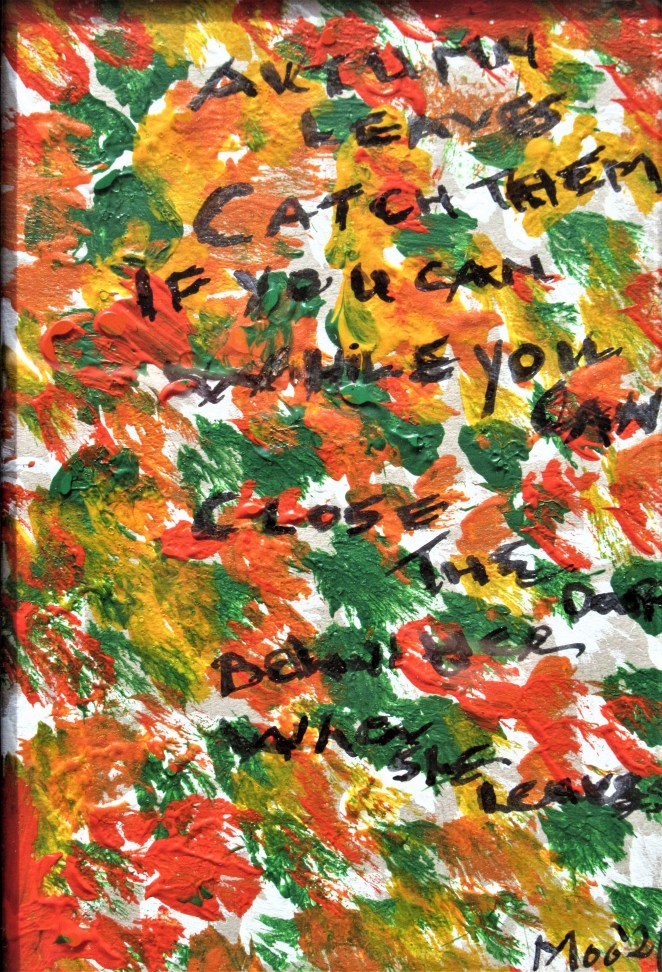
The text reads – “Autumn leaves – catch them if you can – while you can -and close the door behind her – when she leaves.” Oh witty Moo. Painting and occasional poetry too.

Monkey Turns Down Promotion

Monkey Turns Down Promotion

“I hereby appoint you head of the asylum.”

The young office monkey with the plastic stethoscope
was dressed neatly in a white sheet.

“Dr. Freud, I presume?”
Monkey held out his hand
but his witticism was lost in a flood of water
flowing from the flush and over the floor.

Monkey stood there, paddling in piddle.
Inmates with crowded heads and vacant faces,
fools grinning at a universe of folly,
paddled beside him. He wiped
a sick one’s drool from his sleeve.

The office boy spat on his hands,
slicked down his hair, and placed
his stethoscope on monkey’s heaving chest.

“You have no pulse.”
“How do you know I have no pulse?
Surely, you cannot hear my heart
for you have a banana stuck in your ear.”

“Speak up!” said the doctor,
“I cannot hear you:
I have a banana stuck in my ear.”

Then monkey felt fear.

Daylight diminished
and waters closed over his head.
He spurned the proffered paw,
the life belt thrown
by the offer of a new position.

Exit monkey left,
pursued by a chorus:
“Run, monkey, run!”

Commentary:

A Golden Oldie from Monkey Temple (2010). I came across it by accident as I thumbed through some older books – wow, fifteen years ago that came out. A Golden Oldie indeed. I had forgotten all about Monkey Temple. However, the last couple of days I have watched New Zealand vs Canada and England vs France (Women’s Rugby World Cup). Both semi-finals took place at Ashton gate, Bristol. That’s when I started thinking about Bristol and Bristol Zoo.

We had family in Bristol (Westbury-on-Trym) and from an early age we visited Bristol Zoo. One of my favorite places was the old ruined Monkey Temple, full of monkeys that impressed me with their antics. A small, walled zoo, it was full of innovations and I remember well Alfred the Gorilla and Rosie the Elephant. I loved the rides on Rosie’s back. The camels too offered lifts to young children and the elephants took apples from my hand with their long trunks. I also remember the bear pit, and loved watching the brown bear climb to the top of his pole and catch food thrown to him by the visitors.

I think everybody’s greatest thrill came with feeding time for the seals. What a racket when the attendant appeared with his / her pail of fish and he/she threw them to the waiting seals. Almost as thrilling was the penguin house with its aquarium and glass windows. Animals that seemed so clumsy, waddling on land, turn into sea-angels when they dived and we could meet them, face to face, so to speak, almost in their own environment.

My love of zoos reached out and I recall the zoo in Madrid, established when Columbus returned from his voyages with species of animals hitherto unknown. And who could forget Copo de Nieve, the albino gorilla in Barcelona zoo.

Alas, my zoo day’s are over. But the world is wonderful. Today, two deer entered our front yard, lunched on the fallen crab apples, and went to sleep underneath the trees outside our window. Joy to the world and the world brings me joy -sunrise and sunset, colored clouds, the deer in my yard, a fox passing through. However, I must admit I am not impressed by the little red squirrel that nests under the hood of my car and gnaws my cables. Nor by the porcupine who loves the salt in my garage doors and nibbles at the door frame every chance it gets. The love of nature – red in tooth and claw – I guess we have to enjoy the good and put up with the bad. Life’s like that. “Ask the animals, they will teach you.” Bristol Zoo motto.
Sweet Dreams

Sweet Dreams

Amnesia survives in these amniotic waters,
moving in time to the water pump’s heart beat.
I close my eyes and dream. Nothing is the same.

Do I drift dreamily or dreamily drift?
The bath-tub’s rose-petals bring memories –
primroses, bluebells, cowslips, daffodils dancing

beneath the trees in Blackweir Gardens,
or beside Roath Lake, where I biked
on gravel paths so many years ago.

Photos float before me, pictures of moments
I alone recall. Spring in Paris, the trees
breaking into bud along the Champs-Élysées.

Santander in summer, walking the Piquío
as it slumbers beneath the jacarandas.
One winter in Wales, up in Snowdonia,

I ran down a valley between high hills,
on a freezing night, with only the stars
to keep me company, so cold, I nearly froze.

Autumn at the Peace Park in Mactaquac,
with leaves reflected in the head pond.
Or the Beaver Pond with its fall orgy

of gaudily painted trees, leaves drifting down
on this first chill wind, to settle like tiny,
colorful birds in my beloved’s hair.

I remember the look in her eyes when
I caught a falling leaf and put it in
her pocket, telling her to save it,
like a falling star, for a rainy day.

Apocalypse when?

Apocalypse When?

A strange, milk-cloud sky, skimpy, with the sun
a pale, dimly-glowing disc and my pen scarce
casting a shadow as the nib limps over the page.

Out on the west coast, fires still range free and this
is the result, these high, thin clouds casting a spider
web cloak over the sun face and darkening the day.

The west coast: five or six hours by plane and three
whole days to get there by train, even longer by bus,
all chop and change with multiple stops.

The wind blew and the clouds came widdershins,
backwards across the continent. Today they reached
across the ocean to claw the sun from European skies.

It is indeed a small world after all. Isostasy:
you push the balloon in here, and it bulges out
over there in the place you least expected.

Now we are all interconnected in an intricate network
of a thousand ways and means. What does it all mean?
Ripples ruffle the beaver pond’s dark mirror.

The forest mutters wind-words, devious and cruel,
that I sense, but cannot understand. High in the sky
clouds turn into horsemen on plunging steeds.

Fear, fire, flood, foe, poverty, pandemic, crops destroyed,
unemployment, and, waiting in the wings, the threat of civil
unrest, leading to the apocalypse and the war to end all wars.


Pioneer Sky

Pioneer Sky
04 September 2020

Sky and clouds float side
by side in the beaver pond,
mingling shape and color
with the autumn leaves.

When the walking trail
became too crowded,
the beavers left their lodge.
They moved to another pond,
lower down than this one,
and there, where fresh milkweed
grows, they built another dam
and a brand-new lodge.

The great blue heron still
stands on guard, patrolling
his usual watery haunts.
He searches for solitude
in untroubled waters,
weaving his wary way
between white and blue skies
mirrored in the pond below.

Just when I think that life
has become meaningless
I look up at that Pioneer Sky,
celestial blue for hope –
white clouds for purity,
and I seek new meanings.

I also find them
in the rippling patterns
of the Beaver Pond.