Dark Night


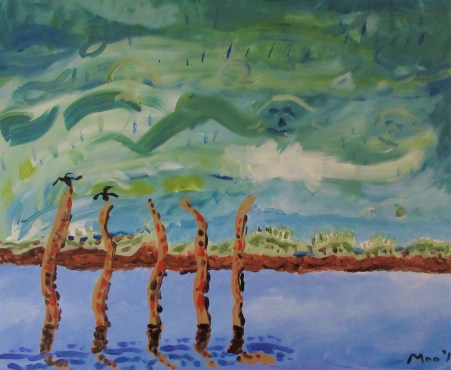
img_0265

Dark Night
(1577-1579 AD)

candlelight
stole the moon’s halo
moth sputtering to its death
this owl high-flying

a cat tears out
mouthfuls of hair
swallows
spits out a hairball
swallows
steal it for a nest

dish and spoon
dance
cats and dogs
rain golden
milky the way
earth’s
thirst is quenched

blind hands
deaf fingers
no longer deft
voices breaking
waves
an unstrung
guitar of sound

fire will one day
come to claim us all

Eight Deer

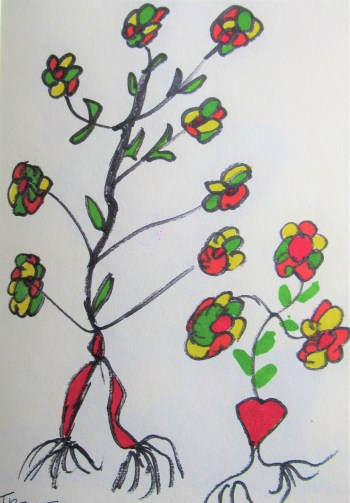
img_0436

Eight Deer
(1113 AD)

eight deer visit
my garden each night
they raid my feeders
capture my birdseed
lusting for gold
anything to keep out
this winter cold

raccoons
leave claw-marks
grubbing for grubs
dug up like donuts
circled on my lawn

who captures whom
when the full moon
descends from the sky
walks among men
making them mad

death by snow plow
snow-melt and crows
Eight Deer emerges
his sacrificed body
preserved on this page
and in salt snow

May Second

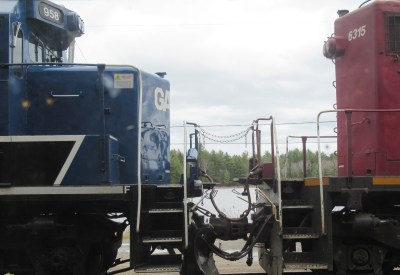
IMG_0228 (2)

May Second
(1808 AD)

bottle tops unscrewed
tighter than the tightest
oyster refusing to open
even at knife-point

plastic this many layered
onion-skin’s pliant defiance
waging its guerrilla war
against arthritic fingers

words tongue-twisted
damning dark mouths
white picket fences
midnight the faces
lightning the teeth

felonious figures
grimy with grimaces
Mother Hubbard’s
cupboard empty hearts

robin redbreasts
battering heads wings
against stony cobbles
this city this square

Autograph

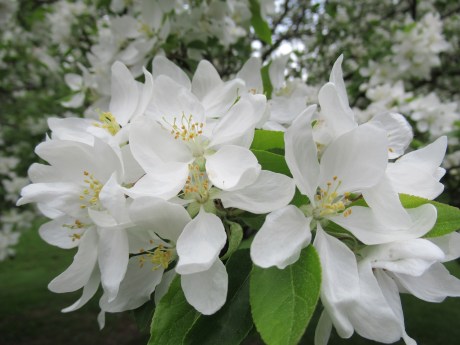
IMG_0476 (2).JPG

Autograph
(1603 AD)

it spews out words
bones to hungry
academic dogs
gnawed the word-knot
grammar’s gristle
doubly chewed
then eschewed

wet concrete sets
where the statute’s
clay feet whisper
damp follies
to waiting bergères

prance advance
macabre the dance
ink its acid burning
fragile the page
held to the light

pin-holes where stars
peep through thin paper
more fragile than
parchment

parched for knowledge
crisp pages crumble
under the fumble
thumbed
by dumb hands
lusting eagerly
for  wisdom drawn
from bone-dry dust

Polyphemus


IMG_0448 (2)

Polyphemus
(1613 AD)

Davey-lamped
one-eyed king
caged in his cavern

a songbird
dispels shadows
lights up his life

pit pines creak
can’t strike a match
walking by touch

lungs black and scarred
following the seam
back to iron cages

singing dark hymns
hoping to surface
to walk in sunlight

a jail cell
these bars’ lifelong
death sentence

below the pit-ponies
frantic and anxious
the pit’s pet canary
dead on his perch

Ghosts

img_0168

Ghosts
(1431-1463 AD)

galley dance
grisly ghouls
skeletons blowing
white in the wind

rangle jangle tangle
bones like trombones
air-hole pierced
the high thigh
pipe of flute

crows for cronies
jolly roger flag
flapped by black
wing strokes

who-hoo the owl’s
night time chant
will seek mercy
grant forgiveness

wind drops
sighs its secret
bodies tap dancing
their swan song

souls aloft
winging away
on shifting air
no longer care

Geld-[de(a)d)]

IMG_0446.JPG


Geld-[de(a)d]

who burnt the cakes
played on his harp
plotted their downfall
under white cliffs
far from the beaches
terra firma forbidden them
no more a foothold

rocks in striped sails
dragon ships sinking
feeble the swimmers
down through dark water
helped by hard iron
chain mail and axes

seeking the bottom
acting as anchors
gone now those actors
lost now their legacies

Writing Memories 10

image3 (5)


Writing Memories 10
Module 5.1 Generation Next 

We have now arrived at our last module: the happiness brought to us by our children and grandchildren. I refer to this as Generation Next. When we emigrated to Canada, our parents stayed behind in what I am now beginning to call the Untied Kingdom. If we were lucky, we saw each other every two years or so. Life’s realities have not changed all that much, and once every two years or so is when we see our daughter and granddaughter. The big difference, of course, is Skype. The social media breakthrough now allows us to see and talk and share on a regular basis. This is wonderful. So, where do we begin with Generation next? With a poem, of course.

Yellow [Poem 1]:

Sunshine and daffodils: my grand-daughter
paddles in the kitchen sink. Her mother
washes feet and dishes. “Sit,” Finley says,
and “stand,” following the words with actions.

Now she says “Yellow, yellow,” as daffodils
fill the computer screen to shine in that
far-off kitchen five hundred miles away
by road, but immediate by Skype.

“Yellow,” Finley repeats, “yellow.” Soon
in that distant province where spring arrives
so much earlier than here, she will see
daffodils dancing their warm weather dance,

tossing their heads to gold and yellow trumpets,
fresh, alive, and young in the soft spring breeze.

Commentary: Amazing how children grow and develop. When Finley first came to visit us, her vocabulary was limited and she would select one word and preach it like a preacher leaning out from her Sunday pulpit. Yellow was such a word. Yellow bananas, yellow birds, yellow daffodils and, of course, yellow jello. Is there really any other color for jello? I tried to convert this poem into prose, but it didn’ change much.

Yellow [Prose 1]:

Sunshine, floating dust motes, and the ever-present scent of daffodils: Finley, my grand-daughter paddles in the kitchen sink, rainbow bubbles from the washing-up liquid, with its hint of fresh green apples. Her mother washes Finley’s feet first, then the dishes. “Sit,” Finley says, and “stand,” she follows the words with suitable actions. Sink water swirls and bubbles as she stamps her feet with the slurp of a washing machine, drubbing old clothes. “Yellow,” she says, “yellow,” as once again my St. David’s Day daffodils fill my nostrils with their heavy perfumes and the computer screen with their brilliant golds to shine in that far-off kitchen five hundred miles away by road, but immediate by I-Pad.  “Yellow,” Finley repeats, “yellow.” Soon in that distant province where spring arrives so much earlier than here, she will walk into the garden, hear the robin’s song, and see the daffodils dancing their warm weather dance, tossing their heads to wind-sound through green leaves and yellow trumpets, fresh, alive, and young, fanned by the scent-bearing, soft spring breeze.

Commentary: Some padding, yes, and an attempt o expand the scene and include more varied details, but a success? I am not sure. Right now, I don’t know that I have captured what I wanted to capture. Maybe it is time to rethink everything and start yet again. Before we do, let’s return to the theme of yellow.

Her Shadow [Poem 2]:

Grubby marks remain where her nose rubbed up
against the window pane. Excited she

stood there, watching birds perched on the feeder.
“Finch,” I pointed. “American Goldfinch.”

“Yellow,” she cried out with joy, “Yellow.” Her
tiny hands plucked at air, catching nothing.

Her nose, all wet and runny, left damp, snot
stained letters, her signature, on the cold

glass. That’s how I remember her. Still the
window stays unwashed and her shadow
often comes between me and the morning sun.

Commentary: We all witness them, those moments when time seems to stand still and we see eternity in a grain of sand, or in a stain on the window pane. And what pain we suffer when the little culprit leaves and the house returns to the now unaccustomed silence that reigned before the enthusiastic arrival of Generation Next. The next poem concentrates on the sense of emptiness, and no I will not retouch these poems. They are just where I want them to be.

Empty [Poem 3]:

Empty now the house, clean the floors where she
spattered food and scattered her toys, polished

the tables, grubby no more, where small hands
clattered fork and spoon, her breakfast not wanted.

Empty the bathroom, the tub where she bathed.
Dry the towels, full the toothpaste tubes she

emptied in ecstasy. Where now her foot
-prints, her laughter and tears, the secret

language she spoke that we never understood?
Empty too my heart where, a wild bird, she

nested for the briefest time, then flew, yet
I possess her still, within my empty hands.

Commentary: We have all shared such moments and they will vary for each of us. You have had them too. Write bout them, preserve them, catch them and imprison them in the lines on the page that form prison bars for words. Keep them. They are as valid as photographs and just as powerful. In fact, with the proliferation of selfies and the gradual disappearance of the hand-written word, they are probably even more powerful than the ephemera that, like butterflies or one day moths, flutter and flitter through the anonymities of our digitalized world. And now, may the light of the poetic and prosaic muses shine upon you and bring you a wealth of inspiration, for my journey is over and this workshop is done.