A Sacrifice to Mithras

F1040022

A Sacrifice to Mithras

“What is this sound?”
“It is your own death sighing,
groaning, growing
while you wait for it
to devour you.”

“What is this feeling”
“It is the itch of your own skin
wrinkling and shrinking,
preparing to wrap you
in the last clothes you’ll wear.”

“What is this taste?”
“It is the taste of your life,
bottled like summer wine
once sweet tasting,
now turning to vinegar.”

“What is this smell?”
“It is waste and decay,
the loss of all you knew
and of all that knew you.

“That carriage outside?”
It is the dark hearse
come to carry you
to your everlasting home.”

“Look on us in our darkness,
help us to seek and see the light.
Keep us strong, keep us brave.
Mithras, always a soldier,
help us to die aright.”

F1010019

Comment: I am re-reading Puck of Pook’s Hill (Rudyard Kipling). It was given to me for a Christmas present (1955) by my father’s younger brother, my Uncle Frank. His signature is there, on the fly leaf, and his hand writing is as I always remember it. As I write these words, I can still hear his voice. The Song to Mithras, on which this poem is based, can be found on page 191, my edition (MacMillan, 1955), as a prelude to The Winged Hats. Without these clues, the poem operates in another space, more personal and more morbid, perhaps. The rites to Mithras were associated with the sacrifice, at midnight, of the black bull. The upper photograph shows one of the Bulls of Guisando (Los Toros de Guisando), which have stood in the province of Avila, in Spain, since time immemorial. So old are they, that the Roman legions left their mark on them in Latin, as you can see from the photo, when they conquered Spain after the Carthaginian wars.  The lower photo shows fighting bulls on a bull farm in Salamanca, Spain. Born from generations of fighting stock, these animals have been bred for thousands of years to die in the bull ring, as the bulls dedicated to Mithras were bred to die in the Roman temples. This is not a defense of the cruelty of bullfighting or the sacrifice of animals. It is rather a statement regarding the longevity of cruelty, of sacrifice, of the natural flow that leads men and women from birth, through childhood, to maturity, and on to old age, and death. My father is long gone now, as is his younger brother. Who will have access to these memories of mine when I go? Who will remember my family when I am gone?

Fire and Flame

IMG_1571 (2)

Fire and Flame

1

The world is on fire.
Someone, somewhere
lit a match.
The world exploded.

A match in the lungs.
the whole world burning.

Someone, somewhere
sneezed into their sleeve.
the world collapsed
in a fit of coughing.

“It isn’t the cough
that carries you off,
it’s the coffin
they carry you off in,”
said the talking head,
scientific boffin.

2

Intelligence, give me
the exact name of things:
corona virus, vaccine,
air that’s pure,
drinkable water,
a new, fresh world
for my daughter
and her daughter.

I wish I could spare them
from all this slaughter.

Comment: The echoes in here are obvious to me, but to how many others? Octavio Paz strolls through the first stanza while Juan Ramón Jiménez patrols the second one. How many people read their poems now? Polvo seco de tesis doctoral / dry dust of a doctoral thesis, as my friend José María Valverde once wrote. He, too, passed and will all too soon be forgotten like the rest. And time: what is it? How does it function? Is it linear or circular and repetitive? It twists and turns, like we did last summer, but not like we’ll do this one. My old arthritic bones will allow me to twist no more. Vingt-et-un, quatre-vingt- et-un: twist and bust. Yet time flows by, like water under Le Pont Mirabeau and days blend into days. 79 days of lock down now, all voluntary, or is it 80? El tiempo aquí no tiene sentido / time is meaningless in here, as my friend and mentor, José Hierro wrote, so long ago. And yes, these memories linger on, as time lingers on, as life lies heavy around us, and time limps by with its lame, old feet, yet looking back, it has raced passed like a spring river in spate. And the leaves are back, and the flowers are coming up, and the spring birds and bees and butterflies are arriving … and, in spite of everything, perhaps even because of it, life is as lovely as it ever was. Keep safe, keep well!

IMG_1264

An Angel at Jarea

IMG_0258

An Angel at Jarea

An angel moves through the room
in the silences between our chatter.
He fills the interstices of speech
with the wonder of feathers
enlightened by rainbows.

Tranquil his footsteps
as we sense his presence.
He places his hand on an arm,
his arm around our shoulders,
and now, commanding silence,
a finger on his lips.

We sit here
scared by our intimate inadequacies,
scarred by the fierceness of our thoughts
as we sense the vacuum
of his soon-to-be absence.

Comment: The video reading of my poem follows. Ruby Allan, one of the five artists invited to participate in the first cohort at KIRA (2017) would always say, when a silence fell on the group, that ‘an angel is moving through the room’. This poem is dedicated to her, and to my friend, Geoff Slater, whose house and gallery we were visiting when the happenings depicted in this poem took place in June, 2017. Several years ago now, but I remember it like yesterday: a magic moment that I have tried to preserve in words. I could never have captured these moments in my verbal snapshots without the assistance of my friends. Thank you all so much.


Mist at Jarea

fundy-05-mistwolfepipers-081

Mist at Jarea

Moving in with the tide,
drawing gauze curtains
over the islands,
climbing, so silent,
pebbles and rocks
to arrive at our windows
and block out the sun.

The mist’s grey face
presses against the panes.
Long lost friends,
come back to haunt us,
loom out of our past.

They bear memories
born beyond the mist,
living now in, and for, this mist.

They come stalking us and tap
with long, cold wisps of fingers
at locked windows and doors,
bolted so they can’t get in.


Rain Again

The rain in Spain
does not stay on the plain

Rain
              When it rained in South Wales, it rained everywhere soaking rich and poor alike. There was no escaping the eternal wetness of Welsh Rain. Whenever we traveled, especially by bus, to another part of Swansea Town, it would be raining there too, but, as my auntie used to tell us when we came back home: “Smile now. Look happy. And remember: we had lovely weather all day. The sun was shining over there where we were. Raining here, at home, all day, was it? What a pity. You should have come on the bus with us!” I remember her smiling, all wrinkles round the eyes, her false teeth shining white, as she flashed a horse’s collar coal-scuttle of a grin, absolutely shameless. But we’d back her up. We’d all smile happily and laugh, and dance, and jump up and down, basking in the joy of the falsified sunshine of her wonderful smile, her shining false teeth. And she was right: where we had been together, the sun had shone all day, in spite of the umbrellas, our wet, cold feet, and all the undoubted evidence of a day of rain.


Empty Nest

fundy 05 mist+wolfepipers 153

Emptiness
is an
Empty Nest

The wind at the window
scratches tiny notes.
I can no longer hear the tune
nor read the words.

Who walks beside me
as I pace my lonely path,
abandoned
in this empty house.

My self-portrait
stares back at me:
a splintered selfie,
framed in a sliver
of silvery glass.

Above me,
the monkey-faced moon,
that itinerant tinker,
walks a fractured way
over broken glass.

The knapsack on his back
is cobbled together
from a finery of cobwebs
and clumsy clouds.

IMG_0039

Bath Time

62074164_10157302392400522_2936552509885382656_n

Bath Time

              My grandfather took a bath once a year, On New Year’s Eve, so he could be ready, so he said, washed and clean, for the New Year. His bath day / birthday was a family event. If we wanted a bath, well the bath water didn’t stay hot for long in the bath-tub at the top of the house, under the rafters, so an old tin bath was dragged into the kitchen and a black, iron kettle was placed on the hob, and water was boiled. One by one, we were immersed, and scrubbed, to emerge pink and glossy. All this happened in the kitchen in front of the fireplace, where we sat up wrapped in bath-robes and blankets, drinking hot cocoa so we wouldn’t catch cold. But my grandfather took his bath at the top of the house, under the rafters, in the old chipped enamel tub with its lion-claw feet, water-stained sides, and its old brass taps. He walked up there fully clothed, walked into the bathroom, and shut the door behind him, drawing the bolt with a finality that shut us all out. He sang the great choruses from Aida, and Nabucco, and we imagined him, wallowing there, in the warm water, with all his clothes on, for it was hard to imagine my grandfather naked. Then, half an hour later, he would emerge, looking just like he did when he walked into the bathroom. We never heard the water running, nor did we hear it draining away. All we heard was the The Hebrew Slaves’ Chorus and my grandfather swinging his Blacksmith’s hammer as he battered at the New Year’s Anvil.

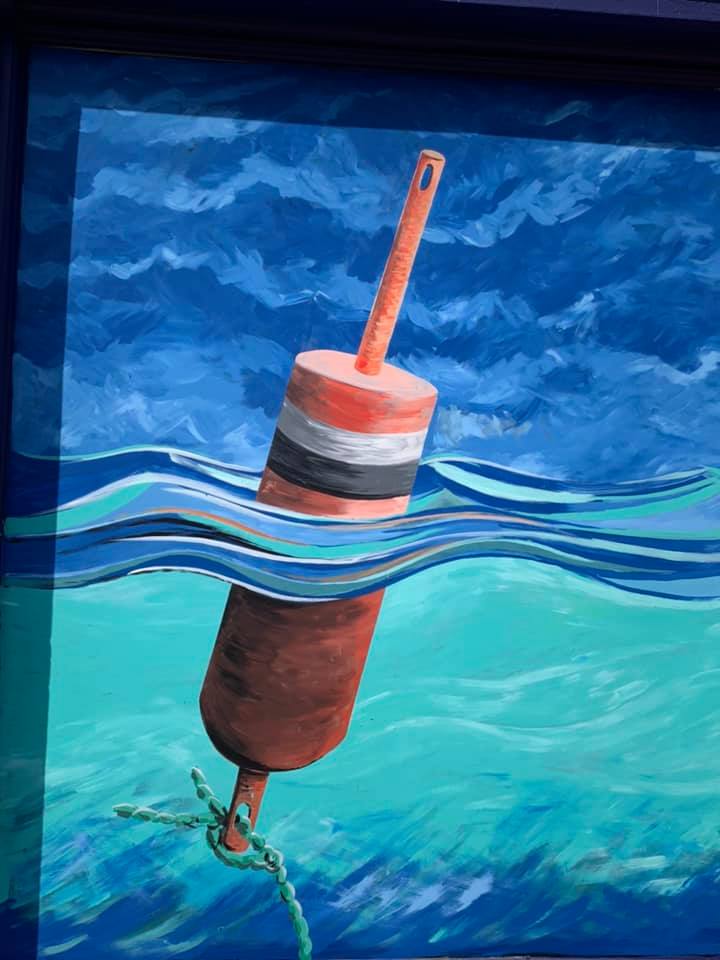
Comment: I didn’t have a photo of an old bath tub in my collection, so the lead picture is one of Geoff Slater’s murals: a buoy (pronounced ‘boy’ in Wales), taking a bath in the sea.  Let me know if you like these Welsh childhood memories, and I will keep adding to them. They are certainly fun to write and I find incredible the many ways in which memories surge as I am learning to speak Welsh. Each new chapter in my journey seems to start a new wave of thought.

Wet Welsh Rain

IMG_0730 (2)

Wet Welsh Rain

              Day after day, rain, drives in over Singleton Park and Swansea Bay. It claws its clouded way, shroud clad in grey cloud, up Rhyddings Park Road, through Brynmill, and up to the Uplands and Sketty, as it was then, now Sgetti. In those days, the rain got everywhere. It swirled around ankles and knees wetting everything below the hem of the raincoat. Umbrellas kept the shoulders dry. But when the wind blew, and gamp and brolly turned inside out, and people looked as though they were duelling with the wind, and threatening to poke each other’s eyes out, then a good soaking was sometimes better and safer and, in the worst of the rain and the wind, the gamps and brollies came down.  As for the puddles: they were everywhere. You walked in them, whether you wanted to or not, and your leather shoes turned into a pulp that let in water. Socks slopped around your feet, wetter than soggy blotting paper aka blotch [hands up if you remember blotch!]. Heads down, we faced the wind, draped around bus stops, waiting for buses that never came singly, but only in threes after much long suffering. Wind like a whiplash drove the rain before it and everywhere, woolen scarves turned into wet wash cloths and woolen gloves became underwater rain-sodden mittens.

Comment: As Tropical Storm Arthur gathers in the North Atlantic, we would do well to remember the good old days of summer holidays in Wales when it rained every day, bob dydd, during the whole two-week vacation. But did it really rain back then? Who remembers now? I seem to remember it was sunny every day, especially when the cricket was suspended with the words Rain Stopped Play displayed across the television screen. Ant the lunch time cricket scores: what joy to listen to them and to discover one day, as I listened on my illicit radio hidden in my school dormitory,  that play had been stopped because of “piddles on the putch, sorry, I mean puddles on the pitch” [hands up if you remember that announcement!]. I am sorry to say that particular radio announcer did not stay in his job for long. A great pity: I found him rather amusing.

We would do well, too, to recall the twelve days without electric power that followed Hurricane Arthur, back in 2014 [hands up if you remember Hurricane Arthur!]. Alas and alack: how accurate are our memories? And did all of those things really happen? As the street vendors and newspaper vendors [hands up if you remember paper boys!] used to cry out on street corners “Echo, Echo, South Wales Echo: Read all about it” or “Post, Evening Post, South Wales Evening Post, read all about it!” The South Wales Echo and the South Wales Evening Post hands up if you remember them … Oh those were the days … or were they? … click here and read all about it!


Morning in Island View

IMG_0262

Morning in Island View

             Morning in Island View and I dream of warm lips rising from stone cold waters. Somewhere, the early sun floats petals across a lily pond. Framed among lilies, my beloved’s face drifts through a watery space. So sweet, her embodiment: she lies languid among the lilies, beside herself in bloom after bloom, each flower gigantic in its frame beneath a wooden footbridge.

            I envision her as she was, this lily who will toil not, nor spin, and who sighs with the morning breeze that ripples her smiling countenance into a thousand fragments. She lies cushioned amid the lily pads, a work of wonder in a liquid impression of fragmented light.

            Fortune rattles its poker dice and they fall haphazardly, here and there, wherever they will. Once thrown, like the spoken word that can never be recalled, they lie there, still on the table’s green baize. They fall, but not by chance and chance itself blossoms with their falling. Like Venus born from the waves, my beloved rises from the waters, born in a conjurer’s trick of blossom turned flesh and pulled from the stream’s dark sleeve to flash her mysterious magic in a thicket of flowering water.

            Now, I see her everywhere: a model in a window, languid in a pavement puddle where raindrops ripple her eyes, couched among the floating clouds as evening steals color from the day. Dusk’s shadows draw their curtains across street and square and now she becomes my lily of the lamplight and I frame her anew in the streetlight’s afterglow, night’s figment dreamed alive beneath distant stars. I walk with her, hand in hand, at noon, when the cathedral wears its strawberry suit, and again in the late afternoon when a blueberry blush descends with bells.

            One evening, in a fit of hope, or is it despair, when my heart pants for a cooling stream, I tread the lily pad path across the pond’s untroubled waters. Dark bells ring out their jug-o-rum chorus as I seek the light of her countenance. Dusk is a violent bruise, scoured purple and red across the waters as I try to become one with my lady of the lake.

            I still don’t know what drew me out. But when I emerged, I sensed that all had changed and that nothing had changed more than I had, the viewer, that once-young man, now old and arthritic, typing away, one finger at a time, battering my key-board to recreate the wanderlust of those day-dreams wrought sous le Pont Mirabeau, along the banks where the Seine flows, or up by the bouqinistes where bridges span the river, words bounce off the page, and painted lilies in the Marché aux Fleurs bewitch the viewer with a staring madness that mirrors pondweed and drifting hair. Now my beloved’s face floats through the cathedral’s eye that ripples in the river. I see the great rose window of Notre Dame, and I seek her once again in those dark waters where she holds out her hands, a place mat for my un-drowned heart.

Her Shadow

IMG_0063

Her Shadow

“Birds, birds,” she shrieked with delight.
“The drab one is a girl like you,” I told her,
“but the bright one is a little boy.”

“Yellow,” she cried again with joy, “Yellow.”
Tiny hands plucked at air, catching nothing.

I can still see her standing there, her nose,
all wet and runny.  She left damp, snot-stained
marks, a sort of signature, on the cold wet glass.

She’s long gone now, way back home, but still
the window stays unwashed and her shadow
often comes between me and the morning sun.