Secret and sacred, this shadow world that walks naked in the inner chambers of the mysterious mind.
Here, in the valley, surrounded by whaleback hills, the horizon limited by fir and fin, I live without limits beneath a limitless sky.
Dream boats sail above me on a sumptuous azure sea and I am a mammal, feet rooted in the soil, dwelling at the bottom of a sea of air.
Mysterious, the circles weave their cycles – sunrise to sunset, moonrise to moonset – and in my dreams a photo of the rising earth seen from a cyclical satellite we call the moon.
Last night, I packed up my troubles in my old kit bag, but this morning my back and shoulders buckle beneath its ponderous weight. I take care not to stumble, especially on the stairs, for if I stumble, I will surely fall, and every fall is a precipice that I will never be able to climb.
I want my feet to take root, to sink solidly into the floor, so that even when the wind of change blows, it will not knock me down. Downstairs, at my kitchen table, the sun promises warmth and comfort.
I raise my gaze and rainbows sparkle, dance on my eye-lashes. I strive upwards, ever upwards, and, turning towards the light, its golden beauty creates in me this morning hymn of praise.
Red Sky After a long conversation with my hero: Travis Lane.
“Red sky at night, shepherd’s delight. Red sky in the morning: sailors take warning.“
But I am not a sailor, nor will I ever be one. Nor a tinker, nor a tailor, nor part of any nursery rhyme.
So easy to follow the sheep, and graze where they may graze, in safety, and the shepherd’s crook all too close at hand, with both hands and shoulder all too ready to save, comfort, and carry home to the security of a safe place.
Better by far to float along, guided by sun, stars, and tide, choosing your own route as you go, or going with the eternal flow, going where it takes you, red skies at night, storm warnings in the morning, and everywhere the give and take of creating new things, new paths, wherever you may choose to go.
“Red car at night, wifey’s delight. Red car in the morning, hubby take warning.”
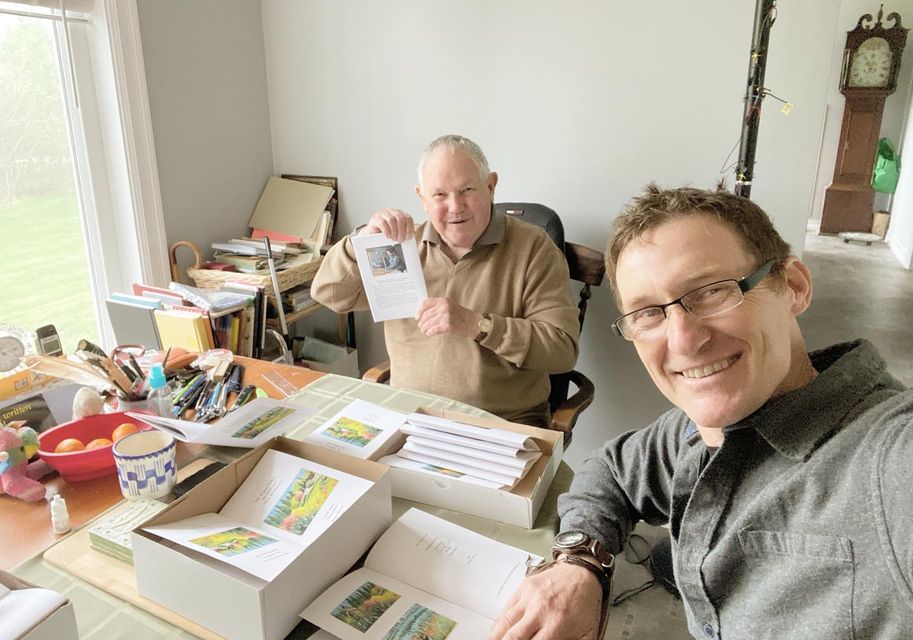
I took the e-file to Covey’s, the Printer on Prospect Street, Fredericton, on Monday. On Tuesday, Jared set up the files for printing, and I received the book on Thursday morning – nice and early. What an incredible turn around. The writing time-frame is interesting too. Geoff painted and posted. I wrote. The whole thing came together in less than a month. It just shows what inspiration, collaboration, and hard work can do. Here is a poem (# 17) from the book.
17
This year’s snow is not last year’s snow. Tell me, if you know, where did last year’s snowfall go?
These flowers you paint, they are not last year’s flowers.
Time flows and the world renews itself. It may seem the same, but it’s not. Nor are you the same. How could you be?
You too have renewed yourself, grown, like these flowers you paint, these flowers that will wither and perish to lie buried beneath fresh snow.
You cannot walk in the same river twice. Nor can you paint the same flower once it has withered and gone. The flowers you paint can never be the ones you painted before.
How do you frame this beaver pond, those paths, those woods? How do you know what to leave, what to choose? Where does light begin and darkness end?
Up and down: two dimensions. Easy. But where does depth come from? Or the tactility, the energy, water’s flow, that rush of breathless movement that transcends the painting’s stillness?
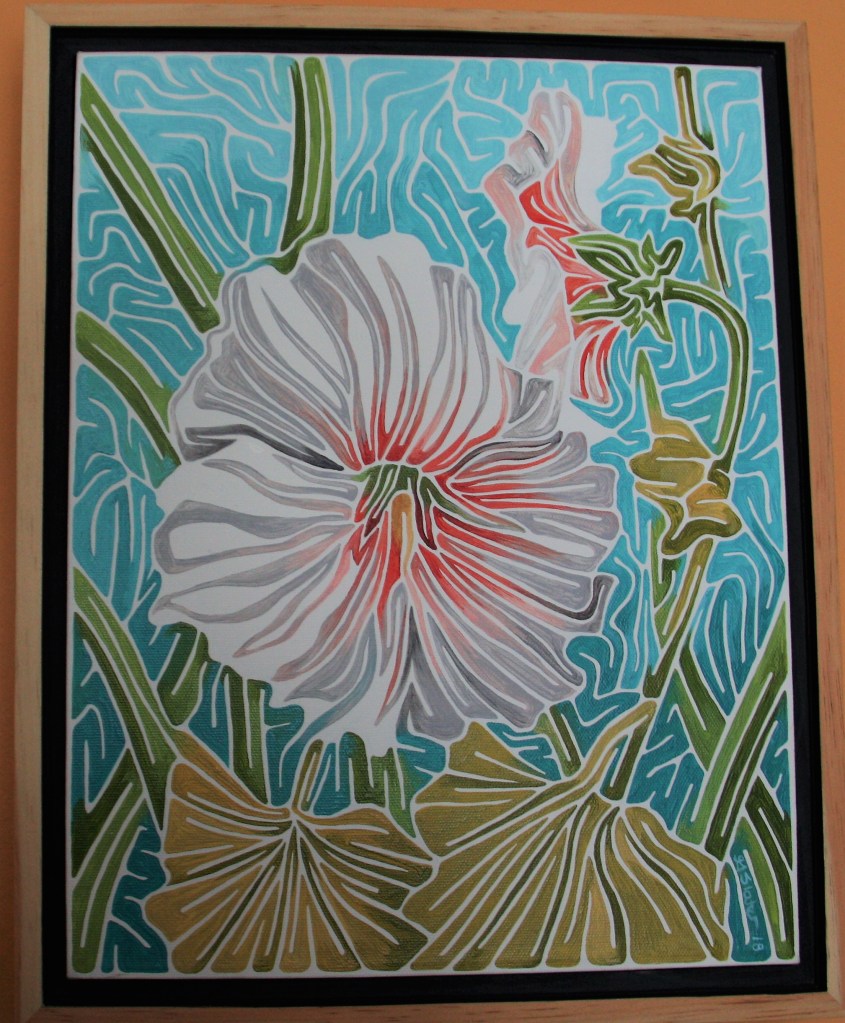
So many questions, so few answers. The hollyhock that blooms in my kitchen is not a real hollyhock. Intertextuality, visible and verbal: this is a poem about a painting of a digital photograph of a hollyhock, a genuine flower that once upon a time flourished in my garden.
A still life, naturaleza muerta in Spanish, a nature morte in French, a dead nature, then, portrayed in paint and hung alive, on display, in this coffin’s wooden frame.
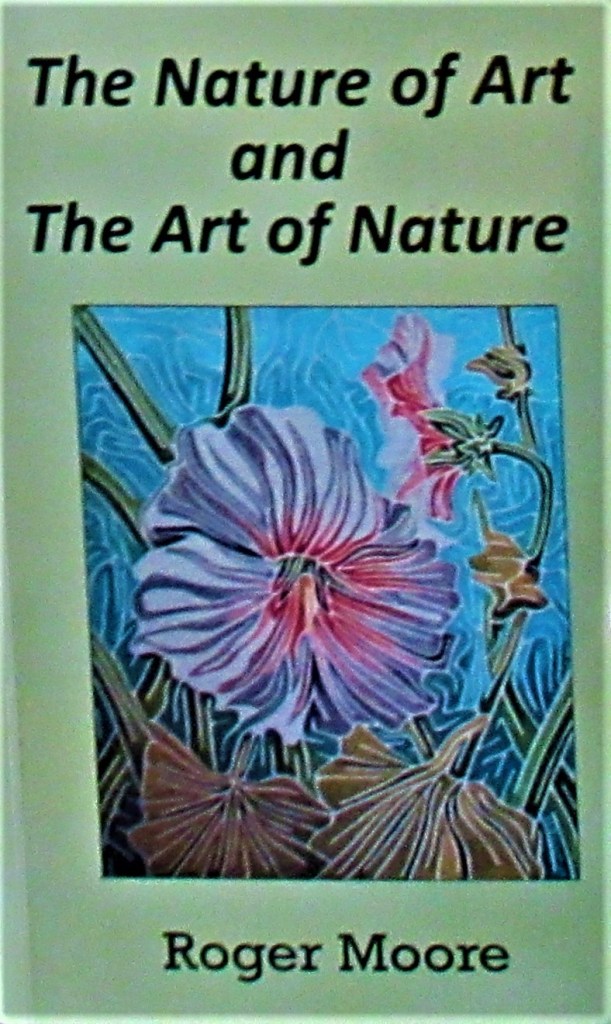
Comment: Back home in Wales, Christmas Day was for family and Boxing Day was for friends. I guess the same traditions still exist here in Island View. And what better friend than Geoff Slater? I met him in 2017 at the first KIRA residency and we have been friends ever since. We have worked on so many projects together: painting, creative workshops, videos, sound recordings, poetry, and short stories. He has illustrated several of my books, McAdam Railway Station, Tales from Tara, Scarecrow, and I have put some of his drawings to poetry, Twelve Days of Cat. Last, but by no means least, his painting of a hollyhock from my garden appears on the front cover of my latest poetry book, The Nature of Art and the Art of Nature (Cyberwit, 2021). The title of the collection, incidentally, came from sundry discussions we had on the nature of art and the Prelude: On Reading and Writing Poetry (pp. 7-31), was written at his suggestion. Poems to Geoff can be found on pp. 43, 44, and 61-62 of The Nature of Art.
So, Boxing Day is for friends. And I dedicate it to Geoff Slater and all the many friends I have made in KIRA, Kingsbrae, and throughout my multiple meanderings through the realms of academia, coaching with the NCCP and the NBRU, researching in communities like the ACH, the AATSP, and the MLA, various editorial positions on academic journals like the IFR, BACH, STLHE Green Guides, STLHE Newsletter, La Perinola, AULA, CJSoTL, Canadian Modern Language Review, Calíope, translating for different associations, including the Discalced Carmelite Nuns in St. Joseph’s Convent, Avila, and volunteering with STLHE and the 3M National Teaching Fellowship. To all those friends out there, including my friends and e-friends in TWUC, the LCP, and the WFNB, and those on Facebook, my blog, and my online Skype and Zoom courses and meetings, plus, of course, those I know via Quick Brown Fox, you are not forgotten. Here, for you, on Boxing Day, is a hug or a wave of the hand and a great, big thank you for being there.
Selection of my books on the sea-shore at Holt’s Point.
“My walk each morning, rain or shine, feathers my black galoshes with dewy grass. There I would ramble through gated doors that kept out the world and sealed in my pen’s work for that day.
I often found myself sidetracked, exploring paths that led through flowerbeds, and up to my favorite sculptures. I paused to watch my fellow artists as they focused on chosen subjects unaware that I was eavesdropping.
Then silently, I would steal away along the well-trod path to my studio, pausing long enough to greet the llamas and baby goats. If I listen carefully I can still hear their bleating.
In wonder, every day, I climbed the steps of wood that led to my studio, opened the door, and turned to breathe in my good fortune. ‘What a blessed woman you are,’ I would tell myself before taking my place for hours on end at my desk, each moment, each stroke of the pen, each letter added to the growing lines on the page, a gift.”
Comment: This is a found poem, found in the sense that it doesn’t belong to me. I met Ginger at KIRA in August, 2019, and we became close friends. We have corresponded regularly since meeting and she has become one of the best beta readers I have ever had, open, fiercely, honest, knowledgeable, and challenging. This challenge for me ‘to be the best that I can be’ really does bring the best out of me as a writer.
A found poem: I found it in one of the e-mails Ginger sent. In it she described a typical day for her at Kingsbrae. Isolated from its e-mail prose, the lines shortened and the thoughts slightly re-arranged, it became this poem, Ginger’s poem, her poem. I offer it to her, as she offered her writing talents to me, openly and with great humility. It can be found in the section entitled Impressions of KIRA Artists on pages 66-67 of The Nature of Art and the Art of Nature (Cyberwit,2021, details to follow when available).
We met at St. Andrews, at low tide, on the underwater road. In secret we shared the closed, coded envelopes of thought, running fresh ideas through open minds.
Our words, brief vapor trails, gathered for a moment over Passamaquoddy, before drifting silently away. Canvas sails flapped white seagulls across the bay.
All seven seas rose before our eyes, brought in on a breeze’s wing. The flow of cold waters over warm sand cocooned us in a cloak-and-dagger mystery of mist.
We spun our spider-web dreams word by word, decking them out with the silver dew drops proximity brings. Characters’ voices, unattached to real people, floated by.
Verbal ghosts, shape-shifting, emerging from shadows, revealed new attitudes and twists, spoke briefly, filled us with visions of book- lives, unforgettable, but doomed, swift to fail.
Soft waves ascended rock, sand, mud, to wash away footprints, clues, all the sandcastle dreams we had constructed that afternoon, though a few still survive upon the printed page.
Comment: We, like the words we leave on the printed page, are survivors. Sometimes, when the seas rise high and our paths grow rough and hard to travel, we need a friend to reach out to us in our time of need. That friendship extends across differences and distances. Here, on the shores of time, we can meet and greet and share. Patos de diciembre, we can paddle together and give each other strength and comfort.
This poem appears on pages 64-65 of The Nature of Art and the Art of Nature, soon to be available at Cyberwit and Amazon. More details later.
What is it about generic greens, their power of growth, renewal, resurgence? In the Auberge, Moncton’s Hospice for cancer patients, sufferers wore green clothes, shirts, blouses, skirts, trousers. Green for recovery, for hope, for the persistent belief that nature mattered, more, that nature could be omnipotent, ubiquitous, everywhere around us. The patients planted a small garden, almost an allotment. They walked in it, sat beside it, watched the flowers grow, grew their own cells anew, hoped.
Exercises are easier, more fulfilling, when done in green surroundings. Go green for improved moods, better self- esteem, growth beyond the muscles of cold iron pumped indoors by hot, sweating bodies. Never underestimate the healing power of walking barefoot on grass, your toes curling into the early-morning coolness of fresh, new dew.
Focus your attention on the here and now. Forget the past. Let the future take care of itself. Your most important therapeutic tool is this moment of awareness when you and your world are one. Erase loneliness and isolation. Don’t pander to the pandemic. Talk to your plants. You may not think they’re listening, but they are. And you must listen to them too. Learn the languages of tree and shrub, of butterfly and bee, of Coneheads and Cape Daisies. Bask in beauty: sunflowers, hollyhocks. All will be well.
“Verde, que te quiero verde. / Green, how I love you green.” Federico García Lorca (!898-1936).
Comment: I have been discussing Mindfulness with several people recently. Whether it be the Covid-19 outbreaks or the necessity of staying apart from friends and family, some of my seem to have become more isolated and more introverted over the last couple of years. As a result, the theme of mindfulness has arisen, often spontaneously. So, this poem is dedicated to all of us who feel the need to live in the moment and to concentrate on the development of our inner growth and being. It is taken from my book The Nature of Art nd the Art of Nature (pp. 134-35), soon to be available on Amazon and at Cyberwit.net







 rogermoorepoet