Carved in Stone 56 & 57

Carved in Stone
56

I stand before the Tzompantli,
the Aztec Skull Racks
in the ruins of the Great Temple
in Mexico City,
and gaze in wonder,
at the multiple meanings
of these decorated deaths.

57

At Teotihuacan,
I climb the Sun Pyramid,
with its carved serpent,
slithering sideways,
as the sun moves.

I heave myself upwards,
panting, sweating,
and when I get to the summit,
I sit there, feet over the edge,
and I feel my heart thumping
as I fight to regain my breath.

Now, I feel purified,
cleansed, sweated dry,
as I watch poor mortals
struggle as I did
to take that final step.

I imagine them laid
on the sacrificial stone,
their chests carved open.

Each beating heart,
when extracted,
will cover altar, priest, and sky,
with a fountain of blood,
so hard those hearts
are pounding. Blood seeds
shoot into the sky
to revive the setting sun
as it drowns in its own blood.

Commentary:

Incredible, looking back, those moments in Mexico when I came face to face with a culture, so old, so alien to me, that I had difficulty coming to terms with it. I do not understand human sacrifice. Nor do I understand the mentality of the conquistadores who held the Aztec Emperor’s feet to the fire and burned them to the bone, leaving him alive. And still he would not tell them the secrets of the kingdom.

“The setting sun as it drowns in its own blood.” A nod to Charles Baudelaire, of course, – “Le soleil s’est noyé dans son sang qui se fige.” Wonderful how these images stay with us. Sunrise – and the sun is born in blood – sunset and the sun sets in its own blood. And was it really true that only the blood of humans, drawn through human sacrifice, sometimes voluntary, sometimes not, would keep the sun in the sky?

And there we go – in blood we were born, in blood we will probably die – all hail the power of blood – unless of course / wrth gwrs – it is contaminated. And what will happen to us then?

Carved in Stone 12

12

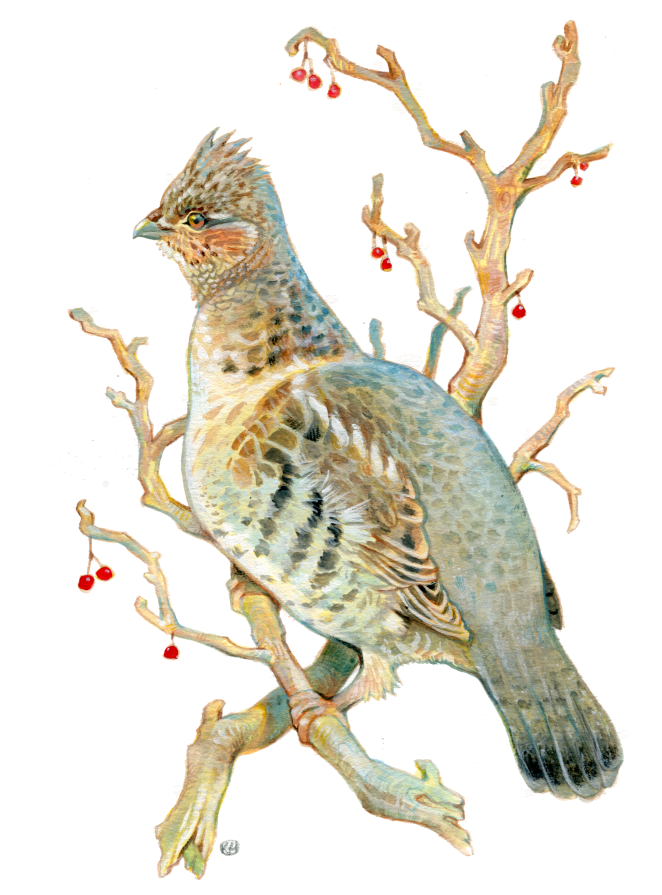
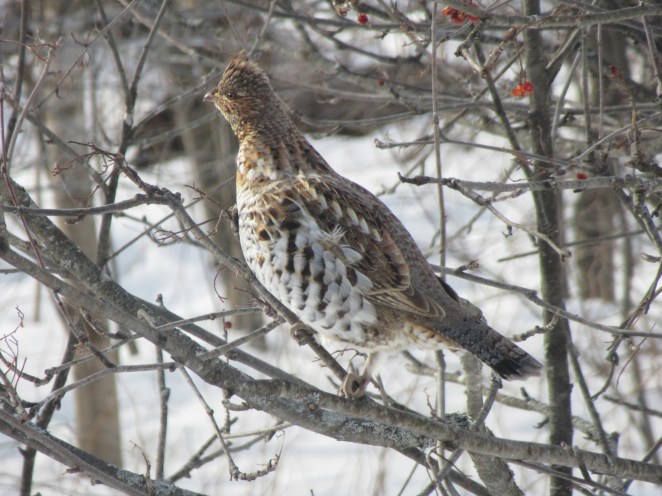
A Ruffed Grouse sought refuge
among the berries
of the Mountain Ash.

I shot him,
not with a gun,
but with a camera.

Intertextuality –
a friend borrowed the photo,
turned it into elegant brush strokes,
and now the painting
hangs on my wall,
opposite the tree
where once he sat.


A still-life
face to face with its reality
as early morning dew
forms on spider webs,
hammock-strung
between grass-blades,
bending in the wind.

And what if the spell breaks
and I can no longer see the fine seeds
of the dandelion clock kissed away
by the lisping lips of time?

What is life?
Is it just an illusion?

Commentary:

I shot him, not with a gun, but with a camera. Interesting. I have never seen the need to take the life of living creatures, except in cases of absolute necessity. And no, I have never killed, let alone for fun or sport. Shooting with a camera, that’s my ideal, and when a friend and fellow KIRA artist likes the photo and offers to paint it … well, that leads us into the nature of intertextuality, where reality becomes photo, becomes painting, becomes a text, and you, dear reader, are contemplating all those moments that join us.

The fine seeds of the dandelion clock kissed away by the lisping lips of time. This image comes from my walks in the Welsh countryside around Brandy Cove, Gower, with my paternal grandmother. “What time is it Nana?” I can still see her, bending down, plucking a dandelion, and holding it out for me to blow the seeds away – one puff, one o’clock, two puffs, two o’clock. I recall the seeds, drifting away on the summer breeze. “The Good Lord loved those dandelions,” she once told me. “That’s why He planted them everywhere.”

What will happen when the wells run dry and water runs out and there are no more dandelion seeds? How long will it be before I can no longer see them? Vis brevis, ars longa. The answer to my questions – I care, but I really don’t know.

Chuck Bowie

Chuck Bowie
(June, 2019)

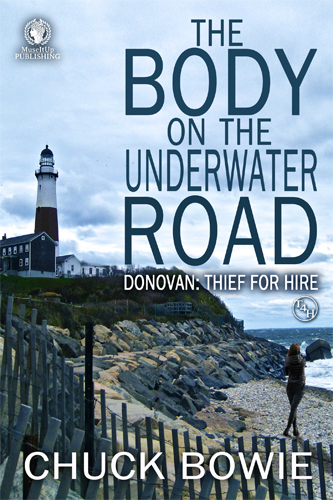
We met at St. Andrews, at low tide, on
the underwater road. In secret we
shared the closed, coded envelopes of thought,
running fresh ideas through open minds.

Our words, brief vapor trails, gathered for
a moment over Passamaquoddy,
before drifting silently away. Canvas sails
flapped white seagulls across the bay.

All seven seas rose before our eyes, brought
in on a breeze’s wing. The flow of cold
waters over warm sand cocooned us
in a cloak-and-dagger mystery of mist.

We spun our spider-web dreams word by word,
decking them out with the silver dew drops
proximity brings. Characters’ voices,
unattached to real people, floated by.

Verbal ghosts, shape-shifting, emerging from
shadows, revealed new attitudes and twists,
spoke briefly, filled us with visions of book-
lives, unforgettable, but doomed, swift to fail.

Soft waves ascended rock, sand, mud, to wash
away footprints, clues, all the sandcastle
dreams we had constructed that afternoon,
though a few still survive upon the printed page.

Comment:
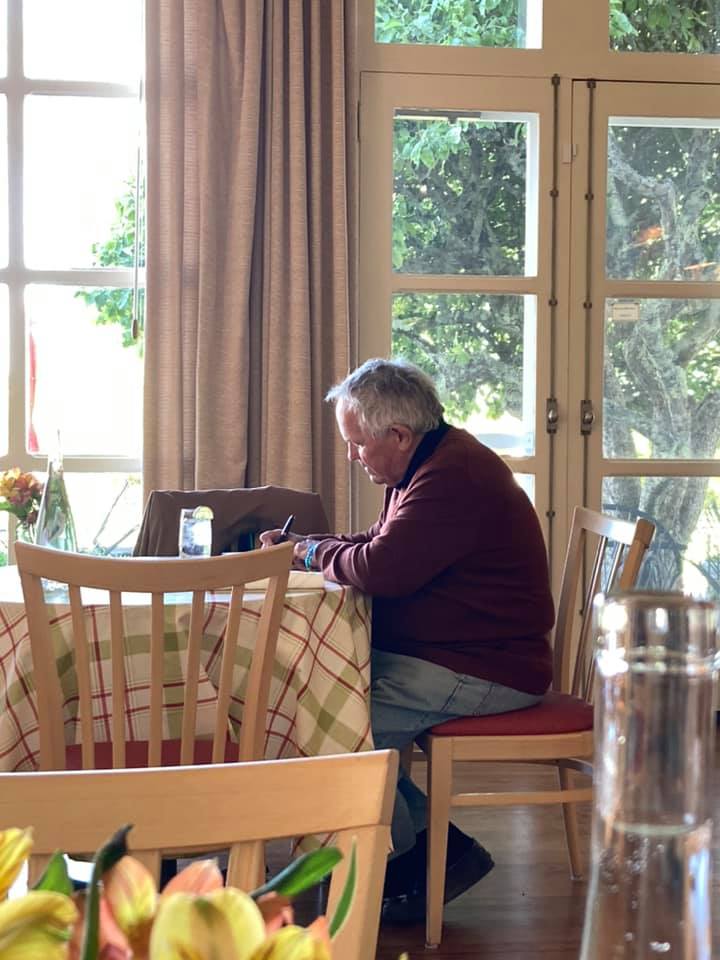
This is a ‘get well soon’ post for my friend, Chuck Bowie. Let us hope it gives him that little boost all artists need, when they feel a little bit down. An excellent writer, I am pleased to support his work and bring it to the attention of the readers of this blog. The poem, incidentally, is taken from my own book, The Nature of Art and the Art of Nature.

Chuck and I met at St. Andrews, on the beach, and spent a pleasant hour or two discussing both art in general and the structure and characters of this book in particular.

Was that really in June, 2019, more than five years ago, when he was resident artist at KIRA? So many tides have risen and fallen since then. So much water has gathered and flowed. Vis brevis, ars longa – life is short, but our art outlives us – long may both authors and their art survive and flourish!

It’s A Small World

It’s A Small World

Light returns to Island View after Monday’s eclipse. Here it is post the total eclipse and daylight is being restored. It was a wonderful experience, totally unlike the last total eclipse we saw, at Skinner’s Pond, In PEI, on 10 July 1972.

That one was unexpected. Nobody talked about it. Nobody said a thing. We travelled to Skinner’s Pond, the birth place of Stompin’ Tom Connors, just to see where he was born. We parked the car, put the dog on a leash, and walked on the beach. Normal sea-side sounds – waves, sea birds, wind among the dune grass – swallows rose and fell, twittering joyfully. A world at peace. Then it happened.

A shadow moved across the sun and the world started to darken. The dog went wild, strained at the leash, started to whimper. The bank swallows began to gather, then, as the darkness deepened, they dived for their burrows and vanished from sight. We shivered and wondered. We had no glasses of any kind. We avoided looking at the sun, and just experienced the world as it darkened and became colder and more silent, save for the sound of the wind in the grass. As the light returned, the dog settled down, the swallows emerged from their tunnels and took to the skies, twittering again. Life, light, and warmth returned to normal.

Monday’s eclipse was so very different. We weren’t intending to watch it, other than on the television. While I was out shopping, early that morning, I joked with the people I met that, during the eclipse, I was going to tuck myself into bed and hide my head under the blankets, in case it was dangerous. [Yes, I have read Day of the Triffids and seen the movie. Now that does date me.] On the way home, I met one of my neighbors. Was I going to watch the eclipse? Once in a life experience. Did I have the right glasses? He told me to avoid normal sunglasses. Told me I wouldn’t get the right glasses now. All sold out. He gave me a strange look when I told him of my decision to bury my head in the blankets – just in case – so no harm would come to me.

Several news items turned up on my computer. In one of them I read that approved special glasses – true specifics and details given – had vanished from the stores in Fredericton. Only one place still stocked them – Canadian Tire, South Side. Ha! I drove back into town and there, on the door of CT-South, I saw a sign – Eclipse Glasses available at Check Outs. I joined the line up of late buyers, bought two pairs, and headed joyfully home.

When the eclipse started, I drove around the block, looking for the best place from which to view it. I parked here, there, and everywhere, tried my glasses out – a small, black line, curved, was slowly and silently invading the sun’s disc. I drove back home and discovered, after an experiment or two, that our back porch was the perfect spot for viewing. We put chairs on the deck, sat down, and watched as the blackness on the sun’s face grew larger. No beach view this. The Island in Island View is in the St. John River / Wolastoq, on the other side of the hill. No sea gulls, no swallows, in our garden. In fact very few birds at all.

As it grew darker, we could hear the soulful hooting of some mourning doves. They soon grew silent. The crows, on the other hand, rose up to defend their territory, just like they do when a hawk passes over and puts its shadow between them and the sun. What a racket of sheer defiance.

Through our glasses we could see wavy lines of light flickering around the visible parts of the sun’s circumference. Occasional red streamers, flared up and out. Then the eclipse became total. We took off our glasses and for two minutes and seven seconds (or so) we basked in celestial glory. Breathtaking. Spell binding. A mystical moment of myth and magic. We sat in silence. Then, the spell broke. The sun emerged from its moon shadow and light returned. The earth warmed. Life was as it was. Nothing had changed, except for us. Light broke where no sun shone, and suddenly we realized so many truths.

How tiny is our world. How enormous is the space around us. How mighty is the universe. How fragile are we humans. How small and insignificant is our world. How glorious is our existence, the joy of life, of witnessing, of seeing such power and such glory. The joys of knowing that we are sentient, and alive.

Two images of partial eclipse – with clouds – Kingsbrae International Residencies for Artists (KIRA, June 2021).

Poems for KIRA 2023 # 1

1

when we two came together
 we closed an ancient circle
becoming one with the standing stones
that measure seasons and time

now we harvest the summers
 lilies lupins fox gloves blue bells
a surfeit of wild flowers plucked
from the maze of our days

we wait and watch the slow snow
settling white on sarsen stone
as time weaves crow’s feet
into the corners of our eyes

2

i listen with my eyes
to the words and thoughts
of long-dead writers.

age-old and wise they walked
alone along the hidden ways
to set themselves free

they fled the royal courts
where power and jealousy
plotted twisted ways

cruel means
justified by brutal ends.
mindless quarrels bitter strife

i also ran away
and slowing down i found
an enviable life

enriched i live
harvesting a wealth
of goodness

days lived far from fear
 envy resentment distrust
in wooded seclusion

Comment: I was invited to attend KIRA as writer in residence this month. However, a weakened immune system and a series of setbacks over the late summer made this impossible. That said, KIRA and the early morning light seen from the Red Room live on in my heart and I will try to complete my planned project, here in Island View, over the next month or so. Wish me luck.

One Small Corner

One Small Corner

 And this is the good thing,
to find your one small corner
and to have your one small candle,
then to light it, and leave it burning
its sharp bright hole in the night.

 Around you, the walls you constructed;
inside, the reduced space, the secret garden,
the Holy of Holies where roses grow
and no cold wind disturbs you.

 “Is it over here?” you ask: “Or over here?”
If you do not know, I cannot tell you.

But I will say this: turning a corner one day
you will suddenly know
that you have found a perfection
that you will seek again, in vain,
for the rest of your life.

Comment: This is the title poem of the book One Small Corner – A Kingsbrae Chronicle, written at the first Kingsbrae International Residences for Artists (July, 2017), and published on Amazon – Kindle that same year. This is the video that accompanies the poem. https://www.kingsbraeartscentre.com/ – turn up your sound. My thanks to all those involved in that first residency and especially to Mrs. Lucinda Flemer, Geoff Slater, and my fellow resident artists, Ruby Allan, Carlos Carty, Elise Muller, and Ann Wright. One Small Corner, along with some other publications, can be found by clicking here. Special thanks for the making of the video itself go out to Geoff Slater, Jeff Lively, and Cameron Lively.

Pain and Pane

Pain and Pane

I am living in a Duke of York world
fraught with mood swings and random changes.
When I am up, I am up, and when I am down,
well, then I am down, and every so often,
I meet in the middle and am neither up nor down.

At night I swim among the constellations
and the stars net silver sequins in my hair.
By day, I walk along a piano’s keyboard
and replay life’s ups and downs like scales,
practicing them, again and again.

I no longer know who or what I am.
I only know I exist right here, at my desk,
my table, in my bed, looking out through
a window that has opened in my head,
a window that serves as a mirror.

I step through it, and go back to my childhood
in Wales. I recall the sunny days of sea and sand,
but also those days when sunlight fails, clouds
gather, and the west wind conjures rain and gales.
Such pain as I press my nose against the window
pane, and watch the raindrops falling again.

The Return

The Return

“You’ve been here before,” my Welsh grandmother
told me when she first held me. At least that’s what
they tell me she said. She married into a Catholic family,
but she never converted, refused to give up her own religion.

As a result, they didn’t respect her and never gave her
the treatment she deserved. I would love to ask her:
“Gran, if I was here before, where was I until I came back?”
Maybe she would know. The others wouldn’t dare ask
the question, let alone answer it. The facts of life were
forbidden things, surrounded by a silence of myth
or else spoken gently, in secret whisperings, with nothing
ever revealed to the young and curious.

Once again I have returned here and can honestly say
“yes, I’ve been here before.” This room seemed strange
the first time I visited, and yet it soon became my home from home.
As soon as I open the door, I embrace the familiar.
This room knows me, as I know it.
I walk to the writing desk, look out of the window,
and everything is at it was the last time I was here.
The sea below me sparkles as it always did.
The tower still stands at the end of the island,
and I know full well that, tomorrow morning,
dawn will flood the room with light.

Each day I am here, I will be blessed with a no sé qué
of mystic mystery that will overflow, fill the well
of my inner creativity, and allow me to fulfill
my destiny and praise those things that enlighten
the world and help to fill it with energy and verbal light.

Click here to listen to Roger’s reading.

Ides of March

Ides of March

Sometimes, as the sun goes down, the shadows close in.
You can sense real people, half-hidden in the mists
rising up from the ground. You shiver in their presence.

They fought a battle here, according to legend.
Legends never lie, though they hide away the facts,
as these mists hide those fallen warriors, brought
back to life, in the half-light, and thirsting for warm blood.

In the distance, blood flows staining the evening sky.
When the hairs on your neck rise up as wraiths, you take
to your heels and run to the place where you left your car.

Westbury White Horse, Badbury Rings, Maiden Castle –
such places are haunted with those whose spirits never left,
never moved on. They stayed here, defending the defenseless,
spirited warriors, never saying die, not even when dead.

Close by, at the hill’s foot, someone has built an altar
crowned by a small, carved cross. Who put those flowers on it?
Who came to bless the peace of those who dream and wait?

The Ides of March have come once more. Now they have gone.
Like all those other Ides before them, like all those years,
those seasons, those warriors. Come and gone. Or not gone,
as you stand there, sensing their spirits, living on and on.

Click here for Roger’s reading.

Comment: The Ides of March – March 15 this year, two days before St. Patrick’s Day. “The Ides of March are come.” “Ay, Caesar. Come but not gone.” William Shakespeare. Julius Caesar. The Ides always seem such a precious time. Sandwiched between St. David (Wales) on March 1 and St. Patrick (Ireland) on March 17, and all so close to the Equinox and the start of spring. It is snowing outside my window as I type. About four inches / ten centimeters down and more to come. But, with the lengthening of the daylight hours and the arrival of spring, we hope the snow won’t last too long.

Writing in the Red Room

Writing in the Red Room

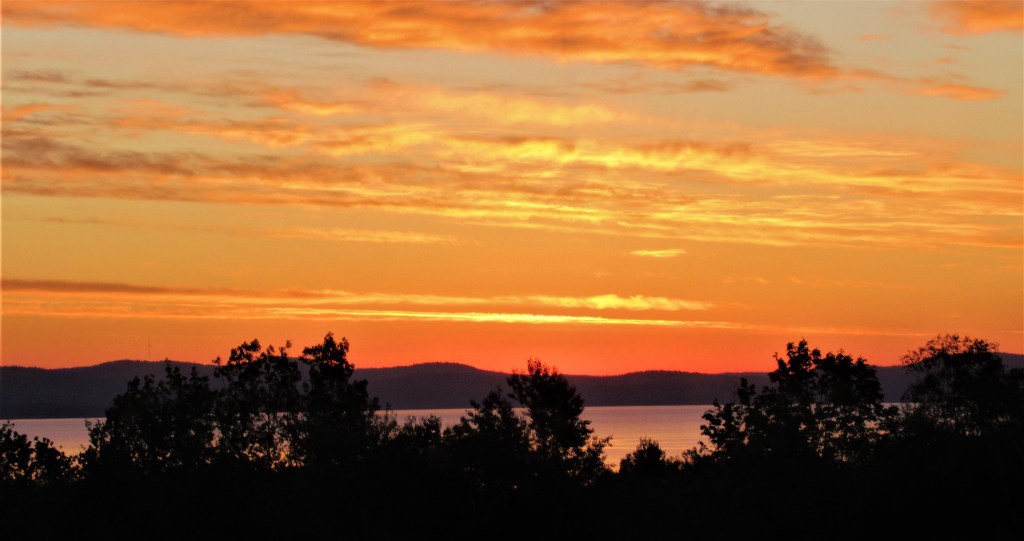
Dawn over Kingsbrae, as seen from the writer’s desk in the Red Room in KIRA. “A poet could not but be gay, in such a jocund company.” Wordsworth, thankfully, for how words change their value as language transforms itself and old values and meanings grow wings and flit away.

Gai saber – from Old Provençal: “gay knowledge” or “gay science”, the art of composing love poetry, especially the art of Provençal troubadours as set forth in a 14th-century work called the Leys d’amors. But one doesn’t have to be gay, in any sense of the word, old or new, to write poetry, and it is difficult not to write poetry when the sun creeps over those hills and lights up the room and the bay below.

Warmth and light flood into your heart. The pen fills with words and they splash out over the page, moving the writer as the sun moves, as light moves, as light breaks where no sun shines as yet, but will, soon, so very soon, and here it comes, filling the heart once more with wonderment, the bay with light, and the page overflowing with the joy of light.

To be here is to be honored and privileged beyond words. To be able to share that joy with others is a blessing that many seek and few find, and none possess, for, like fairy gifts, such powers fade away all too swiftly. And, when all is said and done, one can only be humble, rejoice in each moment, and give thanks.