Tell us about your first day at something — school

Daily writing prompt
Tell us about your first day at something — school, work, as a parent, etc.

Tell us about your first day at something — school

My father held my hand all the way to the convent. I wiggled, squirmed, dug in my heels, but it did me no good. Too firm, his grip, too determined his grim, muscled chin. When we arrived, he dragged me up the gravel path leading to the stark, red-brick building, and jangled the bell that hung from an iron clasp. He kept a tight hold of my hand as the bell’s echoes faded away into the interior corridors. A tapping of feet, and the wooden door opened just enough to let a small, four-year old boy in. My father pushed me through that gap. I turned to wave good-bye, only to see his back as he walked rapidly down the drive.
            “Come along, child, we’ve been expecting you,” a figure in flowing black robes with a white wimple framing her face emerged from the shadows.     The nun closed the door and banished the sunlight. “Welcome,” she said. “Wipe your feet.”
            “It’s not raining. My shoes are clean.”
            “When you enter this convent, you do as you are told. Wipe your feet. Blow your nose and dry your eyes. You should be ashamed: crying at your age.”
            A rough brown coconut mat lay by the door. I stood on it and moved my feet backwards and forwards, sniveling as I did so.
            “Now follow me.”
            The nun walked down the shadowy corridor, her leather sandals flip-flapping against the polished wood floor. The scent from the highly waxed boards rose up and flooded my nostrils. I looked down to see my face distorted by the floor’s polished woodgrains.
            We approached a classroom from which a babble of young voices echoed down the corridor. The nun opened the door and all chatter stopped. She led me to an empty seat on a wooden bench and there I sat. The nun went to the teacher’s desk in front of the class.
            “Class: you will all stand. I ordered you to be silent in my absence. You were talking when I opened the door. Who started the talking?”
            My new classmates stared silently at their feet.
            “I heard voices, many voices. Who started talking? Was it you? You? You?” She stabbed her finger at the class. Nobody said a word and nobody moved. “Will someone tell me who was the first to disobey my orders?”
            Silence.
            “Then I shall punish you all. You will kneel on the floor. You will raise your arms to shoulder height. Like this.” The nun imitated the arms of Christ as he hung from the Cross. “You will recite ten Hail Mary’s,” she turned to me. “Your new classmate will count them. His name will now be Joseph, a good Catholic name that will help him establish his convent identity. Joseph: you may stand, not kneel. Class, begin.”
            The piping of shrill voices chorusing a prayer filled the room.

I looked at the girls as they knelt there, arms out, all dressed alike, and I realized that I was the only boy in this particular class.
Have you ever performed on stage or given a speech?

Daily writing prompt
Have you ever performed on stage or given a speech?

Have you ever performed on stage or given a speech?
I began teaching in 1966 and continued until 2009. In those 43 years of academia, I performed on stage almost every day and gave speeches at least once or twice per class. I began as a top down teacher – I had all the knowledge, and I shared it with the individuals in the class room who had oh-so-much-less knowledge than me.

One morning, later in my career, I looked at myself when I was shaving. I looked deep into my own eyes and asked myself the vital question – “What are you teaching?” I looked at myself, razor in had. My mind was as blank as the look on my face, covered as it was with shaving soap. Then I awoke to a new world – I was not teaching a subject, I was teaching people, real, live human beings who were searching for knowledge, real knowledge, not just book knowledge.

Up until that point I had looked upon teaching in the same way as most of my colleagues did, filling empty heads with knowledge. As one of my old professors, in my first university back in the UK, once told us, after a senate house lunch swilled down with expensive sherry – “Knowledge is that which passes from my notes to your notes without ever passing through anybody’s head.”

That was the day I got down off the stage. I stopped giving speeches – aka lectures – and I asked the people in my class what they wanted to know. The answers surprised me. That was the day I began my teaching career, my real career, teaching people to become better learners, self-teachers, and hence better people. I stopped teaching my subject, and started teaching my students. I taught them how to teach themselves, how to assess the teaching material they were using, how to express themselves verbally and in writing, how to think critically for themselves, how to question everything, including me.

In short, I no longer taught them. I introduced them to Chaos Theory, how to teach themselves, how to assess their own work, how to develop the skills necessary for life-long learning, and how to love the pursuit of knowledge, for its own sake and for their own self-development.

The day I made that decision, I left the stage, retired as an actor and a speech maker, and became a teacher, a real, live teacher, of real, live human beings. It was one of the best days of my life. When I meet my former students, I realize that the stones I cast that day are still rippling round the universal pond of knowledge. Long may those ripples continue to enrich the world of teaching and learning.

What could you do less of?

Daily writing prompt
What could you do less of?

What could you do less of?
I shall deliberately misinterpret that prompt / question and answer it my way. I could do less of listening to stupid adverts, repeated ad nauseam, sometimes with gimmicky tunes – one to two lines maximum – again and again, all day, every day. Surf the channels to escape an ad, and what do you get? A synchronized set up where almost every channel is blasting out the same, or similar, ads at the same time. Have you noticed that when you leave the TV room, and retreat to the kitchen to get some limited peace, the ads follow you because the volume is turned up at ad time so you just can’t escape.

I remember my grandfather, back in the sixties, with the advent of ITV in Wales – the Independent TV channel that used ads – sitting before the TV set, his foot up before the screen and his fingers in his ears so he would not be able to see or hear those ads. Alas, once heard, seldom forgotten, and I can still sing most of those meaningless jingles heard back in my childhood. How it I hate when I go shopping in the supermarket and shoppers tunelessly whistle a TV ad as they shuffle along behind their carts. Alas, ad free programming, all too often, is either expensive or non-existent.

And what about those telephone calls when they put you on hold until the next agent is free to attend to you? I won’t mention names, because I don’t want to get sued, but I guess we have all had the same experience. I had a ninety minute online wait one day, with horrible music, an exhortation to stay on the line so I wouldn’t lose my place in the queue aka line-up, and a 90 second ad that glorified the joys of the company’s product, repeated once every five minutes. I suffered through that ad 18 times on that one call alone. Another local firm gave me the similar treatment, except that it was a one minute ad, repeated once every ninety seconds. I suffered through 10 repetitions in a wait of 15 minutes, got fed up, and hung up the phone.

Look at the peaceful scene above. That’s the view from my bedroom window in Island View. Even the crows are absent, and the early morning silence, like the sun, is golden. Two birds with one stone – a morning person or an evening person? A morning person with dawns like this, but an evening person when a sunset like this one miraculously occurs.

Do you ever see wild animals?

Daily writing prompt
Do you ever see wild animals?

Do you ever see wild animals?

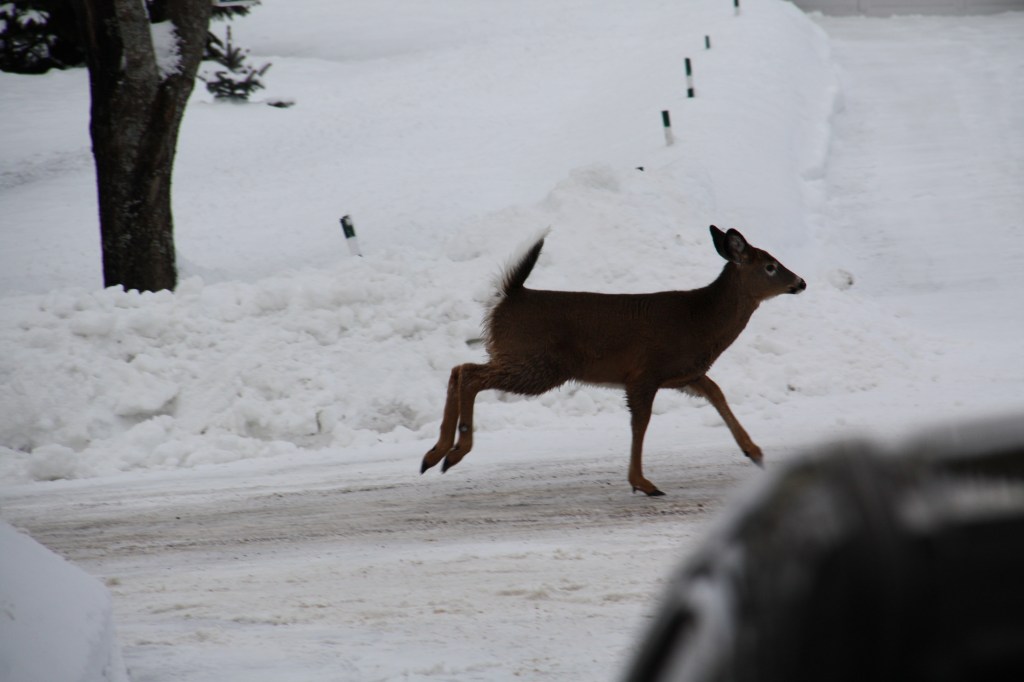
Indeed I do. And sometimes, just like this Wapiti, or White-Tailed deer, they see me as well. Some are camera shy. But this one, caught one morning walking past my garage door, heard the click of the first camera shot, stopped, turned towards the sound, then kindly waited until I had shot him, in the only way I would ever shoot a wild animal, with my camera. Isn’t he a handsome fellow – very photogenic.

Some of the animals that pass through our yard do not seem that wild. This one lay down for a little rest about forty feet from the house. Early morning light, not easy to shoot, but he sat there and waited for me. Alas, I was using a camera with a laser focus and the red flash of the light disturbed him. I didn’t mean to do so. Whoops – there he goes, tail-up and now you know what they mean when they say ‘high-tailing it’ out of the woods and up the road.

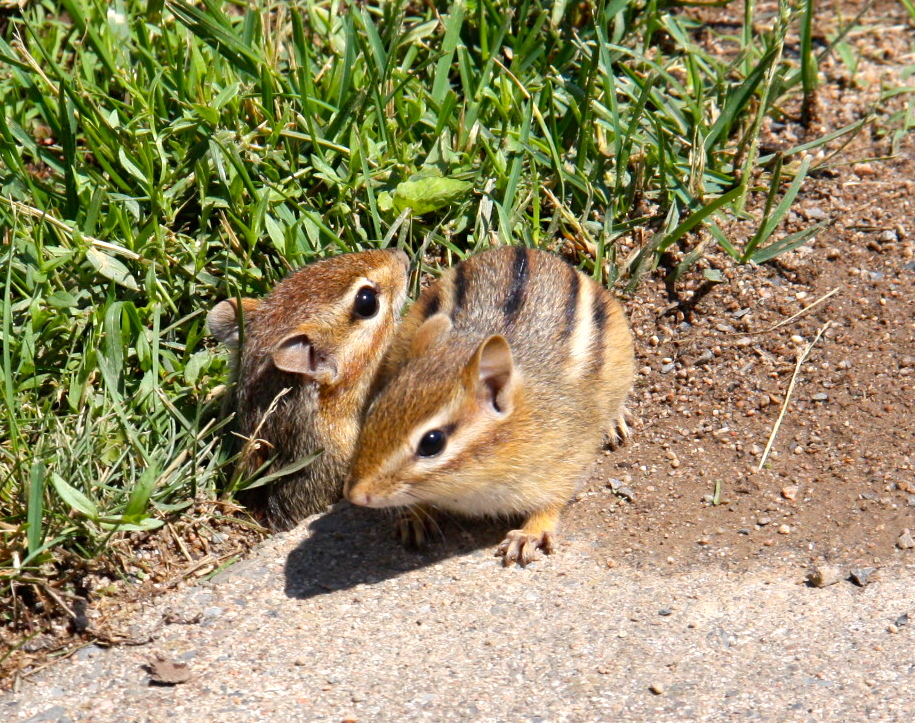
And what about the chipmunks, and the squirrels, and the skunks, and the raccoons, and the jack-rabbits, and the porcupines? They all drop in from time to time. Look at this happy couple. Aw! Aren’t they sweet?

And don’t forget the birds – but give us another prompt – all about our feathered friends -and we’ll talk about them next time

Do you have a favorite place you have visited? Where is it?

Daily writing prompt
Do you have a favorite place you have visited? Where is it?

Do you have a favorite place you have visited? Where is it?

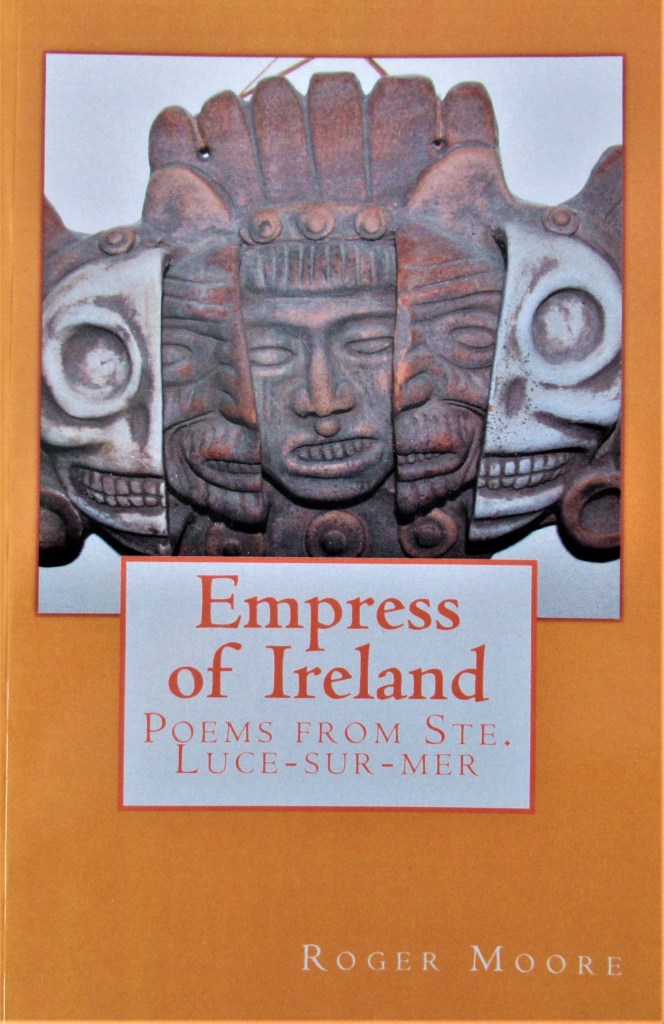
Just one place? So difficult to choose. I have been very lucky in my travels. I haven’t gone far, but I have tried to go deep, returning to the same places again and again. One place I often visited was St. Luce-sur-Mer in Quebec. It is a wonderful little town on the banks of the St. Lawrence River. The sunsets are sheer marvels and the views of the Northern Lights across the bay are just outstanding. Site of the wreck of the Empress of Ireland, it is filled with mystery and memories, as is the nearby Rimouski. Ste. Luce sur Mer would be my third choice.

Oaxaca, Mexico, would be my second choice. The city itself, capital of the state, is packed with history. I taught there for a couple of weeks (maximum six) every year from 1995-2001 and every time I returned I found something different and more mysterious. The dancing and music in the capital, the cascades of fireworks flowing down the facade of a church, the Christmas Cribs that grew day by day as people added to them, the incredible food, and above all the people – dancing in the Zocalo on Sundays to the music of the State Orchestra, crowding the markets with color, and the markets themselves, the scents of peppers, coffee, chocolate – to visit Oaxaca, in those days, was to visit the heart of Mexico. Imagine sitting beneath the tree that Hernan Cortes had sat beneath when he visited Oaxaca just after the Conquest of Mexico City – Tenochtitlan – and talked to the Mixtecs and Zapotecs of the Oaxaca Valley. And the codices – wonderful – I cannot say enough in praise of Oaxaca.

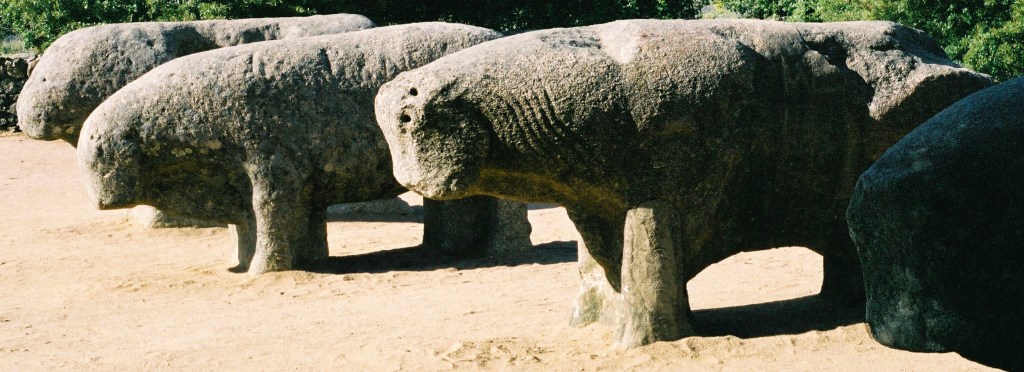
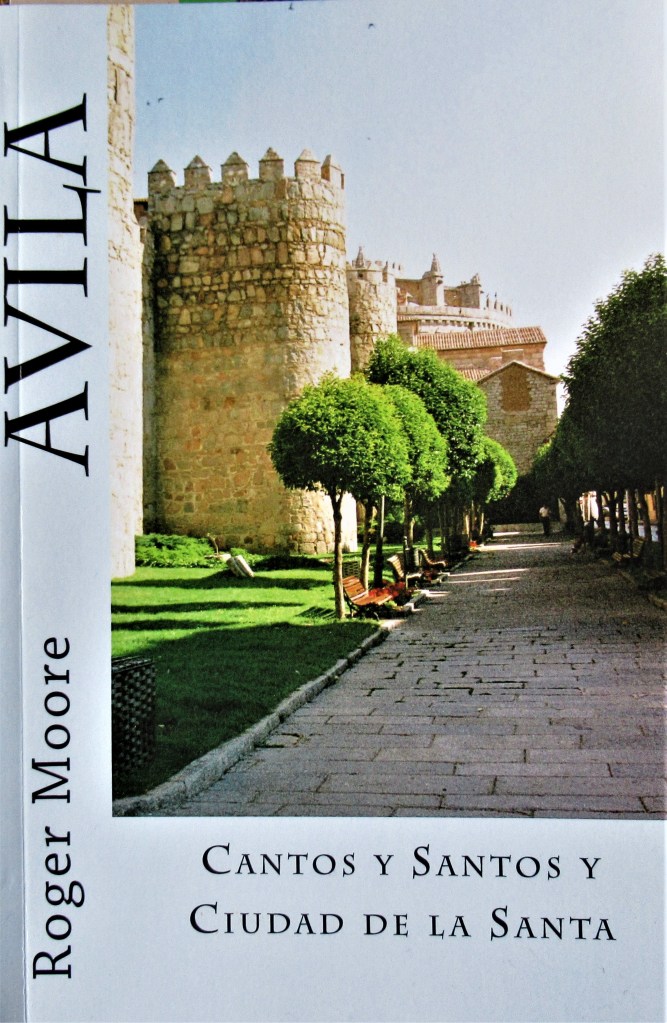
My number one choice: Avila. The lead photo shows the Toros de Guisando. Pre-dating Christianity, these four stone bulls – verracos – were often used as boundary markers by the Vettones who lived there before the Romans. One of these four bulls bears, carved into its side, the marks of one of the Roman Legions that passed this way. The countryside around Avila has to be seen to be believed. The walled city itself is a wonderland – three kilometres of walls, 9 gateways, a Cathedral that shows an enterprising mixture of styles, museums, libraries, squares, and a welcoming people who make you one of the family. I visited here for four summers, 2005-2008, staying for between 6 and 8 weeks on each visit, and always residing in the same place, El Rincon, close by the Mercado Chico.

What is one thing you would change about yourself?

Daily writing prompt
What is one thing you would change about yourself?

What is the one thing you would change about yourself?

Only one thing? I remember a story about a boy who boarded in a monastery school, and there, like the monks, they all changed their dirty habits once a week. So, is a dirty habit a thing? Probably is, if its a brown, sackcloth habit, tightened around the waist with a white cord by a man wearing open-toed sandals and no socks. So, there we go, once a week, on Wednesdays, like those monks, I also change my dirty habits. I also change my shoes, my socks, my shirts, my sweaters, my jeans.

More important, as I grow older, I have permitted myself to change my mind as often as I like. So, yes, I also change my mind, and not just on Wednesdays. And I really do change it when, like my habits, it gets dirty. “Oooh, you’ve got a dirty mind, you have.” “Well, so I do. Never mind, I’ll just go and change it.”

“What did Big Ben say to the Leaning Tower of Pizza?” – I’ve got the time, if you’ve got the inclination.
“How many ears did Davy Crocket have?” – Three – a left ear, a right ear, and a wild front ear.
“What’s yellow and deadly?” – Shark infested custard.
“What’s black and deadly?” – A crow in a tree with an AK47.
“When is a door not a door?” – When it’s a jar.
“What time is it Eccles?” – “It’s eight o’clock.” “Here, how do you know it’s eight o’clock?” “I’ve got it written down on a piece of paper.” “What do you do if it’s not eight o’clock?” “I don’t look at the paper.”
“Ding-a-ling” – That’s my ear ringing. I’ll just pick it up and answer it.
“What’s the first sign of madness?” – Hairs in the palm of your hand. “What’s the second sign of madness?” – Looking for them.

So what is one thing I would change about myself? Possibly the absolute necessity to tell awfully bad jokes. Easy to say – I’ll probably keep adding to these as I remember more of them. Take care – you have been warned.

“How many – men – does it take to change a light bulb?” – Five. One to hold the bulb and four to turn the ladder. Jokes like these can be good or bad. Good because they are occasionally funny. Bad, because it so easy to insert an adjective before – men – and to turn the joke into something more devious and not necessarily very pleasant.

“And that is the end of the gnus,” said the lion on BBC television, as he licked his paws. “Enough, no more. It is not as sweet now, nor as sour, as it was before. Pass the chow mean, please.”

What are your two favorite things to wear?

Daily writing prompt
What are your two favorite things to wear?

What are your two favorite things to wear?

What a strange question. I suppose it merits a strange answer. And the answer is – it depends. You see – I live in Atlantic Canada. Here we have several sayings. One from the Bay of Fundy is – “You don’t like this weather? Hang around five minutes. It will change.”

I had the snow blower prepped for winter a week or so ago. So, what are my two favorite things to wear when snow blowing? Only two? Hat, scarf, water-proof / wind-proof coat, thick gloves, scarf, warm socks, boots that keep out the water and the cold and that have soles that grip into the snow. You mean I have to choose two things from that lot? I just checked the calendar – it’s not April the First, you know.

In summer, when the Fundy Fog rolls in from the sea and wraps scarves of salty mist around the trees, and it becomes so cold, so damp, and so chilly so quickly – what are my two favorite things to wear? I guess you can double-check the list above and eliminate an item or two. But I wouldn’t chuck out too many.

And what about cross-country skiing? As the weather changes, and as you warm up, you need several layers of removable clothing that can be taken off, when you warm up, and placed back on when you hit the shade between the trees and you start to cool down. But only two items? What are you doing to me? And what about the wind-chill factor?

Once, when I walked the picket-line at -35C, we had all been pre-emptively locked out from my former place of employment, we were visited by Flying Pickets from the Northern Part of Canada. They had a saying: “There’s no such thing as bad weather, only bad clothing.” You notice they didn’t say anything about two items of clothing. I wonder why not?

So there you have it. Be prepared, I say. It always depends. And remember: “Never mind the weather / As long as we’re together.” Perhaps those two items might just be you and me! But then, we’re not clothing, are we? Not unless we are just rag dolls.

Who is the most famous or infamous person you have ever met?

Daily writing prompt
Who is the most famous or infamous person you have ever met?

Who is the most famous or infamous person you have ever met?

First, some definitions. What exactly does ‘met’ mean? I met you yesterday, for example. How long was the meeting? A nod and a passing of ships in the night? A stop and a handshake and a brief conversation? Or a genuine meeting of minds when people know each other reasonably well and can be considered ‘friends’? Infamous – that is relatively simple. Meanings, in my quick check, include – well known for some bad quality or deed, eg an infamous war criminal. Well, I have certainly never met any of those, not that I am aware of anyway. What does famous mean? Here’s one definition – famous implies little more than the fact of being, sometimes briefly, widely and popularly known. How wide is widely? How popular is popularly? Never mind. Let’s give it a go.

Brief encounters – I met several famous people briefly. Gento, from Santander, the Real Madrid soccer player and possibly the best winger of his time. John Charles, the Welsh soccer player, born in Swansea, and a good friend of my father. I met him once, briefly, in a Cardiff Street and my father presented me to him. Federico Bahamontes, the first Spanish cyclist to win the Tour de France. I met him, very briefly indeed, outside his bicycle shop in Toledo.

Longer encounters – these include the Spanish poet, Jose Hierro, who taught me Spanish, over three summers, in Santander at the UIMP. I also met Jose Manuel Blecua at that university and he introduced me to the poetry of Francisco de Quevedo. At the University of Toronto I had the good fortune to take courses from Erich von Richthofen, Geoffrey Stagg, Keith Ellis, J. H. Parker, and Diego Marin, each of them famous in their own way, with excellent academic reputations and publications. At Bristol University, I briefly met Jorge Luis Borges, whom I met again at the U. of T. a couple of years later. Academia and literature formed a happy blend in which to meet people who were famous within their own fields.

The same is true of the sporting life. While enjoying Cross-country running at Bristol University and while running for Bristol Athletic Club, I met Martin Hyman, Basil Heatley, Eddie Strong, John Boulter, and several other athletes of international renown. The same thing with rugby. Names that I can drop include Don Rutherford, Full Back for England and the British Lions, with whom I took a coaching course at Bisham Abbey. Welsh rugby personalities that spring to mind include Ray Williams, Billy Hullin, ‘Buck Rogers’, and several other luminaries of whom Alun Priday, Dai Watkins, and Elwyn Williams spring to mind.

But does any of this matter? I remember going to a poetry reading in Avila, Spain. This is what happened after the reading.

After the Reading

Many names were dropped and lay scattered on the floor.
Some of them broke. Others bounced back to their feet
and walked around stiffly, smiling unhappily.

Sugar and saccharine, unnamable sweetness, honeydew melon,
all lay on the ground, with empty shells, hollow metaphors,
accumulated clichés, vague imagery, the blanched bones of poets
that once wore life’s armour of grammar and blood.

When the cleaner came, she summoned a broom
and it swept away the remains:
dust without love, cigarettes butts and smoke,
nothing and nothingness, emptiness, empty nests, shadows of dreams,
living words, dead, now lying in a common grave.

The meaning of meaning – meeting and knowing, famous and infamous, names pulled from a hat like a rabbit and then dropped to the ground where they prick up their ears and scamper away. Yes, I have (briefly) met several famous people. But I know only a few really well. Sometimes, I wonder if I ever really met them, or knew them, and then I ask myself, did any of them know me, or remember me at all? Maybe that should be the larger question!

What is good about having a pet?

Daily writing prompt
What is good about having a pet?

What is good about having a pet?

Good heavens – what a strange question. Here in New Brunswick – Nouveau Brunswick, Canada’s only bilingual province, I guess it depends on whether you are Anglophone or Francophone. Nothing like a nice, healthy ‘pet’, if you are a Francophone, though you have to be wary, very wary, of them at my advancing age. And nothing like some ‘pets de ma soeur‘ for breakfast, with a nice cafe au lait, unless you would rather ‘un bon bin de beans‘.

On the other hand, if you are Anglophone, then the term takes on a different series of meanings, doesn’t it, my pet, I ask my wife. Happily, she neither woofs, nor woofs her cookies in reply. And if this is all double-Dutch to you, don’t worry. It’s all tied up with discourse analysis and the meaning of meaning. Don’t be so mean! What do you mean by that?

I suppose we are all talking about cats and dogs, and budgerigars – not budgie smugglers – and other two and four-legged friends, along with sliding ones, like baby boa-constrictors, that can – like pythons in Florida, grow to an enormous size. Such an enormous size, in fact, that you end up being the pet when the monster rules, and your flush your once-a-baby, now a problem, alligator down the New York toilet to grow even bigger and become a danger to the men and women who patrol the subterranean sewage systems.

And don’t forget Julius Caesar, the pet parrot who told the burglar, in an Irish accent, that “Jaysuss” was watching him” as the burglar tried to burgle the house. Alas, Julius Caesar failed to warn the house-breaker that Jaysuss was in fact a huge, pet Rottweiler that was standing – we stand on guard for thee – right behind the unfortunate man. Who needs a burglar alarm and an AI system, when you have two or three pet, and not petits, Rotties patrolling the house 24/7? Mind you, I wouldn’t call them pets, those Rotten Rotties, though they may cause them in certain people, and very generous ones at that.

Name the most expensive personal item you’ve ever purchased (not your home or car).

Daily writing prompt
Name the most expensive personal item you’ve ever purchased (not your home or car).

Name the most expensive personal item you’ve ever purchased (not your home or car).

I began by checking the meaning of item and found the following – an individual article or unit, especially one that is part of a list, collection, or set. Then I started to think about the meaning of meaning. Is an education an item? Is it an individual unit? Can it be considered part of a list, collection, or set? Let’s put it this way – I started school when I was four years old. I continued until I was 18. Along the way I collected many items of knowledge and many certificates to prove it. Then I went to Paris for a year to perfect my French – now that was an expensive adventure, I can assure you of that. Next came Santander, Spain, for a whole summer, to do for my Spanish what Paris had done for my French. I guess I didn’t really pay for these items, as my parents did, though I helped a little, with odd jobs here and there.

These adventures were followed by 3 years of undergraduate studies. They were covered in part by my local government authority, for which I am eternally grateful, also by my parents, and then I too assisted, again with odd jobs and summer work. Next came graduate school, at the University of Toronto. This was financed by my earnings as a Teaching Assistant and then a Teaching Fellow. My beloved and I got married in Canada, and she found work and also assisted with graduate school and the general cost of living. Assisted? She carried me along when the work load grew too heavy.

Then there was a Canada Council Doctoral Fellowship that helped finance two more years of study in Santander, Spain, where I completed manuscript research at the Biblioteca Menendez y Pelayo. This was followed by my first job, as a lecturer, at the University of New Brunswick, Canada. I taught full-time while completing my doctorate, but my education did not stop there.

I pursued coaching certificates with the National Coaching Certification Program of Canada and soon related coaching methods to in-class teaching methods. This revolutionized my teaching. As did a Certificate in Multi-Media Studies (at UNB), followed by courses in Digital Film and Video. Then came a Teaching Certificate from IATHE – the Institute for the Advancement of Teaching in Higher Education (based in Ottawa, but no longer extant). My Certification process was topped off by a Certificate in Creative Writing from Humber College, Toronto.

All of these degrees and certificates cost money. All contributed to the list of items that go together to form my education. But a personal education, in the meaning I give to the word, goes way beyond an accumulation of certificates. It is a life -long process of growth, personal development, and understanding, of reaching out to other human beings and helping them to create their own lives and their own paths to life-long learning.

Has this been expensive? You bet it has. But its worth is priceless compared to remaining static and enmired in a past knowledge that never develops and never grows, as sometimes – I might even write ‘often’ – happens when learning stops with the acquisition of the Ph.D.

When asked what I teach, my reply is always the same – “People, real, live people.” And that is something that I continue to do whenever and wherever I can. “To know the cost of everything and the value of nothing” – I scarcely remember – nor do I care to know – what cost I paid for each step along a road along which I am still travelling. But I do know and totally appreciate the value of the continuing education that I working so hard to buy.