Meditations on Messiaen Quartet for the End of Time
5
Silence
Pain stops as the sounds of silence break against the walls of the room in which I sit.
Silence, yes, yet silence broken by the renewed intrusion of the clock, by the electric hum from lights and heating, from a distant tv suddenly breaking into my thoughts: cheers from a tennis court, the eternal advertisements invading my innermost being.
What triviality now shatters the Messiaenic mood that wrapped me for a moment in a many colored cloak of musical oblivion.
Now time’s teeth gnaw again and the grandfather clock nibbles at my soul, extracting its essence in a surge of sound, tick-tock, tick-tock.
Westminster Chimes now choke life from the hour and ring the tick-tock knell that files my life away, second by second, minute by minute, day by day.
Meditations on Messiaen Quartet for the End of Time
4
Transitions
Modes of limited transitions, moods of time tapped in time to time’s rhythmic piano.
Scales fall from the listener’s eyes. A transitory awakening, this glimpse of the composer’s vision, each note a new version extracted from abstracts perceived in color, each note a hue, and chords a rainbow spectrum of light glimpsed darkly through a raindrop’s lens.
Birdsong and sunshine. Notes perched on the matinal branch, each in tune with the other, at times discordant, yet the morning chorus diluting the day with the liquidity of light and sound.
Art has almost always told a story, even though, as in the case of the Cave Paintings in Altamira, Puente Viesgo, Lascaux, and elsewhere, we may not know exactly what that story is. On the other hand, many of the great paintings of the Spanish Golden Age (1525-1680) have a hidden narrative that we can often work out. Take, for example, Vulcan’s Forge (1630), painted by Diego Velázquez after his first trip to Italy (1629). On the surface, this is a painting of a typical Spanish Forge of the seventeenth century. Ordinary workmen labour away at their daily tasks, but, and there is always a but, the figure on the left is adorned with a god-like halo. Why? Because he is the bearer of a message. Vulcan’s wife, Venus, has been having an affair with Mars, the god of war. Vulcan has forged a net of fine, golden chains and placed it over the bed where they will loiter. Now, Mars and Venus are trapped in that net, caught in the act, so to speak. No wonder the mouths of Vulcan’s helpers are open in wonderment.
Bisonte Parado: Cenicero de Altamira.
Before the arrival of photography, painting was the only way to record the world, to make a picture of what was happening, to tell a story in paint. That is why a picture is worth a thousand words. I have retold the narrative of the painting of Vulcan’s Forge in 128 words. There is, of course, a great deal more to tell about his and other paintings and how they represent the artist’s narrative reality. The advent of photography changed the artist’s vision of the world. As photography developed and became quicker, faster, and offered what some might consider to be a more accurate version of reality, so artists rethought their role. Was it to capture, in paint, the world as they saw it, with a single visual entry point, and a constant perspective? Or was it to catch the way light fell upon objects (Monet), or to offer multiple entry points (Braque), or to paint the turmoil of the inner mind (Picasso, Miró, Pollock)? Artists could do such things. Until recently, with the advent of the computer, it was much more difficult for the camera to do so. The camera recorded, but artists created and re-created their own narratives of the world around and inside them. Now we can enter photoshop and the equivalent and play around with out own photos of reality, distorting them and twisting them as we please.
Verbal to Visual to Verbal
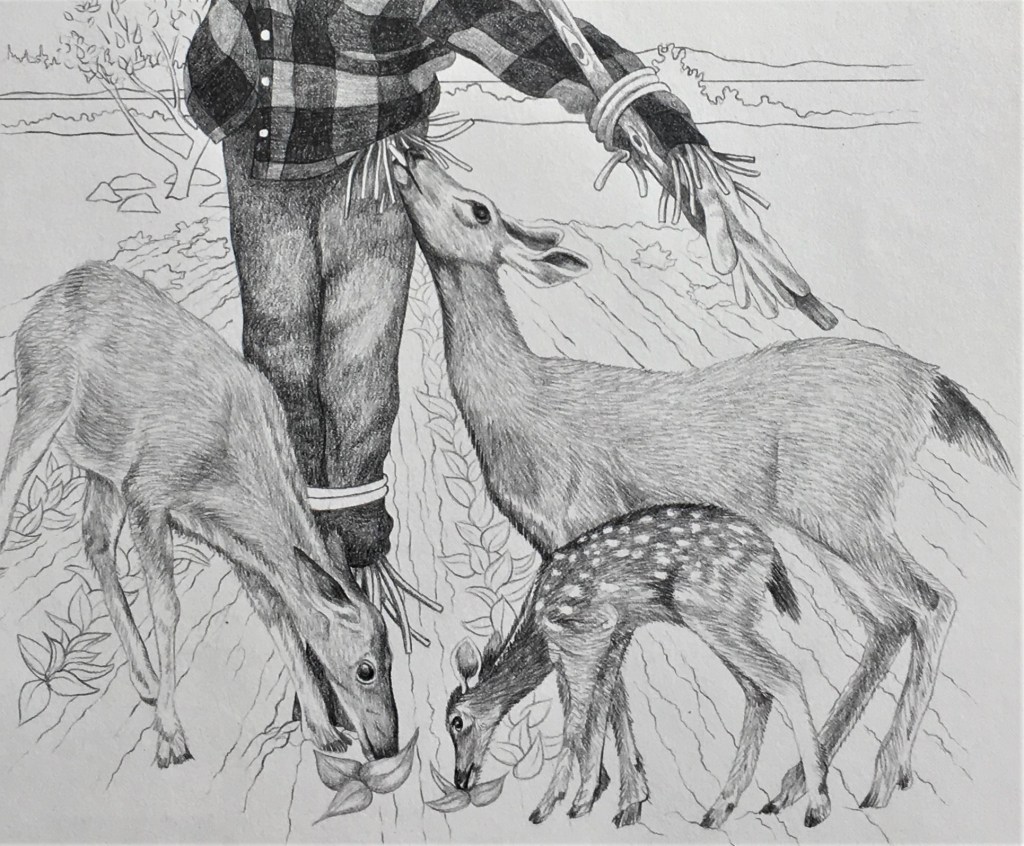
Which came first, the chicken or the egg, the verbal or the visual? Or was there a sort of spontaneous combustion? In the case of Scarecrow, the artistic collaboration between myself, the author, and Geoff Slater, the artist, the words came first: “In the beginning was the word.” He heard me reading my story, started to sketch the characters, and within six months we had produced an illustrated book.
Wonderful drawings. Thank you, Geoff.
Words and narrative first, then an artist’s rendition of key moments in the narrative. However, in the case of Twelve Days of Cat, our second artistic collaboration, Geoff sent me 12 drawings of a cat and I looked at them and worked out a narrative that would join them together in a symbiotic relationship. Scarecrow is an illustrated narrative in prose. Twelve Days of Cat is a narrative in poetry based on what was once an independent series of charcoal sketches. Who cares which came first, verbal of visual, when the results are so pleasing to ear and eye.
The crocodile lives in the wind-up gramophone. The gramophone lives in the top room of the house. The boy winds up the gramophone with a long brass handle, round and round, till the spring is tight. A tight spring frightens the crocodile and he sits quietly in his cage. But as the record goes round and the spring loosens up, the crocodile roars and demands to be freed. He’s the Jack that wants to jump out of the box. His long-term dream is to eat up the witch who looks out of the window and watches the boy as he plays in the yard. Last week the boy decided to dig. He picked up a spade and dug a deep hole that went all the way down to his cousin in Australia. The little dog laughed and joined in the fun, scraping with his front paws and throwing earth out between his back legs like happy dogs do. The witch in the window cackled with laughter and the rooks in the rookery rose up in a cloud and cawed in reply. Only the boy is able to see the witch and he only sees her when she sits in the window. But he knows she wanders through the house, and the air goes cold when she enters and exits the rooms, especially when she brushes past the boy and sweeps his skin with her long, black gown. When the boy got tired of digging, he drove the spade into the ground and left it standing by the hole. When his father came home it was well after dark. He didn’t see the hole but he saw the spade. So he didn’t fall in to the shaft of the coal-mine that went down to Australia. No free trip to the Antipodes for that unlucky dad. He beat the boy for that, for digging that hole. Then he beat him again for lying because the hole didn’t go to Australia. Australia was too far away and the angle was wrong. The boy laughed when he saw that his dad didn’t know where Australia was. “Ha-ha,” he laughed. And his dad beat him again, this time for laughing. Sometimes at night the boy can hear rats running through his bedroom walls. They scuttle and scuffle as they hunt through the guttering. The crocodile growls from time to time in that upstairs room. The witch cackles with laughter. The boy puts his head under the blankets and cries himself to sleep. Sometimes he wishes the crocodile would come and eat up his dad. But he loves his dad like the dog loves his dad even though his dad beats both the boy and the dog. Sudden beatings, they are, that arrive without warning: hail and thunder from a sunny summer sky. “Well, you’re not laughing now,” his father announces as he beats him one more time. “A beating a day keeps disobedience away. There will be no disobedience in this house.” When the father beats the boy, the dog cowers beneath a chair. The boy hears the crocodile growl and smiles through the tears as he wipes salt water from his eyes. “Are you laughing at me? I’ll make you laugh on the other side of your face,” the father taunts the son and beats him again. The crocodile growls. The old witch cackles. The rooks in the rookery rise up in the air and the father’s hair stands up on end like it does when lightning lights up the sky, and thunder rolls its drums, and the sky’s wheels rattle like an old warrior’s chariot whose wheels have not been greased. The veins stand out in his father’s cheeks as the old man once more raises his hand to the boy. The old man tells the same old jokes again and again. The boy must always remember to laugh at them as if he had never heard them before. If he doesn’t laugh, his father gets angry. Some of the jokes are good, and the boy likes the one about the Catholic with the pet crocodile who goes into a bar in Belfast and asks the barkeep if they serve Protestants. ‘Of course we do,’ says the barkeep. ‘Good,’ says the man. ‘I’ll have a pint of bitter for myself and a Protestant for the crocodile.’ Or is it the one in which the Protestant goes into the bar and ask the barkeep if they serve Catholics … anyway … whatever … one night, the boy dreams and it happens like this. The crocodile escapes from the gramophone. The witch hands the boy a leash and a collar and between them they restrain the crocodile. “Walkies?” says the boy. The crocodile nods his head and crocodile and boy walk down the street to the Kiddy’s Soda Fountain on the corner. When the boy walks in with the crocodile, the waitress raises her eyebrows and opens her mouth. “Do you serve grown ups in here?” the little boy asks her. “Of course we do,” says the waitress. “Good. I’ll have a glass of Dandelion & Burdock for myself and a grown-up for the crocodile. Please.” The witch says grace, the boy sips his Dandelion & Burdock, and they all shed crocodile tears as the boy’s pet crocodile chomps on the fast-disappearing body of the boy’s dad. Next morning, the boy wakes up. The witch and the crocodile are sitting on his bed. “I had a funny dream last night,” says the boy. The witch cackles. The crocodile burps, then sheds crocodile tears. The boy starts to laugh. He laughs until he cries and then the witch sheds crocodile tears too.
A duck, in cricket, means the batter has been dismissed without scoring. The 0 resembles a duck’s egg, and hence score of naught is known as a duck! A golden duck means the batter has been dismissed first ball, without scoring, a sad fate indeed. A King Pair is first ball in each innings of a four innings match (two per side).
My cartoon shows an English cricketing duck carrying his bat through a golden shower of life’s purple patches. There are several clichés and double entendres in this title. First, of course, the ignominious duck. Carrying his bat: this has a double meaning (a) to literally carry a cricket bat, as this duck is doing, and (b) to open the batting and carry your bat throughout the innings, un-dismissed, although the other ten wickets have fallen around you. To carry your bat for a duck is as near as impossible as it can possibly be. A golden shower: alas, we are all now familiar with the pornographic version. Some will be familiar with the myth of Jupiter descending as a shower of gold. The golden shower here also represents the shower of golden ducks that has currently descended upon the English cricketing team. Purple patches can be good. However, a purple patch of golden ducks is only good for the opposition bowlers, if you are on the batting side.
England top order quacking and creaking into history of the duck: this article in Tuesday’s Manchester Guardian cricketing section will explain the makings of current duck history for all who are interested. Equally interesting are the double meanings (a) within the verbals of the above cartoon and (b) within the visuals of the drawing itself. For example, the golden duck holes / eggs pecked in the bat, the mingling of gold and purple in the shower falling, the duck eggs woven into the batter’s shirt…
So, here we go, swinging low, swinging to miss, and swinging into history, where batter itself is a neologism replacing batsman as a non-generic term for those who bat, much as bowler, the man, not the hat, is a non-generic term for those who bowl, or fielder for those who field. Now, what on earth are we going to do with ‘gloveman’? Glover, perhaps, or wicket-person, or a return to wicket-keeper, or just a limited keeper? Language is so lovely and the mixture of language and cartoon is is doubly good, as long as everyone is bilingual and can entendre.
“When the snow flies…” they keep saying. I have seen blackfly, felt them nesting in my hair, picking painlessly at my scalp, until, next day, the itching begins and the bites get scratched, one after another, until they turn into scabs.
But I had never seen a snow fly, hard as I tried. When the geese fly… yes, I have seen and wondered at their spring invasion and their autumn retreat. I have marveled too at the goslings’ rapid growth, those golden fluff balls taking first to the water, and then one day, suddenly, they rise in the air.
Last year, in a moment of madness, I stood beneath Aurora Borealis and marveled at the sky’s flickering colors. The light became sound and it was then, astounded, I saw them dancing, those snow flies, dancing me senseless, in their rainbows of light.
Comment: “La Poesía se explica sóla, si no, no se explica” — famous words by Pedro Salinas the great Spanish poet of the Generation of 1927, who taught at Johns Hopkins University. So, I will not attempt to explain my words. They stand for themselves, or not, as the case may be.
However, I will venture into the area of the cliché and the commonplace. People use so many phrases without thinking about what they mean. To examine the cliché and explore its meaning is a delight. What are snow flies? And what will they do when that moment of their release comes about? When the snow flies dance beneath the Northern Lights on a late fall night in New Brunswick, they become visible to the watchful human eye. And now you know what happens “when the snow flies… dance!”
A whole lot of pens. But will they write one word of poetry?
Sense and Nonsense Wednesday Workshop 18 August 2021
Iterative Thematic Unity
Iterative thematic imagery is complicated term, used by academics, for a literary device that is really very simple. When the same or similar images are used again and again in a text this is repetition or reiteration, hence iterative. When they are bound thematically or within the associative fields already present in the poetry, then the repetition is said to be thematic. A work’s unity may be found within the three classical unities of time, space, and action, or it may be found within the imagery that links and unites. It seems complex, but it isn’t really.
“Now you are a river flowing silver beneath the moon. High tide in the salt marsh: your body fills with shadow and light. I dip my hands in dappled water.” The key images fall into two categories, (1) water: river / high tide / salt marsh / water and (2) light: silver / moon / shadow and light / dappled. Now the sense of the words becomes clear. You / your body is likened to a river seen in the moonlight. It can be touched: I dip my hands. This adds an extra sensory dimension and the depth of the images is apparent. And no, it is not a simple message, but it can be decoded and enjoyed because now you can make it yours.
Sense and Nonsense
When we talk poetry, what do we mean by sense and nonsense? Let us begin with automatic writing. Automatic writing is nonsense. Put your pen on the paper, do not let it off, write for five minutes, whatever comes into your head. The Surrealists published these thoughts, however distraught and distracted as meaningful poetry. Major poets (Lorca, Paz) have used these techniques to engender metaphors and images. However, they have searched among their subconscious thoughts and have rejected the dross to choose the genuine images that enlighten the inner world.
Sense or nonsense? “Eye of the peacock, / can you touch what I see / when my eyelids close for the night?” Key images: eye > see > eyelids > and these are linked to the eyes of the peacock, as displayed on his feathers, and this links to the ancient tale of the Argos and the Argonauts, and to the person who closes his eyes to sleep for the night, and the sense that we can touch (tactile) when we dream (visual), a mixing of the senses. The straightforward logic of the nightly news? Definitely not. But the logic of the subconscious world, of the dream world as defined by Carl Jung? Definitely. These words contain internal meanings that are different for each one of us. Logical meaning? Definitely not. Internal sensation that may generate ease or unease? Definitely. Sense or nonsense? That will depend upon the readers and how they react not in their logical minds but in that deep-seated region of subconsciousness where all imagery is related to what Carl Jung calls the racial subconscious.
Are there words or ideas here that you do not understand? Names and theories that you do not know? Literature in general and poetry in particular take you to places where you have never been and to places that you might never have thought of visiting. However, these are lands that will open their delights before you, if you deign to open up heart, mind, and eyes, and venture out to explore them. Use your dictionary, your thesaurus, your google search tool, and expand your verbal and linguistic horizons. Poetry is not an advert. It doesn’t sell you anything. But it can and does open new worlds and it encourages you to explore old worlds set within you. It will not persuade, cajole, and limit your mind and your choice, rather it will embolden you and help to open new horizons.
This auriferous sky, sewn with sharp sequins. Is there a warp, a leaning towards meaning, a lurch maybe towards the moon’s dark side? Questions: knights-errant questing for answers.
Who planted our DNA into that first Garden? Or did the garden fill us with its own seeds? Why did those little plants take root and grow? Why do they now wander everywhere, restless?
This auriferous sky, sewn with sharp sequins. Is there a warp, a leaning towards meaning, a lurch maybe towards the moon’s dark side? Questions: knights-errant questing for answers.
Rampant feet patrol our castle’s heights while we seek instant gratification, swift possession, our fingers probe each passing cloud, reaching for all, but grasping none.
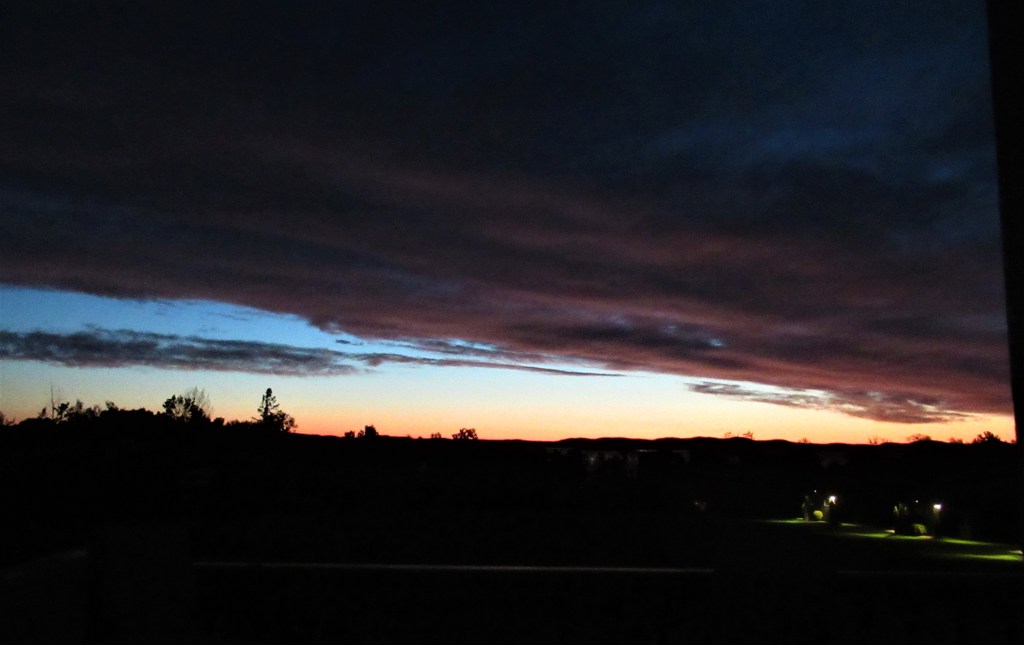
A satellite glides its razor edge, slices the night’s eye into pin pricks of light. The moon balances her orange unicycle on thin black lines, hills edged with trees.
Lesser incandescence of a departed sun, that low, lone moon slowly climbs the sky. Released from their earthbound burdens, who knocks this night at heaven’s gate?
Here on the back porch, midnight slowly covers me with its dark gray cape of grief. My grief is your grief, your grief is mine, all grief is one, why do we all then grieve in vain?
Everywhere the afternoon gropes steadily to night. Some people have built fires, others read by candlelight.
Geese, drifts of snow their whiteness, settle on the riverbank. They walk on thin ice at civilization’s edge. Around them, the universe’s clock ticks slowly down.
Who forced that scream through the needle’s eye? Inverted, the Big Dipper, hangs its question mark from heaven’s dark eyelid.
Ghosts of departed constellations stalk the sky. Pale stars bob phosphorescent on the flood.
The flesh that bonds, the bones that walk, the shoulders and waist on which I hang my clothes, now they stand alone and listen at the water’s edge to the whispering trees.
They have caught the words of snowflakes strung between the stars. Moonlight is a liquor running raw within them.
Comment: The verse version (above) is from Though Lover’s be Lost. The prose version (Below) is from Stars at Elbow and Foot.
Building on Sand
Everywhere the afternoon gropes steadily to night. Some people have built fires, others read by candlelight. Geese, drifts of snow their whiteness, settle on the riverbank. They walk on thin ice at civilization’s edge. Around them, the universe’s clock ticks slowly down. Who forced that scream through the needle’s eye? Inverted, the Big Dipper, hangs its question mark from heaven’s dark eyelid. Ghosts of departed constellations stalk the sky. Pale stars bob phosphorescent on the flood. The flesh that bonds, the bones that walk, the shoulders and waist on which I hang my clothes, now they stand alone and listen at the water’s edge to the whispering trees. They have caught the words of snowflakes strung between the stars. Moonlight is a liquor running raw within them.
Timothy heard his older brothers moving from room to room, searching for him. He knew they would find him but for now he had found refuge beneath his grandfather’s double bed. It was dark under there in that sepulchral space. He had placed his grandfather’s enormous Royal Doulton chamber pot between himself and the door so that the dog would not pick up his scent, run to his hiding place, and lay the Judas lick upon his cheek.
His grandfather had forgotten to empty the chamber pot. Dark urine splashed on Timothy’s hands and sleeves as he squeezed behind the giant china pot that overwhelmed his nose fills with his grandfather’s nocturnal vapors.
The voices got louder as his brothers climbed the stairs and approached the bedrooms on the upper floor.
“Where is he now, drat him?”
“Don’t worry, we’ll find him.”
“And then he’ll be for it.”
“I’ll beat him with the little red brush they use for cleaning the fireplace.”
“That will teach him.”
Timothy was familiar with those threats, especially the little red brush.
He remembered the fox the hounds killed at his feet, one sunny morning a year before. He cycled down the lane outside his family’s summer cottage. The fox limped along the side of the lane, saw the boy on his bike, but too tired to run from him, continued limping in the roadway. Timothy got off his bike, leaned it against the rough stone country wall, and watched the fox. Its tail, speckled with mud, dragged behind its low-slung body, sweeping the ground. Timothy observed the twigs and thorns protruding from its black-tipped orange redness.
Timothy walked towards the fox. It tried to move away from the boy but collapsed and lay at the edge of the lane, flanks heaving, tongue lolling out through the white strings of thick foam that choked the muzzle and streaked saliva on the forequarters.
The hounds came from nowhere, an incoming, barking tide that rounded the corner and rushed towards Timothy who froze with a fright that pressed him against the wall. Sun-warmed stone jutted sharp edges into his back. As he stood there, unable to move, a rough hand came over the wall and grabbed him by the shoulder. He felt himself hauled upwards. The flint points dug into his back and he yelped as the firm hand drew him over the top of the wall to safety.
“Get out of there, you stupid boy, or the hounds will have you.”
Timothy hid his face in the farmer’s rough homespun shirt. He shuddered as the dogs bayed and growled and scrapped and scratched. Then the fox, it must have been the fox, let out a high-pitched yap and whine and the pack gargled itself into a drooling, slobbering sort of silence. The farmer pushed Timothy’s face away from his shoulder and forced his head towards the spot where the hounds, on the other side of the protective barrier, rubbed their ears into the dead fox’s torn and bloodied body.
“That’s what they’d have done to you, my boy. Never come between a pack and its kill.”
Timothy watched a member of the hunt staff pull a knife from his jacket. The foxhunters broke into cheers and howls of pleasure when the man severed the fox’s brush and held it on high. The farmer thrust Timothy towards the Master of Hounds.
“Here, blood him, Master, he was in at the kill.”
The Master of Hounds opened his mouth to flash a smile filled with pointed, foxhound teeth. He stooped, dipped his fingers in the still warm fox blood, and streaked a smear across the boy’s face.
“There,” he said,” you’re blooded now. One of us, eh what?”
The mingled scents of fox and hound and blood and death and urine and feces made a heady mixture and Timothy started to hyperventilate. His breath came hard in his throat and, as he struggled to breathe, tears rolled down his cheeks.
Timothy feels safe in his secret hiding place beneath his grandfather’s bed. He can hear his brothers’ taunts and calls as they search for him, but they haven’t found him yet. Sticks and stones may break my bones, he whispers, but names will never hurt me. But names do hurt. Tiny Tim they call him and ask him where he hides his crutch. I don’t limp, Timothy once replied. When he said that, one of his brothers, Big Billy, kicked Timothy as hard as he could with the toe of his boot, just above the ankle. Timothy screamed with pain. You’ll limp now, said Big Billy, and his other brothers found the joke so funny that they all called kicked Tiny Tim at every opportunity. Limp, Timmy, limp, they chanted as they chased him round, limpTiny Tim, Tiny Timmy.
“He’s not up here,” one of his brothers called out.
“Must be out in the garden, the coward, we’ll have to hunt out there for him,” another replied.
“Can’t run, can’t hide,” said Big Billy. “Get the dog, we’ll track him down.”
The voices finally faded. Protected by the barrier of his grandfather’s cold but intimate body waste, Timothy curled up like a fox in his den and fell asleep. He dreamed of the proud brush of a tail flying in the wind, of a warm stone wall, drenched in sunlight, and of a farmer’s strong, all-protecting arm.
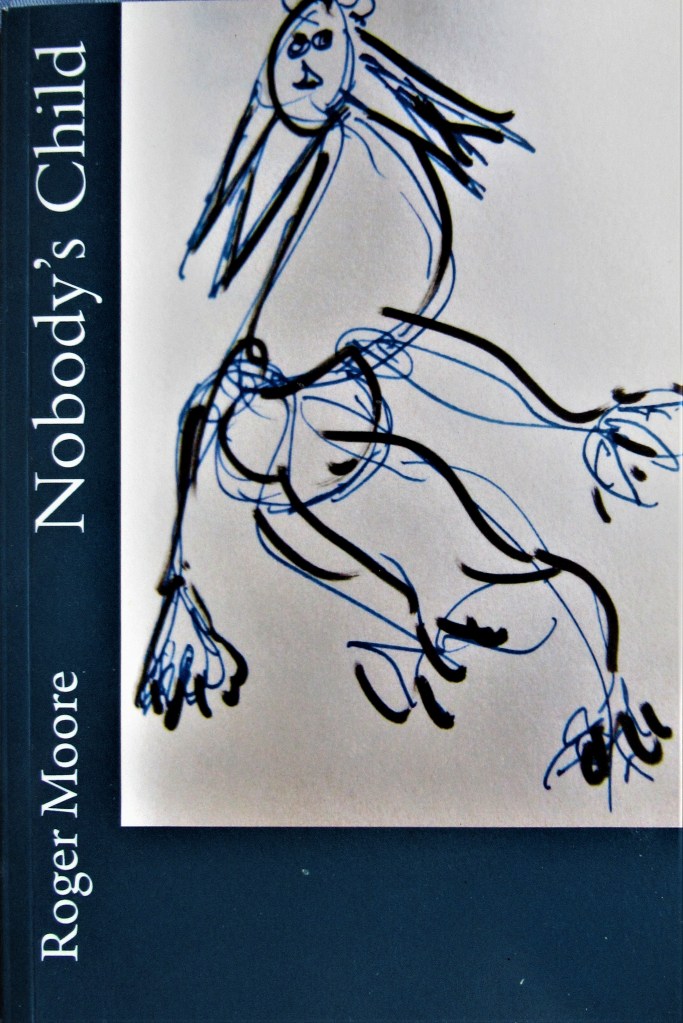
Comment: I have written several versions of this story, some longer, some much shorter, some in the first person singular, some in the second person. In all of them, the word-play on the little red brush (fox and fireplace) is paramount. This particular version occurs in my short story collection, Nobody’s Child available on line. Sometimes a story will not leave me alone. It wanders around, takes slightly different twists and turns, and new images and scenes emerge, as they do in this particular piece. Alas, I didn’t have a photo of a fox, so I used a photo of three plump pigeons hiding, you might even say ‘cowering away’, from a hungry hawk circling overhead while they hid in a crack in a wall in Avila, Spain. It always surprises me to know how many people (and animals) flee from what Robbie Burns called “man’s inhumanity to man”.







 rogermoorepoet