The Book of Everything

Discourse Analysis
and
The Meaning of Meaning

Words have dictionary definitions that allow us to agree on what they mean. In this fashion, when I say ‘my grandmother’, you automatically know that I am referring either to the mother of my mother (maternal grandmother) or the mother of my father (paternal grandmother). This is the dictionary meaning of the word ‘grandmother’.

But words have lives of their own, and their meaning changes when used by individuals. You, the reader, never knew my grandmothers. You never will. They both passed away a long time ago. I loved them both, but for very different reasons, and to me they were as different as different can be.

This means that when you, the reader of these words, reach the word ‘grandmother’, the faces you see, the emotions you feel, the memories conjured up by that word are totally different from mine. Same word, same dictionary definition, different personal memories, experiences, relationships. In addition, the role that our grandmother(s) played in our lives will be very different too. That role may vary from culture to culture, from language to language, and from the social structure of the changing society in which we live.

For example, when I first went to Santander, Spain, I visited a family who lived in a large, detached house that contained three generations of the family – grandmother and siblings, father and mother, grandchildren, and an assortment of aunts and uncles. No need for babysitters in that household. Everybody had a vested interest in the development of the young ones and the older ones received tender, loving care, twenty-four hours a day, every day of the week.

I lived from time to time in the same town as my own grandparents. I saw them regularly, but rarely on a daily basis. When my parents sent me to my first boarding school, age six (if I remember correctly), I lost contact with my family. My paternal grandfather died when I was away at school. My maternal grandmother died while I was away at school. My paternal grandmother died when I was living in Spain. My maternal grandfather died when I was living in Canada. Alas, after those early years, I scarcely knew them. My experience, then, was so different from that of other people.

When I moved to Canada, the Atlantic Ocean separated me from my parents. My daughter, born in Canada, grew up with no close knowledge of her grandparents. The word ‘grandmother’ did not mean the same to her as it did to the grandchildren in Santander, or to me. How could it? All those miles between the families, and visits limited to a couple of weeks every other year at best. Although the dictionary meaning is always the same, what a difference in the emotional meanings for each person using that word.

Discourse Analysis, the way I use it, builds not on the dictionary meanings of words, but on their emotional and personal resonance. I take the standard, dictionary meaning of words, twist it, look for meanings at different levels, and then build an alternative narrative on that changed meaning. I have great fun doing so.

Part of that verbal fun comes from my childhood. I listened to Radio Shows like The Goon Show and Beyond Our Ken. Giles’ Cartoons gave my names like Chalky White, the skeletal school teacher, or Mr. Dimwitty, a rather dense teacher in another school. These shows also twisted the meaning of words and drew their humor from such multiple meanings. The Goon Show – “Min, did you put the cat out?” “No, Henry, was it on fire?” Or on an escaped convict – “He fell into a wheelbarrow of cement and showed every sign of becoming a hardened criminal.” Or from Beyond Our Ken – “My ear was ringing. I picked it up and answered it. ‘Ken here, who am I speaking to?’ ‘Larry Choo.’ ‘Ah, Choo.’ ‘Bless you, Ken.’ Verbal scenes like these – it’s hard to get visual pictures from listening to the radio – remain engraved in my memory banks. More than engrained, they become part of the verbal system from within which I write.

This system includes Direct Discourse, Indirect Discourse, and the Twisted Discourse of an Inventive Mind that still wishes to create. It also comes from Francico de Quevedo’s Conceptismo, from Ramón del Valle-Inclán’s esperpento, and from certain aspects of Albert Camus’s Theory of the Absurd, all blended with the poetry of Jacques Prévert and the songs of Georges Brassens. This from the latter – “Tout le monde viendra me voir pendu, sauf les aveugles, bien entendu.” Everyone will come to see me hanged, except the blind of course.

This is not always easy humor, nor is it a comfortable way to see the world. But it is a traditional one with a long literary history. The title of my book goes back to Francisco de Quevedo, of course, who, in 1631, in Madrid, published El libro de todas las cosas y otras muchas más / The book of everything and a lot more things as well. Don Roger turns to his good friend Don Francisco whenever he needs a helping hand.

The pieces themselves were first published on my blog rogermoorepoet.com. They have been revised, and I have added some more pieces in a similar vein. Tolle, lege – Take and read.  Above all, enjoy this world of mine, with its subtle and not so subtle humor, its sly digs at many of our follies, and its many forms of creativity.

The Book of Everything
and
a little bit extra

Click on the title to purchase this book.

What’s your favorite recipe?

What’s my favorite recipe?

I find it hard to talk about my favorite recipe at a time when so many people in this world of ours are desperately short of food. I get regular messages from the local food bank – can I help them out? And I try to do my best. Alas, my pittance is a drop in the ocean of want and need.
Our local supermarkets have food baskets that you can add to your food bill. These will then be handed over to those who distribute food to the needy. Then there are the checkouts where I am regularly asked if I will add $2 to my bill for the food bank. I usually give $5 or $10.
I see old men sitting at the entrances to stores, a coffee cup before them with some petty cash in it. I also see homeless, workless people at traffic lights with signs held up, asking for cash.
I don’t want to start on war zones, on the accidental-on-purpose starvation of people, on the targeted destruction of homes, animals, and crops. Nor do I want to contemplate the rising prices of what used to be staple groceries and are now becoming luxury items – olive oil, meat, coffee.
While I can still afford some, but not all, luxuries, far too many people can’t. And yet you ask me what is my favorite recipe? Well, here goes –

Take one pound of charity, stir in a pound of love, add a spoon full of humanity, mix with half a pint of the milk of human kindness, sprinkle the mix with a half cup of sugar – to take away some of life’s bitterness, pepper it with ground Good Samaritanism – to add some neighborly love, and complete it with essence of humanity – to remind us that we are still human. Then distribute it, free of charge, everywhere you possibly can but, above all, not just to the needy, but to those who are capable of changing the situation, but for some reason or other, refuse to do so.
Pax amorque.

What is your favorite form of physical exercise?

Daily writing prompt
What is your favorite form of physical exercise?

What is your favorite form of physical exercise?

As the arthritis gets worse and the pain grips more and more, I am not sure that I have any favorite form of physical exercise. Perhaps getting in and out of the whirlpool bath? Getting out after a half hour or so soaking, is easy enough. But getting in, after a couple of days without one – well, that can be a bit of a pain.

Then there’s getting up in the morning. That is exercise in itself. Hauling myself out of bed. Limping to the bathroom. Doing some s-t-r-e-t-c-h-i-n-g when I remember too. Painful to do, but I usually feel usually a bit better afterwards. Don’t forget the obstacle race of making it, half-asleep, to the bathroom during the night. Then there’s getting dressed in the morning and that’s always an interesting exercise. Sometimes I need help with socks, or shirt, especially after a bath. Shoes are always a wrestling match, as are shorts and jeans. What used to take me about 90 seconds, now takes closer to ten or fifteen minutes. Hardly aerobic!

And speaking of aerobics, physical exercise can also refer to anaerobic and an / aerobic with lactic acid build up. Lactic acid and the ensuing cramps have never been anyone’s favorite form of physical exercise, unless they are masochists instructed by a sadistic coach, as sometimes happens.

The stairs are always a great physical exercise. Easiest is walking safely downstairs in the morning. But there is always the fear of a fall, especially with the turn round the Newell post at the bottom. And then there’s climbing up again safely at night. That takes longer and longer, one painful foot lift at a time.

Cooking has become a physical exercise too. Peeling the vegetables and cutting them up can be quite vigorous. Standing at the stove cooking, gently stirring the food, that is good exercise, as is setting the table and serving the food.

But perhaps my favorite exercise is what the Abulenses call El paseo de la nevera. This is to get up, to walk to the fridge, and to grab another can of beer or open a new bottle of wine. Maybe that is my favorite form of physical exercise, that and the repeated elbow lift and flex that is necessary to drain the can or the bottle or the glass. And don’t forget, there’s always the pinch of salt and the over-the-shoulder salt throw, always necessary with this style of blogging, where everything you read should be taken with a large pinch of salt.

Do lazy days make you feel rested or unproductive?

Daily writing prompt
Do lazy days make you feel rested or unproductive?

Do lazy days make you feel rested or unproductive?

How on earth do you define a lazy day? If a Lazy Boy is a chair, what is a Lazy Day? Is it something like a Lazy Rocker? Or a Lazy Twister? ‘Come on, let’s twist again’! Is it no more than a lazy, hazy, crazy day of summer, as the song would have it? In which case, is it possible to have a lazy day when summer has gone, the days grow cold, and autumn is on the way? And who is having the lazy day, anyway? And is that a lazy painting I see before my eyes?

Enjoying retirement, as I am, busy or not, I feel quite rested, most of the time. As for being productive or unproductive, well! I feel productive when I post an answer to a blog prompt. So today, I am being productive. Ipso facto, I suppose I am not being lazy, though the sun is shining outside, the leaves are actually staying on the trees, after the overnight frost, and are not hurrying and scurrying and busying themselves in falling to to the ground. It’s a lazy leaf day – they are definitely not being productive. If they were, they would be littering the yard for me to tidy them up and then they would be productive by making me labour, and I would not be having a lazy day, because I would be busy picking up the leaves, putting them into piles, then waiting for the busybody wind to stop being lazy and to interfere with my work and scatter leaves around the garden again.

So, back to the original prompt – Do lazy days make you feel rested or unproductive? Let us give a totally non-committal, political answer – after all, it is the election season – and say – “It depends”. It depends on the multiple meanings of a lazy day, rested, productive, or unproductive. If the hen doesn’t lay an egg, is she being lazy and unproductive? Or does she feel fulfilled and rested? I could ask any one of the dozen or so eggs I keep resting in the fridge. Oh boy, do they have a restful time, lying there, eggs-in-waiting. And what are they waiting for? That joyous moment when they appear in public, are cracked open and whisked into omelets or scrambled like the brain – rested, rusted, busy, productive or unproductive – of anyone so twisted that they would write anything like this in response to a simple prompt. A simple prompt, you say? Now that’s a great departure point – what do you mean by a simple prompt? Answers on an egg-shell fragment please!

Ah yes, it’s another busy, productive day and my scrambled brains, like the scrambled eggs I devoured for breakfast, are all as busy as little bees can be, even though the bees are now out of season and there are none left in the garden. And with that I bid you farewell, au revoir, or is it adieu? I’m too lazy to care? Please choose whichever buzz word suits you best!

What things give you energy?

Daily writing prompt
What things give you energy?

What things give you energy?

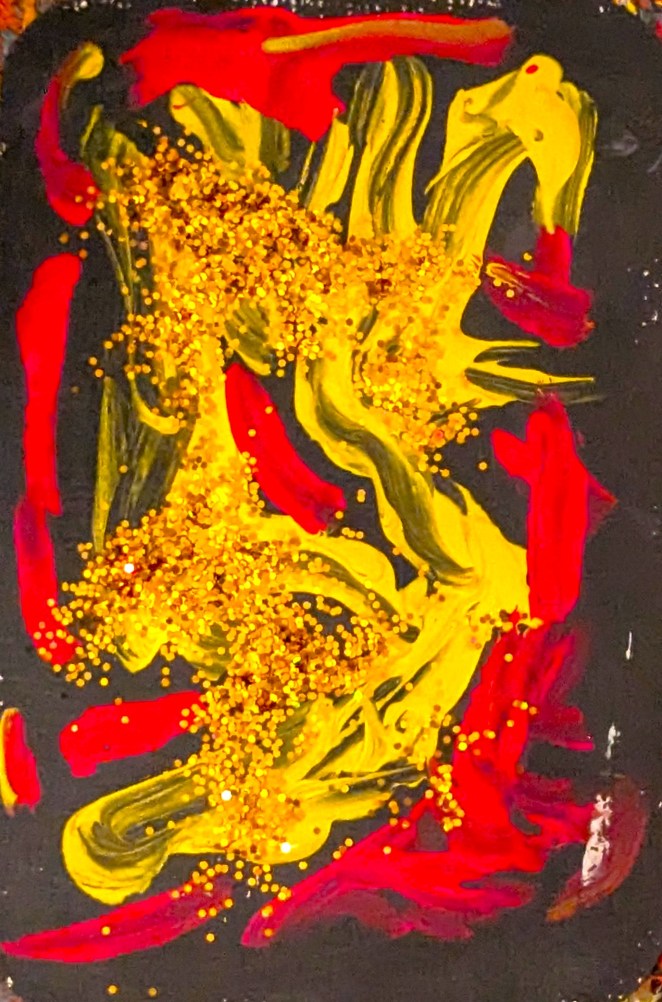
What on earth do you mean by energy? And why should energy be associated with things? For example, today’s painting (above) is by my friend Moo. He calls it Joy to the World. It is indeed a joyous painting, full of light and creative energy. The photo does not do justice to the painting, which sparkles and reaches out to draw the viewer in. We must never underestimate the energy that comes from the creativity and art that creative people put into their art works. It is like bread cast upon the waters – it will return tenfold. The world would be a sad place if we lost our powers of creativity and invention. May we always keep them close by us, and turn to them when the skies are grey – for with our ingenuity and skills we can always turn those grey skies blue again. It just takes time, trust, belief, creativity, and a little bit of energy.

Or is the prompt referring to the energy that comes from food? Vonnegut refers to such energy as comes from the breakfast of champions. Was that really Scott’s Porridge Oats? Certainly used to be – and all those caterwauling bagpipes puffing out their oaten tunes. More foods, please. Cornish Hens and Kedgeree, unzipped bananas, eggs – preferably fresh and free range – boiled, poached, scrambled, fried, or served in various types of omelets … energy from food – oh, I could go on and on and on … caws wedi pobi, cennin a tatwystortilla espanola, paella de mariscos, calamares en su tintachapulines from Oaxaca … food as a source of energy … wow! And who said the foods had to be written in English?

Mind you, an alternate source of energy is the current news cycle. When not a storm in a tea-cup, sugared or un-sugared, it is ferocious and opinionated enough to set people banging their heads against the walls so the pain will come from an alternate source. And noise demands energy – energy in (and also garbage) and energy out (mainly garbage), and all that rage, fury, wind, despair, blather, generated by written, printed, spoken, televised, radio borne waves of noise. We could start a wind farm if we trapped the blatherings of congress, the senate, the houses of parliament.

Meanwhile, we live in a large house, almost a barn really. Some of our friends call it our hacienda. They are the ones who speak no Spanish and can’t pronounce Quevedo correctly, even though I’ve known them for a quarter of a century. Actually, strictly speaking, most of them are ex-friends now. Many went AWOL when I retired and the rest disappeared, fates unknown, during Covid.

That house has an electric furnace that warms us in winter and circulates cool air, in summer, from the basement (cool) to the upstairs bedrooms (warm). We also have a fireplace insert that burns wood. But we only use that in emergencies (power loss during cold weather or storms) or for decoration (the yule log) at Christmas and over the New Year.

A large house means large heating bills. About ten years ago, we installed a wonderful heat pump that serves the whole house. It heats in winter and cools in summer. It also halves (or more) our electricity bills. Most of the house functions on electricity, hydro-electricity from the dam at Mactaquac, just up the road. No coal-fired furnaces for our electric supply. We do, however, have the ability to connect to a petrol-driven generator. But we rarely, if ever use it and that, too, is for emergency use only.

Otherwise, many of the things we use on a daily basis – computers, cell phones – can be battery driven (when the power fails) and those batteries can be charged in the car (during emergencies) or from reserved chargers hidden away. The car itself is a normal gas engine – nothing special – as is the snow blower. We do not use solar power – nor wind power – but we do have candle power and our fireplace insert can be used for heating food and boiling water.

So there, as a challenge to your lack of clarity, you have a clear account of my many sources of different types of energy. Oh, and don’t forget, I am energized by earing your prompts apart and chomping them into tiny pieces.

Comment – revised, Sunday, 22 September 2024.

What’s your favorite word?

Daily writing prompt
What’s your favorite word?

What’s your favorite word?
Seems like a daft question to me. Just one word?

Llanfairpwllgwyngylldrawbwlchllantisilioggogogoch – how’s that for a single word? And what’s wrong with married ones anyway. Or should I go for something like – home, health, morning (good or bad), night, how? -as in How! And what about the vast quantity of expletives that are found in so many languages? Many of them are single words, although many others are found in fertile and creative compound structures.

Of course, wrth gwrs, we are thinking of how many single words in how many languages? Or are we? I personally think that phrases might be more important than single words. Thank you becomes gracias (in Spanish) or te / se lo agradezco (more formally). It changes to merci (in French) or merci bien, or merci beaucoup, or grand merci, or merci mille fois, or je vous remercie. Then, in Welsh it becomes diolch, though many prefer diolch yn fawr.

Mind you, when living in Mexico, especially in some of the more isolated villages where food and water are not always the cleanest, bathroom may be a key word. Quick is also an important one. Put them together and you get bathroom quick! Help is also very useful when travelling alone and lost. As is Please! Por favor, in Spanish – two words of course!

Single words, in isolation, can be very dangerous. Especially when using a second language that one doesn’t dominate. Examples of embarrassing mistakes are multiple in the language-learning text-books. Speaking of which, it is interesting how infrequently they offer phrases like “Where is the bathroom?” or “I need the toilet. Now.” Alas, they also avoid the inevitable consequences like – “Too late!” “Sorry!” “Where is the nearest dry cleaners?”

A funny thing, language. And other people’s languages are equally funny. By funny, I mean weird, strange, and unpredictable, especially without a sharp cultural knowledge to permit the speaker to actually understand what he or she wants to say and how to phrase it correctly. Simple example – embarazada, in Spanish, does not mean embarrassed, it means pregnant. You would be surprised at how many young ladies, learning Spanish in Spain, have amazed their hosts and teachers by the simple announcement, often in class, that ‘estoy embarazada’‘I am pregnant’ – and I have seen the looks of amazement adorning the sympathetic faces of the families gathered round the table or the looks on the faces of the classes being so addressed.

So, a little knowledge is a dangerous thing. I can think of very few words, single words, that I would use on their own. But I can think of many, many phrases, most short, that I would be happy to use, and many more that I would avoid at all costs. As the students in the lower grades of Spanish used to say – “Buenas Nachos” and “I only want to be able to ask for a beer.” “Can’t we watch the Smurfs?” Have you ever tried to understand humor in another language, another culture? It is one of the hardest things to master, especially when it depends on the double-meaning of words, words which, all too often, only have one meaning in the pocket dictionaries people carry around with them. Caveat emptor. Buyer beware. And tread carefully, for you may not know just whose toes you are treading on, nor why, nor how they will react – the people, not the toes. Dangerous things those pronouns.

On the other hand, we can always go religious and turn to the Bible for advice. There we find “Faith, hope, and charity, and the greatest of these is charity.” So. Problem solved. I have found my one word – Charity. That said, I do like the painting Moo offered me for this prompt. He calls it Hope. And remember, you can’t go wrong with any of those three words – Faith, Hope, and Charity. Tolle lege. Amen.

Solitary 1 & 2

Solitary 1 & 2

1

They drove me there,
passed through the gates,
unpacked my trunk,
chatted with the head,
shook my hand,
then drove away.

The metallic clang
of the closing gates
still lives with me.

How old was I?
Six? Seven?
I no longer know
and there’s nobody
left alive to tell me.

I remember so well
the woodgrain on the desk,
the carved initials,
the loneliness that bit,
the barred windows
of that empty classroom.

2

An only child,
taken away,
left among strangers?

Why, why, why?
Doubt’s pinball
bounces round
my empty skull.

What am I?
Who am I?
Why am I?

How did I become
whatever it is
that I became? 

mea culpa
mea culpa
mea maxima culpa

Was I the one to blame?

Comment:
I prefer it as two poems, rather than a poem and a commentary. It may even be better written in the third person. I’ll have to think about that! It’s always a good way to work. Thank you to all who commented, by email or otherwise! Your comments always help me think, and re-think.

Solitary

Solitary

They drove me there,
passed through the gates,
unpacked my trunk,
chatted with the head,
shook my hand,
then drove away.

The metallic clang
of the closing gates
still lives with me.

How old was I?
Six? Seven?
I no longer know
and there’s nobody
left alive to tell me.

I remember so well
the woodgrain on the desk,
the carved initials,
the loneliness that bit,
the barred windows
of that empty classroom.

Comment:
Looking back, I wonder just how and why I ended up in a series of boarding schools, starting when I was only six years old. What does that abandonment do to an only child, taken away, and left among strangers? I still have nightmares and wake up screaming, from time to time.

Why, why, why? The pinball of doubt bounces round the interior of my head as I struggle to plot different paths, different ways, how life could have, might have, been so different.

I guess that schooling, force fed, made me what I am. But then the pin ball starts again – what am I? Who am I? Why am I? And how did I become whatever it is that I became? Mea culpa, mea culpa, mea maxima culpa – was I then the one to blame?

What are you doing this evening?

Daily writing prompt
What are you doing this evening?

What are you doing this evening?

This evening, I am thinking about how September is the month in which academics, thinkers, and philosophers, as well as everyday people, can be reborn. I wrote this article 25 years ago. Re-reading it now, I am amazed by its clairvoyance. Here are my thoughts from way back then.

“September Renaissance: The Annual Adventure of (Re)Creating the Individual.”

This address was delivered to faculty at MOUNT ALLISON UNIVERSITY on 07 September 1999. It is a revision (and an extension) of the adress I delivered to students at St. Thomas University during the inaugural speech delivered to the incoming class of students by the winner of the St. Thomas University Excellence in Teaching Award.

Tomorrow, 08 September, 1999, is a very special day for me, and I would like to share my Special Day with all of you.

“A Special Day?” you think. “It must be his birthday.”

But no, it’s not my birthday. Could it be my Saint’s Day then? If we were in class, and you were all students, I would see some puzzled faces. A hand would be raised: “Please Dr. Moore, what’s a Saint’s Day?”

I would smile at the student brave enough to ask that question. “Good question!” I would say. “When one person asks a question, class, there are twenty people in the room, perhaps more, who wanted to ask that question, but did not raise their hands because they were afraid to do so. Never be afraid to ask questions. Question everything. Question everyone. Ask questions all the time. That, in part, is what you are here for: to ask questions and to learn to ask the right questions.”

So: what is a Saint’s Day? Well, in Spain, people often have two celebrations a year: their birth day and their Saint’s Day. Their birthday is, of course, the day they are born; their Saint’s Day is the Feast Day of the Saint after whom they are named. That was a good question, class, and you have gained a little knowledge! But No! It is not my Saint’s Day.

Why is today such a special occasion for me? Again, if this were a classroom I might, at this stage, do one of several things:

  • I might divide you into groups and ask you to discuss the question;
  • I might turn on a video;
  • I might access the classroom computer and show you a multi-media presentation;
  • I might give you a lecture or a talk or a question and answer session, much as I am now doing;
  • I might send you to the library to find out the answer for yourselves;
  • I might send you to the computer room to surf the net in search of an answer;
  • I might ask you to work together on an interactive listserve and let others help you access the information;
  • I might send you home early with reading material for the next class;
  • I might send you home to watch a specific television program;
  • I might set you the question as a Problem Based Learning Group Research Project (written answers on my desk, tomorrow, by 3:15 pm!);
  • I might ask you to write your essay in a journal page or in a researched essay (due in six weeks time, with annotated bibliography!);
  • I might ask you to tap in to your subconscious and freewrite around the question for fifteen minutes;
  • I might tell you to do some thinking and asking around, because that specific question will be on the final examination;
  • I might ask you to design a poster or your own multi-media presentation demonstrating the meaning of the question and several possible answers …


… Clearly, there is no right or wrong approach and there are many ways of dealing with what is, on the surface, a relatively simple question. You are using many of these approaches in your own classes here at Mount Allison University and I do not presume to tell you that one way is right and another wrong. So much depends on the shifting relationships between teacher, learner, class size, class maturity, work capacity, research resources, and subject matter. At Mount Allison you have a national reputation for the excellence of your students and of your faculty. You have proved over a long period of time your ability to distinguish between the more important questions and the correct research and investigation procedures; above all, you know how to choose those that are most suitable to you and to your own students.

Since this is NOT a classroom, since you are not my students, and since I would have great difficulty in dividing you up into small groups so that you could discuss why tomorrow is such an important day for me, I will provide you with the required answer: TOMORROW, September 8, 1999, is my RE-BIRTH-Day! Tomorrow, I celebrate the day of my RE-BIRTH. Thirty-three years ago tomorrow, I was RE-BORN.

Permit me to share with you the matter of my RE-BIRTH!

It came about like this: On September 8, 1966, I got up at 4:00 am, ate a light breakfast, packed my suitcases into my father’s car, and headed for Heathrow Airport, London. There I boarded BOAC Flight 1040 and at 3:00 pm that afternoon I landed in Toronto, Ontario, Canada. By 3:15 pm, I was passing through Canadian Customs and Immigration and by 3:30 pm, I was RE-BORN as a Canadian.

This RE-BIRTH was not an easy process. It took me a long time to learn to act, think, and speak like a Canadian. It also took me a long time to realize that while the Canadian within me was growing stronger every day, other parts of me, even when they were rigorously maintained, were beginning to die. Thus, at the same time as I celebrate my RE-BIRTH as a Canadian, I mourn the gradual passing away of my Welshness, the slow disappearance of my Welsh family, the fading of my Welsh friends, some of whom I have not seen in more than thirty years.

Yes! I was RE-BORN 33 years ago tomorrow. But this is not the only RE-BIRTH that I have undertaken. There have been many other rebirths:

  • 28 years ago, I emigrated from Ontario and was RE-BORN as a New Brunswicker;
  • 27 years ago, I left the University of New Brunswick and was RE-BORN as a St. Thomas University professor;
  • 24 years ago, I was RE-BORN when I graduated with my PhD and was officially no longer a student;
  • 5 years ago, when I visited the Dominican Republic, I was RE-BORN as a conscious critic of certain neo-colonial policies and attitudes towards Developing Countries; in the DR, incidentally, I was also held up at gun-point — and surviving THAT little incident certainly guaranteed an instant RE-BIRTH which I celebrated in the closest bar!
  • 4 years ago, in December 1995, I was RE-BORN as a pseudo Professor of Education when I visited Oaxaca, Mexico, as part of what was later to be called the St. Thomas University – University of New Brunswick – Universidad Autónoma Benito Juárez de Oaxaca Faculty Exchange Program;
  • And tomorrow, on September 8, 1999, as I celebrate the 33rd anniversary of my being RE-BORN as a Canadian, I am in fact in the process of being RE-BORN yet again.


I will explain how in a moment. Meanwhile let me say that along with the pain and struggle for RE-BIRTH come various things:

  • PRIDE: in the fact that I, along with everyone else in this room, can achieve RE-BIRTH;
  • HUMILITY: in the knowledge of how fortunate I am, together with all of you gathered here in this room today, to be counted among those who are still capable of RECREATING their lives and of being RE-BORN;
  • RESPONSIBILITY: in the knowledge that when we are RE-BORN a new set of duties falls upon our shoulders;
  • ENERGY AND ENTHUSIASM: in the knowledge that I, like every one of you, am capable of sharing the secret of my RE-BIRTH with the students who come to my office and my class almost every day in search of the new selves which they wish to create for themselves.


This summer, to prepare myself for this Fall’s RE-BIRTH, I did the following:

• I revised all my courses;
• I attended the University of New Brunswick Multi-Media Institute for three weeks and completed my Certificate of Multi-Media Studies;
• I reconstructed, with the aid of Clare (without whom I would not be here today, but perhaps I’ll tell you more about that later), my web page;
• I (re)commenced my annual summer reading program to update my thinking.

I say all this to assure you that I know as well as you do that knowledge is not a solitary, self-contained unit which, once attained, stays with us forever. Knowledge is an ongoing process; learning is a lifetime commitment; you, as faculty, teach at Mount Allison University, as I teach at St. Thomas University, not just to earn a salary, but to continue a life-long commitment to teaching and learning. If you are like me, you love the sheer process of teaching and learning; you love the contact with young, developing minds.

I try always, as I am sure you do, to encourage my students to start their life studies with us at St. Thomas and to continue their life studies when they leave university. We do not say “Learn for four years and then you can stop learning for you will have all the knowledge you will need for the rest of your lives.” At least, I hope we don’t.

And it is the same thing for us, as faculty. For we, as faculty, are actively involved in our own ongoing research and scholarship, some of which we publish and some of which we use in our classes; research moreover, without which the knowledge we share with our students would be a dead package, taken from our notes, and handed over without thought or revision, or consideration, to the next generation, much as certain forms of knowledge were handed to me when I was an undergraduate by some of the teachers de cuyos nombres no quiero acordarme / by teachers whose names I do not wish to recall, to borrow the famous words with which Cervantes opened perhaps the world’s greatest novel: Don Quijote de la Mancha.


So what did I read this summer?

Amongst other things, I read about the RENAISSANCE — the RE-BIRTH of Western Civilization in the 15th and 16th Centuries; I also read about the REFORMATION that came about as a direct result of the challenges and questions posed by the RENAISSANCE; and I read about the COUNTER-REFORMATION that sprang up as a reaction to and dialogue with that first REFORMATION.

I also realized, not for the first time, the similarities between our own age and that of the RENAISSANCE. The RENAISSANCE, as Marshall MacLuhan pointed out in The Gutenberg Galaxy, was a time of new ideas and new technology; in addition, a radical change occurred in the paradigm of man’s learning and thinking. The known world was expanding with the voyages of discovery that set out to East and to West. Man’s view of the universe changed with the various discoveries in optics that allowed us to see objects in space larger and in more detail than ever before. This led, of course, to the concept of the heliocentric universe, where human beings were displaced, away from the centre of creation; a new concept for the Church, and one that they fought against bitterly at the time.

In the same period the printing press had an enormous influence on the dissemination of knowledge, and totally changed peoples’ ways of disseminating, creating, receiving and perceiving written information. It is very difficult for us to understand, even today — perhaps especially today — the impact of the printed word on a semi-literate society in which, again according to Cervantes, groups of people would gather in the evenings to have books read out loud to them by the one or two people in the village who could read. Walter Ong has described this process to us in Orality and Literacy, another book which I (re)read this summer. Suffice to say, that for us, as a television generation, it is difficult to understand the initial impact of radio upon our parents and grandparents. For the new generations of students emerging today, it is difficult to imagine life without the instant communication of television, telephone, email, and computer.

In many ways, the impact of print must have been similar to the impact of the electronic technological revolution which we are going through today. And one thing I know for certain, after completing my Certificate in MultiMedia Studies: none of us are aware, nor will we be fully aware for a long time yet, of the full impact of the electronic technological revolution upon the hearts, souls, intelligence, and minds (not to speak of the wrists and eyes) of those who use it and of those who are now growing up, many of whom know no other way of accessing information.

The paradigm of knowledge and technical skill is still changing and developing explosively; as a result, we are still unaware of exactly what can be achieved by the new media. Take computer chess, for example. Chessmaster 2000 had approximately 150 games programmed into its chess library; Chessmaster 4000 not only has 1500 games programmed in, but also presents us with games in which Karpov commentates in digital audio his own moves in his own matches!

Yet, in spite of this tremendous rate of progress, few of us who follow Chess would have dreamed that Deep Blue, programmed by a gentleman from Clare’s home town of Bournemouth, would thrash Karpov, the world chess champion from the Soviet Union, only a year or two down the road. Nor can we understand the extremely rapid progress that leads us in a matter of months, to see the memory banks in a pc clone expand from 1 gig of memory to 4 gigs of memory, to 6 gigs of memory, to the 10.6 gigs of memory that Dell is advertising in its latest computer sales. In some ways, it is like the 10, or 12, or 14 zeros that are now following the initial figures in the MEXICAN FOBAPROA SCANDAL: so many zeros that the concept of the magnitude of the debt is beyond the understanding of most of us.

In our day, then, as in the Renaissance, the paradigm of knowledge is expanding explosively. Knowledge in the Renaissance evolved so quickly that few individuals were capable of grasping the full meaning of the REVOLUTION, the RENAISSANCE, the REBIRTH which they were observing and in which they were involved. In fact, the RENAISSANCE BATTLE OF THE BOOKS or the continuing discussions between the ANCIENTS AND MODERNS were very similar in many regards to some of the discussions regarding the FUTURE OF EDUCATION that we are holding in all the Atlantic Provinces Universities right now. Authority or Innovation? The old ways or the new? Technology or Tradition? Whatever side we come down upon, these discussions are good for us all for they mean we are alive and thinking and that our knowledge is not a dead but a living thing.

This summer, I also (re)read Mikhail Bakhtin; I believe with him, that human beings can live in a DIALOGISTIC RELATIONSHIP WITH THEIR CHRONOTOPOS — that is to say, in less Bakhtinian language, that people can hold a dialogue with their time and their space, a dialogue which can bring about change, new directions, new commitments, in short, a RE-BIRTH.

And now, from Dialogue to Drama: Wayne C. Booth, in Freedom and the Individual (the Oxford University Amnesty International Lectures of 1992) wrote that we are all individuals, writing the drama of our own lives; each student’s entrance to Mount Allison University, in Wayne Boothian Theory, is a chance for that student to begin his or her play again; all students can rewrite their roles and their characters; as we can rewrite our lives and our roles. In short, each one of you can, like me, be RE-BORN. And believe me: September is the month in which this ANNUAL REBIRTH can and should take place.

I also read several books on the THEORY OF TIME: sidereal time, atomic time, linear time, instantaneous or contemporaneous time … many of the courses I teach at St. Thomas University are based on linear time: each term, they progress steadily from Day 1 to Day 36; however, our lives as teachers and learners are also based on seasonal or cyclical time. For teacher and student, the learning and teaching cycle begins anew every September; this is the time of the SEPTEMBER RENAISSANCE or RE-BIRTH. September then is the month for us ALL to be RE-BORN.

In some ways, the most important books I read this summer were all written on or about don Francisco de Quevedo. These books no longer have a single author. We are no longer dealing with one person’s ideas. Thus, although Pablo Jauraldo Pou’s name adorns the edition of the latest and best biography of don Francisco de Quevedo, Quevedo’s life has actually been researched by an extensive team of scholars, students, and friends, so large, that only the most important dozen or so can be acknowledged. The same is true of James O. Crosby’s edition of the Sueños, or of Ignacio Arellano and Lia Schwartz Lerner’s edition of the metaphysical poetry, or of Crosby and Jauralde’s edition of Quevedo y su familia en setecientos documentos notoriales, a compendium of legal documents concerning the Quevedo family which runs from 1572 to 1724.

In fact, when a single author, not a member of a team, writes on Quevedo nowadays, it is to offer a study of just a small portion of the author’s work. In this fashion, Josette Riandière de la Roche’s Nouveaux documents quévédiens: Une famille à Madrid au temps de Philippe II deals with a very short time period and only a selected aspect of the life of the poet. In similar fashion, Santiago Fernández Mosquera’s La poesía amorosa de Quevedo: disposición y estilo desde CANTA SOLA A LISI deals with only one aspect of Quevedo’s poetry, that of the love poems seen in the light of the sonnet sequence to Lisi.

TEAMWORK: it is becoming more and more necessary to work as a member of a team in order to keep up with the knowledge explosion with which we are confronted. I once said, tongue in cheek, that a TIER 2 CIDA GRANT APPLICATION demands the construction of a team. You need

  • a reader who specializes in how to read the AUCC / CIDA guidelines as they change from year to year;
  • an interpreter who specializes in what the current buzzwords are in government circles actually mean and how to use them in your documents;
  • an accountant who specializes in cash flow, international money transfer, and book balancing;
  • a manager who specializes in Results Based Management or whatever form of management system is the current government buzz word;
  • this manager must also have organizational skills to link the various parts of the application to the Results Based Management that is currently demanded by AUCC/CIDA.

Further, the manager must have people skills in order to hold the team together when things are going badly or well, for triumph and disaster, as we well know although both impostors are ever present when applying for Grants from Government Sources; you also need

  • a writer who specializes in writing up the final text so that it will convince the granting authorities that you, the applicant, another often forgotten member of the team, actually knows what you are doing;
  • finally you need what I call a people person or a wheeler – dealer who will get out there and make the appropriate contacts and find out who are the current movers and shakers and who will actually give you the internal promotion that your CIDA GRANT needs if the application is to be successful.

I would also suggest, perhaps not totally tongue in cheek, that a similar team approach to the writing of SSHRCC GRANTS FOR THE HUMANITIES would not be a bad idea.

TEAMWORK: As I said earlier, I completed my Certificate in MultiMedia Studies at the University of New Brunswick this summer. One of the things that I learned was the importance of teamwork in computing.

In our first SCENARIO FOR A CASE STUDY this summer, for example, we were required to design and build a commercial web site. Of course one person can build a website, and a pretty good one at that. But the studio team which we were given consisted of

  • a graphic artist,
  • a sound engineer,
  • a creative director,
  • a computer tech,
  • a multimedia specialist,
  • a photographer,
  • a specialist in digital photography,
  • a graphics designer, and
  • a colour specialist.

We did not have digital video capacity and were forced to contract digital video out. Costing was also a major part of the exercise: how many people, how many tasks, what order for the tasks, how many hours, how much time, how much money! I repeat: the new paradigms of knowledge that are developing around us will be demanding more and more teamwork from us.

I will end this brief presentation by reminding you that this fall, on Saturday October the Sixteenth, 1999, to be precise, the Atlantic Teaching Showcase will be coming to St. Thomas University, Fredericton. I hope to see some of you in St. Thomas, at that meeting. I am, as many of you know, the Chair of the Atlantic Association of Universities Teaching Showcase for this year.

However, I have not arranged the Showcase on my own. On the contrary: I have gathered a team of faculty and together we are working towards the Teaching Showcase. In fact, I have one person looking after finances, another looking after registration, another building a website, another looking after catering, another looking after audio visual equipment, another booking rooms, another organizing the program, another recruiting and organizing student help. We have planned and arranged the program between about eight of us.

An exercise in teamwork, no less.

I know that in all that I have said so far today, here at Mount Allison University, I am talking to people who know as much as I do, or more, about all these things: REBIRTH, RENAISSANCE, TEAM WORK, COLLABORATION. For a very long time, I have been impressed by the quality of Mount Allison’s teachers and by the quality of Mount Allison’s students.

In five weeks’ time, at the Atlantic Association of Universities Teaching Showcase, there will be a session entitled “WORKING TOGETHER: MODELS OF COLLABORATION INSIDE AND OUTSIDE THE CLASSROOM.” This particular session is a perfect example of the type of teamwork I have been talking about today. The session was presented to me in its entirety as a proposal for a single session incorporating 4 papers and some interactive discussion. The session will have a 90 minute slot and I very much hope to be present for what promises to be an exciting time. The session currently consists of a series of four papers, as follows:

  • “Mixing media: High Theory, Low Culture (or Inviting Popular Culture into the Classroom”;
  • “Collaborating with Students: Sharing Power over Syllabus Design”;
  • “Interdisciplinary Collaborative Project: A Model”;
  • “Beyond Discipline: Facilitating Collaborative Student Research”.

The session organizers are all associated with Mount Allison University and I would like to congratulate Professors Pat Saunders-Evans, Deborah Wills, Robert Lapp, Jeff and Ausra Burns on the hard work they have put in to an excellent integrated proposal.

Imitation, they say, is the best form of flattery. I have stood here today and spoken to you and you have kindly listened to my words. Tomorrow, I will spend part of my RE-BIRTH-DAY with you, here at Mount Allison. I have been invited to attend your Learning and Teaching Development Workshops, and I hope to take back to St. Thomas University some of the excellent ideas on which you are working here on campus. You are nationally and internationally recognized leaders in your field. Tomorrow, it will be my turn to listen to, and learn from, you!

Thank you for inviting me here.
And thank you for listening.

How would you design the city of the future?

Daily writing prompt
How would you design the city of the future?

How would you design the city of the future?

What future? Utopian or Dystopian?

Dystopian – how does one plan to design the city of the future in, for example, Syria, Gaza, Ukraine, a war-torn African country? There are wars and rumors of wars. What sort of future city does one design in the aftermath of a nuclear war? Bunkers for the elite? Underground tunnels? Radiation free zones? MAD – Mutually Assured Destruction – and who would be alive to inhabit one of those cities? The ultra-rich might escape on their super-yacht-space-crafts. But where would they go? And for how long would they survive? And what sort of cities would they build when they got to wherever they were going? From some of the rumors that I am hearing, the multi-billionaires are already building those -super-survival-Noah’s-Ark-Bunker Cities in various parts of our world as it is now. A water world? A dust storm world? A radio-active world? First, define the future, and then we can design for it.

And remember how many times, during and after the first Iraq war, we have heard generals and politicians boasting that ‘we bombed them back to the stone age.’ Just think about that. The stone age. Primitive in the extreme. No electricity, no running water, no regular food supply, no weapons other than sticks and stones, no bronze (that age came later), no iron (that age came later), no medicine, no doctors, no hospitals … think twice before you celebrate ‘bombing anyone back to the stone age’, because that might just happen to you, over the next few years. And remember, if everybody turns off all sources of light, we will be entering a very dark age indeed.

Utopian – Voltaire’s Candide – “everything is for the best in the best of all worlds.” Great. Now re-read the paragraph above. Even if our desired Utopian world avoids a nuclear holocaust and turns out to be the best of all worlds, we are still looking at climate change, rising seas – with the accompanying joy of developing new waterfront properties!??? as someone phrased it recently – over-population, mass population shifts, a dwindling set of natural resources, a scarcity of food and, more important, a scarcity of drinking water, and a tremendous division between the ultra-rich and the super poor. We are also dealing with forever plastics, polluted water, air pollution, the extinction of vital and diverse species, and so many more problems. A Utopia, perhaps, but a Dystopian Utopia, not a total disaster, but a Utopian world walking the plank towards a shark-infested sea.

So, tell me, how do we design the city of the future? A super-charged Noah’s Ark, space ship city, sailing to Planet B because we have flooded Planet A with so many devastating Dystopian indulgences? A deep-earth bunker, or linked set of bunkers, way below the earth, where a select community think they can ride out the coming storm? And what if our planet disintegrates and becomes just another dust cloud, its debris floating in the universe?

I would like to think that my own city of the future would be a small one-roomed, wooden cottage, buried six feet deep, in the peace and quiet of a rural cemetery. But who will bury me, if the world around me perishes and I survive only to fulfill my human fate, and die? I would also welcome a fiery end with my ashes scattered in the peace of the countryside, or in my own garden. Then I think of the wildfires currently consuming large parts of the world and I wonder if any of that will survive. Moreover, can a welcome grave in an enormous graveyard be considered a city of the future? If it can, get planning.

Mors omnia solvit / death solves everything. Indeed it does. And it will solve this question, this problem, and the future city, that I will never design or inhabit, unless, along with Blake, “we build Jerusalem, in England’s green and pleasant land.” If England’s Green and Pleasant Land still exists. And from what I am reading in the dystopian English press, there is little chance of that! And anyway, I live in Canada, so what has England’s polluted and dystopian land got to do with me?