On what subject(s) are you an authority?

Daily writing prompt
On what subject(s) are you an authority?

On what subject(s) are you an authority?

First, I would like a definition of an authority. Here’s what I found – 1. the power or right to give orders, make decisions, and enforce obedience – as in “he had absolute authority over his subordinates”. 2. a person or organization having power or control in a particular, typically political or administrative, sphere as in – “the health authorities”. Isolating the words enforcement, power, and control, I am delighted to say that no, I am not an authority on anything, and I have no control over anyone. Also, I am not a monarch, and I have no subjects.

What happens if we change the meaning of the words slightly and ask another question? Here is a suggestion from the online Cambridge Dictionary – searching for an answer to my question “What is an example of authority on the subject? – I found this – The phrase “authority on the subject” is correct and usable in written English. You can use this phrase to describe someone who has extensive knowledge or experience on a particular topic. For example, “Dr. Smith is considered an authority on the subject of modern psychology.”

Now this becomes a very interesting question and it can be answered from a variety of perspectives. In our two person household, I deem myself an authority on some forms of cooking. I regard my beloved wife, my better two-thirds as I call her – an authority on the forms of cooking that I have trouble with – for example, baking, cooking vegetables, boiling eggs. She does a wonderful boiled egg. I am hopeless at boiling eggs – either too hard or too soft, usually the former. But I am the authority on Spanish omelets and scrambled eggs. They are my specialities. She makes wonderful chowders. I specialize in gazpachos, sopa de quince minutos a very quick (15 minute) Spanish sea-food soup, and Cawl Mamgu and other Welsh stews.

Once we step outside our kitchen, the world changes. In a world (New Brunswick) where cricket is virtually unheard of (save in the minds and cultures of fellow immigrants) I am considered an authority on cricket. Not that I am an authority, but at least I know what it is and have a good idea of what is happening in a cricket match. Therefore, we must also consider ‘being an authority’ in the context of the audience that receives our words of wisdom. To my nine year old grand-daughter, I am an authority on several subjects. However, I have absolutely no control over her – how she thinks and what she does. I can suggest or persuade, but I cannot and will not enforce.

In the undergraduate classroom, in which I taught for 43 years, I was considered an authority on Spanish by my students. Outside the classroom (and sometimes inside it) I learned more from my students than they ever learned from me, especially in my formative years as a Canadian when I was learning to skate and to ski. Don’t go there – too many painful memories of falling only to rise again!

But when we moved from the classroom to the wider university, to the full Canadian Scene of the Learned Societies, as they used to be called, I became the learner and the authorities were to be found elsewhere, often on the podium, sometimes in the bar. Same thing when we move onto the international stage. There are very few world authorities, in my field. However, there are many wannabe’s, but for them, after careful analysis of their strengths and weaknesses, I have usually had very little respect.

So, today we have opened another can of worms and look at them, wriggling and crawling before our very eyes. Worms – one of my friends really is an authority on earth worms. She knows all about them. Another of my friends is an authority on worms in puppies and kittens. A world wide authority, known every where and often quoted? I doubt it. But certainly in my garden and the vet hospital where I take my pets, they are both authorities.

Ah, the joys of Discourse Analysis – maybe, one day, I can be an expert on that. But take my words, as always, with a large pinch of salt, and, whatever you do, don’t put salt on slugs, and snails, and puppy dog tails. On that point, we can all be authorities.

What makes a teacher great?

Daily writing prompt
What makes a teacher great?

What makes a teacher great?

When Moo descended from Mount Academia, he brought down with him the ten tenets to which great teachers, knowingly or unknowingly, commit. He asked me to transcribe them here, since they were in danger of being neglected and / or forgotten.

  1. Mastery of the subject – great teachers know their subjects inside out. They do not read their graduate school notes to their students, heads bowed, chins on chest, droning on in a low, boring mumble. They encourage questions and are open to debate with their students about the subject that they know so well and openly love.

    Master thy subject.

  2. Humility – great teachers are humble. They know that they are not omniscient. They also know that knowledge changes across time and that they too must change and follow new ideas. They also know, perhaps instinctively, that some of their students are as intelligent as they are. They never dismiss their young charges as idiots, fools, or lunatics to be beaten and forced into the required shape.

    Be humble.

  3. Flexibility – great teachers are flexible, not rigid. They can bend the rules, reshape the syllabus, change pace and tone to match the needs of their students. In addition, they ask their students about their needs and try to address those needs in a personal way, sometimes on a one on one basis.

    Be flexible.

  4. Reaching out – great teachers reach out to their students as a group and as individuals. They never paint themselves into the know-all corner where they alone know best, and they know, with absolute certainty, what’s best for their students. Great teachers know, above all, that one size, in great teaching, neither fits nor benefits all.

    Reach out.

  5. Equal treatment – great teachers treat their students equally. They do not fawn on the best and scorn the worst, nor do they teach by the WWII convoy system, teaching only at the speed of the slowest. By extension, great teachers try to create an atmosphere of love in learning and joy in the subject.

    Practice equality.

  6. Honesty – great teachers are honest, fiercely honest. They know their own strengths and weaknesses, their own limitations. They work on their weaknesses, striving to turn them into strengths. They also push the boundaries of their limitations, striving always to keep up with the ever-changing frontiers of knowledge.

    Be honest.

  7. Human beings – great teachers know that they are human beings and they recognize early on in their careers, that while they are teaching a subject, they are also preparing fellow humans for a life beyond the ivy-covered walls of academia. By extension, they emphasize the humanity of their students and try always to develop and sustain that humanity.

    Be human.

  8. The meaning of meaning – great teachers reach out beyond their subjects to teach the meaning of meaning. Why is the subject important? What can each individual use this hard-earned knowledge for, in their own lives? How can they reshape their own lives and create better ways of learning and living? This teams up with reaching out and enters the realm of learning for learning’s sake and love of learning and love of knowledge.

    Love thy learning.

  9. Creativity – great teachers are creative. They open their students’ minds to new ideas, fresh knowledge, better ways of doing things. They never use phrases like ‘thinking outside the box’ and they do not build better boxes, one or two sizes larger than current boxes, inside which their students must now sit, work, and think. Creative teachers tear down the walls of medieval academia and open their students’ minds to the winds of change and fresh knowledge.

    Be creative.

  10. Life long learning – great teachers teach students how to think for themselves, how to teach themselves, how to self-assess, how to check and double-check the knowledge (all too often nowadays, fake news and / or false knowledge) handed down to them from a multitude of sources, far too many of them unreliable. Great teachers teach their students to know themselves. They also teach them how to work out whether a source is a reliable fount of information, or not. In short, they teach life long learning and neither they, nor their students, ever give up hope.


    Teach Life Long Learning.

Write about your first crush.

Daily writing prompt
Write about your first crush.

Write about your first crush.

No. No, I can safely say that I have never had that sort of crush, except on a teddy bear or a little poo-pee aka puppy. I guess my first real crush was an orange crush. And no, again, not that orange crush either. I guess I have never been a fan of the Denver Broncos. But, as a child, I loved Orange Crush and Dandelion and Burdock, the former suitable for children and the latter looking remarkably like grown aka groan up beer.

During my time at university, I fell victim to several crushes. One was at the bottom of a collapsed scrum while playing rugby. Never much fun that sort of crush. All those sweaty, smelly bodies. Another came in an attempt to beat the Guinness Book of Records under the achievement – how many people can you get inside an English Telephone Kiosk? This was in the sixties, when England actually had telephone kiosks. If you have never seen a real English telephone kiosk, there’s one down in Kingsbrae Gardens, and I highly recommend a visit to that antiquity – almost as good as the statues in the gardens.

Anyway, one day in rag week, a group of Bristol University students, me among them, started crowding into a telephone kiosk. We entered upright, tried kneeling, others kneeling on our shoulders. We managed about twelve.

Doors open or doors closed? This baby came with no instructions. Poor parents, even more miserable single parents. And they are almost always young women, aren’t they? Come to think of it, maybe we should have invited some female students to join us – much lighter in weight and far less smelly – in the bad sense!

So, we tried a different tactic. If the first measure was a crush, and indeed it was, well, the second measure??? Judge for yourselves. One of us held the door open, the rest of us lay down like logs, feet outside the door, and the newcomers lay down on top of us. Ingenious indeed. But those at the bottom could scarcely breathe. They were the victims of a real crush.

Like the finger in the woodpecker’s hole, we reversed it – feet in, heads out. We got up to twenty-seven students. Then we ran out of student volunteers. Revolting. We asked passers-by to help us. But to no avail. Reversed and removed. Equally revolting. Sent our efforts in, with photos. There was no response. We didn’t make it. I still don’t know what that particular crush record is.

In Cassis-les-Calanques, 1960, I was one of eight people standing in a Citroen Deux Chevaux. That was quite a crush. But, in Santander, Spain, 1970, Clare and I watched 11 people, yes, eleven, get out of a SEAT 600, a 600cc Spanish four-seater car, otherwise known as a bullet / bala, and with about as big an engine as your lawnmower. They exited, one by one, and proceeded to enter the local church for Sunday mass. Can you imagine 11 people riding on your lawnmower?

Maybe that wasn’t a crush at all. Maybe it was just a (Morris) minor miracle.

How do you waste the most time every day?

Daily writing prompt
How do you waste the most time every day?

How do you waste the most time every day?

Answering stupid questions like these – now that would be a great response. But there are other ways to waste time – like mousing around on the computer – some call it surfing, which sounds like fun – but acting like a mouse that’s chasing its own tail / tale, well, that is most surely a waste of time. Playing verbal cat and mouse games is a good way to go too.

Most devilish of all, sitting in a car, beside a lollipop person, who has just stepped out and stopped you from joining the car, ten yards ahead of you, that is now the last car in the latest convoy to be held up, while you are now the first car waiting to go next time. You sit, and sit, and wait.

Then – INSPIRATION – I turn my disc player on and lo and behold – Pete Seeger sings The Abraham Lincoln Brigade, from the Spanish Civil War. What’s special about that, you ask? Well, how about the chorus? – “No pasara’n! No pasara’n!” / “They shall not pass! They shall not pass!” sang the Abe Lincoln Brigade as the battle for Madrid thundered on. I open the car window, turn up the volume, bellowing it out loud while waiting to count the cars coming from the opposite direction.

It was a very long wait. And then the first of 109 cars, trucks, and various other vehicles appeared. Bored now with The Abraham Lincoln Brigade, I changed quickly to Viva la Quinta Brigada, kept the volume up high and “No Pasara’n! The pledge that made them fight” rang out as the official truck with its magic sign “Follow me!” crept up in front of me, turned, and started to crawl, snail mail style, down almost two kilometres of highway at 10 KPH.

When we got to the end of the road works, he turned into someone’s driveway, and I, and the next two cars behind me, followed him. I learned a few choice words to add to my vocabulary – “Like WTF do you think you are doing?” “It says follow me! on your truck.” I replied. ” I just did.” And off he went again on a long, four letter rant. Then, on foot, he stood in front of the convoy that had stalled anyway, now having nobody to follow, and guided his three black sheep out onto the road that led to freedom.

Well, that was an adventure and an absolutely total waste of time. As the court case will be, when I appear before the magistrate next week. Believe you me, if you believe all this, you would believe anything. And, congratulations, you have just successfully wasted another five minutes of your precious time and I have wasted ten of mine writing this piece.

Who do you spend the most time with?

Daily writing prompt
Who do you spend the most time with?

Who do you spend the most time with?

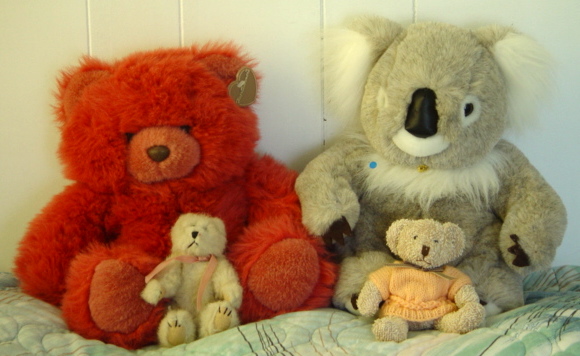
My Teddies. I know, I know. Most of you will say “A Teddy Bear is not a real person. You can say what, but you can’t say who.” And most of you would be wrong. Teddy Bears are trained confessors – they listen to everything you tell them – in silence – and they never condemn you. They are a great comfort too, and are just as good and effective as a comfort dog. Also, they are very, very obedient. Tell your Teddy Bear to sit and wait, and s/he does, very patiently.

I sleep in the same room as my teddies. And since I am in that room for 8-10 hours almost every night, that doesn’t leave much time for spending with other people. Besides which, while Rose and Teddy, the big ones, Mother and Father Bear, so to speak, usually stay in the bedroom, while Basil Bear, the small pocket bear with the pink ribbon, often travels with me, in my pocket, and usually sits on the table with me at meal times and when I read and write.

And remember – Teddy Bears don’t eat your porridge, so you never have to look at your Teddy Bear and say “Who’s been eating My porridge?” I hate porridge, by the way, “Porridge, porridge, thin and brown, waiting for breakfast when I come down. They clean the table of every dish, eggs and bacon, cheese and fish. But however early, however late, porridge is always sure to wait.” Sometimes I wish my Teddy would devour my porridge, especially when it’s burnt. I wounder if I could train him?

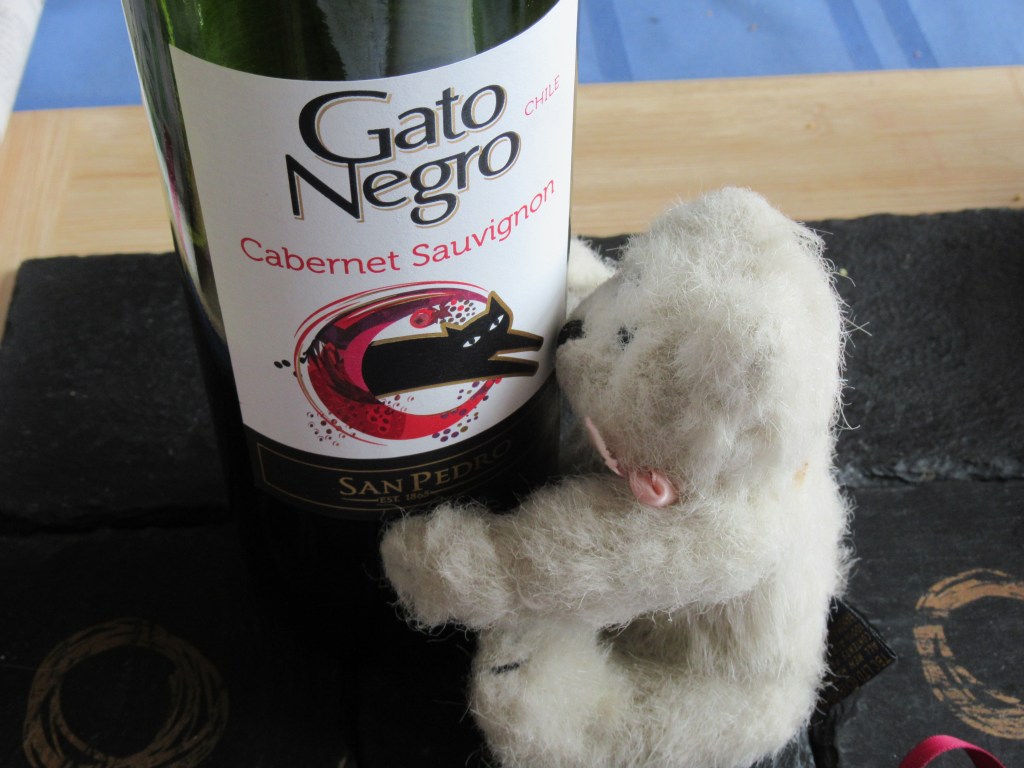
Here’s Basil Bear, on the table with me, helping me to choose my wine. He reads the label, very carefully, and then tells me which one it is. Now that’s what a Care Bear does – cares for and looks after his human. And look at that Black Cat – I do think he’s envious of Basil, four green eyes filled with the light of jealousy. I hope he doesn’t scram my Basil – a gath wedi scrapo Basil fach.

I also talk to that friend , who always walks with me. As Antonio Machado says – “El que habla solo, espera hablar con Dios un dia.” “He who talks to himself hopes to talk to God one day.” Let’s hope that particular chat is delayed a little bit longer. I enjoy writing these prompts. So, happy thoughts, and may you all share a Teddy or two who really care.

If humans had taglines, what would yours be?

Daily writing prompt
If humans had taglines, what would yours be?

If humans had taglines, what would yours be?

I really only want a one word tag – poet, and that’s the name of my blog – rogermoorepoet.com.

An award-winning teacher, researcher, poet, and short-story writer, I was born in Swansea, the same town as Dylan Thomas, the famous Welsh poet, whom I emulated in my youth. I wrote poetry throughout my childhood, but I never took lessons, nor was I known as a poet.

Early in 1962, I sent a sonnet to the poetry competition of the Stroud Festival of Religion and the Arts. I left school and was studying in Paris, when the results came out and I discovered that I had won first place in that competition. In my absence, a deserving boy from my school was sent to pick up the award, a book of poetry, signed by Ursula Vaughan Williams. The poem was published in Trydan and I have a copy of it somewhere.

Throughout my undergraduate career (1963-1966), I wrote poetry. Much of my early work appeared in my university’s student arts review, The Nonesuch Magazine – the Flower of Bristol that giveth great light. Alas, I was not studying English, and only the English students seemed capable of being called poets, so I was always called something else. I wrote a lot about nature, back then. One day, when I hand delivered my poetry submission, the editor of Nonesuch, an English student, asked me if I was a pantheist. “Good heavens, no,” I told him. “I’ve got a girl friend.” This answer did nothing in university circles to affirm my wanna be status as a poet.

Some of these poems survived and a couple appeared in Stars at Elbow and Foot. Here is one from Last Year in Paradise.

St. Mary Redcliffe

Time and Temple Meads
have begrimed your wand-thin spire,
the tallest in England.

You waved goodbye
to the Cabot boys,
Nova Scotia bound,
as they set sail.

Starlings lime your belfry,
gift and inspiration
of Merchant Adventurers,
that gentlemen’s company.

Worms wriggle and gnaw
at your ship’s figure-head,
harbored now, bare-breasted,
sturdy in your oak-beam nave.

Rust rustles and creaks
at the Edney Gates,
wrought to last centuries
by Bristol ironmasters,
themselves apprenticed
to learn time’s laws.

I call myself a poet. I think of myself as a poet. In Santander, Spain, I was known as the mad Welsh poet! What an honour it would be to have Roger Moore Poet as my tagline. I’d rather leave the ‘mad Welsh’ out.

But why stop at one tagline? I am also an award winning teacher and researcher. And a long-term rugby coach. How would they be as tags? Roger Moore Coach? Roger Moore Teacher? Roger Moore Researcher? Not quite the same thing. No resonance and I can produce no links to attach to those names. They are much more run of the mill. Anyone can be a coach, a teacher, a researcher. Not everyone can be a poet, let alone a famous poet, like Dylan Thomas. Besides which, I live in Idlewood, not Milkwood.

There is one other alternative, however. Roger Moore 007. Alas, that one belongs to someone much more famous than me, even though we share the same name. But I might go one step further. How about 3M-007? That would do at a pinch – pretty unique – there aren’t many of them about! I love it. So there we go – a choice of two taglines, either of which fit – Roger Moore Poet and Roger Moore 3M-007.

Which one would you choose for me? “A rose by any other name would smell as sweet.” But remember, I ain’t no rose. So please don’t tread on the tails of my all-disguising, multi-colored 3M-007 poetry coat.

What is your career plan?

Daily writing prompt
What is your career plan?

What is your career plan?

“Pull the other one, it’s got bells on,” as the comedian said on our old black and white TV back in the late fifties when the television shows first started. My grandfather bought that TV in 1953 in order for us to watch the Coronation of Elizabeth II. I was nine years old at the time. Now I am – hold on – “How old am I? Let me count the days” – as Shakespeare might have written, if he had actually written his own plays and poems. Or were all those glorious words written by a conspiracy of authors who then had their work claimed by some else aka Willy the Shake? Snake oil, all of it, or as they say in some parts of Wales – blydi hel.

I wonder how many of my readers know how to play Tute, a Spanish card game, slightly akin to whist? Well, in it you score by singing – Canto las veinteo canto las cuarenta – well, I am well on my way to winning my game of Tute because Canto las ochenta!

So, at eighty years of age, after fifteen years in retirement, what sort of career plan can anyone have? Plan – is it a detailed proposal for doing or achieving something? Or might it be – an intention or decision about what one is going to do? As for career – is it an occupation undertaken for a significant period of a person’s life and with opportunities for progress?

So, in my retirement, what opportunities are there for progress when I seem to be regressing most of the time? And what plans can I make when the unplanned knocks on my door at irregular, uncomfortable intervals?

And that’s the problem with prompts and life in general – one size designed to fit all and I do not fit in. Never have. I no longer have a career. I no longer have any plans. I drift with the winds and the waves “as idle as a painted ship upon a painted ocean.”

I guess my only plan is to stay afloat for as long as possible and to avoid, if I can, that deadly dive down, down, down, into Admiral Brown, and down to Davey’s Locker.

What was the last live performance you saw?

Daily writing prompt
What was the last live performance you saw?

What was the last live performance you saw?

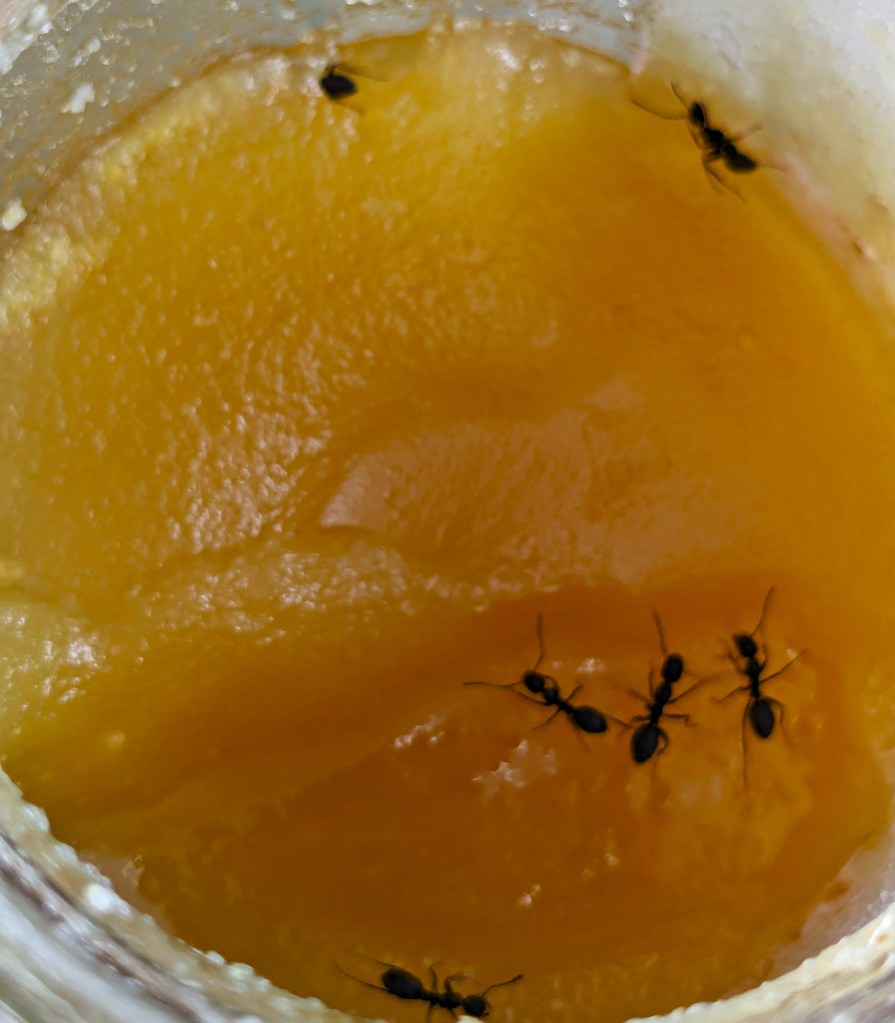
Depends on how you define performance, doesn’t it? Here’s one from a couple of days ago. I left the lid of my pot of wildflower honey slightly open and, guess what? This is what I saw inside. Actually, there were fourteen of them. Some ran for it. Some were so absorbed that they just lay there, inebriated. I grabbed my cell phone and took this shot.

It could have been a video. The seven that fled, it might have been eight, looked like a broken line of can-can girls fleeing from the Moulin Rouge. But look at the color of that honey. Such a rich, warming gold. It was, quite simply, one of the best honeys I have ever tasted. And I have to say, that I cannot blame the ants for invading such a honey-trap paradise.

The live performance was the running, fleeing, burying into the honey, and wild whimpering of the ants. Then, when I squished them, it was their feeble twitching, followed by their gradual submission to a force majeur.

The Nature of Art and the Art of Nature – a live performance, followed by a still life. A nature morte, as they say in French, or a naturaleza muerta, as the Spanish say. On the bright side, I like to think that they found their land of milk and honey, their earthly paradise, before they met their tragic end.

What do you do to be involved in the community?

Daily writing prompt
What do you do to be involved in the community?

What do you do to be involved in the community?

Covid started a long period of isolation for many people of my age. We started by washing everything that came into the house – beware of touching things, they might carry the Covid virus. Then it was wear a mask and avoid crowds. Then it was telephone calls, parcels of groceries left on door steps, groceries ordered online and then picked up by car, no visitors, avoid crowded places…. At times, it bordered on hysteria.

That was 2020. But Covid wasn’t over. I have cut my own hair since 2019 and I still avoid crowds and wear a mask. As I emerged less and less, I saw fewer and fewer people. Old friends faded away, some, the less fortunate ones, permanently. Most ceased to visit. Gradually communications ceased.

2024 – May -01 – I purchased a new Rollator – a Nexus 3. For a week now, I have been out walking with it. Thirty minutes a day. I go round the block. I also visit the local park and walk the trails. Life is still out there, waiting to be lived. When I walk round the block, neighbors come out from their houses and talk to me. I have a little seat on the Rollator and can sit and chat with them for as long as they want. Old friends have returned.

Yesterday, I met some new friends. “We haven’t seen you around here before. Are you new?” A boy and his mother. The boy took a liking to my Rollator – he was three years old. He climbed on it, sat on it, tooted a non-existent horn, rang a non-existent bell, and brum-brum-brummed a non-existent engine. What fun we had. I told his mother I was an author and asked her if she would like a copy of Teddy Bear Tales to read to her boy. She said yes and when I see her next, I will give her one.

So, back to the question – What do you do to be involved in the community? I walk around the block and now I carry copies of my poetry books and short stories in my little carry bag. When I meet people, I offer them gifts of poetry and prose. Sometimes they say yes – and that is how I get myself involved with the community – as the Island View Bard.

Prompts and Impromptus

Prompts and Impromptus

The creative process is different for each one of us. I think of three different creative modes.

The Quarry and Treasure Trove – I write in my journal every day. I have done so for nearly forty years. For me, it is a treasure trove of creativity and I can return to it anytime I want to to revive old memories and to research old moods. I think of it as a quarry that contains valuable images and metaphors that can be used in different ways to create and recreate. I also find that, as I journal, I distinguish between that which is mere dust and ashes and can be abandoned, and that which is a genuine gemstone that can be polished and published. Writing regularly helps me to distinguish between the commonplace and that one piece of gold that emerges.

Impromptus – Some people, like the cat above, wait patiently for inspiration to come. Sometimes it does, sometimes it doesn’t. When it doesn’t, they blame Writer’s Block or something similar. While you can sit and wait for inspiration, using the methods outlined in The Quarry and Treasure Trove you can ‘go out and make things happen’. Seek and you will find. Knock and it will open. Now that’s inspiration for you!

Prompts – The creative writer can also use prompts. I have used those that appear in Word Press, but only in sporadic fashion. I do not use them everyday. In fact, I have been a bit down and otherwise engaged recently, and my visits to social media have been very limited. I apologize to my friends – we few, we happy few, we band of siblings.

One of my best friends has been helping me through this rough patch. She has been putting together a book of creative prompts. She converted that into a webpage called  judyandco.com and I highly recommend her work to anyone who, like me, gives up the ghost for a little while, and then wishes to regain the creative spirit. As she wrote to me only this morning – “there’s a bunch of free stuff on there” -.

So, for those who need a kick start for their creativity, try clicking on  judyandco.com – I am sure you will find inspiration there.