Hair of the Dog

IMG_0040 (3)

Hair of the Dog

I awoke to the dog’s tongue licking my hand. When I moved, he jumped off the bed, ran to the door, turned and barked. The hall clock chimed six times, early for me to get up, but I did because I needed a pee. The dog followed me into the bathroom, whimpering. Street noises seemed louder than usual. The dog started barking again and a voice called out from the hall below.
“Anyone home?”
The dog clattered down the stairs woofing wildly. Still in my pajamas, I looked over the balustrade to see the milkman standing below.
“Hello,” he said. “The door was open and I just dropped in to see if everything was all right. Where’s your mother?”
“In bed, asleep,” I dug with my index finger at the sleepy crackling gathered in the corner of my eye.
“Not if I know her,” the milkman said. “She’s run off again and taken a bottle with her. You’d better get dressed.”
I scowled at the milkman, went back upstairs, and looked in my mother’s bedroom. Her red flannel nightie lay in a heap on the floor by the unmade bed, with its rumpled sheets and pillows all higgledy-piggledy. The bed felt cold beneath my fingertips and the clothes she had worn the day before had gone.
“I’ll get dressed,” I shouted. “I’ll just be a moment.”
“Sure,” the reply floated up the staircase.
“You’re right,” I said to the milkman as I met him at the bottom of the stairs. “She’s gone.” The first rays of sunshine touched the stained-glass windows above the door, and fragmented colors danced with dust motes, turning the milkman’s white uniform into a harlequin suit of lights.
“Not the first time she’s gone AWOL,” the milkman winked at me.  “She’s got quite the reputation round here. You’d better go out and find her. I bet she’s in the park with the others. That’s where she goes when the mood takes her. I see her sometimes when I’m in the milk float. I’d take the dog, if I were you. He’ll find her. He usually does.”
The dog whimpered as we got to the end of the drive. I checked my watch: 6:30 AM. The early sun slowly sliced through the morning’s damp creating rainbows in the mist. I shivered.  The milkman waggled his fingers in a silent good-bye and his electric milk float hummed then lurched out into the street with a clinking of bottles.

I stood at the roundabout at the corner and didn’t know which way to go.
“Find mum,” I said and patted the dog’s head. He wagged his tail, put his nose down, turned right, and set off down the main road towards the city center.
Shadows danced on the lower ironwork of the locked park gates. A child’s swing creaked gently in the breeze. The dog sniffed at the gates, lifted his leg on them, gave them a generous squirt, then put down his nose and tugged at the leash.
I followed the dog as he went past the gates and pulled me towards a hole in the hedge, just large enough to squeeze through. The dog whined with excitement and pawed at the gap. I followed pushing aside the bushes.
The dog whined again and tugged me towards a sort of mound that lay on the nearest park bench. Newspapers offered scant warmth to the body that they covered. A hand hung down and the dog licked it frantically. I touched that hand and the dog’s lick joined us in an unholy matrimony. Beside the sleeping figure on the bench, an inch or two of what appeared to be whisky huddled at the bottom of a forty-ounce bottle. Other empty bottles lay on the wet grass, like spent cartridges, some of them pointing at the woman’s head.
Shuffling feet had worn down the grass where the woman lay. I saw traces of blood on bandages and empty syringes. Some needles had been wiped on the pair of torn pink panties that peeped out of the grass.
The dog continued licking at the woman’s hand then stopped, pointed his nose at the sky and let out a single, piercing howl.
I shook my mother’s shoulder.
“Mum, Mum,” I called, but she didn’t move. She was locked in a land where I dared not follow her. I took out my cell phone and called the police.

They arrived with a park attendant who opened the gates and let their car in. They took one look at my mum and called for an ambulance. When it got there, the ambulance men examined my mum, said she was alive, put her on a stretcher, and carried her to the ambulance. I told them I wanted to accompany my mum to the hospital.
“Not with that dog, you don’t,” the driver replied. He got in, started the engine, turned on the siren, and pulled away.

I took the dog home, called for a taxi, and it took me to the hospital. When I got to the room in which they had caged her, she was unconscious. She never woke up.
I buried what was left of my mum ten days later, after the autopsy.


Crow’s Feet


img_0146

Crow’s Feet

So many meanings, so many possibilities. I remember them round my grandmother’s eyes, wrinkles, laughter lines, crow’s feet. And then there are the real crows, sauntering, swaggering, two roadside hops, and take off. So bold, that sometimes they will stand there and defy you and your car, refusing to fly, but always leaving their footprints, crows’ feet in the snow.

We have a family of seven. They own our garden. Visit us every day. Check us out. Nothing like the whistle of the wind in their pinions as they sweep low over our roof, summer and winter, all year round. We belong to them, not them to us.

IMG_0147

Crows: such shadows, hovering  in our minds, casting their shadows over our lives and our deaths, for ‘the coward dies a thousand deaths, the hero dies but one’ and down, deep down, we are all cowards, in one way or another, and the crows await each one of our thousand deaths.

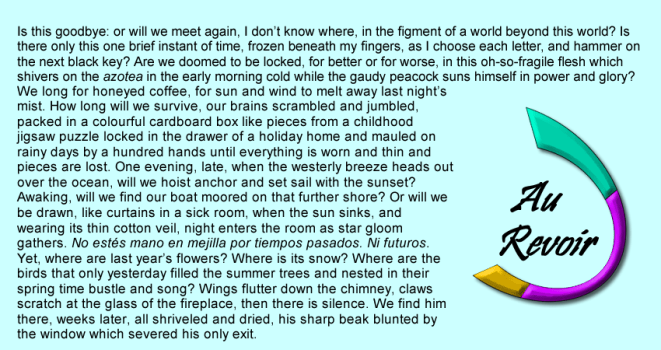
Au Revoir

Au Revoir

Au Revoir

Commentary:

This construction (verbal and visual) dates back to my visits to Oaxaca, Mexico (1995-2001). So many friends, so many happy relationships, and then the world turned and I never went back. I remember doing yoga early in the morning on the azotea. Zopilote, the turkey vulture, wings motionless, flew high above the world, the sun lighting up his wings with its fiery flame. Zopilote, aka Trickster, the bird who stole fire from the gods and brought it back to earth so women could make men their morning chocolate over the old wood stoves or open fires. Or was that all a myth, fake news as some would say today when everything we touch is fake? So much has been lost, destroyed. So much beauty, verbal and visual, has been laid aside, destroyed, and forgotten. Au revoir, good-bye, will we ever see it again? Adieu, goodbye, we will never see it again, it’s gone for good. So much meaning in these brief French phrases, synonyms in English, yet carrying such different meanings in French.

Amarrada nuestra barca a otra ribera … Antono Machado wrote those words. We will awake one morning, he suggested, to find our boat moored on the other side of the river between life and death. And so we will. But in our daily lives, we try to ignore that fact. We seize the day, drowning our sorrows in a sea of forgetfulness: for tonight we’ll merry, merry be, we sing, but tomorrow we’ll be sober. Or will we? And nowadays, who cares anyway? As Seamus Heaney writes “my friends and neighbors, let it flow. We’ll be stood no rounds in eternity.”

Yesterday, I met a man in a wheel chair sitting outside the store where I was shopping. He asked me if I could spare some change and I told him I only carried plastic (true). Then next man who approached gave him a cigarette. My beloved was sitting in the car and I gave her a five dollar bill from the parking money and asked her to give it to the man in the wheel chair. So: how did we feel? Good for an act of charity? Bad for not responding immediately? Terrible that we see people living in poverty in a supposedly rich country? Fearful that one day the money would run out and that we too would be out there, begging for money, grateful for a cigarette, a hand out, a helping hand … happy for anything that would help postpone the inevitable end?

And then there was the bird that fell don the chimney and perished in the fireplace. We never even knew he was there until we found his feathers and his body, lifeless among cold ashes. So which is it to be: au revoir or adieu? Or even worse, the middle finger, the scowl, and the old ‘screw you’?

Growing Up

IMG_0817 (4).JPG

Growing Up
in Brynmill

They drag the kids kicking and squealing
from childhood’s universe into an older
world of smoking and drinking, forbidden
fruits stolen after Christmas dinner when
drowsy grown-ups’ eyes are turned away.

Why do bigger boys follow smaller ones,
buying their sisters’ kisses then thrusting
their fingers into little girls’ knickers, or
invading Woolworth’s and tucking stolen
goods in shirts with their buttons undone?

The games they play: offering a little girl
a cigarette  or a sweet while two boys
wait behind the garden gate with a sharp
knife to  press against the victim’s throat.

Dies Irae

IMG_0139

Dies irae

Nowhere has she found peace, save
in the dregs at the bottle’s bottom.
She solves life’s dilemmas with single
malt or grape’s blood fresh-plucked.

Doctors tell her that she must stop drinking,
not stoop to conquer yet another bottle.
The remedies they suggest will never suit her.
Family and friends lecture her in vain. 

She knows she will not live forever,
that one day a higher power will call.
So she opens another bottle of Scotch,
just a drop before she goes. She falls

to the floor, and lies asleep. Three still
born babies cover her with their love
to keep her warm. “Sleep well,” they say,
“you’ll find greater peace in eternity.”

Commentary: Another poem that was not easy to write. The last line is a tribute to Seamus Heaney and his poem, Yellow Bittern, the inspiration for this one. “You’ll be stood no rounds in eternity.” In the literary theory of Intertextuality, texts talk to texts and a series of interlaced textual dialogs move across time and space. Hablo con mis ojos a los muertos, I speak through my eyes with the dead, as Francisco de Quevedo said in the 17th century. He was reading Seneca, another great writer born in Spain, when he wrote those words.
I restructured this poem three times. I began, following Seamus Heaney, with the first person singular [I]. Then I changed it to the second person singular [you], but you, in English, can never approximate to the intimacy of tu [versus vous] in French, or the multiplicity of [versus usted, vosotros, vosotras, ustedes} in Spanish. Finally I settled on the third person and settled on she [rather than he]. I guess when  a woman loses three children, she is entitled to lose herself in a bottle of Scotch and shut out the world.

Village Bully

IMG_0114 (2).JPG

Village Bully
Pyle Corner,
Bishopston

“Shall I thump you one?” he asked.
And the fist that removed five teeth
from an opposition player hovered near my face.

He was always like that with smaller men:
a punch, an elbow, a kick, a threat so loud…
yet people his own size frightened him.

Many times I saw him back down from larger boys
and when someone was bigger,
well, that was always another story!

I’ll never forget him though: superb
against Cubs, Brownies, and Girl Guides,
but when the real Boys came to play,
why, he had one of his off days.

We called him “the million-pound body
with the one-shilling brain.”

Hate drove him. He lived off it, thrived on it,
until one day he discovered that the face
he really hated was staring back at him
every morning when he shaved.

He went downstairs, put his head in the oven,
and turned on the gas.

Time-Spirits

IMG_0868.JPG

Time-Spirits

Zeitgeist

Zeitgeist is a concept from 18th- to 19th-century German philosophy, translated as “spirit of the age” or “spirit of the times”. It refers to an invisible agent or force dominating the characteristics of a given epoch.
Wikipedia

Those who cannot learn from history are doomed to repeat it.

“Plus ça change, plus c’est la même chose.”

Poems for troubled times.

Introduction

Our world finds itself in an incredible mess right now. Somehow, we have to sort it out. Images and metaphors tie past, present, and future together. We must pick our ways through the difficulties of these troubled times, as you must pick your way through the intricacies of these poems. Many of you will give up. Some of you, the chosen few, will make your way to the heart of each poem.

These poems are deliberately cryptic. Each one is a mind game I am playing with you. I do not underestimate you. I have placed clues throughout each poem and if you follow the clues you will arrive at many of the poem’s hidden meanings. Some poems are more difficult than others, their meaning more recondite. Others seem very straightforward, yet still contain secrets.

            This style of poetry has a long history going back to Anglo-Saxon riddles and way beyond, back into the mists of time. Luis de Góngora (1561-1627) and Francisco de Quevedo (1580-1645) specialized in similar forms of recondite poetry, often based on metaphor and the juego alusivo-elusivo, the game of alluding to something while eluding the act of saying what it is. Jorge Guillén (1893-1984) and Federico García Lorca (1898-1936) also played this game, as did Octavio Paz (1914-1998). In the works of all of these poets, the clues may rest in the poem or they may be found in a generic knowledge of the mythology of the poem’s exterior world.

             Always remember that “those who cannot learn from history are doomed to repeat it” (George Santayana). Otherwise expressed, in the words of T. S. Eliot: “Time present and time past / are both perhaps present in time future / and time future contained in time past” (Burnt Norton). The seeming anachronisms in these poems suggest that all time is ever-present and that each new day presents us with events that have already occurred on many occasions.

Commentary: The idea for Time-Spirits aka Zeitgeist was born around the kitchen table in Island View on Saturday, 22 December 2018, during a literary conversation between Gwen, Victor, and Roger. A poem at a time, one after another, grew from that table top chat. The result: 70 poems, not easy to read, deliberately difficult, that reflect our troubled times. My thanks to Geoff Slater, line-painter, who drew the cover picture: Robin Red in Claw and Breast, a symbol of nature ‘red in tooth and claw’. So are we in the words of Albert Camus who writes ‘nous sommes ou les meurtriers ou les victimes’ . Is it the early bird that catches the worm? Or is it the late worm that gets caught by the bird? Whichever: it’s the worm that gets eaten, until the robin bites the dust, when he is eaten in his turn. Just think of it as nature doing its regular recycling …


IMG_0865 (2).JPG


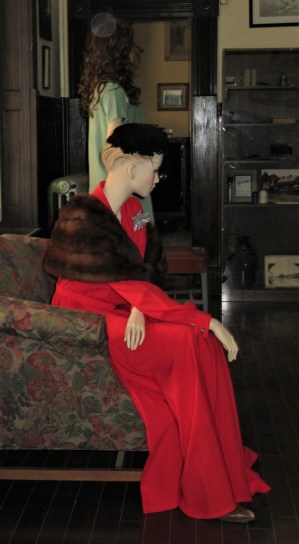
Mannequins


IMG_0836

Mannequins
McAdam Railway Station #12

“He startles the unaware, that man by
the door, in uniform, with his youthful
looks and old-fashioned peaked cap,

fingers poised by his silver watch chain
ready to pull out his Waltham pocket watch
and check the time against the master-clock.

Two ladies wait in the waiting room.
One wears winter robes of red and black
while the other wears velvety green. Both

are motionless, one seated, one standing. Yet
if you watch them from a corner of one eye,
you will see shadowy gestures as their lips move.

Overnight they have changed into summer
clothes, gauzy, almost see-through, flowery
patterns, light-weight wedding boots, laced,

restful, cool, thin-soled. ‘Are you for real?’
I ask the standing one, for a joke. When she
nods and winks, a chill settles over the room.”

IMG_0676 (2).JPG


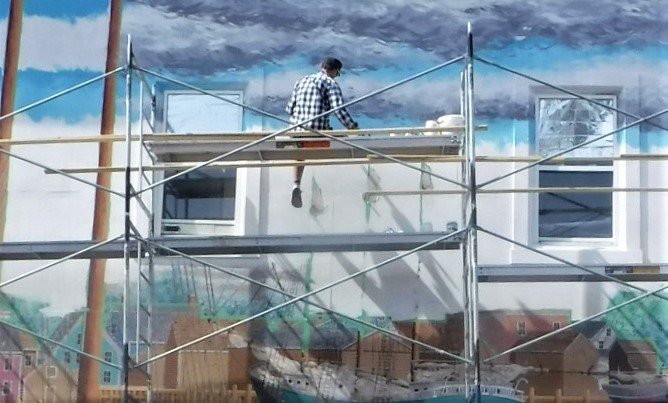
Murals

IMG_0692.JPG

IMG_0659 (2).JPG

Murals
McAdam Railway Station #11

Painting a mural,
inside, interior
wall, knowing it will
stand time’s test.

Viaduct broken,
a tumbled engine,
Canadian workers,
railwaymen all,

some from Macadam,
pebbled the floor,
handrail, radiator
camouflaged for war,

part of the painting.
Depart from the station.
Turn right. Straight ahead,
flaked peeling paint.

So sad, this outside
mural, exposed to winter’s
snow, frost, winds, and ice.
So vulnerable

and so ephemeral.
Such a short-lived
summer, over in a day.
Butterfly on a rock.

IMG_0691 (2).JPG

image1 (2) - Copy.JPG

Comment: This sequence comes from the indoor and outdoor work (murals) of my friend Geoff Slater. Geoff told me how ephemeral were the outdoor murals with a life-span of about ten years before they needed redoing. After that, the paint starts to fade, then crack, then dry and peel away. Our Canadian winters with their icy cold and the ensuing springs with their frost and thaw do not help. The protection, no ice, no snow, no sun, no rain, afforded to the interior murals means that they will last so much longer. Our outdoor art, unless cast in the firmest stone, is ephemeral. Like a butterfly, it will not last much longer than a brief summer day. Hence the final metaphor.